
AI did not cite one lucky page. It cited us 88 different ways.
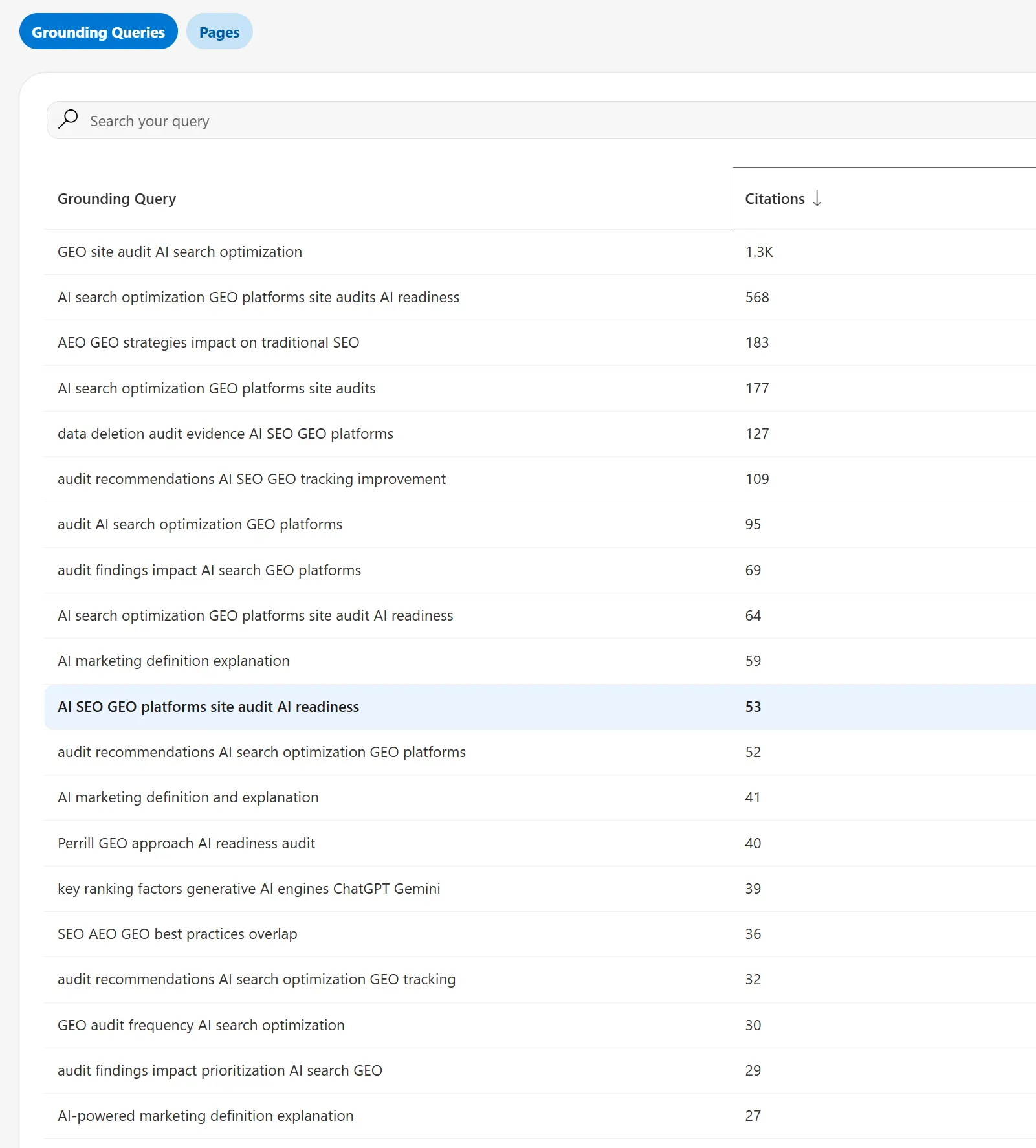
We stopped asking which keyword we rank for and started asking which questions AI can answer using our content. The Bing export showed 88 distinct grounding query clusters, from beginner definitions to audit workflows, and our top cluster alone registered 1,259 citation references. That is not one breakout post carrying the site. That is a library built using Zelitho that AI can retrieve across the whole buyer journey.
clusters
citations
covered
clusters
Source: Bing Webmaster Tools AI Performance Grounding Queries export (Jun 2026). Grounding queries are grouped phrases AI used when retrieving cited content, not full user prompts. Methodology and definitions.
Breadth on paper. Concentration in practice.
Eighty-eight grounding clusters sound like a moat. Be honest: the top 3 clusters account for 53.3% of query-level citation references (2,009 of 3,768). That tension is real. Breadth exists, but there is a center of gravity. Google ignored it. AI quoted it 3,258 times. documents one URL dominating audit intent. One page dominated AI answers. Then seventeen showed up the same day. documents more pages cited over time. This page shows why that breadth holds: semantic coverage across intent clusters, not luck on one phrase.
Four clusters, three funnel stages
AI systems do not retrieve one page for one keyword. They match intent clusters: grouped phrases in Bing’s export. Zelitho appears across 88 such clusters in the audit window. Eighty-seven sit outside the top phrase. Topical authority in AI search looks like semantic coverage, not SERP position.
GEO audit and readiness (largest cluster)
Audit-intent queries dominate the export. Checklist format wins. Google ignored it. AI quoted it 3,258 times. is the proof. Supporting guides like the GEO audit checklist and Complete GEO guide deepen the cluster.
| Query (grouped phrase) | Citations |
|---|---|
| GEO site audit AI search optimization | 1,259 |
| AI search optimization GEO platforms site audits AI readiness | 567 |
| audit recommendations AI SEO GEO tracking improvement | 109 |
AEO metrics and measurement
Mid and late-funnel “how do we measure this?” content. Pairs with the AEO success metrics post (463 page-level citations). Lower per-query volume, but it answers the question buyers ask after they understand GEO.
| Query (grouped phrase) | Citations |
|---|---|
| answer engine optimization metrics | 19 |
| AEO key performance indicators | 14 |
| track AEO performance | 5 |
SEO vs AEO vs GEO overlap
Comparison content earns citations when structure is scannable: tables, when-to-use sections, clear prioritization. The GEO vs SEO vs AEO post (340 page-level citations) serves this cluster.
| Query (grouped phrase) | Citations |
|---|---|
| AEO GEO strategies impact on traditional SEO | 183 |
| SEO AEO GEO best practices overlap | 36 |
| AEO vs GEO vs SEO digital strategy prioritization | 9 |
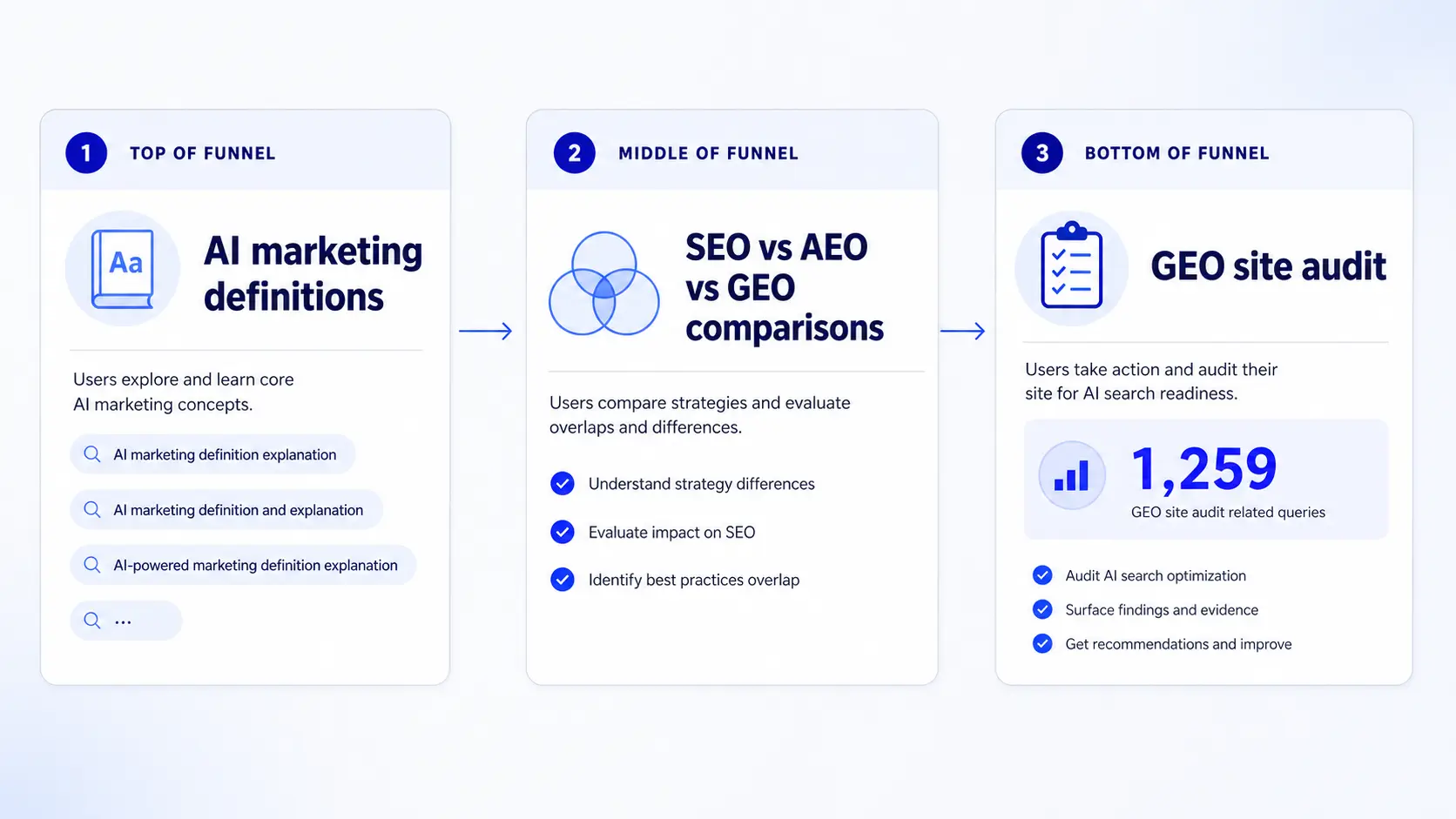
AI marketing definitions (top of funnel)
Definition posts feed retrieval for broad questions. Lower per-query volume, but they widen the moat. Someone asking “what is AI marketing?” can still land on Zelitho content before they ever search for a GEO audit.
| Query (grouped phrase) | Citations |
|---|---|
| AI marketing definition explanation | 59 |
| AI marketing definition and explanation | 41 |
| AI-powered marketing definition explanation | 27 |
“We were not trying to win one query. We were trying to own the conversation around GEO.”
Zelitho content teamThe metric we map content against now
One keyword is fragile. Query drift, one URL going stale, an algorithm shift, and the number collapses. Eighty-eight retrieval clusters across definition, comparison, and audit intent is resilient. That is topical authority in AI search.
Query clusters, not keywords
Grounding queries are grouped retrieval phrases. Map content to clusters, not exact-match keywords.
Funnel coverage
Definitions, comparisons, and audits all appear in the export. AI can answer the next question in the journey.
Cluster siblings
Each cluster has 2 to 4 supporting URLs cross-linked, as we laid out in One page dominated AI answers. Then seventeen showed up the same day.
Monthly query export
Re-export grounding queries from Bing AI Performance. Watch new clusters appear and gaps close over time.
“Topical authority in AI search looks like a library that answers the next question, not a blog that chases the last spike.”
Zelitho content teamHow to build an 88-query moat (without publishing 88 posts)
You do not need one post per query variant. You need one strong asset per intent cluster, cross-linked from the highest-citation URL in each cluster. Content built using Zelitho defaults to the structured, retrieval-ready format these clusters reward.
Start with Google ignored it. AI quoted it 3,258 times. for the breakout checklist story. Read One page dominated AI answers. Then seventeen showed up the same day. for how cited pages grew over time. This page is the query-level proof behind both.
“Eighty-eight queries is not eighty-eight posts. It is four clusters with depth behind each one.”
What changed our content mapSix steps to map your retrieval space
Repeatable workflow for teams building topical authority in AI search.
- 1Export grounding queries from Bing AI Performance monthly.
- 2Group by intent (definition, comparison, how-to, audit), not by exact phrase.
- 3Identify gaps: clusters with retrieval demand but no dedicated URL.
- 4Publish one asset per cluster (checklist, guide, comparison), not one post per query variant.
- 5Cross-link cluster siblings from the highest-citation URL in each cluster.
- 6Track concentration. If top 3 queries exceed ~50% of query-level references, diversify.
Source data
All metrics below come from Bing Webmaster Tools AI Performance Grounding Queries and Pages exports, dated June 5, 2026. Grounding-query totals and page-level totals use different denominators. Do not sum them to equal each other.
| Metric | Value | Source |
|---|---|---|
| Grounding query clusters | 88 | Grounding Queries export |
| Sum of query-level citation references | 3,768 | Same export |
| Top query citations | 1,259 | “GEO site audit AI search optimization” |
| Top 3 queries combined | 2,009 | Rows 1 to 3 in export |
| Top 3 share of query-level sum | 53.3% | 2,009 ÷ 3,768 |
| Page-level citation total (site) | 5,969 | Pages export |
| Cited pages | 44 | Pages export |
| Date range | Jan 1 to Jun 2, 2026 | Export filenames Jun 5, 2026 |
Top 10 grounding queries
| Rank | Query | Citations |
|---|---|---|
| 1 | GEO site audit AI search optimization | 1,259 |
| 2 | AI search optimization GEO platforms site audits AI readiness | 567 |
| 3 | AEO GEO strategies impact on traditional SEO | 183 |
| 4 | AI search optimization GEO platforms site audits | 177 |
| 5 | data deletion audit evidence AI SEO GEO platforms | 127 |
| 6 | audit recommendations AI SEO GEO tracking improvement | 109 |
| 7 | audit AI search optimization GEO platforms | 95 |
| 8 | audit findings impact AI search GEO platforms | 69 |
| 9 | AI search optimization GEO platforms site audit AI readiness | 64 |
| 10 | AI marketing definition explanation | 59 |
What this case study does not prove
- 88 queries does not mean 88 independent rankings or guaranteed future citations.
- Grounding-query totals (3,768) do not sum to page-level totals (5,969). Different views with overlapping mappings.
- Query-level data is sampled and aggregated.
- Scope is Microsoft Copilot, Bing AI summaries, and select partners. Not ChatGPT, Perplexity, Gemini, or Google AI Overviews.
- Concentration risk exists (top 3 = 53.3%). Breadth is real but not evenly distributed.
Frequently asked questions
What is a grounding query in Bing AI Performance?
A grouped phrase summarizing key terms the AI used when retrieving cited content. It is not a full user prompt. One grounding query can map to multiple pages; one page can appear under multiple grounding queries.
Does Zelitho rank for 88 keywords?
No. The export shows 88 grouped retrieval clusters where Zelitho content was cited, not traditional search rankings or keyword positions.
Why is the top query so much larger than the rest?
Audit-intent clusters around GEO site audits dominate. Google ignored it. AI quoted it 3,258 times. covers the breakout asset for that cluster.
Do grounding-query totals equal page-level citations?
No. Different exports with overlapping mappings. Query-level sum is 3,768; page-level total is 5,969. We label each denominator in the source table.
How does this relate to the breadth case study?
One page dominated AI answers. Then seventeen showed up the same day. shows more pages cited per day over time. This page shows more query clusters those pages serve.
Is 88 queries enough to call it a moat?
It signals semantic coverage across the buyer journey, but top-3 concentration (53.3%) means diversification still matters. Breadth is real but not evenly distributed.
How do I map my own content to query clusters?
Export grounding queries monthly from Bing AI Performance. Sort by citations, group by intent (definition, comparison, how-to, audit), and publish one strong asset per cluster.
References
Methodology definitions summarized from Microsoft Bing Webmaster Tools AI Performance documentation.
- AI citation and scope. A citation is the total number of times your content was visibly referenced or shown as a source in AI-generated answers during the selected date range. AI Performance reflects activity across Microsoft Copilot, AI-generated summaries in Bing, and select partner AI integrations. It does not measure rankings, authority, performance, or importance.
- Grounding queries. Short grouped phrases representing key terms the AI used when retrieving content that was cited. They are not full user questions or prompts. One grounding query can map to multiple pages; one page can appear under multiple grounding queries.
- Citations vs engagement. A citation indicates that content was visibly referenced in an AI-generated answer. It does not represent traffic, clicks, or user engagement.
- AI vs traditional search metrics. Grounding and citations show how AI systems use your content to generate answers. This differs from traditional search metrics, which measure rankings, clicks, and traffic.
- Content practices for AI inclusion. Align content with user intent; use descriptive headings, concise sections, tables, and FAQ-style structure; strengthen depth across related topics; support claims with evidence; keep content fresh and accurate; maintain consistency across formats.
- Data sampling and views. AI Performance data is aggregated and summarized, not a complete log of every citation. Totals may differ across Pages, Grounding Queries, and timeline views. Timeline trends are observational and cannot be attributed to a single cause or event.
- Measuring on your site. In Bing Webmaster Tools, open AI Performance for your verified site. Export page-level citations, grounding queries, and timeline metrics as CSV or Excel. Use Grounding Query to Pages mapping to connect phrases to URLs. Data refreshes daily with a short processing delay.
Definitions [1] to [7] on this page are paraphrased for readability. Export filenames dated June 5, 2026.
Source: Microsoft Bing Webmaster Tools. AI Performance in Bing Webmaster Tools
One keyword is fragile. Eighty-eight clusters is a moat.
Start with Google ignored it. AI quoted it 3,258 times., then write your first cluster post for $5, and export grounding queries monthly to watch new retrieval phrases appear.