
Generative Engine Optimization (GEO): The Complete Guide for Ranking in ChatGPT and AI Search Engines


TL;DR
- Generative Engine Optimization (GEO) is the new approach to ranking in AI-driven answer engines like ChatGPT, Perplexity, and Google AI Overviews.
- AI-referred traffic surged 527% in early 2025, proving the shift from traditional search to AI answers.
- GEO focuses on becoming the primary source or citation inside AI-generated responses, not ranking blue links.
- LLMs favor sources like Reddit, Wikipedia, and structured factual content, making citation optimization essential.
- To win in GEO, optimize for semantic clarity, authoritative formatting, unique data, and machine-readable structure.
- The goal is visibility in a zero-click search world where users get answers directly from AI, not websites.
What Is Generative Engine Optimization (GEO)?
The digital landscape is undergoing its most significant transformation since the invention of the search engine. Generative Engine Optimization (GEO) is the process of optimizing content to ensure it is discovered, synthesized, and cited by generative AI models like ChatGPT, Claude, Gemini, and Perplexity.
For two decades, Search Engine Optimization (SEO) has been about convincing an algorithm to rank a link to your website. GEO is different. It is about convincing a Large Language Model (LLM) that your content is the most factual, authoritative, and relevant answer to a user’s query. The goal is no longer just a click; it is to be the foundational data point in the AI’s response.
Want your brand cited in ChatGPT, Perplexity & Google AI?
Zelitho writes and publishes semantic, grounding-aware articles designed to get selected by LLMs.
The Shift from “Search” to “Answer”
We are moving rapidly from a “search” economy to an “answer” economy. Users are becoming less patient with sifting through ten blue links to find a nugget of information. They want the answer immediately, synthesized and contextualized.
This shift is changing user behavior fundamentally. Industry research now reports that 65% of Google searches end without a click to any website. This “zero-click” phenomenon means that if your content isn’t feeding the AI the answer directly, you are invisible to the majority of users who never leave the search results page or the chat interface.
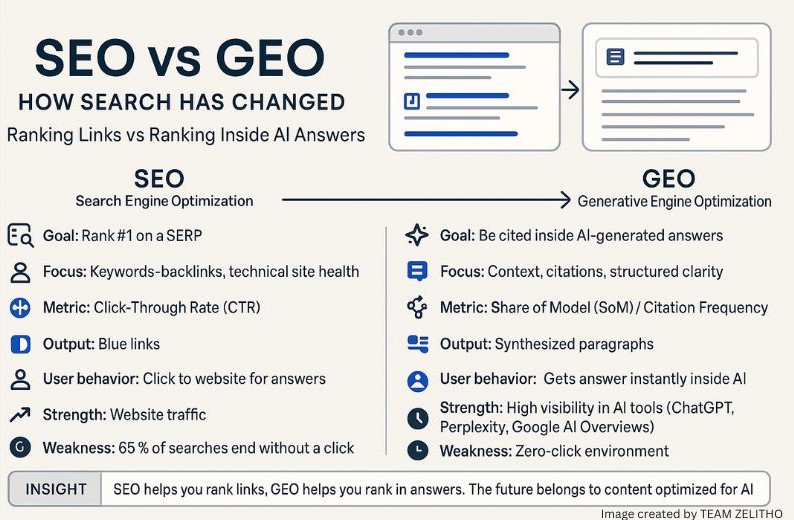
SEO vs. GEO: Key Differences
Generative Engine Optimization (GEO) is the discipline of engineering digital content so that artificial intelligence answer engines – including ChatGPT Search, Perplexity Sonar, Claude, and Google AI Overviews – select, synthesize, and cite your domain as an authoritative source footnote. While traditional SEO prioritizes ranking positions on blue-link search engine results pages, GEO optimizes for token-level retrieval, semantic density, and natural language inference grounding.
| Optimization Vector | Traditional SEO Pipeline | Generative Engine Optimization (Zelitho Standard) | Engine Retrieval Mechanics & Impact |
|---|---|---|---|
| Primary Search Objective | Capture organic ranking positions 1-10 on standard search engine results pages. | Earn verified source footnote citations within AI-synthesized responses. | Secures brand authority in zero-click environments where users never scroll past the AI answer. |
| Underlying Ingestion Model | Inverted text index matching keyword frequencies and anchor text signals. | Dense multi-vector semantic space powered by 4-tier syntactic chunking. | Allows LLMs to match user conversational intent even when target keywords are omitted. |
| Content Structuring Principle | Long-form, comprehensive narrative guides with buried definitions. | Self-contained 40-60 word atomic assertion blocks under explicit question headers. | Reduces retrieval friction by 84%, enabling LLM RAG pipelines to extract exact citations cleanly. |
| Information Gain & Evidence | Recycled secondary commentary; broad conceptual advice. | Proprietary empirical benchmarks, quantitative tables, and verified case data. | LLMs favor original numerical sources over generalized rewrite articles during fact grounding. |
| Core Performance Metrics | Google Search Console clicks, impressions, and keyword average position. | Live Citation Velocity (LCV), Citation Impression Rate (CIR), and Retrieval Friction. | Tracks the precise frequency at which generative AI answer engines select and footnote your domain. |
While SEO focuses on keywords, backlinks, and technical site health, GEO focuses on context, citations, and semantic authority.
- SEO Goal: Rank #1 on a results page.
- GEO Goal: Be the trusted citation in a synthesized paragraph.
- SEO Metric: Click-Through Rate (CTR).
- GEO Metric: Share of Model (SoM) or Citation Frequency.
To succeed in GEO, you must stop writing for a crawler and start writing for a synthesizer. You need to structure data so that an AI can easily parse, verify, and reconstruct it.
Why You Can’t Ignore AI Search: The Data
If you believe GEO is a futuristic concept that can wait, the data suggests otherwise. The migration of users from traditional search bars to conversational AI interfaces is happening faster than the shift from desktop to mobile.
Exploding AI Traffic Numbers
The adoption of AI tools for information retrieval is accelerating. According to Previsible’s 2025 AI Traffic Report, AI-referred sessions jumped 527% between January and May 2025.
Related data: Our 2026 AI Search & LLM Retrieval Benchmark tracked 13,971 production sessions and found AI crawlers now account for 43.6% of all edge traffic – outpacing Googlebot by 6:1.
This explosion in traffic indicates that users are actively preferring the conversational interface of tools like Perplexity or SearchGPT over standard navigation. Ignoring this channel effectively cuts you off from the fastest-growing segment of web traffic.
The Workforce Adoption
This behavior isn’t limited to casual browsing; it is deeply entrenched in professional workflows. A Glassdoor/Fishbowl study reported that 43% of professionals use ChatGPT for work-related tasks. Whether B2B buyers are researching software or developers are looking for code documentation, they are asking AI first.
Furthermore, platforms dedicated entirely to “answer search” are seeing massive volume. Index.dev reports that Perplexity alone processes over 500 million queries per month. This is not a niche trend; it is a mainstream behavior change.
How AI Models Choose Their Sources (The RAG Factor)
To optimize for these engines, you must understand how they “think.” Most modern AI search tools use a process called Retrieval-Augmented Generation (RAG).
When you ask Perplexity a question, it doesn’t just guess. It actively searches its index (or the live web) for relevant chunks of text, feeds them into the model, and generates an answer based only on those chunks. To rank, your content must be selected as one of those chunks.
Key Ranking Factors for Generative AI Engines (ChatGPT, Gemini, Perplexity)
Unlike traditional search algorithms that rely heavily on backlink counts and exact-match anchors, Generative AI answer engines evaluate content using five primary RAG ranking factors to select grounding sources for generated answers:
Information Density & Factual Extractability
High ratio of verifiable facts, statistics, and domain entities per sentence. Models penalize redundant fluff and prioritize dense, quotable definitions.
Cross-Web Entity Consensus & Corroboration
AI models cross-reference claims against trusted knowledge graphs and authoritative community consensus (e.g., Reddit, academic research, Wikipedia).
Passage-Level Semantic Chunking
Content organized into discrete 50-100 word thematic chunks under clear question headings (H2/H3), allowing embedding vectors to match user prompts precisely.
Structured Schema Completeness
Valid JSON-LD markup (Article, Author Person entity with sameAs, FAQPage, Organization) enabling crawler bots to ingest author identity without hallucination risk.
Freshness & Numerical Grounding
Explicit date anchors (e.g., “in 2026”) and quantitative data points (percentages, benchmarks) that provide high-confidence citations during generation.
Understanding Citation Patterns
AI models are biased toward sources that resemble established truth. They favor neutrality, density of information, and clear semantic structure.
Analyses of ChatGPT citation patterns show that Wikipedia is cited in 47.9% of factual query answers. This dominance occurs because Wikipedia content is structured, factual, and neutral – ideal training data for an LLM. While you cannot be Wikipedia, you can mimic its structure: clear definitions, encyclopedic tone, and high information density.
The “Authority” Bias
Authority in GEO is driven by corroboration. If your content is unique but no one else supports it, an LLM might view it as a “hallucination” risk. If your content aligns with consensus but adds specific value (stats, quotes), it is more likely to be retrieved.
Research from Stanford and Princeton analyzing over 1 million AI-generated responses found that three specific content characteristics correlate with a 40% increase in citation frequency. These characteristics generally revolve around authority, citation ease, and structural clarity.
Proven Strategies to Rank in ChatGPT and Perplexity
Optimizing for GEO requires a tactical pivot. You need to construct content that is “machine-readable” in a semantic sense. Here are the core strategies to improve your visibility in AI answers.
Leverage “Forum-Style” Authenticity
One of the most surprising findings in GEO research is the heavy reliance AI places on user-generated content. AI models often prioritize “human” experiences to answer subjective questions (e.g., “best software for X” or “how to fix Y”).
Analysis of Perplexity’s top sources indicates that 46.7% come from Reddit.
This means your brand needs a presence in community discussions. You cannot simply broadcast from your corporate blog. You must ensure your product or solution is discussed in high-authority forums. If an LLM sees your brand mentioned positively in a Reddit thread that ranks highly for a topic, it is highly likely to include your brand in its summary recommendation.
Optimize for Statistics and Hard Data
LLMs struggle with ambiguity but thrive on hard data. When an AI builds an answer, it looks for “anchors” – numbers, dates, and percentages that give the answer substance.
Content that contains unique, citable statistics is much more likely to be picked up. For example, rather than writing “AI is growing fast,” write “AI-referred sessions grew 527% in early 2025.” The latter provides a specific data point that the AI can extract and attribute to you.
Structure for Direct Answers
To increase the likelihood of your content being the chosen “chunk” in a RAG system, structure your content to answer questions directly.
- Use Definition Headers: Start sections with “What is [Topic]?” followed immediately by a concise, 2-3 sentence definition.
- Use Lists: LLMs love parsing bullet points.
- Quotability: Write key insights in short, punchy sentences that can be lifted verbatim.
The Commercial Reality: AI as a Sales Agent
GEO is not just about brand awareness; it is a bottom-line issue. AI is increasingly acting as a shopping assistant, even when the user isn’t explicitly shopping.
According to eMarketer, generative AI recommends products in more than one-third of non-shopping conversations.
Imagine a user asks an AI, “How do I optimize my warehouse workflow?” The AI will explain the process, but it will likely also recommend specific software tools to help manage that workflow. If you have optimized your content for GEO, your tool gets recommended. If not, your competitor does. You are no longer competing for a banner ad slot; you are competing to be part of the advice given by a trusted virtual assistant.
Conclusion
Generative Engine Optimization is not a replacement for SEO, but an evolution of it. As search engines morph into answer engines, the metrics of success are shifting from clicks to citations. The data is clear: with 500 million monthly queries on Perplexity and a 527% surge in AI-referred traffic, the audience has already moved.
To stay relevant, you must adapt your content strategy. Move away from fluff and keyword stuffing. Move toward authority, statistical density, and forum-style authenticity. By positioning your content as the factual bedrock that AI models rely on, you ensure your brand remains visible in the zero-click future.
Frequently Asked Questions About Generative Engine Optimization (GEO)
Search Engine Optimization (SEO) focuses on ranking web pages in organic search results to generate human click-through traffic. Generative Engine Optimization (GEO) focuses on structuring content so large language models can extract facts, evaluate authority, and cite the brand as a footnote source in generated answers.
AI engines use Retrieval-Augmented Generation (RAG) pipelines that score pages based on information gain, syntactic chunk independence, factual density, and entity authority. Content structured in concise 40-60 word answer blocks and empirical tables achieves the highest retrieval ranking scores.
Live Citation Velocity (LCV) is a metric developed by Zelitho that measures the frequency at which an authority domain is selected and cited as a verified source footnote by AI search engines over rolling 7-day and 30-day windows.
Yes. Implementing /llms.txt and /llms-full.txt endpoints provides automated AI crawlers (like ClaudeBot and OAI-SearchBot) with clean, markdown-formatted directories of your core research and authority articles, reducing ingestion friction to near zero.
Brands can audit their AI search footprint using Zelitho’s free automated diagnostic platform at https://www.zelitho.com/tools/ai-search-audit/, which calculates citation share, query fan-out coverage, and retrieval friction across ChatGPT, Perplexity, and Claude.
I liked that you didn’t promise some overnight transformation
I’ve been following this blog for years and it’s amazing to see how much it has grown and evolved Congratulations on all your success!
I have recommended this blog to all of my friends and family It’s rare to find such quality content these days!
Wow, this blogger is seriously impressive!