
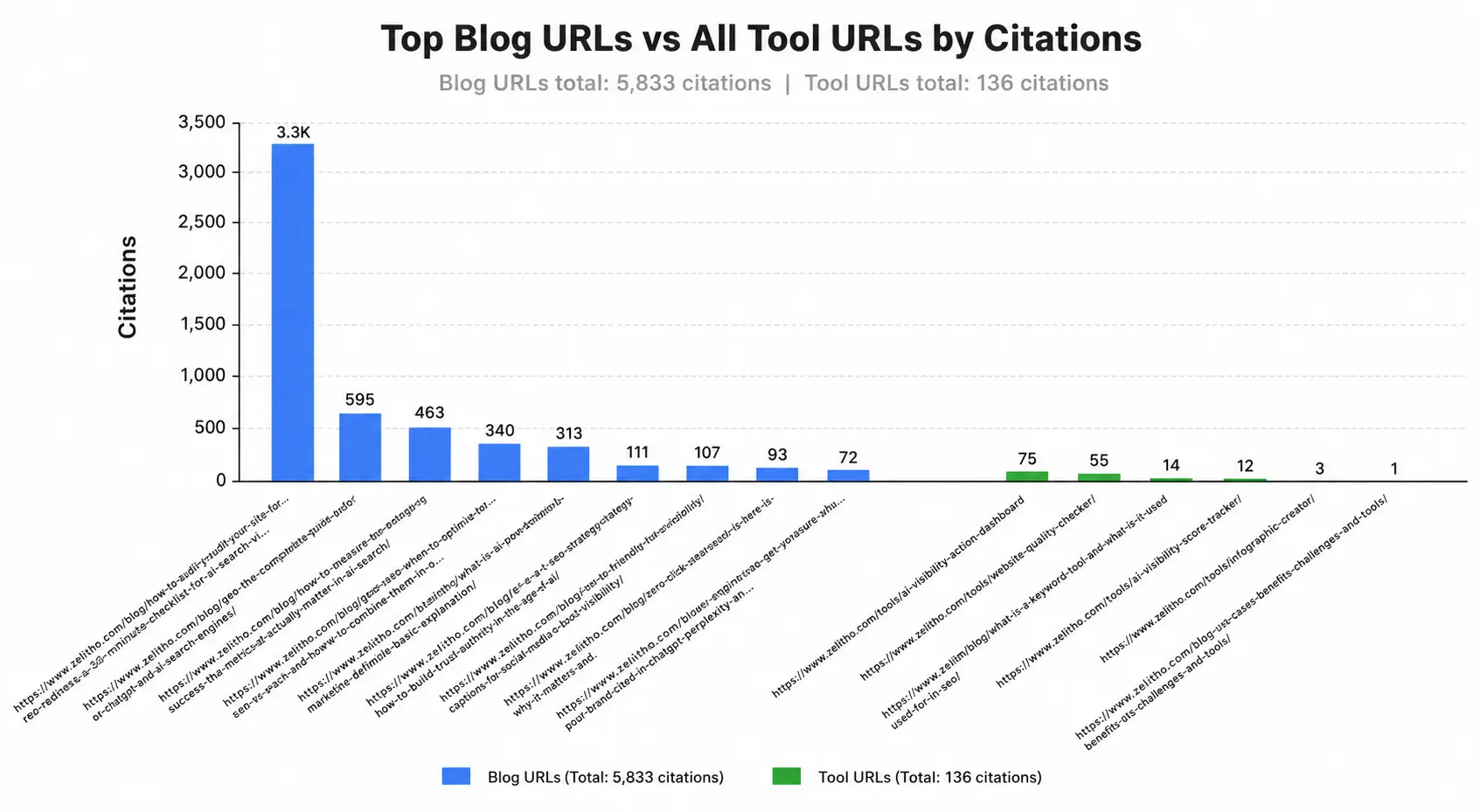
5,833 citations from blog posts. Why AI quoted our blog 43x more than our tools.
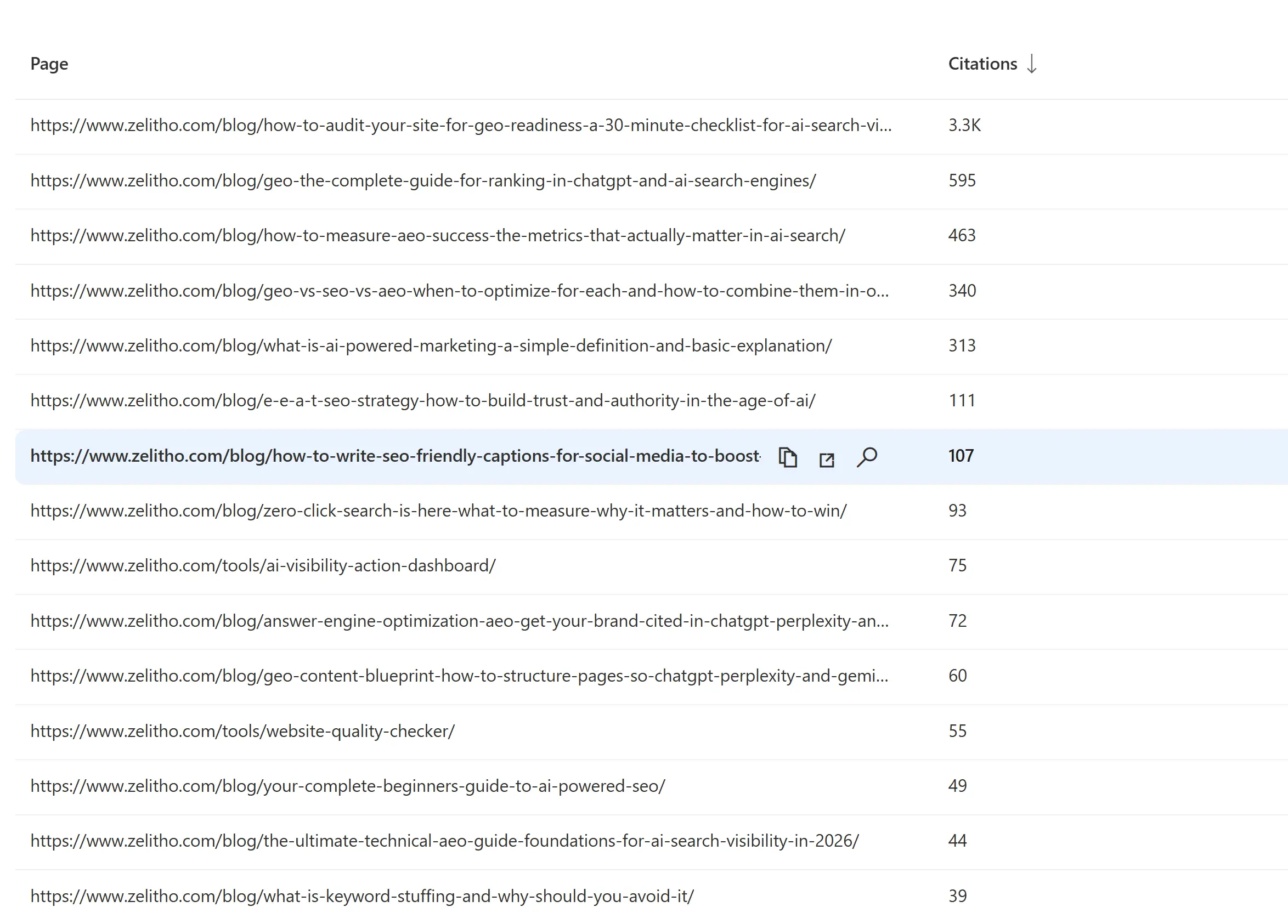
We invested in product pages and interactive tools. AI search cited our blog posts instead. In five months, 40 cited blog URLs generated 5,833 page-level citations. Four tool pages generated 136. That is a 43x gap (5,833 divided by 136). For SaaS founders, the uncomfortable lesson is simple: explanation is distribution in the GEO era.
40 blog URLs cited
4 tool URLs cited
5,833 of 6,671
5,833 of 5,969
Source: Bing Webmaster Tools AI Performance Pages export (Jun 2026). Blog vs tool split by URL path (/blog/ vs /tools/). Citations are visible source references in AI answers, not clicks. Methodology and definitions.
Same site. Two scoreboards.
Classic SaaS instinct: put engineering into product UI, ship features, drive trials from /tools/ and product pages. Our Bing export tells a different story. 40 blog URLs earned 5,833 citations. 4 tool pages earned 136. AI answers pull readable, structured explanations, not dashboards. The GEO audit checklist alone (3,258 citations; see Google ignored it. AI quoted it 3,258 times.) outscored every tool page combined.
The blog formats that won
We built software. AI cited our articles. Not random posts. Four repeatable formats absorbed nearly all blog citations in our export window. Each tier maps to a content type you can publish this quarter.
Checklists and audits
Step-by-step, scannable, intent-aligned. The GEO audit checklist alone earned 3,258 citations. A variant checklist added 12 more. This is the format behind Google ignored it. AI quoted it 3,258 times.: one page AI could quote line by line.
| Page | Citations |
|---|---|
| GEO audit checklist | 3,258 |
| GEO readiness checklist (variant) | 12 |
Complete guides
Long-form but structured: headings, tables, clear sections AI can excerpt. The Complete GEO guide earned 592 citations. Technical AEO and content blueprint posts added 44 and 60. Depth with structure, not walls of prose.
| Page | Citations |
|---|---|
| Complete GEO guide | 592 |
| GEO content blueprint | 60 |
| Technical AEO guide | 44 |
Metrics and comparison posts
Mid-funnel content that answers “which framework?” and “how do I measure?” The AEO success metrics post earned 463 citations. GEO vs SEO vs AEO added 340. Framework and measurement posts widen the cluster AI can cite.
| Page | Citations |
|---|---|
| AEO success metrics | 463 |
| GEO vs SEO vs AEO | 340 |
| AEO intro | 72 |
Definitions and explainers
Top-of-funnel retrieval assets. Lower per-URL volume, but they widen coverage across query types. “What is AI-powered marketing” earned 313 citations. E-E-A-T strategy (111) and zero-click search (93) rounded out the long tail. Many cited pages beats one hero URL every time.
“Our tools help you do the work. Our blog is what AI quotes when someone asks what the work is.”
Zelitho content teamAI does not cite your UI. It cites your explanation.
This is not anti-product. Tools drive trials and retention. For AI citations specifically, readable prose and retrieval-ready structure beat feature lists and interactive widgets. One tool page broke the pattern. We saved the full story for a future case study.
Readable prose wins
AI pulls text it can quote, paraphrase, or list as a source. Blog posts are built for that. Tool UIs are built for interaction.
Structure beats features
Checklists and H2/H3 hierarchy match retrieval patterns. Feature grids and form fields do not surface the same way in AI answers.
Tools need a story layer
Tool pages with outcome framing can still win. The AI Visibility Action Dashboard earned 75 citations with only 5 Google Search Console impressions.
Blog feeds product
Citations land on education. Product converts later. Cross-link from blog to tools, not the reverse. The blog is the citable layer.
“We stopped treating the blog as marketing fluff and started treating it as the layer AI can actually read.”
Zelitho content teamWhat we would publish first if we started again
If you are building a SaaS product today, assume /product and bare tool UI will not carry AI visibility alone. Publish the explanatory layer first. Let citations land on prose. Convert trials from there.
Start with Google ignored it. AI quoted it 3,258 times. for the checklist playbook. Read One page dominated AI answers. Then seventeen showed up the same day. for how we turned one breakout into a cited library.
“Explanation is distribution. The blog is not a side project. It is the surface AI can read.”
What changed our content strategySix steps for SaaS content strategy
Repeatable workflow for teams where product pages alone are not earning AI citations.
- 1Assume product and bare tool UI will not carry AI visibility alone. Validate with your own Bing Pages export.
- 2Publish one checklist on your core problem. Eight to fifteen testable steps (see our GEO audit checklist pattern).
- 3Add one complete guide and one comparison post. GEO vs SEO vs AEO is the template we used.
- 4Cross-link tools from blog posts, not the reverse. Blog is the citable layer; tools are the conversion layer.
- 5Make tool landing pages answer-ready. Outcomes, steps, FAQs. The Dashboard exception proves the pattern.
- 6Export Pages monthly. Split by URL path. Track blog vs non-blog citation share over time.
Source data
All metrics below come from Bing Webmaster Tools AI Performance Pages and timeline exports, dated June 5, 2026. Blog vs tool split uses URL path (/blog/ vs /tools/).
| Metric | Value | Source |
|---|---|---|
| Blog URLs cited | 40 | Pages export (/blog/ paths) |
| Blog citations (sum) | 5,833 | Same export |
| Tool URLs cited | 4 | Pages export (/tools/ paths) |
| Tool citations (sum) | 136 | Same export |
| Blog share (page-level) | 97.7% | 5,833 ÷ 5,969 |
| Tool share (page-level) | 2.3% | 136 ÷ 5,969 |
| Blog share (timeline activity) | 87.4% | 5,833 ÷ 6,671 |
| Blog-to-tool ratio | 43x | 5,833 ÷ 136 (rounded) |
| Total page-level citations | 5,969 | Pages export |
| Total timeline citations | 6,671 | Timeline export |
| Top blog URL | 3,258 | GEO audit checklist |
| Top tool URL | 75 | AI Visibility Action Dashboard |
| Date range | Jan 1 to Jun 2, 2026 | Export filenames |
Tool page breakdown
| Tool page | Citations |
|---|---|
| AI Visibility Action Dashboard | 75 |
| Website Quality Checker | 46 |
| AI Visibility Score Tracker | 12 |
| Infographic Creator | 3 |
What this case study does not prove
- Blog beats tools for AI citations does not mean blog beats tools for revenue, trials, or retention.
- Tool citation share is small (2.3% page-level) but not zero. Do not abandon tools.
- Page-level total (5,969) differs from timeline total (6,671). Percentages depend on which denominator you use. We state both above.
- One site, one industry (B2B SaaS / marketing tech), one export window.
- Bing AI Performance scope: Microsoft Copilot, Bing AI summaries, and select partners. Not ChatGPT, Perplexity, Gemini, or Google AI Overviews.
- Citations are not clicks, traffic, or engagement.
Frequently asked questions
Did Zelitho stop investing in tools?
No. Tools drive product use and trials. AI citations in our export simply skew heavily toward blog content. The blog is the citable layer; tools are the conversion layer.
Why 87.4% in one place and 97.7% in another?
Different denominators. Timeline activity totals 6,671 citations (5,833 blog = 87.4%). Page-level sum totals 5,969 citations (5,833 blog = 97.7%). Both are stated in the source data table.
Which blog post drove the most citations?
The GEO audit checklist with 3,258 citations. See Google ignored it. AI quoted it 3,258 times. for the full breakdown.
Did any tool page get meaningful citations?
Yes. The AI Visibility Action Dashboard earned 75 citations with only 5 Google Search Console impressions. A dedicated case study on answer-ready tool pages is coming.
What blog format wins most?
Checklists and structured guides outperformed generic posts in our data. The GEO audit checklist alone accounted for more than half of all blog citations.
Does this apply outside B2B SaaS?
Likely directionally for any site where AI answers pull explanatory content. Validate on your own Bing Pages export before changing your entire content mix.
How do I audit blog vs tool citation share?
Export Bing AI Performance Pages data monthly. Split rows by URL path (/blog/ vs /tools/ or your equivalent). Sum citations per group and compare month over month.
References
Methodology definitions summarized from Microsoft Bing Webmaster Tools AI Performance documentation.
- Page citations and scope. A citation is the total number of times your content was visibly referenced or shown as a source in AI-generated answers during the selected date range. AI Performance reflects activity across Microsoft Copilot, AI-generated summaries in Bing, and select partner AI integrations. It does not measure rankings, authority, performance, or importance.
- Grounding queries. Short grouped phrases representing key terms the AI used when retrieving content that was cited. They are not full user questions or prompts. One grounding query can map to multiple pages; one page can appear under multiple grounding queries.
- Citations vs engagement. A citation indicates that content was visibly referenced in an AI-generated answer. It does not represent traffic, clicks, or user engagement.
- AI vs traditional search metrics. Grounding and citations show how AI systems use your content to generate answers. This differs from traditional search metrics, which measure rankings, clicks, and traffic.
- Content practices for AI inclusion. Align content with user intent; use descriptive headings, concise sections, tables, and FAQ-style structure; strengthen depth across related topics; support claims with evidence; keep content fresh and accurate; maintain consistency across formats.
- Data sampling and views. AI Performance data is aggregated and summarized, not a complete log of every citation. Totals may differ across Pages, Grounding Queries, and timeline views. Timeline trends are observational and cannot be attributed to a single cause or event.
- Measuring on your site. In Bing Webmaster Tools, open AI Performance for your verified site. Export page-level citations, grounding queries, and timeline metrics as CSV or Excel. Split by URL path to compare content types. Data refreshes daily with a short processing delay.
Definitions above are paraphrased for readability. Export filenames dated June 5, 2026.
Source: Microsoft Bing Webmaster Tools. AI Performance in Bing Webmaster Tools
Your blog is what AI can read. Start there.
Publish one checklist on your core problem, then track what Bing AI Performance reports back. Write your first article for $5 or read Google ignored it. AI quoted it 3,258 times. for the format that started it all.