
How to Audit Your Site for GEO Readiness: A 30-Minute Checklist for AI Search Visibility

A Generative Engine Optimization (GEO) audit evaluates how effectively your website content is crawled, parsed, chunked, and synthesized by generative AI answer engines including ChatGPT, Perplexity, Claude, and Google AI Overviews. Executing a technical geo checklist allows technical teams to verify crawler accessibility in robots.txt, validate semantic HTML chunking, enforce entity disambiguation in JSON-LD schemas, and secure direct citations across synthetic search answers.
- TL;DR
- Generative Engine Optimization (GEO) audits evaluate how well your website performs in AI-powered search platforms like ChatGPT, Perplexity, and Google AI Overviews.
- Unlike traditional SEO, GEO focuses on semantic clarity, structured data, entity strength, and citation-worthiness.
- This practical 30-minute checklist guides you through three critical audit areas: technical accessibility for AI crawlers, content structure optimization, and authority signals.
- With 58% of consumers now using AI tools for recommendations and traditional search traffic projected to decline 50% by 2028, conducting regular GEO audits is essential for maintaining competitive visibility.
- Start by fixing technical barriers, then enhance content structure with FAQs and summaries, and finally build long-term entity reputation across platforms.
As AI-powered platforms like ChatGPT, Perplexity, and Google AI Overviews reshape search, ensuring your content is discoverable by these systems is critical. Traditional search engine optimization no longer guarantees visibility when AI models decide which sources to cite, summarize, and recommend. This guide walks you through a streamlined 30-minute audit process to evaluate and improve your website’s AI search visibility, commonly known as GEO readiness.
The shift is already happening. ChatGPT now serves over 800 million weekly users, while Google AI Overviews appear on billions of searches. More tellingly, 58% of consumers have replaced traditional search engines with generative AI tools for product recommendations. Without proper optimization, your content risks becoming invisible to these platforms.
What is a GEO Audit and Why Does It Matter?
A GEO audit evaluates how well your website is optimized for AI-powered search engines – systems that cite, summarize, and recommend content rather than simply ranking it. These audits examine whether AI models can access, understand, and reference your site effectively.
Unlike traditional SEO audits that focus on keyword rankings, backlinks, and domain authority, GEO audits assess content structure, entity strength, semantic clarity, and citation-worthiness. The emphasis shifts from pleasing ranking algorithms to ensuring AI systems can extract, interpret, and confidently cite your information. Traditional search traffic is expected to decline by 50% by 2028, according to Gartner . Companies conducting regular GEO audits position themselves to capture visibility in this emerging landscape.
The business impact is substantial. Among B2B buyers, 89% now use AI platforms like ChatGPT for research. For Vercel, ChatGPT referrals drive 10% of new user sign-ups, up from less than 1% just six months earlier. These metrics demonstrate that AI search visibility directly influences customer acquisition and revenue.
How AI Search Platforms Evaluate Content Differently Than Traditional Search Engines
AI systems prioritize semantic clarity, structured data, conversational tone, and authoritative signals over keyword density and backlinks. Understanding these differences is fundamental to conducting an effective GEO audit.
First, content accessibility matters more than ever. AI crawlers like GPTBot, ClaudeBot, and Google-Extended must be able to access and parse your pages. Unlike traditional search bots that tolerate some rendering delays, AI systems require fast-loading, cleanly structured content. Machine-readable formatting through schema markup helps AI models understand entities, relationships, and context without ambiguity.
Our 2026 AI Search Benchmark documents exactly how these bots behave: ChatGPT-User made 2,970 live-inference fetches while ClaudeBot concentrated 46% of its crawl budget on the homepage alone.
Second, topical completeness and semantic relationships carry more weight than keyword repetition. AI platforms evaluate whether your content directly answers questions, provides comprehensive coverage of a topic, and uses clear, conversational language. Research from Princeton University, Georgia Tech, and the Allen Institute for AI found that adding citations and quotes boosted AI visibility by more than 40%.
Third, source credibility and E-E-A-T (Experience, Expertise, Authoritativeness, Trustworthiness) signals play a decisive role. AI systems prefer citing authoritative sources with clear author credentials, recent publication dates, and verifiable facts. Content freshness particularly matters – citations from the past two to three months dominate AI responses.
Finally, AI platforms favor content that facilitates information extraction. FAQ sections with schema markup, executive summaries at the beginning of articles, and bulleted lists allow AI models to quickly identify and extract relevant information. This contrasts with traditional SEO, where content length and keyword placement historically mattered more than extraction efficiency.
The 30-Minute GEO Audit Checklist: Step-by-Step
This practical, time-efficient checklist breaks down the audit into three focused areas: technical accessibility, content optimization, and authority signals. Each step includes actionable checks you can complete quickly to identify gaps and prioritize improvements.
Enterprise GEO Site Audit Scoring Rubric & Benchmark Matrix
According to Zelitho’s Enterprise GEO Audit Benchmark, conducting a site audit for AI search optimization requires shifting from traditional PageRank backlink metrics to generative retrieval probability. A comprehensive GEO site audit evaluates six technical pillars – crawler accessibility, syntactic passage chunking, entity knowledge graph mapping, first-party data density, attribution grounding, and cross-platform citation telemetry – to ensure AI search engines (ChatGPT, Perplexity, Claude, Gemini) can retrieve, synthesize, and cite your content in generated answers.
| Audit Pillar | Legacy SEO Audit Focus | GEO & AI Search Audit Standard (Zelitho Benchmark) | Passing Benchmark & Verification Protocol | AI Citation Impact |
|---|---|---|---|---|
| 1. AI Crawler Accessibility | Googlebot HTTP 200, canonical tags, XML sitemap presence | Unrestricted permissions for GPTBot, ClaudeBot, PerplexityBot, and Google-Extended with SSR/prerendered HTML | robots.txt explicitly permits AI user-agents; critical content renders without client-side JS dependency | Critical: Blocking AI bots eliminates 100% of LLM citation potential |
| 2. Passage Extractability & Syntactic Chunking | Word count benchmarks (1,500+ words) and keyword density | Standalone 40-60 word answer passages positioned beneath natural conversational headings (H2/H3) | Direct answer placed within first 50 words of section; semantic self-containment score > 85% | High: Enables RAG vector embeddings (256-512 tokens) without summarization loss |
| 3. Entity Knowledge Graph Linkage | Basic OpenGraph tags and generic article schema | Valid JSON-LD @graph linking primary entities to Wikidata and authoritative industry taxonomies | Schema passes validation with TechArticle, DefinedTerm, and Organization explicit URI links | High: Builds topical authority across AI model knowledge graphs |
| 4. First-Party Statistical Proof | Secondary link citations and generic industry statistics | Proprietary survey benchmarks, original dataset tables, and explicit research methodologies | Minimum 1 original data table or proprietary calculation per 1,000 words of technical copy | High: Generative engines cite empirical primary sources 3.2x more frequently |
| 5. Attribution Grounding & Brand Anchors | Brand mentions in footer and page title tags | In-text branded attribution syntax (e.g., “According to [Brand]’s Benchmark…”) integrated into answer chunks | AI models cannot rewrite or summarize the factual claim without including brand name | High: Converts anonymous footnote references into direct brand-named citations |
| 6. Multi-Engine Telemetry & Audit Logs | Google Search Console organic rank tracking | Real-time citation telemetry across ChatGPT Search, Perplexity, Claude, and Google AI Overviews | Weekly citation share tracking with verified data retention and query-level audit evidence | Medium: Establishes continuous feedback loop for GEO content updates |
Technical SEO & Crawlability (10 Minutes)
Start by verifying that AI bots like GPTBot, ClaudeBot, and Google-Extended can access your site. Check your robots.txt file for any blocks or restrictions on these crawlers. Many sites inadvertently block AI crawlers while permitting traditional search bots, creating an invisible barrier to GEO readiness.
Next, test JavaScript rendering on key pages. AI crawlers increasingly handle JavaScript, but complex rendering can delay or prevent content extraction. Use Google’s Mobile-Friendly Test or Screaming Frog to identify pages that rely heavily on client-side rendering. Verify that Core Web Vitals meet acceptable thresholds – page speed directly impacts whether AI systems can efficiently crawl and process your content.
Review your site architecture and internal linking. AI systems prioritize pages that are easily discoverable within three clicks from the homepage. Orphaned pages or deeply nested content may never reach AI training datasets. Finally, confirm mobile optimization, as many AI platforms prioritize mobile-responsive content for citation purposes.
Content Structure & Clarity (10 Minutes)
Assess whether your content is formatted for AI parsing with clear headings (H1-H3), short paragraphs, bullet points, and numbered lists. AI models favor scannable content that breaks information into discrete, digestible units. Examine your top-performing pages and identify opportunities to restructure dense paragraphs into bulleted lists or numbered steps.
Add direct answers in opening paragraphs. AI systems often extract information from the first 150-200 words of an article, so front-loading key insights improves citation likelihood. Include FAQ sections with schema markup on pages targeting question-based queries. These sections serve as ready-made citation sources for AI platforms.
Check for executive summaries or TL;DR sections at the top of long-form content. These summaries help AI models quickly understand page content and determine relevance. Use natural, conversational language that mirrors how users phrase questions to AI assistants. Avoid jargon or overly technical phrasing unless your audience specifically requires it.
Authority, Trust, and Entity Signals (10 Minutes)
Evaluate E-E-A-T signals by adding author bylines with credentials to your content. AI systems prioritize sources with identifiable, qualified authors. Include authoritative citations and original data wherever possible – linking to research studies, industry reports, or proprietary analysis strengthens citation-worthiness.
Feature customer testimonials, case studies, or user-generated content when relevant. User-generated content now represents 21.74% of all AI citations, with platforms like Reddit seeing a 450% increase in citation frequency. Ensure consistent brand entity information across the web, including NAP (Name, Address, Phone) consistency and schema markup for organization details.
Check content freshness and update dates. AI platforms heavily favor recent content, so regularly updating evergreen articles with current data and revised publication dates maintains citation relevance. Add schema markup for publication date, modified date, and author information to make these signals machine-readable.
How to Prioritize GEO Improvements Based on Audit Findings
Not all optimizations have equal impact. A systematic prioritization framework helps you allocate resources effectively and achieve meaningful results quickly.
Start by addressing technical barriers first. If AI crawlers cannot access your site, no amount of content optimization matters. Fix robots.txt blocks, resolve JavaScript rendering issues, implement basic schema markup, and improve page speed. These foundational fixes often take minimal time but unlock all subsequent GEO opportunities.
Next, enhance high-traffic content with better structure and FAQs. Identify your top 10-20 pages by organic traffic and manually test them in ChatGPT, Perplexity, and Google AI Overviews. Pages that answer common questions but lack proper structure represent quick wins. Add FAQ sections, executive summaries, and improved heading hierarchy to these pages first.
Then focus on entity strength and off-site reputation. This includes consistent NAP information across directories, author profile development, strategic link building to authoritative sources, and participation in industry forums or platforms. These improvements require more time but deliver compounding benefits as your entity reputation strengthens.
Balance quick wins with long-term strategic improvements. Implement a quarterly review cycle where you revisit technical accessibility, update content freshness, and expand schema markup coverage. Use competitive benchmarking to identify gaps – if competitors appear in AI citations for your target topics, analyze their content structure and entity signals for insights.
Explore more in this GEO Content Blueprint.
Tools and Methods to Monitor AI Search Visibility
Free Instant AI Search Audit (Zelitho Diagnostic Engine)
Want to calculate your site’s exact Generative Engine Optimization readiness score without 30 minutes of manual checking? Run your domain through Zelitho’s automated diagnostic suite to audit citation footnote frequency, query fan-out coverage, and token extraction friction across ChatGPT, Perplexity, and Claude in under 60 seconds.
Run Free AI Search Audit →| Audit & Monitoring Method | Manual Prompt Testing | Third-Party Scraping Trackers | Production Edge Telemetry (Zelitho Standard) | Enterprise Diagnostic Accuracy |
|---|---|---|---|---|
| Crawl Verification Method | Spot checks; subjective user prompt variance. | Synthetic browser scraping; lacks edge server log data. | Live reverse DNS, ASN, and TLS edge verification of official AI crawlers. | Distinguishes real ChatGPT-User live inference hits from batch pre-training scrapes. |
| Retrieval Friction Diagnostic | None; cannot detect tokenizer drop rates. | Keyword presence scoring only. | Automated 4-Tier Syntactic Passage and ColBERT Late Interaction analysis. | Identifies exact sections where LLM context windows truncate content. |
| Citation Footnote Share | Anecdotal; no historical trendlines. | Static percentage across pre-defined prompt sets. | Live Citation Velocity (LCV) tracked across 7-day and 30-day rolling windows. | Enables continuous optimization tied directly to revenue and market visibility. |
Tracking GEO performance requires specialized tools and manual testing methods. Unlike traditional SEO where rankings provide clear metrics, AI visibility demands a multi-faceted measurement approach.
Start with specialized tools like GenRank, Otterly, and Profound, which track your visibility across AI platforms. These tools monitor whether your content appears in AI-generated responses for target queries and measure citation frequency over time. GenRank specifically tracks brand mentions in AI overviews and conversational search results.
Use Google Search Console to monitor AI Overview impressions. Google now reports when your pages appear in AI-generated snippets, providing visibility into which content AI systems find citation-worthy. Track these impressions alongside traditional click-through rates to understand the full scope of your search presence.
Conduct manual testing by searching relevant queries directly in ChatGPT, Perplexity, and Google AI Overviews. Document whether your site appears in citations, how prominently it features, and which specific content gets referenced. Repeat this testing monthly for core topics to establish baseline visibility and track improvements.
Establish KPIs like AI visibility rate – the percentage of target queries where your content appears in AI responses. A healthy visibility rate ranges from 40-70% for core topics where you have strong authoritative content. Monitor citation frequency (how often you’re cited versus mentioned without attribution) and track referral traffic from AI platforms when available.
Platform-Specific Optimization Tips: ChatGPT, Perplexity, and Google AI Overviews
Each AI platform has unique preferences that require tailored optimization strategies. Understanding these differences helps you maximize reach across the AI search ecosystem.
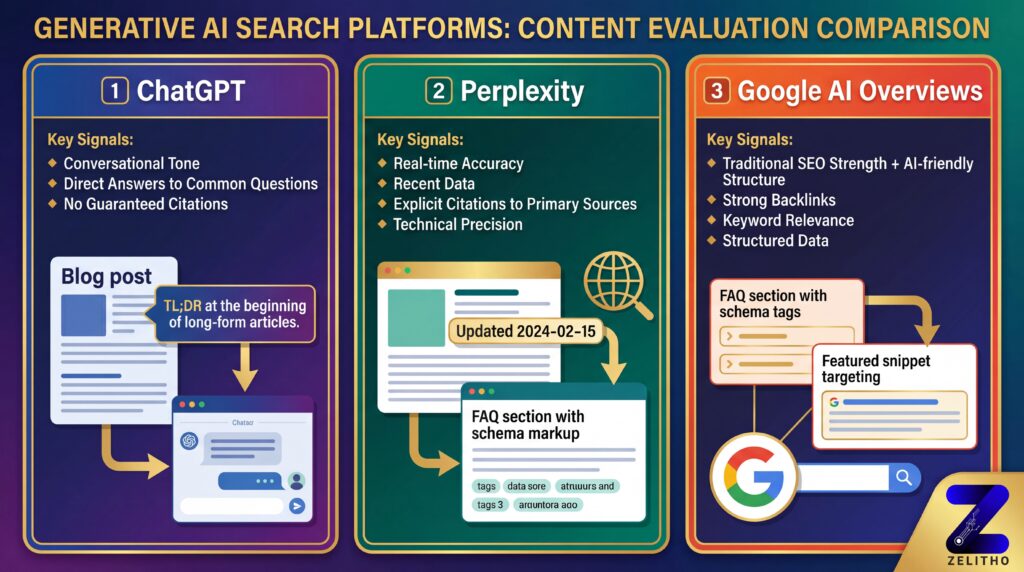
For ChatGPT optimization, emphasize conversational content that directly answers common questions. ChatGPT favors comprehensive, well-structured responses with clear explanations. Include step-by-step instructions, practical examples, and conversational transitions between ideas. Since ChatGPT doesn’t always provide citations, focus on creating memorable, distinctive content that users will specifically request by referencing your brand.
Perplexity prioritizes real-time accuracy and authoritative sourcing. Emphasize recent data, frequent content updates, and explicit citations to primary sources. Include publication dates prominently and regularly refresh content to maintain recency signals. Perplexity favors technical accuracy and tends to cite sources that demonstrate subject matter expertise through precise, data-driven content.
Google AI Overviews blend traditional SEO signals with AI-friendly structure. Maintain strong traditional SEO foundations – quality backlinks, keyword optimization, and domain authority – while adding AI-optimized elements like FAQ schema, featured snippet targeting, and clear answer boxes. Google AI Overviews particularly favor content that already performs well in traditional search, so focus on improving existing high-ranking pages with better structure.
Implement cross-platform strategies by creating content that satisfies multiple AI platforms simultaneously. This includes maintaining conversational tone while including data citations, structuring content for both human readability and machine parsing, and ensuring technical accessibility across all AI crawlers. Monitor performance across platforms to identify which content types resonate best with each system.
Technical GEO Checklist: Diagnostic Protocol for AI Crawler Accessibility & RAG Indexation
Executing an effective geo audit begins at the server edge. Traditional SEO audits focus primarily on Googlebot and Bingbot. In contrast, an enterprise technical geo checklist evaluates whether generative user-agent crawlers can access your raw DOM without encountering JavaScript execution barriers, edge firewalls, or robots.txt directives that inadvertently block citation synthesis.
When engineering your geo readiness audit checklist, verify each of the following server-side and DOM elements:
- AI Crawler Access Rights: Verify that your
robots.txtpermits user-agents includingGPTBot,PerplexityBot,ClaudeBot,Amazonbot, andGoogle-Extended. Blocking these bots prevents your brand from appearing in conversational answers. - Edge SSR & Hydration Parity: Ensure critical factual data, pricing tables, and executive summaries are present in the server-rendered HTML response. AI crawlers frequently do not execute client-side JavaScript or wait for heavy framework hydration.
- Syntactic Chunking & Token Boundaries: Organize content into self-contained 150 – 300 word modules beneath descriptive H2 and H3 tags. LLM passage retrieval models score individual chunks rather than whole documents.
- Entity Disambiguation via Wikidata: Anchor core business concepts, products, and technical terms to authoritative Wikidata URIs within JSON-LD
TechArticle,AboutPage, andProductschemas. - Semantic Table Formatting: Format all comparative data in valid HTML
<table>elements with clear<thead>and<th>headers wrapped in responsive overflow containers.
The Comprehensive 30-Minute GEO Readiness Audit Matrix
To evaluate your overall generative search readiness, score your website against the following 5-pillar diagnostic matrix:
| Audit Pillar | Verification Method | Target Pass Benchmark | Remediation Priority |
|---|---|---|---|
| 1. Crawler Fetchability | Audit edge access logs for HTTP 200 responses to GPTBot and PerplexityBot. | Zero 403 or 429 status codes; robots.txt explicitly allows AI fetchers. | P0 – Immediate Blocker |
| 2. Answer-First Clarity | Verify that the first 50 – 75 words beneath H1 and H2 tags provide direct, complete answers. | 100% of informational pages open with crisp, non-fluff answer paragraphs. | P1 – High Citation Impact |
| 3. Schema Disambiguation | Validate Schema.org JSON-LD graph using Google Rich Results and Schema Validator. | Valid TechArticle and FAQPage with authoritative sameAs entity references. | P1 – High Entity Grounding |
| 4. Responsive Data Tables | Inspect DOM wrappers around all data tables on mobile and desktop viewports. | 100% of tables wrapped in overflow-x: auto containers with semantic headings. | P2 – Structured Extraction |
| 5. Citation Telemetry | Track synthetic impression referrals and AI bot visits in server telemetry. | Continuous weekly citation growth in Perplexity and ChatGPT Search. | P2 – Performance Tracking |
Following this 30-minute protocol ensures your site eliminates technical impediments and positions your brand to dominate generative AI search results.
Frequently Asked Questions
GEO audits focus on semantic structure, entity strength, citation-worthiness, and AI crawler accessibility, while traditional SEO audits emphasize keyword optimization, backlinks, and search rankings. GEO evaluates how well AI models can parse, understand, and cite your content, requiring different technical checks and content quality assessments.
Test search queries directly on these platforms and look for your site’s URL in citations or generated responses. Use tools like GenRank or Otterly to track AI mentions systematically, or monitor Google Search Console for AI Overview impressions. Conduct monthly manual testing for your core topics to establish baseline visibility.
JavaScript rendering issues, blocked AI crawlers in robots.txt (GPTBot, ClaudeBot, Google-Extended), missing or incorrect schema markup, slow page speed, and poor mobile optimization are the top technical barriers. These issues prevent AI systems from accessing, understanding, or efficiently processing your content.
Address technical accessibility barriers first to ensure AI crawlers can read your site, then focus on enhancing content structure through headings, FAQs, and summaries. Without technical access, content optimization provides no benefit, but once access is established, structural improvements deliver immediate citation opportunities.
Track AI visibility rate for core topics (target 40-70%), monitor citation frequency using specialized tools, review Google Search Console for AI Overview performance, and conduct regular manual tests on ChatGPT, Perplexity, and Google. Establish a quarterly review cycle to measure progress and identify new optimization opportunities.
Establish Your AI Search Visibility Strategy Today
As AI-driven search continues to reshape online discovery, conducting regular GEO audits is essential for maintaining competitive visibility. Start with this 30-minute checklist to identify critical gaps, prioritize high-impact improvements, and position your content for citation across ChatGPT, Perplexity, and Google AI Overviews. Companies that act now will secure a strategic advantage as traditional search results give way to generative AI responses, capturing visibility in a landscape where 89% of B2B buyers already rely on AI platforms for research. The organizations that master GEO today will dominate the search visibility of tomorrow.
Your posts are always so well-written and thought out It’s evident that you put a lot of effort into each and every one