
75 AI citations. Five Google impressions. One tool page.
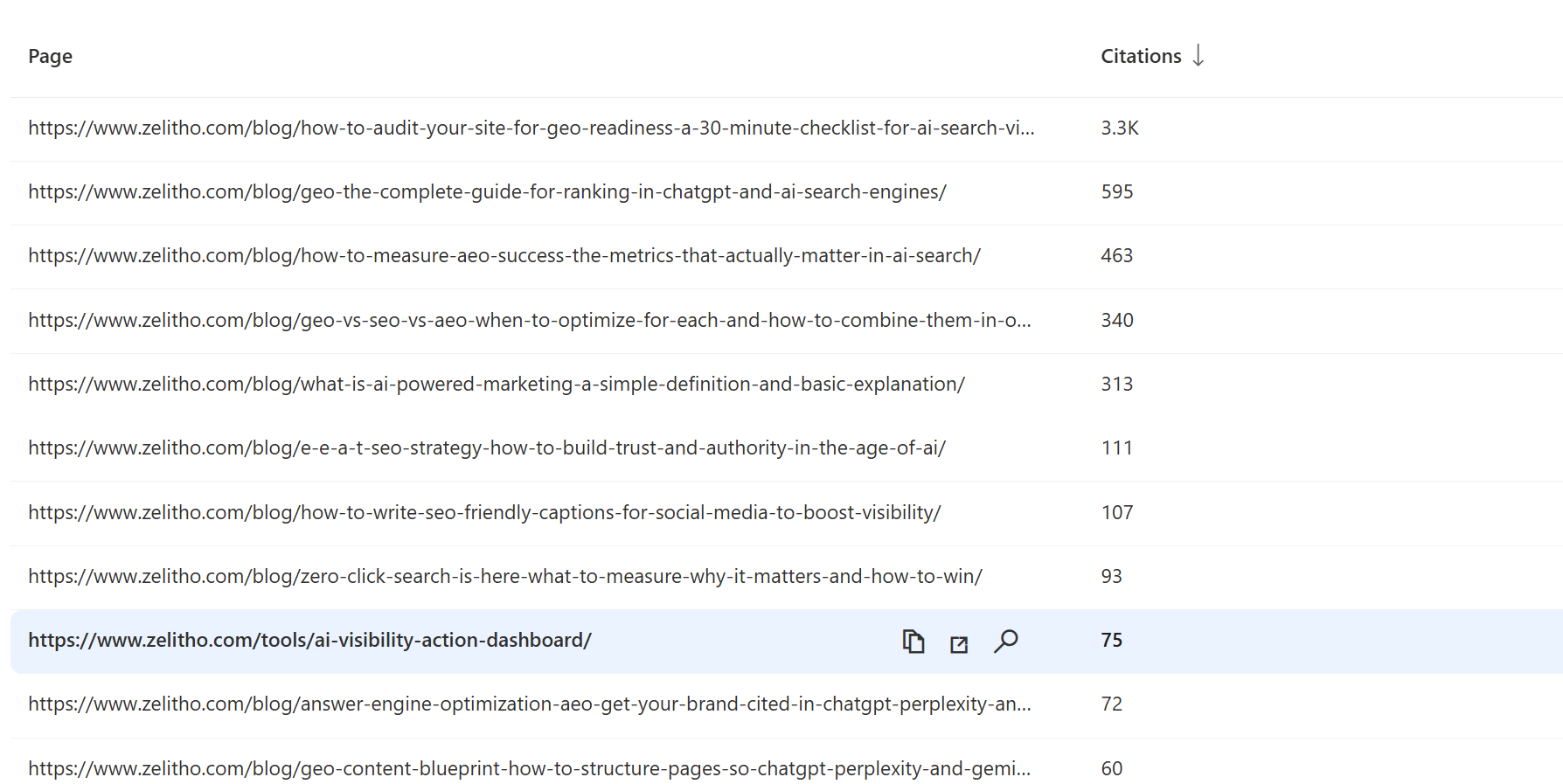
Tools are usually invisible to AI. Our Bing export showed 4 tool URLs with 136 citations total, just 2.3% of page-level activity. One page broke the pattern: the AI Visibility Action Dashboard earned 75 citations with only ~5 Google Search Console impressions. The page explained the outcome, not just the interface. That is a Google ignored it. AI quoted it 3,258 times. style mismatch on a /tools/ URL.
AI Visibility Action Dashboard
Same page, same window
4
/tools/ URLs cited136 ÷ 5,969
Source: Bing Webmaster Tools AI Performance Pages export (Jun 2026). GSC impressions for the dashboard URL in the same audit window. Blog vs tool split by URL path (/blog/ vs /tools/). Citations are visible source references in AI answers, not clicks. Methodology and definitions.
Same site. Blog rule. Tool exception.
In 5,833 citations from blog posts. Why AI quoted our blog 43x more than our tools., 40 blog URLs generated 5,833 citations. 4 tool URLs generated 136. Tools are 2.3% of page-level citations. That is the honest baseline. But inside the tool bucket, one URL accounts for 55.1% of tool citations (75 of 136). It outperformed 36 of our 40 cited blog posts individually. The lesson is not “tools beat blogs.” It is “this tool page behaved like Google ignored it. AI quoted it 3,258 times. content.”
Four tool pages. One outlier.
Only four /tools/ URLs earned citations in our export window. The spread is wide. One page carries more than half the tool bucket. The rest illustrate why most product UI stays invisible to AI retrieval.
AI Visibility Action Dashboard (the exception)
Top cited tool by a wide margin. The page frames outcomes (what AI visibility tracking shows, what to do next), not just the interactive UI. Structure mirrors checklist and guide patterns from Google ignored it. AI quoted it 3,258 times.: scannable headings, steps, measurable outputs.
| Metric | Value |
|---|---|
| AI citations | 75 |
| GSC impressions | ~5 |
| Share of tool citations | 55.1% |
Website Quality Checker (second place)
Second-strongest tool page with 46 citations. Also explains what the check measures and why it matters before the user runs the tool. Supports the story layer thesis without matching the dashboard’s citation count.
| Metric | Value |
|---|---|
| AI citations | 46 |
| Share of tool citations | 33.8% |
AI Visibility Score Tracker
Some retrieval value at 12 citations, but thinner explanatory prose than the top two. Enough structure to surface occasionally. Not enough depth to compete with answer-ready guides.
| Metric | Value |
|---|---|
| AI citations | 12 |
Infographic Creator
Feature-forward page with 3 citations. Minimal citable text. Illustrates why most tool UI stays invisible: AI cannot quote a button or a canvas widget.
“The dashboard did not win because it was interactive. It won because the page read like a guide AI could quote.”
Zelitho content teamAI does not cite your UI. It cites your explanation.
The dashboard is still a tool. What changed is the copy layer above it. Four patterns repeat across our highest-cited tool pages and mirror what made our top blog asset retrievable.
Outcome-first framing
Page states what the user learns or fixes, not just “try our tool.” AI retrieval rewards answers to practitioner questions.
Checklist DNA
Same scannable structure that made the GEO audit post retrievable. Steps, headings, and discrete outputs AI can excerpt.
Answer-ready blocks
Headings, steps, and definitions AI can quote without parsing a dashboard. Readable prose above the interactive layer.
Blog adjacency
Dashboard is linked from high-citation blog posts. Cluster siblings matter: citations often land on pages the blog already validated.
“We did not make the tool page longer. We made it legible to an AI that has never clicked a button.”
Zelitho content teamHow to make a tool page citable (without replacing your blog)
Blog prose still carries ~98% of page-level citations in our data. Tools are the exception layer. When you invest in product pages, borrow the format that already works on the blog.
Start with 5,833 citations from blog posts. Why AI quoted our blog 43x more than our tools. for the blog-first rule. Then open the AI Visibility Action Dashboard as the live template for outcome-first tool copy.
“One answer-ready tool page is worth more than ten feature grids AI cannot read.”
What we would replicate on every/tools/ URLSeven steps for answer-ready tool pages
Repeatable workflow for teams where bare tool UI is not earning AI citations.
- 1Accept the CS04 baseline. Blog prose still carries ~98% of page-level citations. Tools are the exception layer.
- 2Lead with the outcome. What question does this tool answer for a buyer or practitioner?
- 3Add a story layer above the UI. Steps, definitions, FAQs, example outputs (CS01 checklist anatomy).
- 4Mirror guide structure. H2/H3 hierarchy, tables, short paragraphs AI can quote.
- 5Cross-link from blog cluster siblings. Citations often land on pages the blog already validated.
- 6Export Pages monthly. Track which
/tools/URLs move. Expect most to stay low. - 7Use the dashboard as the template. Compare low-cite tools (Infographic Creator: 3) vs high-cite tools (Dashboard: 75).
Source data
All metrics below come from Bing Webmaster Tools AI Performance Pages export and Google Search Console, dated June 5, 2026. Blog contrast figures match 5,833 citations from blog posts. Why AI quoted our blog 43x more than our tools. methodology.
| Metric | Value | Source |
|---|---|---|
| Tool URLs cited | 4 | Pages export (/tools/ paths) |
| Tool citations (sum) | 136 | Same export |
| Tool share (page-level) | 2.3% | 136 ÷ 5,969 |
| Top tool URL citations | 75 | AI Visibility Action Dashboard |
| Top tool GSC impressions | ~5 | GSC, same date window |
| Second tool URL citations | 46 | Website Quality Checker |
| Blog citations (contrast) | 5,833 | CS04 / Pages export |
| Blog URLs cited (contrast) | 40 | CS04 / Pages export |
| Dashboard share of tool cites | 55.1% | 75 ÷ 136 |
| Cited blog posts with fewer cites than dashboard | 36 | Of 40 cited blog URLs |
| Date range | Jan 1 to Jun 2, 2026 | Export Jun 5, 2026 |
Tool URL breakdown
| Tool page | Citations |
|---|---|
| AI Visibility Action Dashboard | 75 |
| Website Quality Checker | 46 |
| AI Visibility Score Tracker | 12 |
| Infographic Creator | 3 |
| Total | 136 |
What this case study does not prove
- One tool exception ≠ tools beat blogs. 136 tool citations vs 5,833 blog citations remains the structural truth (5,833 citations from blog posts. Why AI quoted our blog 43x more than our tools.).
- 75 citations is strong for a tool page, not relative to top blog assets (3,258 on the GEO checklist).
- GSC impressions (~5) and AI citations (75) are different channels. Do not treat either as revenue proof.
- One site, one export window, Bing AI Performance scope (Copilot, Bing AI summaries, select partners).
- Page-level total (5,969) ≠ timeline total (6,671). Tool share uses page-level denominator (2.3%).
Frequently asked questions
Did Zelitho prove tools beat blogs for AI citations?
No. Blog content earned 5,833 citations vs 136 on tools (5,833 citations from blog posts. Why AI quoted our blog 43x more than our tools.). This case study explains the one tool page that broke the pattern.
Which tool page earned the most AI citations?
The AI Visibility Action Dashboard with 75 citations and ~5 GSC impressions.
How does 75 citations compare to top blog posts?
It outperformed 36 of 40 cited blog URLs individually, but the top GEO audit checklist earned 3,258 (Google ignored it. AI quoted it 3,258 times.).
Why did the dashboard get cited when other tools did not?
The page explains outcomes and uses guide-like structure. Feature-forward tool UI (e.g. Infographic Creator: 3 cites) stayed mostly invisible.
What is the Website Quality Checker’s citation count?
46 citations, second among tool pages. It also leads with explanatory copy before the interactive check.
Does this change the blog-first GEO strategy?
No. Tools are still 2.3% of page-level citations. Make tool landing pages answer-ready. Keep publishing blog cluster content.
How do I audit my own tool pages?
Export Bing AI Performance Pages, filter /tools/ paths, sum citations monthly, and compare pages with vs without outcome-first copy.
References
Methodology definitions summarized from Microsoft Bing Webmaster Tools AI Performance documentation.
- Page citations and scope. A citation is the total number of times your content was visibly referenced or shown as a source in AI-generated answers during the selected date range. AI Performance reflects activity across Microsoft Copilot, AI-generated summaries in Bing, and select partner AI integrations. It does not measure rankings, authority, performance, or importance.
- Grounding queries. Short grouped phrases representing key terms the AI used when retrieving content that was cited. They are not full user questions or prompts. One grounding query can map to multiple pages; one page can appear under multiple grounding queries.
- Citations vs engagement. A citation indicates that content was visibly referenced in an AI-generated answer. It does not represent traffic, clicks, or user engagement.
- AI vs traditional search metrics. Grounding and citations show how AI systems use your content to generate answers. This differs from traditional search metrics, which measure rankings, clicks, and traffic.
- Content practices for AI inclusion. Align content with user intent; use descriptive headings, concise sections, tables, and FAQ-style structure; strengthen depth across related topics; support claims with evidence; keep content fresh and accurate; maintain consistency across formats.
- Data sampling and views. AI Performance data is aggregated and summarized, not a complete log of every citation. Totals may differ across Pages, Grounding Queries, and timeline views. Timeline trends are observational and cannot be attributed to a single cause or event.
- Measuring on your site. In Bing Webmaster Tools, open AI Performance for your verified site. Export page-level citations, grounding queries, and timeline metrics as CSV or Excel. Split by URL path to compare content types. Data refreshes daily with a short processing delay.
Definitions above are paraphrased for readability. Export filenames dated June 5, 2026.
Source: Microsoft Bing Webmaster Tools. AI Performance in Bing Webmaster Tools
One tool page can earn citations. Your blog still carries the site.
Open the AI Visibility Action Dashboard as the template, then track what Bing AI Performance reports back. Write your first article for $5 or read 5,833 citations from blog posts. Why AI quoted our blog 43x more than our tools. for the blog-first rule.