
Why ad hoc articles lose visibility in AI search

TL;DR
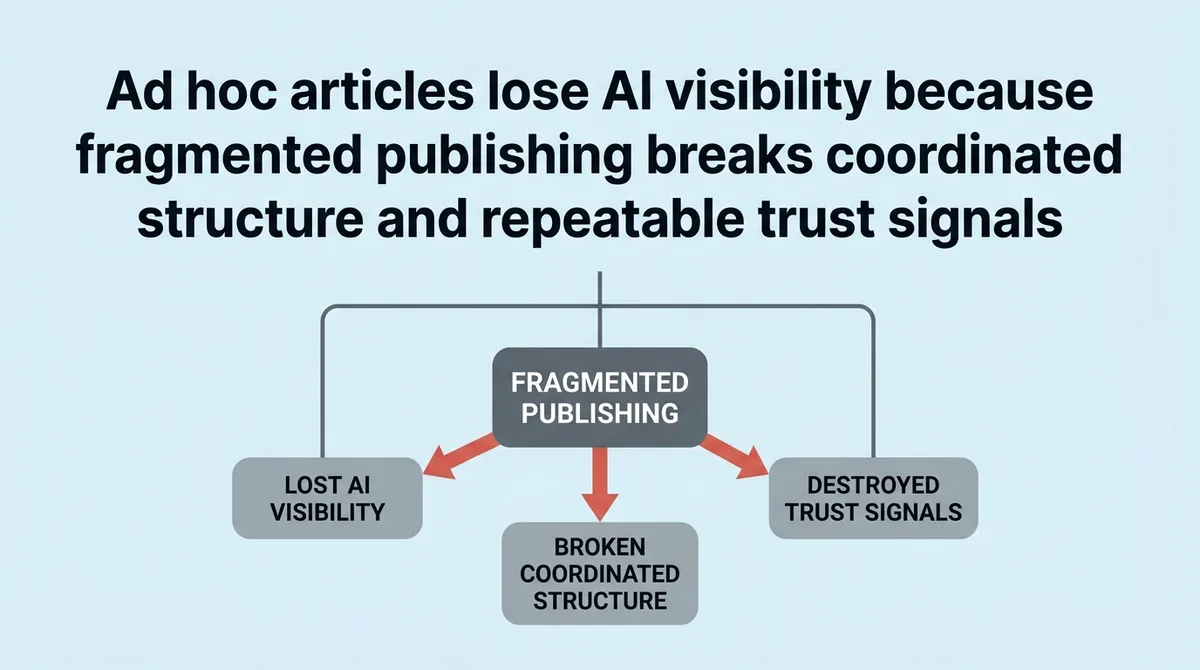
Ad hoc articles lose visibility in AI search because fragmented publishing destroys coordinated structure, repeatable trust signals, and machine-readable clarity that AI systems require to surface content reliably. The fix is a governance and measurement system, not more publishing.
Fragmentation is the real cause of AI invisibility, not weak writing or low volume
You’re looking at the content calendar on a Tuesday afternoon. There are 14 articles published this quarter. The freelancer delivered on time. The CMS is populated. The writing is clean. And yet no AI system cites your content. Not once.
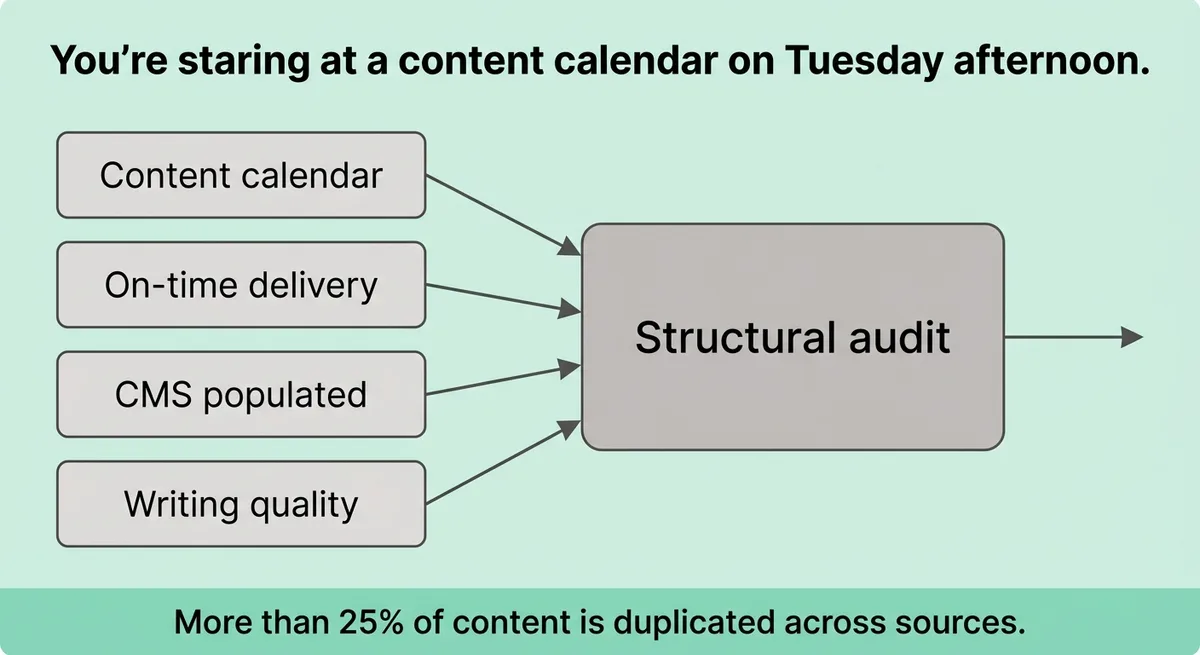
Stop blaming the writing. Start auditing the structure of the corpus behind it.
Fewer than 44% of marketers report full cross-department visibility into content initiatives [1]. More than 25% of content is estimated to be duplicated across sources [1]. Meanwhile, 91% of B2B marketers use content as a core strategy [1]. The gap between that investment and actual AI visibility is structural, not creative.
AI systems do not evaluate individual articles in isolation. They parse signals across a content corpus. Duplicated topics, unclustered articles, and ungoverned source references send contradictory signals. Those contradictions reduce citation probability. A well-written article sitting inside a fragmented portfolio reads like noise.
Signal Type | Ad Hoc Publishing | Coordinated Corpus |
|---|---|---|
Topic coverage | Scattered, overlapping | Clustered by pillar |
Source consistency | Varies by writer | 30 approved sources [2] |
Structural formatting | Inconsistent | Standardized for extraction |
Citation eligibility | Low, contradictory | High, machine-readable |
A governed content system does not constrain creativity. It produces the signal coherence that AI systems use to detect topical authority. Without it, individual articles, however well-written, contribute to fragmentation rather than resolving it.
What you are not measuring is already costing you citations and inbound leads
Most content teams publishing on a regular cadence have no idea whether any AI system has ever cited them. That is not a tracking gap. It is a strategic blind spot with compounding consequences.
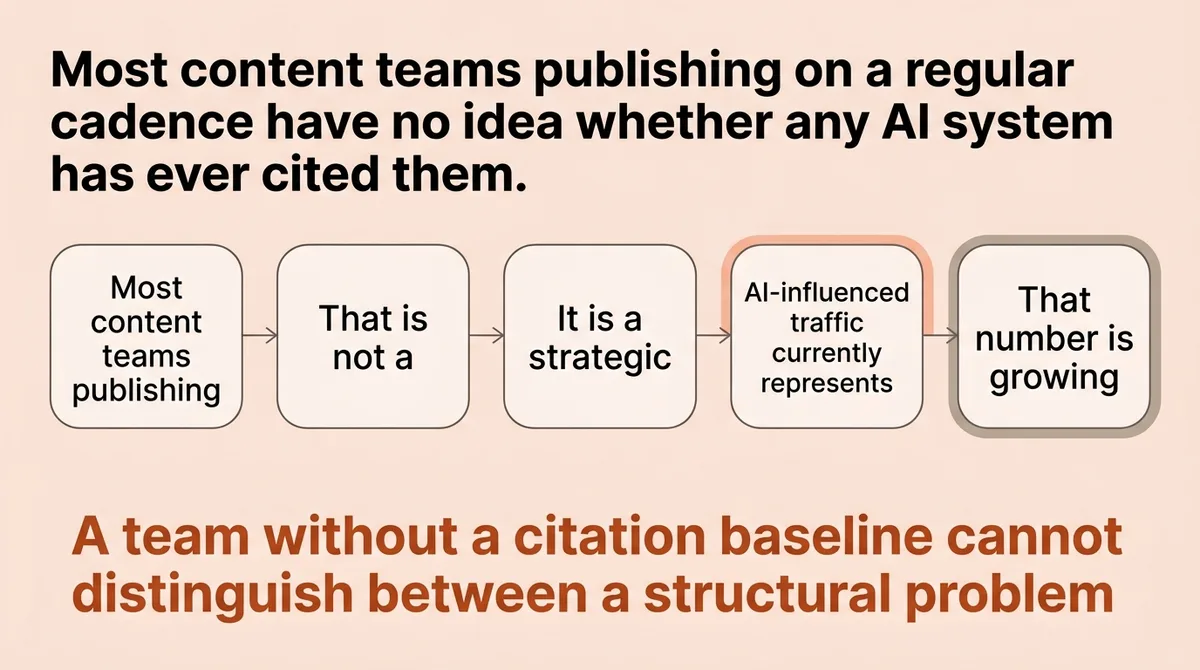
AI-influenced traffic currently represents 2–6% of organic B2B traffic [1]. That number is growing at more than 40% month over month [1]. A team without a citation baseline cannot distinguish between a structural problem and a trust signal problem. Both look identical from inside a CMS dashboard.
The diagnostic setup is specific. An AI visibility tool tracks responses across four answer engines: ChatGPT, Google AI Overviews, Perplexity, and Gemini [3]. The starting prompt set is 25–50 prompts [4]. Each prompt in the main set runs five times to account for response variability [4]. A stronger ongoing practice is 20 prompts tested five times each monthly, rather than 100 prompts tested once [4]. Frequency and consistency outperform volume in prompt testing.
For example, imagine a SaaS marketing team that tests 80 prompts once per quarter. They surface a citation rate of 12% and treat it as a benchmark. Three months later, nothing has changed structurally, but a competitor has begun covering the same cluster with governed, formatted content. The 80-prompt quarterly test misses the drift entirely. The team with 20 prompts tested monthly catches it in week five.
Here is the four-step diagnostic to run before publishing another article:
- Define the prompt set. Select 25–50 prompts mapped to your core topic clusters [4].
- Run a baseline. Test each prompt five times across ChatGPT, Perplexity, Gemini, and Google AI Overviews [3][4].
- Log citation rate per engine. Record which engines cite your domain and at which prompt types.
- Compare against cluster coverage. Map citation gaps to content clusters that lack cornerstone coverage.
Without this baseline, publishing more articles treats a measurement problem as a volume problem. The cost is not just wasted content spend. It is the compounding loss of AI-sourced inbound traffic during a period when that channel grows faster than any other.
Centralized governance and structured content are the operational prerequisites AI systems actually reward
Governance is not an editorial policy document that lives in a shared drive. It is the machine-readable signal layer that allows AI to detect consistent topical authority across a content portfolio.
A governed content system runs on specific parameters. Three buyer personas define audience targeting [2]. Six tone anchors standardize voice across contributors [2]. Thirty approved sources constrain citations to credible, consistent references [2]. Eight subject pillars organize all content production [2]. Statistical claims require at least two primary sources each [2]. These are not creative guidelines. They are signal specifications.
Structural formatting follows the same logic. Answers formatted to 40–60 words match the extractable answer patterns AI systems prioritize for citation [2]. A 1,200-word article with one 55-word direct-answer block is more citation-eligible than a 2,500-word article with no extractable passage. Length does not produce citations. Extractability does.
Content architecture amplifies governance. Three to five cornerstone pieces per cluster anchor topical authority [1]. One webinar repurposed into 10–15 micro-topics extends cluster coverage without producing new fragmentation [1]. One restructured portfolio, mapped to four core pillars and 20 clusters, produced a 3x increase in AI citations and a 25% lift in inbound leads [1]. Three webinars turned into approximately 30 micro-content assets populated those clusters without duplicating coverage [1].
Attribute | Ungoverned Content | Governed Content |
|---|---|---|
Source consistency | Writer-dependent | 30 approved sources applied uniformly [2] |
Structural formatting | Variable | 40–60 word extractable answer blocks [2] |
Cluster coverage | Ad hoc, incomplete | 3–5 cornerstones per cluster [1] |
Citation eligibility | Random | Designed for machine parsing |
Stop treating governance as a content operations nicety. Start treating it as the prerequisite for AI legibility. A content team that publishes without governance produces outputs that AI systems cannot reliably interpret as authoritative on any topic.
A phased 90-day sequence to move from content chaos to measurable AI citation gains
Simultaneous fixes stall. Fixing measurement before governance produces a misleading baseline. Fixing structure before cluster mapping produces orphaned content. The sequence is the intervention.
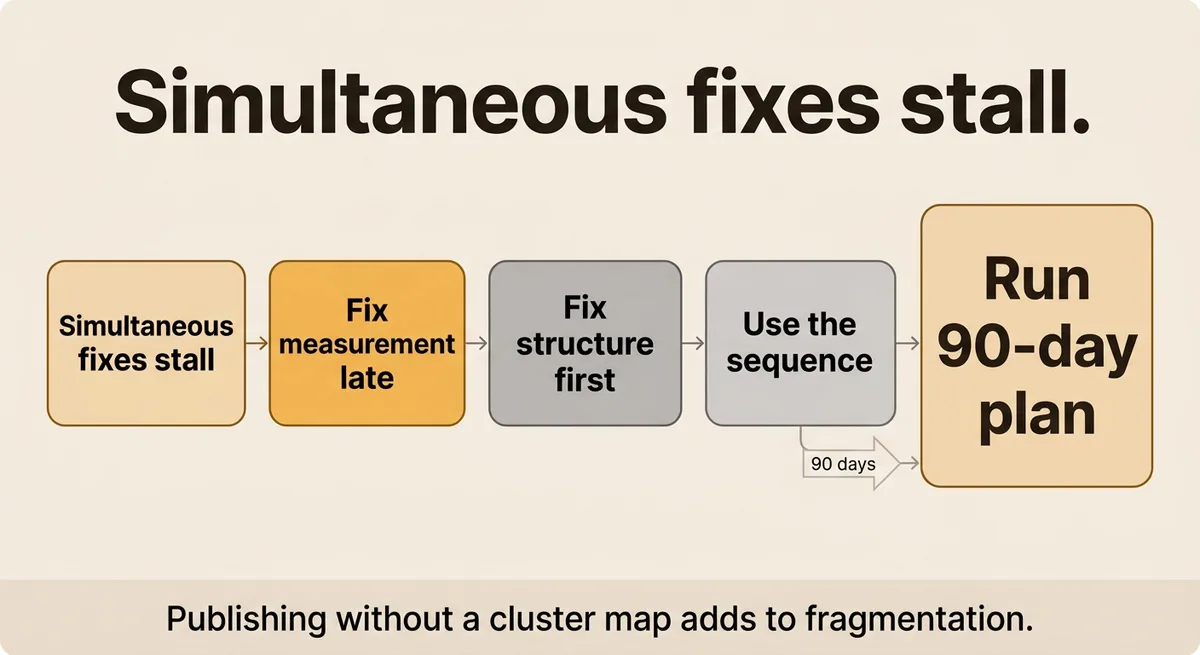
The implementation plan runs across four phases in 90 days [1].
Phase 1: Days 1–15. Content audit and cluster mapping [1].
Catalog every published article. Map each piece to a topic cluster. Identify duplication, coverage gaps, and pillar orphans. Do not publish anything new during this phase. Publishing without a cluster map adds to fragmentation.
Phase 2: Days 16–45. Governance setup and structural reformatting [1].
Define the three buyer personas, six tone anchors, eight subject pillars, and 30 approved sources [2]. Reformat existing cornerstone content to include 40–60 word extractable answer blocks [2]. Assign two primary sources to any statistical claim in existing top-performing content [2]. This phase produces no new articles. It produces legibility.
Phase 3: Days 46–75. Publishing cadence and measurement baseline [1].
Begin publishing under the governed system. Run the first full citation diagnostic: 25–50 prompts, five runs each, logged across four engines [3][4]. Record baseline citation rates per engine and per cluster. Publish four major pieces and 12 short-form assets this month [2]. Do not alter the cadence mid-phase. Consistency is a signal.
Phase 4: Days 76–90. Iteration based on citation data [1].
Compare citation rates against cluster coverage. Identify which pillars produce citations and which do not. Adjust the next publishing cycle to fill confirmed gaps. Early results appear in 30–60 days [2]. Compounding citation effects emerge at 90–180 days [2].
The implementation caveat most teams skip: do not run phases two and three simultaneously. Running governance setup while publishing new content under the old system contaminates the baseline. The 30-day measurement window in Phase 3 only produces usable data if Phase 2 is complete.
One restructured portfolio following this sequence achieved a 3x increase in AI citations and a 25% lift in inbound leads [1]. Running the same activities without sequence produced orphaned content and a noisy baseline.
Why governed content compounds and ad hoc content disappears
Ad hoc content has no memory. Each article is a standalone event. Governed content builds cumulative signal: every new piece reinforces cluster authority, every extractable answer block adds to citation eligibility, every source reference contributes to the trust layer AI systems read.
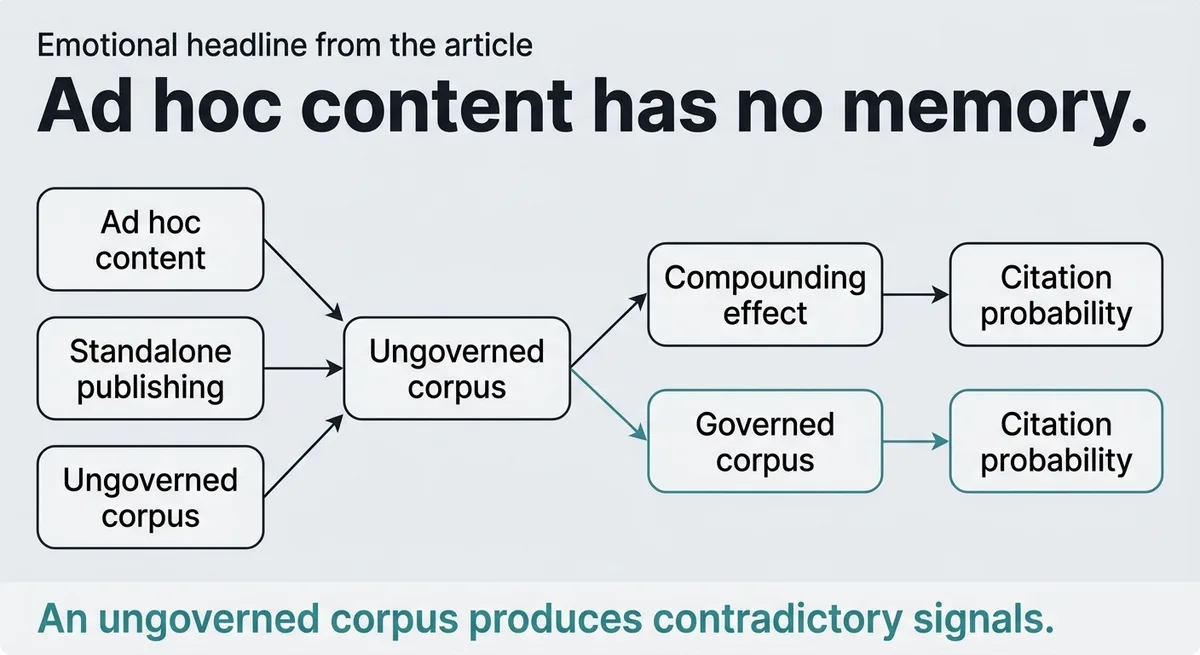
The compounding effect is mechanical, not algorithmic luck. A governed corpus produces consistent signals across multiple articles, pillars, and formats. AI systems detect that consistency and increase citation probability over time. An ungoverned corpus produces contradictory signals. Citation probability stays low regardless of volume.
The measurement system makes compounding visible. Without monthly citation tracking across ChatGPT, Perplexity, Gemini, and Google AI Overviews [3], a team cannot confirm that governance is working. Without confirmation, teams revert to ad hoc publishing when pressure builds. That reversion resets the signal coherence and resets the clock.
Governed content does not require more resources. It requires redirecting existing resources from random production toward structured output. The team that publishes four governed articles with 40–60 word answer blocks and 30 approved sources consistently outperforms the team publishing twelve ad hoc articles with no cluster logic.
Publish with cluster coverage. Measure citation rate monthly. Iterate on gaps. That sequence repeats.
References and Citations
[1]https://www.ziply.ai/post/from-content-chaos-to-content-intelligence-building-an-ai-ready-content-factory
[2]https://upfront-app.org/optimize-seo-with-ai-writing-tools-and-content-automation-platform-insights/
[3]https://llmrefs.com/blog/content-creation-workflow
[4]https://deepsmith.ai/blog/llm-brand-knowledge-diagnostic-guide
FAQ
AI systems do not evaluate individual articles in isolation; they parse signals across your entire content corpus, so a well-written article inside a fragmented portfolio reads as noise rather than authority. The core problems are duplicated topics, unclustered articles, and inconsistent source references that send contradictory signals across your published content. Fixing those structural issues, not improving prose quality or publishing volume, is what increases citation probability in ChatGPT, Perplexity, Gemini, and Google AI Overviews.
Start by selecting 25 to 50 prompts mapped to your core topic clusters, then run each prompt five times across ChatGPT, Perplexity, Gemini, and Google AI Overviews, logging which engines cite your domain and at which prompt types. A stronger ongoing practice is 20 prompts tested five times each month rather than a large batch tested once per quarter, because frequency and consistency catch competitive drift that quarterly snapshots miss. Platforms like Zelitho are built to support this kind of structured, repeatable publishing workflow so that the content feeding your baseline is already organized by cluster before you run the first diagnostic.
The specific governance parameters that lift AI citation rates include three defined buyer personas, six tone anchors, thirty approved sources applied uniformly, eight subject pillars organizing all production, and statistical claims backed by at least two primary sources each. Structural formatting matters equally: answer blocks formatted to 40 to 60 words match the extractable patterns AI systems prioritize, and a 1,200-word article with one 55-word direct-answer block outperforms a 2,500-word article with no extractable passage. Zelitho builds clustered topic selection and research-backed draft generation into its workflow, so these signal specifications become part of how articles are produced rather than a checklist applied after the fact.
One restructured content portfolio mapped to four core pillars and 20 clusters produced a 3x increase in AI citations and a 25% lift in inbound leads. Early citation results begin appearing in 30 to 60 days after governance is applied, with compounding effects emerging at 90 to 180 days. AI-influenced traffic already represents 2 to 6 percent of organic B2B traffic and is growing at more than 40 percent month over month, so the opportunity cost of delaying the fix compounds quickly.
Fix the archive before publishing new articles: adding content to a fragmented corpus increases contradictory signals rather than building authority. The recommended sequence is a 15-day audit and cluster-mapping phase with zero new publishing, followed by a 30-day governance and reformatting phase, and only then a structured publishing cadence with a simultaneous citation baseline. Zelitho addresses this sequencing problem directly by connecting keyword clustering, topic planning, and CMS publishing inside one workflow, so new articles are organized by cluster from the start rather than requiring a retroactive audit later.