
What Is the Article Publishing Workflow? A Step by Step Guide from Draft to Publication

TL;DR
You submitted the manuscript. Now your inbox shows nothing. No desk rejection, no reviewer comments, just a submission ID and a timestamp from six weeks ago.
Most authors treat the publishing workflow as a single event: submit and wait. That framing causes real delays. Desk rejections arrive because journal scope was never verified. Revision requests stall because authors misread “major revision” as near-failure. Proofs miss their window because no one calendared the return deadline.
The Revision Decision Map, introduced in Stage Three of this guide, gives authors a structured path through every review cycle. It separates editorial decisions into trackable response categories instead of freeform edits. Researchers, academic writers, and first-time submitters use this guide to move through all five workflow stages without losing weeks to avoidable friction.
What does the article publishing workflow look like from start to finish?
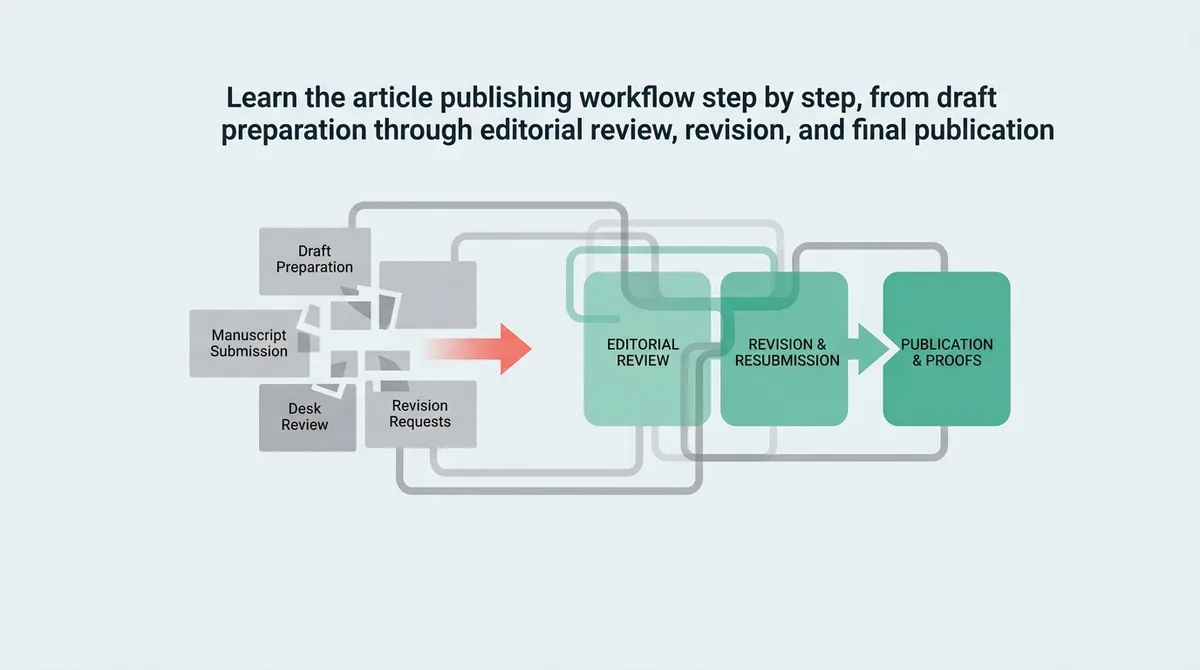
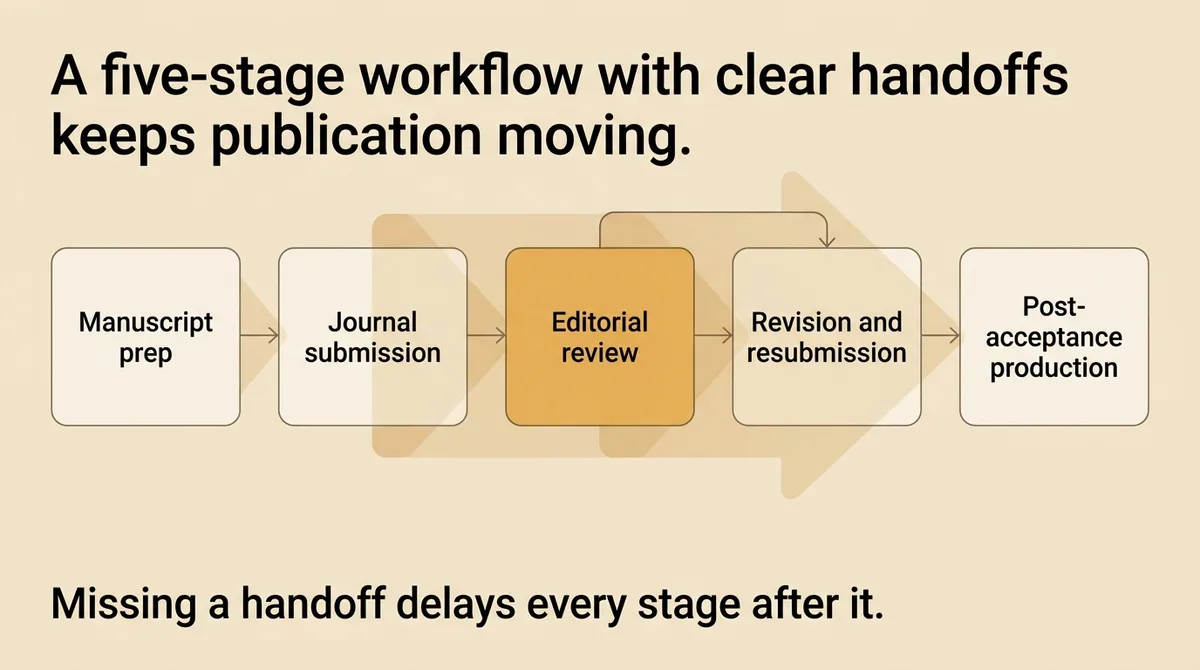
The workflow runs in five stages: manuscript preparation, journal submission, editorial review, revision and resubmission, and post-acceptance production. Each stage has a defined output and a handoff point. Missing one handoff delays all stages that follow it.
Stage One: Preparing Your Manuscript Before You Submit Anything
Manuscript preparation is a workflow stage. Most authors treat it as a formality.
That framing is the source of the most preventable delay in academic publishing. A researcher submits a 7,000-word empirical study to a journal whose stated scope is theoretical review. The desk rejection arrives 48 hours later. The author restarts the journal search, reformats references, adjusts the abstract word count, and loses two weeks before anything reaches a reviewer.
Journal selection shapes every stage that follows it. The scope match, the reference style, the figure resolution requirements, and the ethical compliance declarations all differ by journal. Getting these wrong before submission means getting them wrong again after rejection.
Choosing open access or subscription is a pre-submission decision, not an afterthought.
Over 600 journals are fully open access [1], which means the format choice is available at the point of journal selection. Authors who defer this decision until after acceptance often find themselves locked into a format that limits their article’s reach. That decision belongs in Stage One.
Use this checklist before you submit anything:
Preparation Item | What to Verify | Common Failure |
|---|---|---|
Title page | Author order, affiliations, corresponding author | Missing co-author sign-off |
Abstract | Word count matches journal limit | Over-length abstract triggers desk rejection |
References | Style matches journal guide (APA, Vancouver, etc.) | Inconsistent citation format |
Figures | Resolution at 300 DPI minimum | Low-res images flagged in production |
Ethical compliance | IRB approval number, conflict of interest statement | Missing declaration causes automatic hold |
Stop submitting until you have checked every row in that table. A missing conflict of interest declaration does not get flagged by a reviewer. It gets flagged by an editorial assistant before the manuscript reaches a desk editor, and it adds time with no scientific benefit.
The scope match is the most consequential pre-submission check. Read the aims and scope statement of your target journal. Then read the abstract of your manuscript. If the two do not match in subject, method type, and study scale, find a different journal before you submit.
What Actually Happens During Editorial Review and Why Most Authors Misread It
Editorial review has four possible outcomes: desk rejection, major revision, minor revision, or acceptance. Most authors know this list. Very few treat each outcome correctly when it arrives.
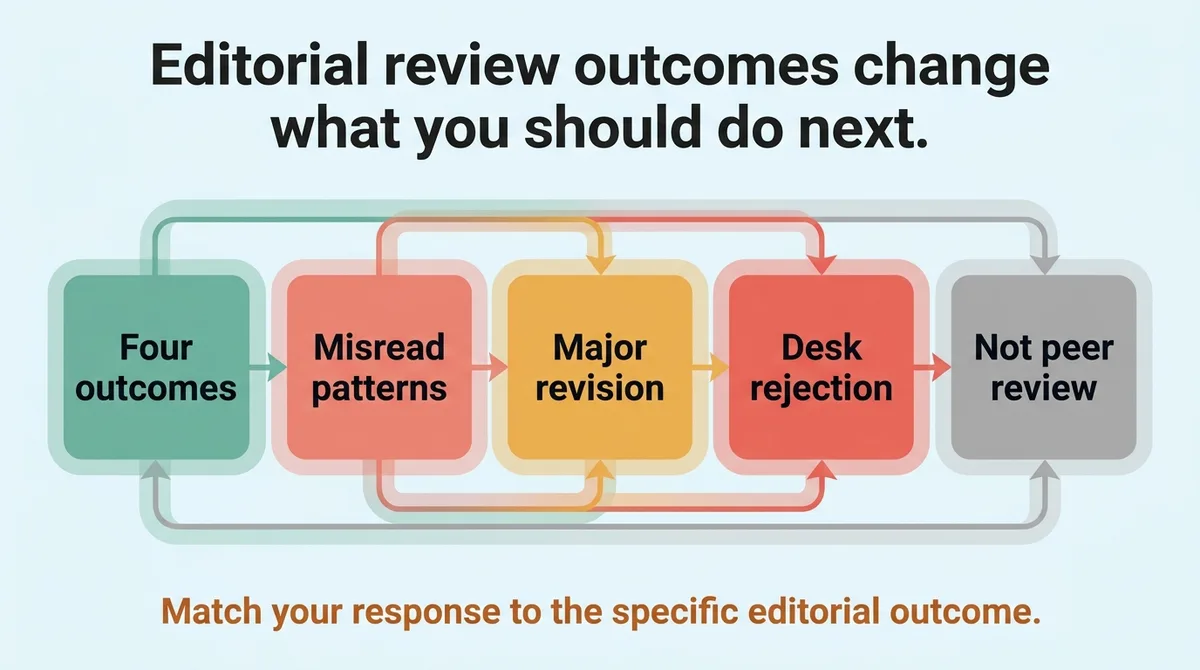
Stop treating major revision as a near-rejection. Start treating it as a conditional acceptance with conditions attached.
Desk rejection means the manuscript did not pass the editor’s initial screen, usually for scope, format, or obvious methodological problems. It is not peer review. Some publishers complete this screening within 48 hours of submission [2]. Authors who do not track their submission status miss this early signal and assume their work is under review when it has already been returned.
Major revision means reviewers found problems worth solving. It is the most common non-rejection outcome for manuscripts that pass desk review. Withdrawing a paper after a major revision decision and resubmitting it elsewhere restarts the entire clock. That costs a minimum of six weeks at the new journal before any reviewer sees the work. Authors who withdraw after major revision typically do so because they misread the feedback, not because the paper was wrong for the journal.
Minor revision means reviewers found small problems. Authors sometimes treat this outcome carelessly because it feels close to acceptance. Careless responses to minor revision requests produce a second review cycle that could have been avoided.
Silence during the review period usually means the manuscript is in queue. Journals manage dozens of concurrent submissions. A manuscript under review for four weeks is not failing. It is waiting. Authors who interpret silence as failure withdraw papers that were days from a decision.
The practical move during a long review window is a polite status inquiry to the editorial office, sent no earlier than four weeks past the journal’s stated average review time. One inquiry, not a series. Editors notice frequency.
The Revision and Resubmission Cycle: A Decision Path Most Guides Skip
Most revision guides tell authors to revise carefully and respond to reviewers. That advice skips the actual structure of a successful resubmission.
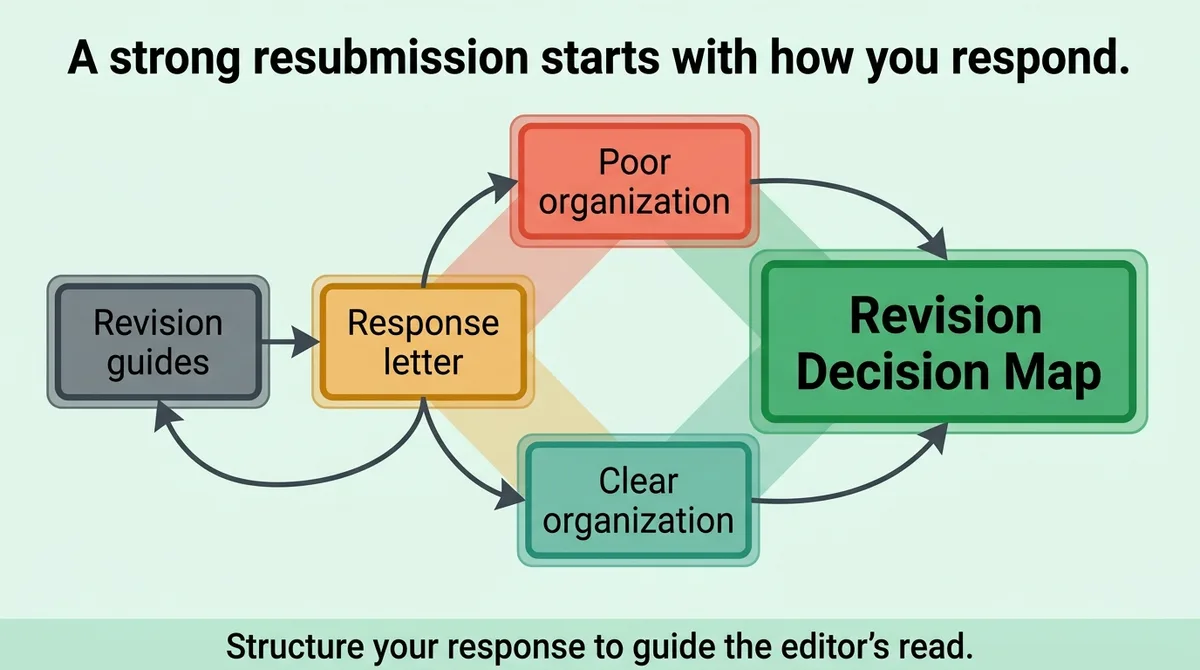
Editors often read the response-to-reviewers letter before they read the revised manuscript. A poorly organized response letter signals that the author did not engage with the feedback carefully. A well-organized letter signals the opposite, and it shapes how the editor reads the revision.
The Revision Decision Map is a structured approach to every reviewer comment. For each comment, the author makes one of three explicit decisions: accept the comment and revise accordingly, modify the comment’s premise and revise partially, or decline the comment with a written justification grounded in the manuscript’s method or scope.
Every comment gets a number. Every number gets a response. Every response cites the specific line or section where the change appears in the revised manuscript.
Here is the difference between a weak response and a structured one:
Element | Weak Revision Response | Structured Rebuttal |
|---|---|---|
Comment numbering | Not used | Reviewer 1, Comment 3 |
Response to accepted comment | “We revised this section.” | “We revised lines 214–219 to clarify X. See revised manuscript.” |
Response to declined comment | “We disagree.” | “We respectfully decline this revision because our study design does not permit X. See Section 2.1 for the rationale.” |
Manuscript cross-reference | None | Every change tied to a line or paragraph |
The blind spot most revision guides skip: authors edit their manuscript thoroughly but write their response letter in one sitting at the end. That sequence produces mismatches between what the letter claims was changed and what the manuscript actually shows.
Write the response letter in parallel with the revision. When you make a change, document it immediately. The letter should be a record of the revision process, not a summary written from memory.
Open access articles receive 1.6x more citations and 6x more downloads than subscription articles [1]. If format decisions were deferred at Stage One, the revision stage is the last point where authors can raise the open access question with the editorial office. Post-acceptance format changes are rarely available, and they carry higher processing fees when they are.
The Revision Decision Map also protects authors from reviewer overcorrection. Reviewers occasionally request changes that would shift the manuscript’s scope, contradict its stated method, or require data the study did not collect. The map gives authors a documented basis for declining those requests professionally. Editors expect some pushback. They do not expect authors to accept every comment without analysis.
Post-Acceptance Production, Compliance, and the Final Release Steps
Acceptance is not publication. The production stage sits between them, and it contains several author tasks with hard deadlines.
A concrete example: an author receives a proof review email four days after acceptance. The email requests corrections within five business days. The author sees it, marks it as something to handle later, and returns to it twelve days after the email arrived. The journal missed its production cycle. The article delayed by one full issue, which in a quarterly journal means three months.
That delay was not editorial. It was logistical.
Production tasks after acceptance follow a set sequence. Authors must complete each one within the specified window:
Proof review: Read the copyedited proof against your accepted manuscript. Check author names, affiliations, figure labels, and reference formatting. Flag errors in writing, not verbally. Return within the stated window.
Author order confirmation: Production staff confirm the author list against the submission record. If an order dispute exists, it must be raised at proof stage. Post-publication corrections to author order are time-consuming and require formal requests.
ORCID registration: Many journals now require a registered ORCID identifier for the corresponding author. Register before acceptance if possible. Delays at this step hold the record from populating correctly in indexing databases.
Licensing agreement: Open access articles require a Creative Commons license selection. Subscription articles require a copyright transfer agreement. Both require a signature from the corresponding author. Neither can proceed without it.
Embargo and preprint deposit: Some journals permit preprint deposit of the accepted manuscript before the version of record appears. Confirm the journal’s self-archiving policy at this stage, not after publication.
Open access articles carry an average Altmetric attention score of 4.9 versus 2.1 for subscription articles [1]. That difference reflects real-world attention from media, policy documents, and online discussion. Licensing decisions made at the proof stage directly affect whether that attention is possible.
The clarity built during the Revision Decision Map makes production smoother. A manuscript revised with numbered line references and consistent internal logic requires fewer copyediting interventions. Authors who revised carefully receive cleaner proofs. They also catch fewer errors at proof stage because fewer were introduced during revision.
The core lesson here — that most delay is logistical, not editorial — holds just as true outside academic publishing. Content teams hit the same wall: a good draft sits stalled because the CMS handoff, the formatting pass, or the internal link check becomes its own bottleneck. Zelitho is built around removing that exact gap for blog content specifically, running keyword research, drafting, and direct CMS publishing as one continuous step instead of a handoff between tools and people.
After proofs are returned and the licensing agreement is signed, the journal assigns a DOI and schedules the article for publication. Authors receive a publication confirmation. At that point, the workflow is complete.
Every stage has a next step, know yours before you submit
The publishing workflow does not stall because research is weak. It stalls because authors treat submission as the end of their active role.
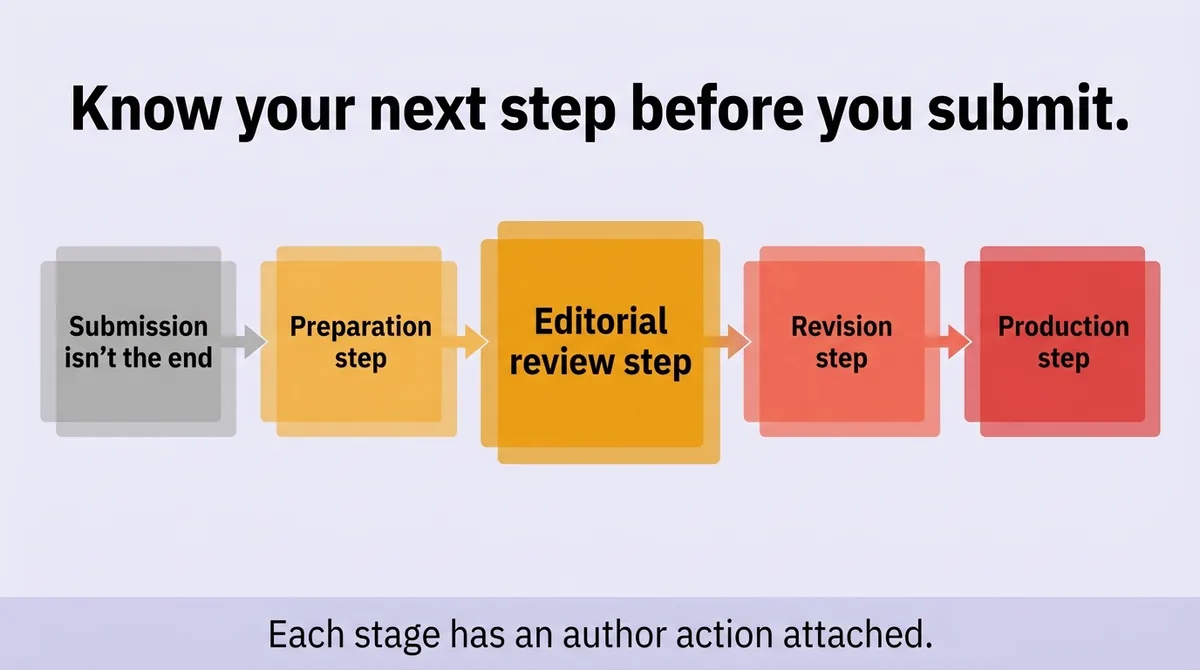
Each stage covered here, preparation, editorial review, revision, and production, has a specific author action attached. Preparation requires scope verification and file compliance. Editorial review requires status tracking and accurate decision interpretation. Revision requires the Revision Decision Map: numbered responses, parallel documentation, and explicit decisions on every comment. Production requires proof return, ORCID registration, license selection, and preprint deposit within stated windows.
The Revision Decision Map is the stage where most authors either recover or fall further behind. A structured rebuttal letter, written in parallel with the revision itself, is the single most reliable way to advance from major revision to acceptance without a third review cycle.
Know which stage you are in. Know the output that stage requires. Submit that output before the window closes.
References and Citations
[1]https://www.springernature.com/gp/authors/publish-an-article
[2]https://authors.wiley.com/author-resources/Journal-Authors/Publication/index.html
FAQ
The article publishing process runs in five stages: manuscript preparation, journal submission, editorial review, revision and resubmission, and post-acceptance production. Each stage has a defined output and a handoff point, and missing one handoff delays every stage that follows. The most commonly skipped stage is preparation, where scope mismatch, incorrect reference formatting, or missing ethical compliance declarations trigger desk rejections before any reviewer sees the work.
Authors should treat a major revision as a conditional acceptance with conditions attached, not as a near-rejection, and respond using a numbered comment-by-comment rebuttal letter written in parallel with the revision itself. For each reviewer comment, make one of three explicit decisions: accept and revise, partially accept with a modified premise, or decline with a written justification grounded in the manuscript’s method or scope. Writing the response letter from memory after finishing the revision is the most common mistake, and it produces mismatches between what the letter claims was changed and what the manuscript actually shows.
Articles stall in editorial review most often because authors misinterpret silence as failure, withdraw papers that were close to a decision, or treat major revision as rejection and restart the submission process unnecessarily. A manuscript under review for four weeks is typically in queue, not failing, and withdrawing it to resubmit elsewhere adds a minimum of six weeks at the new journal before any reviewer sees the work. The practical move during a long review window is one polite status inquiry to the editorial office, sent no earlier than four weeks past the journal’s stated average review time.
After acceptance, authors must complete proof review, author order confirmation, ORCID registration, licensing agreement signature, and preprint deposit decisions, each within the journal’s stated deadline. Missing a proof return window by even a few days can delay publication by a full issue cycle, which in a quarterly journal means a three-month delay. For teams managing high-volume blog or content publishing rather than academic journals, platforms like Zelitho handle the CMS handoff and publishing step inside the same workflow used for drafting, eliminating the equivalent logistical gap between content creation and live publication.
Open access articles receive 1.6 times more citations and 6 times more downloads than subscription articles, and they carry an average Altmetric attention score of 4.9 compared to 2.1 for subscription articles. This format decision should be made at the manuscript preparation stage, not deferred until after acceptance, because post-acceptance format changes are rarely available and carry higher processing fees when they are. The same principle applies in content marketing: format and distribution decisions made early in the workflow determine reach. Zelitho addresses this by building topic selection, optimization for AI search surfaces, and CMS publishing into one connected process so format and visibility choices are not left to a separate manual step after content is already drafted.