
What is research to publish automation for blog content?

TL;DR
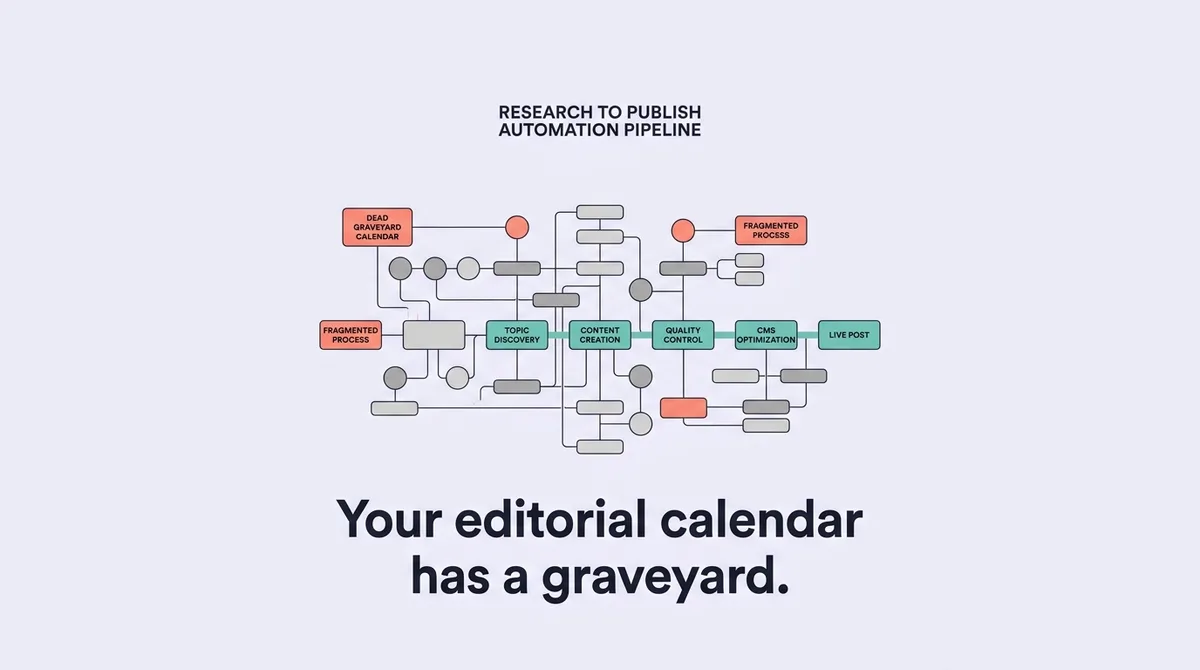
Your editorial calendar has a graveyard. ChatGPT drafts sit in Google Docs. A freelancer submitted copy three weeks ago. Your CMS has four posts in “draft” status with no publish date. The blog has not moved in 90 days.
The usual fix is more tools: another AI writer, another content brief template, another Slack reminder to the team. Each tool adds a handoff. Each handoff adds delay. The process fragments further.
Research to publish automation is a connected five-stage pipeline that moves a post from seed keyword to live article without manual translation between stages. Human review happens at two defined checkpoints only. Content and marketing leads at B2B SaaS companies and agency operators managing multiple client blogs use this system to hit consistent output without compounding their workload.
What does research to publish automation actually mean?
Research to publish automation is a structured pipeline where keyword data, brief generation, draft production, SEO optimization, and CMS publishing connect in sequence. Each stage outputs a structured file that the next stage reads directly. No human manually translates work from one tool to another. The system runs continuously, with human review placed at defined checkpoints rather than distributed across every step.
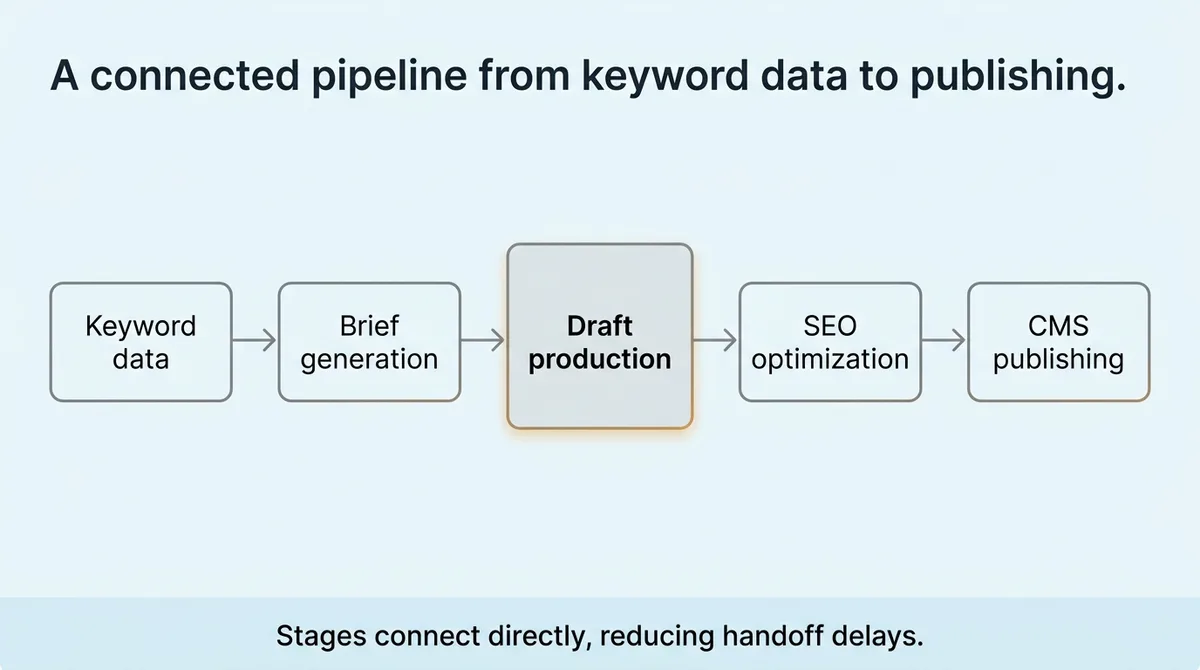
The five-stage pipeline that replaces your scattered content process
Picture this: it is Tuesday morning. You open your content tracker and see six rows with the status “in progress.” Two have been there for five weeks. One freelancer is waiting on a brief. One brief is waiting on keyword approval. Nothing is blocked by complexity. Everything is blocked by handoffs.
That is not a capacity problem. That is a process architecture problem.
The Research-to-Publish Pipeline solves it by treating blog production as a single connected system, not a collection of separate tasks. It runs across five stages [1], each passing a structured output directly to the next stage.
This article is not a list of AI writing tools. It is a blueprint for connecting those tools into one workflow where output flows forward without human translation at every joint.
Automated keyword tools refresh topic data every few minutes [1], which means the first stage of the pipeline feeds itself. The system does not wait for a marketing manager to pull a keyword report on Monday morning.
Stage | Input | Output | Automation Level |
|---|---|---|---|
Topic Discovery | Seed keyword, domain | Keyword clusters, prioritized topics | Full |
Brief Generation | Topic cluster, SERP data | Structured content brief | Full |
Draft Production | Brief, word count tier | Raw article draft | Full |
Optimization Review | Draft, SEO targets | Scored and edited draft | Semi (human checkpoint) |
Publishing Orchestration | Approved draft | Live post, indexed | Semi (human checkpoint) |
Each stage reads the previous stage’s output. No reformatting. No copy-pasting between tabs. No briefing a freelancer over email and waiting for questions.
Stop managing tools separately. Start treating your content workflow as one file that moves forward.
You probably believe automation kills quality, here is why that assumption breaks the workflow before it starts
The assumption sounds reasonable: if a machine writes the draft, the output will be generic and the brand voice will disappear.
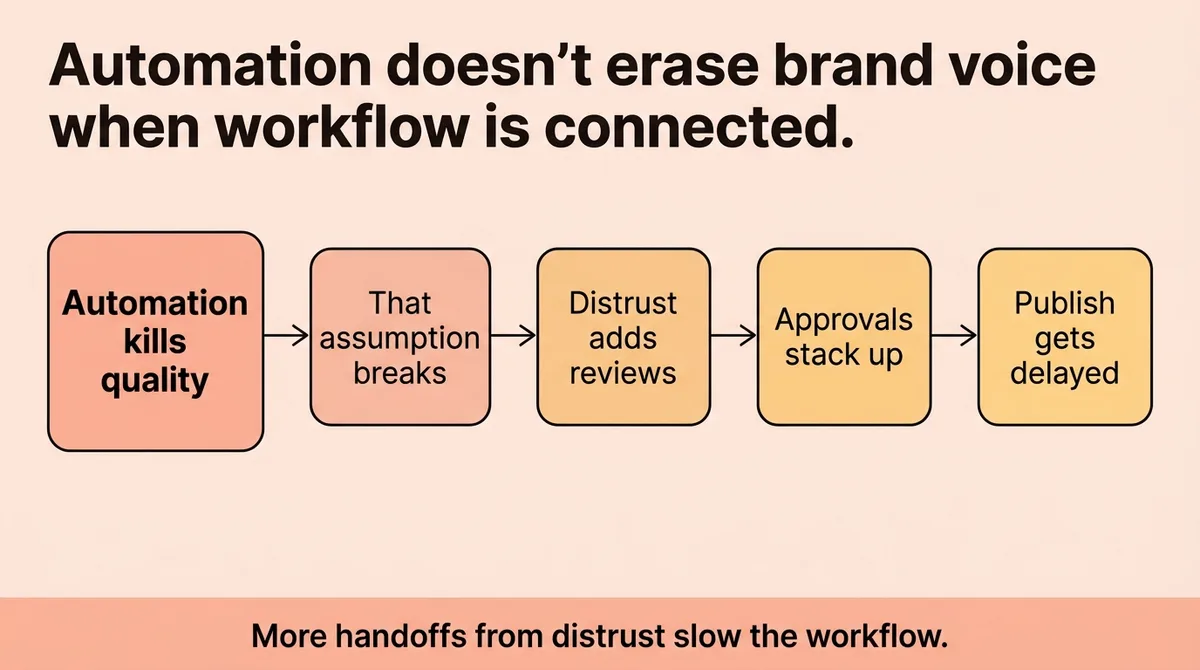
That assumption is false. Believing it causes a specific, measurable mistake.
Teams that distrust automation insert human review at every stage. A manager approves the keyword. A senior writer reviews the brief. The same writer reviews the outline. A second editor reviews the draft. The same editor approves the SEO changes. A third person pushes publish.
That process is slower than fully manual writing. It also produces no quality advantage, because reviewers at each step assume someone else caught the real problems.
43% of blog management tasks can be automated without quality loss [1]. The remaining 57% does not need manual review at every sub-step. It needs human judgment at defined decision points.
A team producing 50 blog posts in two months [1] does not do it by reviewing every paragraph. They place human review at brief approval and final edit only [1]. Everything between those two checkpoints runs automatically.
The contrast is direct:
Indiscriminate review model: Human touches every stage. Output slows to the speed of the slowest reviewer. Quality inconsistency comes from reviewer fatigue, not from automation.
Checkpoint review model: Human approves the brief before drafting begins. Human reviews the final draft before publish fires. Automation handles the steps between. Output scales. Quality stays consistent because the brief defines the standard.
Automation does not reduce quality. Distributed, unstructured human interruption does.
How research and topic discovery feed the draft without human translation in between
A single seed keyword, run through an automated clustering tool, surfaces over 200 long-tail variations [1]. That is not a list to review manually. That is a structured dataset the system uses to generate briefs.
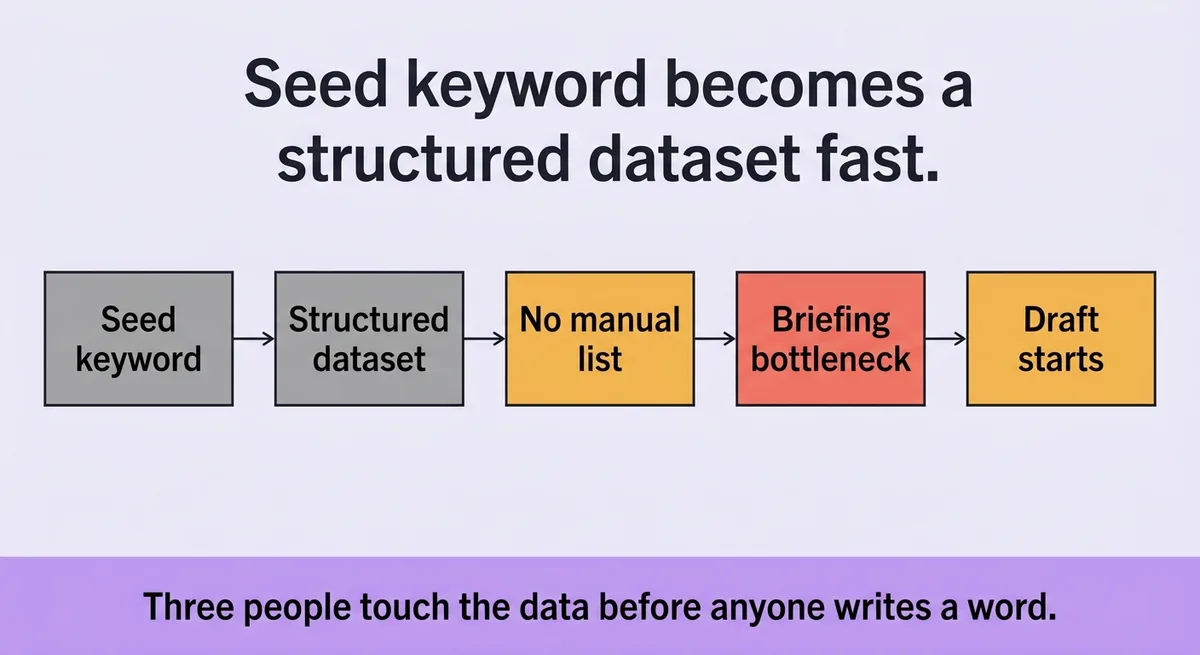
This is where most teams lose time. They export a keyword list into a spreadsheet, send it to a strategist, wait for the strategist to group topics by intent, then brief a writer. Three people touch the data before anyone writes a word.
The Research-to-Publish Pipeline removes those three handoffs. Keyword clusters feed directly into a brief template. The template populates automatically per topic. No strategist translates data into direction.
What the automated brief must contain:
That last item matters structurally. The pipeline runs a pillar-cluster architecture. Pillar pages run 3,000 to 5,000 words [1] and benchmark against 3,000-word resources already ranking [1]. Cluster articles run 1,500 to 2,500 words [1] and benchmark against 1,500-word explorations in the same SERP [1]. Supporting micro-posts run 800 to 1,200 words [1]. Each pillar supports 8 to 15 satellite articles [1].
The brief template knows which tier a topic belongs to. It sets word count, internal link requirements, and competitive benchmarks automatically.
- Target keyword and search intent classification
- Word count tier based on content architecture
- Internal link targets from existing published posts
- Competing content signals from current SERP
- Pillar or cluster designation
Teams configure the brief template once. The system populates it per topic, per tier, every time.
The draft prompt reads directly from that brief. No writer opens a document and interprets a strategy doc. The brief is the prompt. The prompt produces a draft that already targets the right keyword, the right intent, and the right length.
One content team spent six weeks producing 12 articles before discovering that half the briefs had misaligned search intent. The keyword data was correct. The manual translation step introduced the error. They removed the manual briefing step, ran briefs directly from clustered keyword data, and re-ran the same 12 topics cleanly in under two weeks.
Intent drift came from manual briefing. Automating the brief-from-cluster step dropped rework to near zero on the next production cycle.
Publishing orchestration and the exact checkpoints where a human must stay in the loop
The back half of the pipeline is where most operators feel least confident. Publishing feels like the moment where something can go very wrong while no one is watching.
That worry is valid. It resolves with checkpoint design, not with manual oversight of every step.
Publishing orchestration covers five automated actions: SEO scoring against target benchmarks, metadata population (title tag, meta description, OG fields), internal link insertion based on the existing content map, CMS scheduling to the approved calendar slot, and post-publish indexing pings to Google Search Console.
None of those five steps require a human. They require a correctly structured draft as input. The structured draft comes from a brief that a human approved before drafting began.
That is the first mandatory checkpoint: brief approval before drafting starts.
The second mandatory checkpoint: final review before the publish trigger fires.
These two checkpoints are not optional. Removing either one creates a specific failure mode.
Skip brief approval, and the system drafts at scale around the wrong intent. 50 articles drafted on misaligned briefs [1] means six weeks of production that needs full reconstruction. That is not a hypothetical. It is a measurable consequence of removing the first checkpoint.
Skip final review, and metadata errors, tone issues, or factual gaps go live without a filter. A single published article with a significant error costs more time to correct than the review would have taken.
The two checkpoints take under 20 minutes combined per article at standard review pace. Everything else in the pipeline runs without waiting.
Producing 50 blog posts across two months [1] becomes operationally realistic when human time concentrates at exactly two moments per post. Distributed across 50 articles, that is roughly 16 hours of focused human review, total. The rest of the production time is pipeline run time.
The Research-to-Publish Pipeline also closes a loop that most content teams ignore. After a post publishes, performance data (rankings, click-through rate, time on page) feeds back into the topic discovery stage. Topics that perform signal which clusters to expand. Topics that stall signal which content tiers to adjust. The system improves its own topic prioritization over time without a quarterly strategy session.
How the Research-to-Publish Pipeline compounds output without compounding effort
Most content operations scale linearly. More posts require more writers, more editors, more project management time. Output grows, but so does overhead.
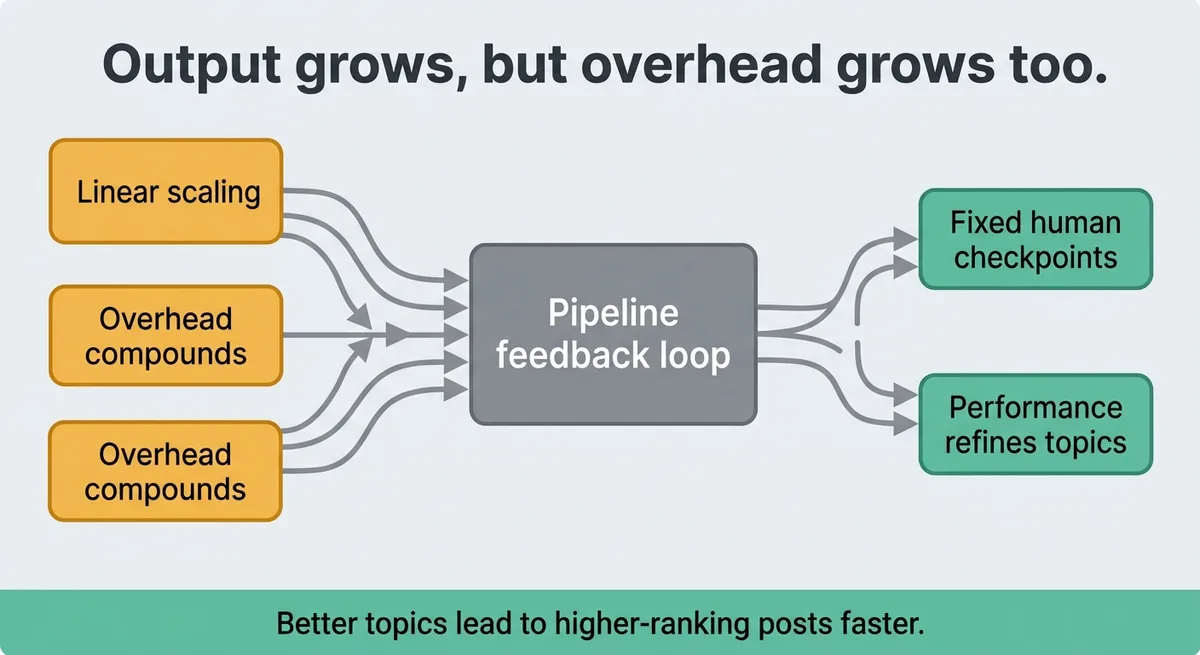
The Research-to-Publish Pipeline breaks that ratio. Each stage feeds the next using structured data. Human time stays fixed at two checkpoints per post. Pipeline run time is not human time.
The compounding effect comes from the feedback loop. Published performance data refines topic selection. Better topic selection produces higher-ranking posts faster. Higher-ranking posts generate more internal link targets for future cluster articles. The pipeline gets more efficient with every production cycle.
Stop treating automation as a tool to bolt onto your existing process. Build the process around the Research-to-Publish Pipeline from the start. Your next 50 posts can ship in two months with two human checkpoints each.
FAQ
What is research to publish automation for blog content?
Research to publish automation is a connected pipeline where keyword discovery, brief generation, draft production, SEO optimization, and CMS publishing flow in sequence without manual handoffs between each stage. Each stage produces a structured file the next stage reads directly, so human review concentrates at two defined checkpoints rather than being scattered across every step. Platforms like Zelitho are built around this exact model, connecting topic selection through to live publishing inside one system instead of requiring separate tools for each phase.
How do you automate research for blog articles without losing quality?
You automate blog research without losing quality by placing human review at exactly two checkpoints: brief approval before drafting begins, and final review before the publish trigger fires. A single seed keyword feeds an automated clustering tool that surfaces 200-plus long-tail variations, which populate a structured brief automatically, removing the manual translation step where intent drift most often occurs. Zelitho applies this structure by running clustered topic selection, title and scope confirmation, and research-backed draft generation as a single connected sequence, so quality is enforced at the brief level rather than through reviewer fatigue at every stage.
What are the biggest bottlenecks in a blog content production workflow and how do you fix them?
The biggest bottlenecks in blog production are handoffs between stages, not the stages themselves: a freelancer waiting on a brief, a brief waiting on keyword approval, a draft waiting on an editor who assumes someone else already reviewed it. These handoffs cause posts to stall in draft status for weeks despite no complexity blocking them. The fix is a pipeline architecture where each stage outputs a structured file the next stage reads directly, with human judgment applied only at brief approval and final review, not distributed across every sub-step.
How many blog posts can a small team realistically publish per month using content automation?
A small team using a connected research-to-publish pipeline can realistically produce 50 blog posts in two months, roughly 25 per month, by concentrating human time at two checkpoints per article rather than reviewing every stage. Across 50 articles at under 20 minutes of combined human review per post, total focused human time is approximately 16 hours for the full batch. The key condition is that the pipeline handles keyword clustering, brief population, draft generation, SEO scoring, and CMS scheduling automatically, with humans approving the brief and reviewing the final draft only.
What should an automated content brief include for SEO-focused blog articles?
An automated content brief for SEO-focused articles must include the target keyword and search intent classification, a word count tier matched to content architecture, internal link targets from already-published posts, competing content signals pulled from the current SERP, and a pillar or cluster designation. The word count tier is not arbitrary: pillar pages run 3,000 to 5,000 words, cluster articles run 1,500 to 2,500 words, and supporting micro-posts run 800 to 1,200 words, with each pillar supporting 8 to 15 satellite articles. When briefs are populated automatically from clustered keyword data rather than written manually, intent drift drops to near zero because no human translation step sits between the data and the draft prompt.
References and Citations
[1]https://sedestral.com/en/blog/automating-blog-management-with-ai