
What is research-backed content, and why can it improve search visibility?

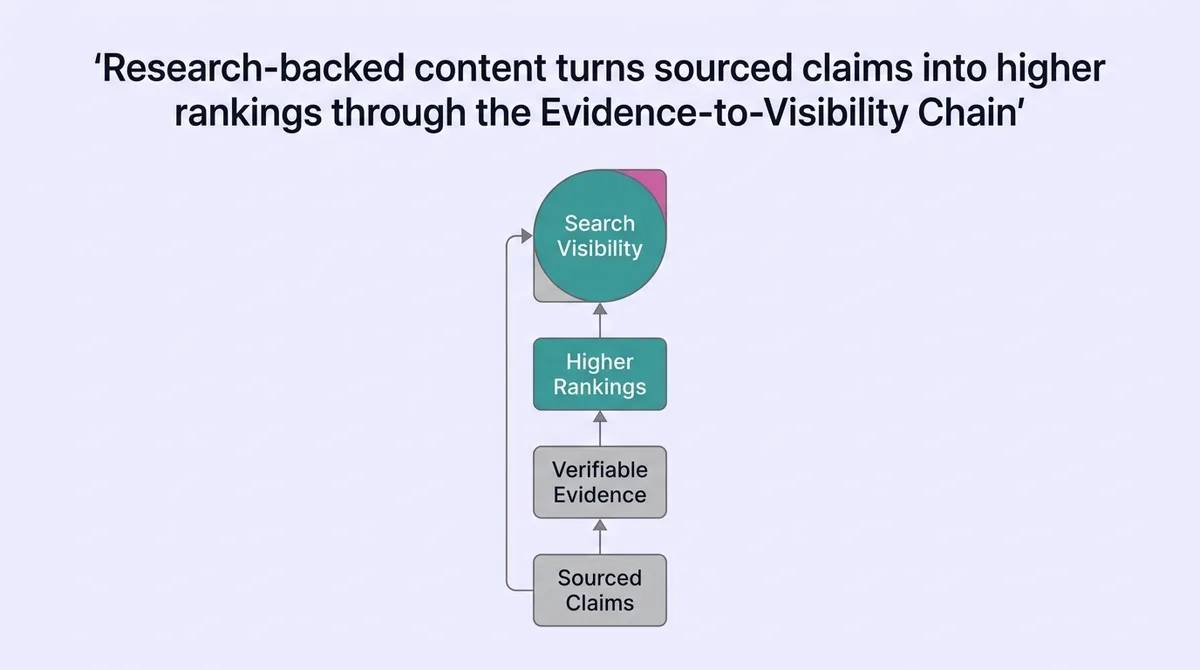
TL;DR
Your blog tab has been open for six days. The draft is there. The ChatGPT output is there. The freelancer’s Google Doc is there. None of it has shipped.
The common fix is to add more sources, write longer posts, or hire another writer. That produces longer drafts that still do not ship. When they do ship, they compete poorly against pages built on verifiable evidence. Length without source depth does not move rankings.
This article defines research-backed content precisely, then maps the mechanism that connects source quality to search visibility. That mechanism is called the Evidence-to-Visibility Chain. It runs from claim structure through behavioral signals to ranking outcomes. Content teams managing stalled pipelines and agency operators running thin margins will find a direct framework here, not a checklist of vague improvements.
What research-backed content actually is , and what it is not
Stop treating citation volume as proof of credibility. Start treating source type as the actual signal.
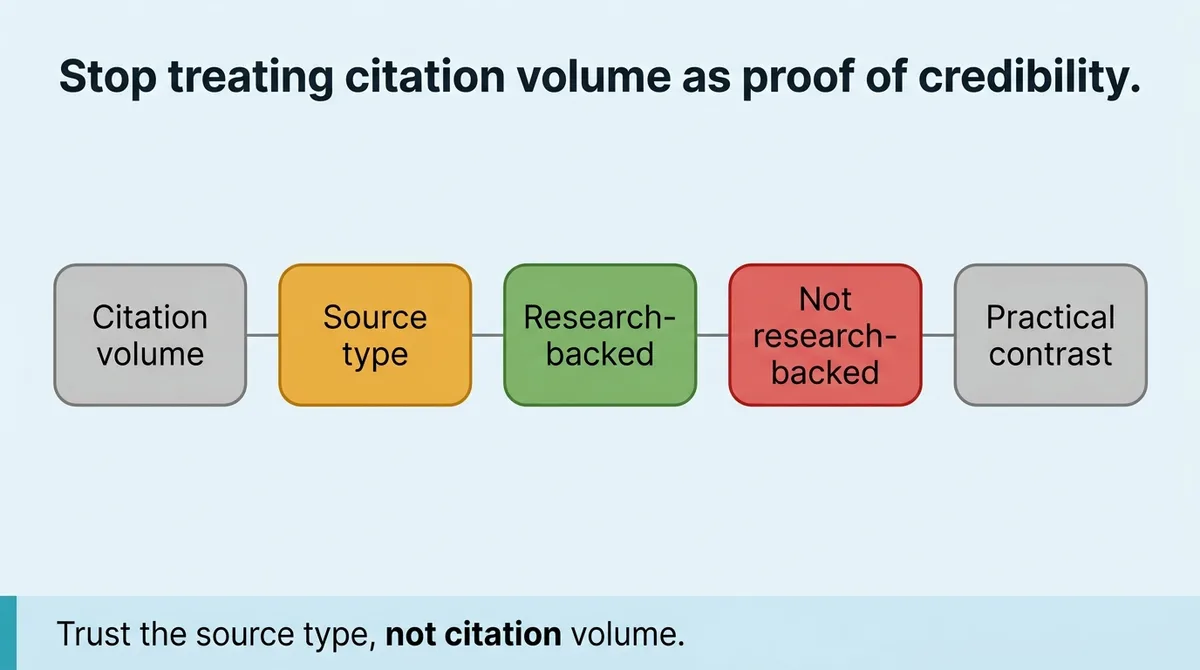
A piece earns the label “research-backed” only when its claims trace back to an original data source. A statistic without a named study, a quoted figure without a linked dataset, a numbered list dressed in confident language: none of these qualify.
Here is the contrast that matters in practice:
| Dimension | Research-Backed Content | Opinion-Led Content |
|---|---|---|
| Source type | Primary: study, dataset, institutional report | Secondary: blog, summary article, trade press |
| Claim structure | “Study X found Y in population Z” | “Most experts agree that…” |
| Reader trust response | Extended engagement, return visits, citations | Skim, exit, no link acquisition |
The publishing infrastructure to support this exists at scale. Worldwide science and engineering output reached 3.3 million articles in 2022 [2]. Content teams that skip primary sources are not working around a shortage. They are making a choice.
The first link in the Evidence-to-Visibility Chain is source selection. Every factual sentence in a published piece should have a clear answer to one question: what primary source supports this claim? If the answer is “another article said so,” the chain breaks before it starts.
One implementation caveat worth noting: a primary source must also be relevant. Citing a clinical pharmacology paper to support a SaaS marketing claim creates the appearance of rigor without the substance. Relevance and recency both factor into how readers and search systems evaluate source strength.
Why search systems and readers respond to evidence the same way
Search systems do not read content the way humans do. They read behavior. Time on page, return visits, and inbound links are all behavioral outputs produced when readers find material credible and useful.
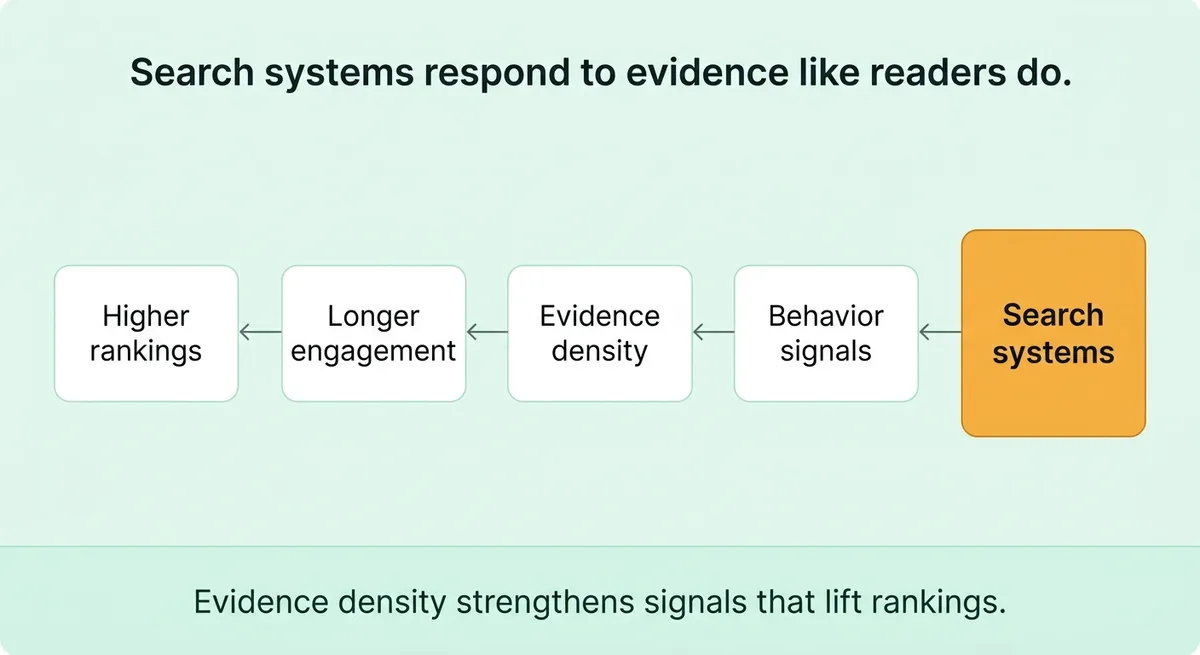
This is not two separate problems. Reader trust and search ranking improvement share the same input: evidence density. When content cites real, relevant sources, readers engage longer. Longer engagement strengthens the behavioral signals that search systems measure. Stronger signals push pages up. Higher-ranked pages attract more qualified readers, who engage longer still.
That cycle is the Evidence-to-Visibility Chain in motion.
Over 50% of traffic to academic publishing platforms originates from search engines [1]. Even highly specialized, evidence-dense material depends on search for reach. That figure reframes the common assumption that rigorous content finds its audience through professional networks alone. It does not. Search is the primary distribution mechanism even for evidence-heavy material.
The broader connection between content quality and discoverability infrastructure holds at the brand level too. Research identifies four main SEO components as drivers of online brand positioning [3]. Content credibility is not separate from SEO strategy. It is embedded in how search systems infer authority from the pages they rank.
The hidden worry underneath most stalled content pipelines is this: “Our writing is solid. Our topics are relevant. Why aren’t we ranking?” The answer is often that a competitor is publishing denser, better-sourced material on the same queries, and the behavioral gap is compounding quietly each quarter.
The cost of publishing without evidence: what you are silently competing against
Opinion-led content and evidence-dense content compete in the same index. Search systems do not separate them by intent. They rank them against each other.
When two pages target the same query, topical depth and source signals act as tiebreakers. A well-written post with no primary sources loses that tiebreak to a moderately written post with three cited studies. This is not catastrophic in one quarter. It is quiet and cumulative, which makes it harder to diagnose.
Here is a directional consequence with real shape: a content team publishing ten articles per quarter without primary sources may see flat or declining organic impressions within two to three quarters. Indexed pages with stronger evidence profiles displace them on overlapping queries. The team sees traffic plateau and assumes the topic is exhausted. The topic is not exhausted. The credibility gap is widening.
Content marketing reach scales significantly when credibility is present. One benchmark places the visibility reach of credible content marketing at 97% [4]. That figure represents the upper range of what sourced, distributed content can achieve in competitive markets. Evidence-light content does not access that range.
Structure also matters at the sentence level. Placing key phrases within the first 50 to 70 characters of a title is a structural signal search systems use to evaluate query alignment [2]. Research-aligned content satisfies this naturally because its titles are precise. A title built around a specific study or dataset is inherently more specific than a title built around a vague category.
The audit move here is simple. Pull your last five published pieces. For each core factual claim, identify whether it links to a primary source or a secondary blog. That ratio predicts your competitive position on overlapping queries more accurately than word count, publish frequency, or topic breadth.
A common piece of guidance says to write longer content for better rankings. That guidance is incomplete. Length without evidence density does not close the credibility gap. A 3,000-word post built on secondary sources loses ranking ground to a 1,200-word post built on three cited studies and precise title structure.
Five visibility levers that research-backed content activates
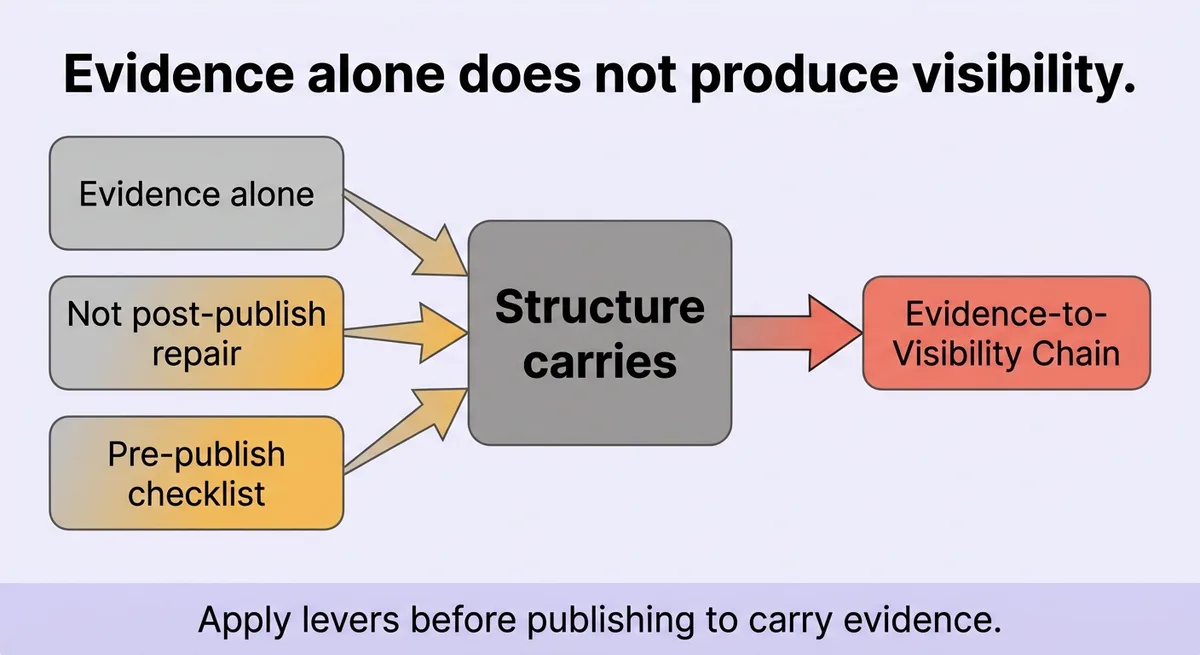
Evidence alone does not produce visibility. Structure carries the evidence to the right readers at the right moment. The Evidence-to-Visibility Chain runs through five specific levers. Apply at least three before publishing. Treat this as a pre-publish checklist, not a post-publish repair.
Lever 1: Title precision
Recommended article title length is 8 to 10 words [1]. That constraint forces specificity. A title with 8 to 10 words cannot be vague. It names a subject, a scope, and often a source type. Evidence-led framing produces this precision naturally because the subject is the finding, not the category.
Lever 2: Keyword integration depth
Placing keywords three to six times in an abstract or opening section mirrors how search systems scan for topical relevance [1]. This is not keyword stuffing. It is alignment between the density of a topic’s treatment and the signal search systems use to classify page relevance. Evidence-rich content achieves this because it returns to its central claim repeatedly, through different data points.
Lever 3: Author and source profile consistency
Consistent author profiles across Google Scholar, ORCID, LinkedIn, and ResearchGate build the authority signal that supports content discoverability over time [2]. For agency operators managing multiple client blogs, this means setting up and linking these profiles once per client, then keeping them current. A byline with no professional profile behind it carries less authority than a byline connected to a consistent publication record.
Lever 4: Visual evidence
Charts, data tables, and figures drawn from cited sources create additional discovery pathways. Google Images functions as a separate discovery channel for content with strong visual data representations [2]. A table showing study results or a chart drawn from a cited dataset earns index placement that a text-only post does not. Visual evidence also reduces the cognitive load on readers scanning quickly, which shortens time-to-comprehension and increases the likelihood of a return visit.
Lever 5: Distribution across content versions
Sharing preprints, postprints, and final versions of content across repositories extends indexed reach without duplicate-content risk [2]. For blog content teams, this translates to distributing structured summaries, data excerpts, and linked references across platforms where different reader segments search. A LinkedIn post linking to the primary source, a newsletter excerpt citing the dataset, and the full article on the blog create three indexed touchpoints from one piece of evidence-backed work.
One content team applied levers one, two, and four to a single article rewrite. They replaced vague category framing with a title built around a specific benchmark, integrated the primary keyword into the opening three paragraphs, and added two data tables from cited studies. Organic impressions on that URL increased within six weeks, with no change to the publish date or link profile.
Evidence first, then structure, then visibility , in that order
The Evidence-to-Visibility Chain is a sequence, not a set of parallel options. Source quality determines what claims can be made. Claim precision determines what titles and structures become possible. Structure determines which behavioral signals accumulate. Behavioral signals determine ranking outcomes.
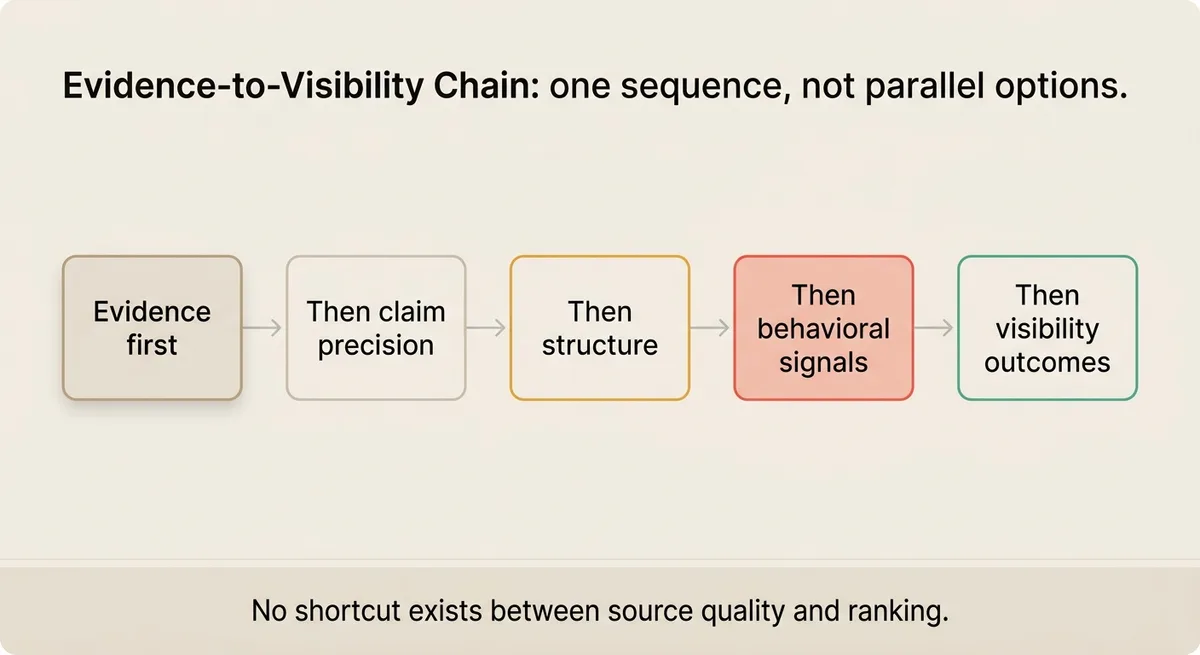
Skipping the first step and applying levers two through five to opinion-led content does not produce the same result. Search systems infer credibility from behavior. Behavior reflects reader response to actual evidence. No shortcut exists between source quality and ranking outcome.
For content teams managing stalled pipelines, the first move is not a new tool or a new freelancer. It is an audit of source quality across existing drafts. For agency operators running thin margins across multiple client blogs, the leverage point is a replicable source-selection step built into the brief, not added as a revision after the draft arrives.
The Evidence-to-Visibility Chain gives both operators a named sequence to follow, check, and repeat. Start with the primary source. Build the claim from there.
References and Citations
[1]https://www.wiley.com/en-us/publish/editor-insights/enhance-your-article-s-visibility-a-guide-to-seo/
[2]https://www.cureusjournals.com/blog/top-10-tips-for-boosting-article-visibility-on-google
[3]https://pmc.ncbi.nlm.nih.gov/articles/PMC11066527/
[4]https://bima.co.uk/how-content-marketing-boosts-brand-visibility-in-competitive-markets/
FAQ
Yes, citing primary sources improves search rankings indirectly but measurably by increasing reader engagement, which generates the behavioral signals search systems use to evaluate page authority. When content links to real studies and datasets rather than secondary blog summaries, readers stay longer, return more often, and are more likely to link back, all of which compound into ranking gains. A moderately written post with three cited studies consistently outperforms a well-written post with no primary sources on overlapping queries because the behavioral gap widens each quarter.
The Evidence-to-Visibility Chain is a four-step sequence where source quality determines claim precision, claim precision enables better title and page structure, structure accumulates behavioral signals, and behavioral signals drive ranking outcomes. It is a strict sequence, not a menu of parallel options: skipping source selection and applying structural tactics to opinion-led content does not produce the same result. The chain breaks the moment a factual claim cannot be traced to a named primary source.
Strong writing quality alone does not close the credibility gap when a competitor is publishing denser, better-sourced content on the same queries. Search systems rank pages against each other on the same index regardless of content type, and topical depth plus source signals act as tiebreakers that writing polish cannot override. The diagnostic move is to audit your last five published pieces and check whether each core factual claim links to a primary source or a secondary blog, because that ratio predicts competitive position more accurately than word count or publish frequency. Platforms like Zelitho address this at the workflow level by generating research-backed drafts with citations built in before the article reaches the editing stage, which removes the most common point where source quality is skipped.
The five visibility levers are title precision (8 to 10 words built around a specific finding), keyword integration depth (3 to 6 appearances in the opening section), author and source profile consistency across platforms like Google Scholar and LinkedIn, visual evidence such as data tables and charts from cited sources, and distribution of content versions across multiple indexed touchpoints. Apply at least three before publishing rather than treating them as post-publish repairs. Zelitho builds several of these levers, including structured title planning and research-backed draft generation with citations, directly into its workflow so teams do not have to layer them on manually after the draft exists.
Pull your last five published pieces and, for each core factual claim, identify whether it links to a primary source such as a study or dataset, or a secondary source such as another blog. That source ratio predicts your competitive position on overlapping queries more reliably than word count, publish frequency, or topic breadth. A content team publishing ten articles per quarter without primary sources can expect flat or declining organic impressions within two to three quarters as indexed pages with stronger evidence profiles displace them on shared queries.