
What Is Organic Social Media Content? A Clear Definition and How It Differs From Paid Social

TL;DR
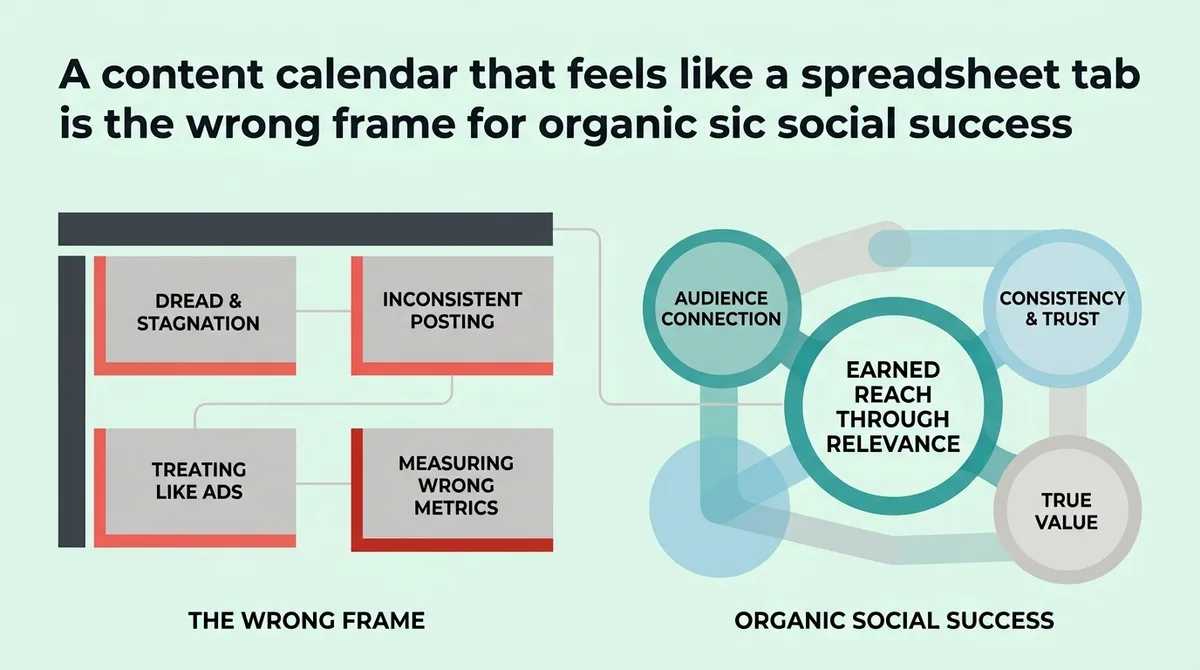
You opened the CMS this morning, saw the last post dated nine weeks ago, and felt the specific dread of a content calendar that exists only as a spreadsheet tab.
Most teams treat organic social as a free version of paid ads. They post when they have something to promote, measure it against paid metrics, and conclude it doesn’t work. That framing is the problem. Organic content operates on a different mechanism entirely, one built on consistency, relevance, and audience behavior over time.
This article defines organic social clearly, explains how unpaid reach actually moves through a platform, and gives you a side-by-side comparison with paid social. Whether you manage one brand’s content or twelve client accounts, the framework here helps you assign the right approach to the right goal before you write a single word.
What does organic social media content mean?
Organic social media content is any post you publish on a social platform without paying to distribute it. It reaches people through follows, shares, algorithmic discovery, and direct searches on the platform itself. No ad budget moves it. Its reach depends entirely on how the platform scores its relevance to your audience.
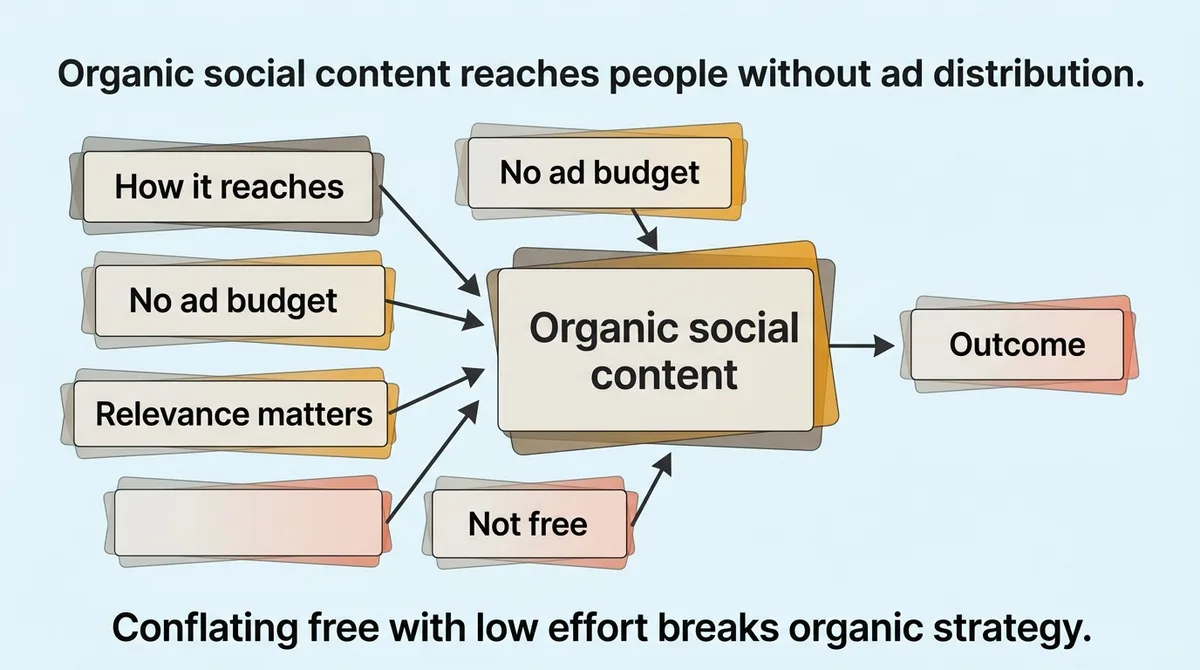
This is not the same as free. Organic content costs time, creative effort, and consistent execution. The distinction matters because conflating “free” with “low effort” is exactly what stalls most content programs.
The Plain Definition: What Organic Social Media Content Actually Means
Organic content is anything you post without a paid promotion attached to it. A product update on LinkedIn, a behind-the-scenes video on Instagram, a reply thread on X: all of these are organic if no budget is pushing them toward a wider audience.
The reach comes from three sources: your existing followers, the people who share your post, and the algorithm’s decision to surface your content to users who don’t yet follow you. That third source is where most people lose clarity.
Around 74% of consumers trust social media to guide purchase decisions [2]. That trust is built through consistent, credible posting over time. Not through a single campaign. Organic content is the mechanism that earns that trust, because it shows up repeatedly without the visual marker of a sponsored label.
One false assumption worth correcting early: organic reach is not dying. It is becoming more selective. Platforms reward content that generates fast engagement signals, holds attention longer than average, and prompts saves or shares. The content that “doesn’t reach anyone” usually lacks one of those three qualities, not a budget line.
Stop blaming the algorithm for low reach. Start asking whether your content gives people a reason to share it in the first 10 seconds.
Sixty percent of consumers say they are more likely to buy after seeing a product or service on social media [2]. That statistic does not specify paid or organic. It measures exposure. Organic content creates that exposure for a fraction of the cost, provided it earns the platform’s distribution.
How Unpaid Reach Works and Why Most People Misread the Algorithm
Organic reach does not flow randomly. Every major platform uses a scoring system that evaluates how quickly a post earns engagement after publishing, how long people spend with it, and whether they take a secondary action like saving or sharing.
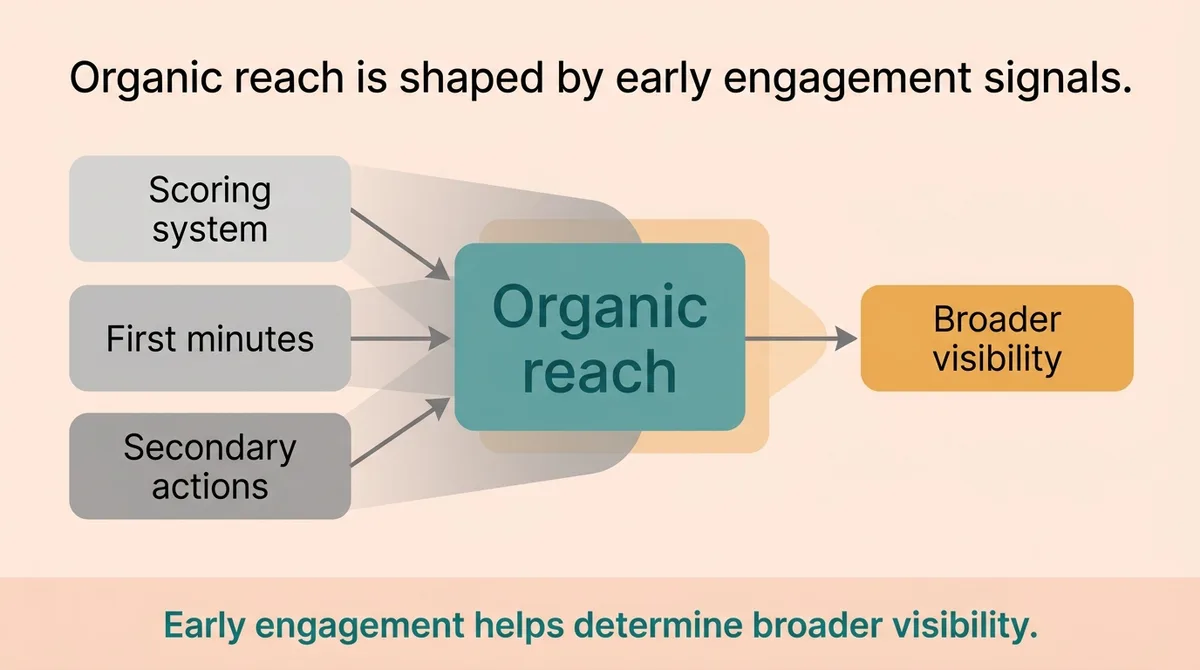
Post timing matters because the algorithm uses your first 30 to 60 minutes of engagement as a signal. A post that earns 20 comments in the first hour tells the platform this content is worth showing more broadly. A post that earns 2 comments in four hours gets suppressed, regardless of how much effort went into creating it.
Eighty-four percent of social media users access platforms via mobile devices [3]. That single fact changes how you should format organic content. Long text blocks, horizontal video, and small font graphics all perform worse on mobile. Organic reach drops when people scroll past without stopping. The format decision is a distribution decision.
Here is the practical consequence: teams that spend six hours per week on social content [3] but format everything for desktop are burning that time for minimal distribution. The content exists. The reach doesn’t follow.
Most misreads of the algorithm come from one bad habit: comparing two posts with different formats or different posting times, then drawing conclusions about content quality alone. Organic reach is a system with multiple inputs. Changing one variable at a time reveals what’s actually driving distribution.
A sharper way to think about it: organic reach is a score your content earns, not a reward your account deserves. The platform does not know or care that you spent three hours on a graphic. It measures what the audience does in the first window after you post.
The correction is straightforward. Track engagement rate by post format. Track average watch time or scroll depth if your platform provides it. Then shift budget toward the formats that score highest, even if those formats feel less polished.
Organic vs Paid Social: A Side-by-Side Breakdown That Clarifies the Real Difference
Organic and paid social are not two versions of the same strategy. They serve different goals, operate on different timelines, and fail in different ways when misapplied.
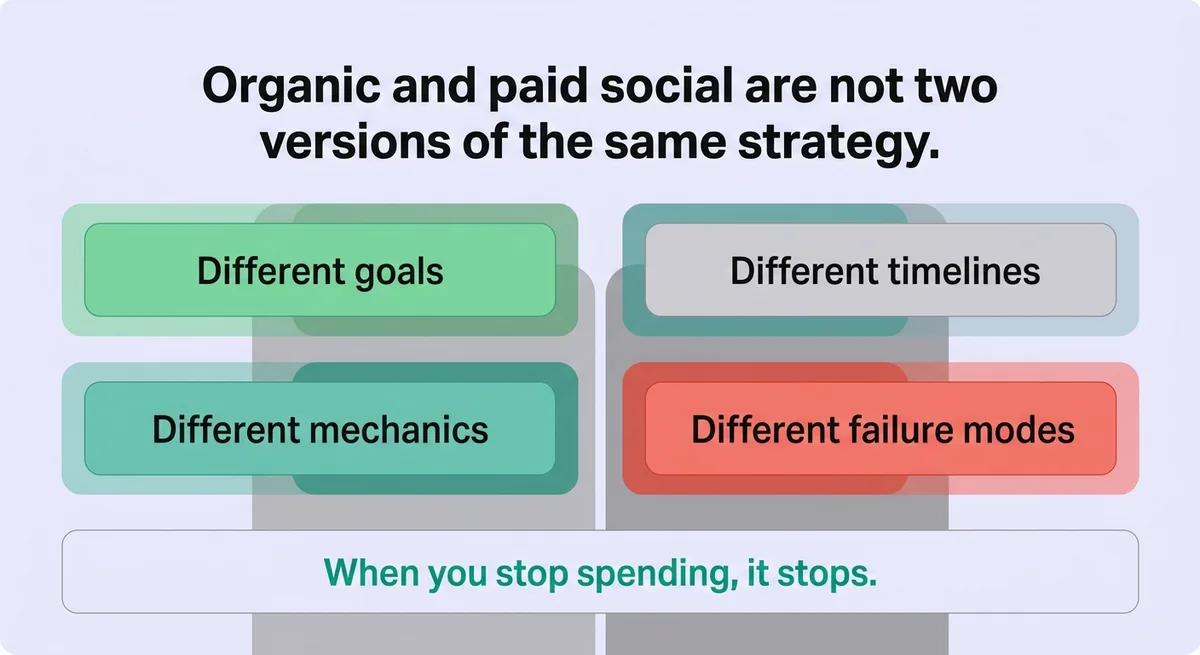
Paid social buys guaranteed reach. You define the audience, set the budget, and the platform serves your content to that segment regardless of whether they follow you. The reach is immediate and predictable. The moment you stop spending, it stops. Forty-six percent of consumers say they would pay more for a brand they trust [2]. Paid social can generate visibility quickly, but it does not build the trust that drives that willingness to pay more. Organic content does.
Seventy percent of customers prefer shopping via mobile apps compared with prior years [2]. That behavioral shift affects both channels, but it hits paid social differently. Mobile ad fatigue is real. Users have trained themselves to identify sponsored labels and scroll past them. Organic content that appears in a feed without a sponsored tag gets evaluated differently by the same user.
Factor | Organic Social | Paid Social |
|---|---|---|
Cost structure | Time and creative resources | Direct ad spend per impression or click |
Reach control | Earned through relevance and engagement | Purchased, targeted by demographic or behavior |
Timeline | Compounds over weeks and months | Immediate, stops when budget stops |
Trust signal | Higher, no sponsored label | Lower, visibly promoted |
Best use case | Brand credibility, audience retention | Product launches, lead generation, retargeting |
Failure mode | Inconsistency kills compounding | Budget misalignment kills ROI |
The failure modes in that table are worth pausing on. Organic content fails through inconsistency. One strong post every three weeks produces almost nothing because the algorithm sees no pattern to reward and your audience builds no habit of checking for you. Paid social fails through budget misalignment: spending on the wrong audience segment, at the wrong funnel stage, with creative that doesn’t match what the audience needs at that moment.
A team that runs paid ads without any organic presence is renting visibility they will lose the moment the campaign ends. A team that only posts organically with no paid amplification may build slowly but builds something that persists. Neither approach alone is optimal. The question is which one you need right now.
When to Use Each Approach: A Decision Framework for Beginners
The decision between organic and paid is not about budget size. It is about what you need to happen and how fast you need it.
Use organic content when you are building long-term credibility. When your product requires a longer consideration cycle. When you are growing an audience that will eventually convert over multiple touchpoints. When you need to stay visible between campaigns without ongoing spend.
Use paid social when you have a specific, time-sensitive offer. When you need to reach an audience you don’t yet have. When you are retargeting visitors who already showed interest. When you are testing messaging and need fast data.
There are six types of social media content formats that consistently drive organic performance [1]. They include educational posts, behind-the-scenes content, user-generated content, polls and interactive formats, storytelling posts, and product demonstrations. Each format serves a different stage of the relationship between your brand and your audience.
Here is the Decision Framework simplified into three questions. Answer them before opening your content calendar.
Question 1: Do I need results in the next 30 days? If yes, paid social is the faster path. Organic content rarely compresses into a 30-day window with meaningful results for accounts that aren’t already established.
Question 2: Do I have an existing audience, even a small one? If yes, organic content can work right now. An audience of 500 engaged followers outperforms an audience of 5,000 passive ones. Start posting consistently and measure engagement rate, not follower count.
Question 3: Am I trying to retain people who already know me or attract people who don’t? Retention is an organic strength. Acquisition at scale needs paid amplification.
The most common mistake is choosing based on cost alone. A team that avoids paid social entirely because it “costs money” is ignoring the time cost of organic content and the opportunity cost of slow growth. A team that runs paid campaigns without organic content sends new visitors to a profile that hasn’t posted in two months. Both errors are fixable.
One practical starting point: run organic content for 60 days with a consistent posting schedule, at least three times per week. Measure which post formats earn the highest engagement rate. Then use paid to amplify those specific formats to a cold audience. This sequence reduces wasted ad spend because you already know what your audience responds to before you pay to scale it.
The Decision Framework works because it uses real audience data instead of assumptions. You stop guessing what a cold audience wants and start proving it with a warm one first.
Choose the right channel before you create a single post
Most content stalls because teams skip the channel decision. They open a blank doc, write something, publish it, and then ask why it didn’t perform. The sequence is backwards.
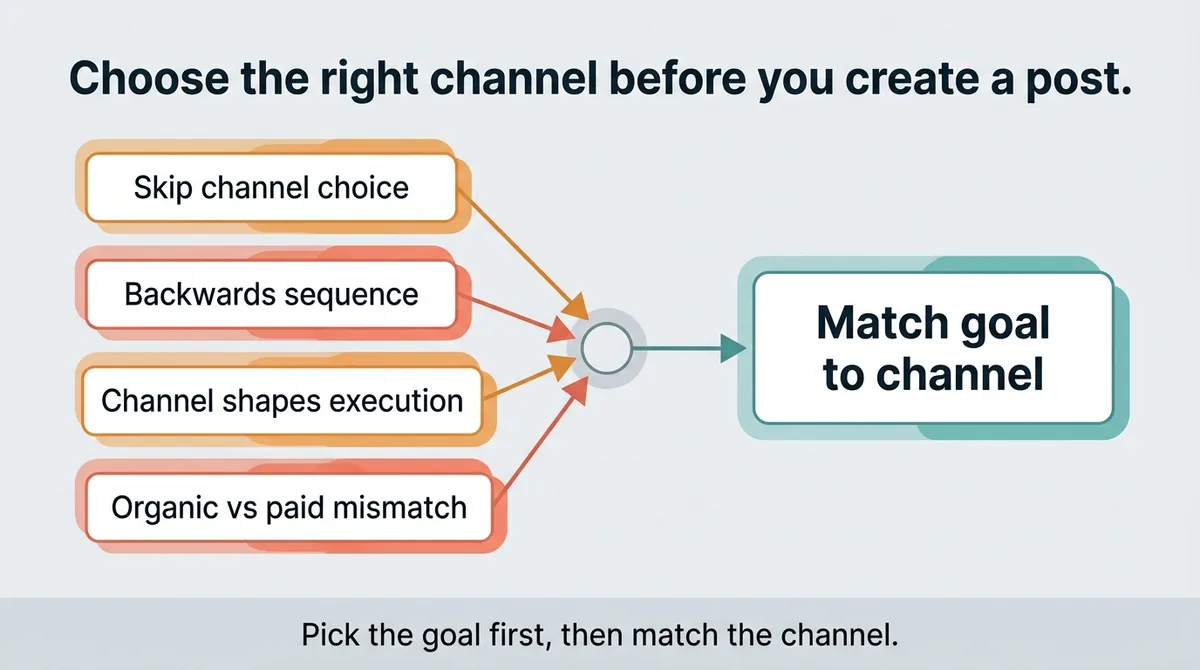
The channel decision shapes the format, the cadence, the success metric, and the timeline you hold yourself to. Organic content measured against a paid social timeline will always look like failure. Paid social measured against an organic trust-building goal will always look expensive.
Pick the goal first. Match the channel to it. Then build the content. Apply the Decision Framework before the work starts, not after.
References and Citations
[1]https://www.semrush.com/blog/organic-content/
[2]https://www.storelab.app/blog/what-is-organic-social-definition-tips
[3]https://techdella.com/glossary/organic-social-media/
FAQ
Organic social media reach works through a platform scoring system that evaluates how quickly a post earns engagement after publishing, how long people spend with it, and whether they take secondary actions like saving or sharing. The first 30 to 60 minutes after you post act as the critical signal window: strong early engagement tells the algorithm the content is worth distributing more broadly, while slow early engagement gets the post suppressed. Reach comes from three sources, your existing followers, people who share your post, and the algorithm surfacing it to non-followers, and that third source is where most teams lose clarity.
Organic social content earns reach through relevance and audience engagement at no direct ad cost, while paid social buys guaranteed reach by targeting defined audience segments with a budget that stops the moment you stop spending. Organic content compounds over weeks and months, builds trust without a sponsored label, and is strongest for brand credibility and audience retention. Paid social is faster and better suited to time-sensitive offers, cold audience acquisition, and retargeting, but it rents visibility rather than building anything that persists.
Use organic social when you are building long-term credibility, have a product with a longer consideration cycle, or need to stay visible between paid campaigns without ongoing spend. A practical sequence is to post organically at least three times per week for 60 days, identify which post formats earn the highest engagement rate, and then use paid to amplify only those proven formats to a cold audience. This approach reduces wasted ad spend because you validate what resonates with a warm audience before paying to scale it, and platforms like Zelitho can help maintain that consistent publishing cadence by streamlining content production from topic selection through to publishing.
Low organic reach despite regular posting is almost always a format or engagement-signal problem, not a frequency problem. Since 84% of social media users access platforms via mobile, content formatted for desktop, such as long text blocks, horizontal video, or small-font graphics, gets scrolled past without stopping, which tells the algorithm the post is not worth distributing further. The fix is to track engagement rate by post format, identify which formats generate fast early engagement, and shift your creative effort toward those, rather than assuming the algorithm is at fault.
A small team can maintain a consistent organic social schedule by treating content production as a system rather than a series of one-off creative decisions, anchoring the calendar to a repeatable set of proven formats like educational posts, behind-the-scenes content, and user-generated content. Consistency matters more than volume because the algorithm rewards accounts it can predict, and one strong post three times per week outperforms sporadic bursts. For teams also managing blog content alongside social, Zelitho addresses the same fragmentation problem in written content by connecting topic selection, drafting, and publishing into one workflow, reducing the operational overhead that causes publishing cadences to stall.