
What Is Keyword Clustering With Machine Learning for SEO?

TL;DR
You exported 800 keywords from Ahrefs last Tuesday. You renamed the tab “master list.” It is still sitting there.
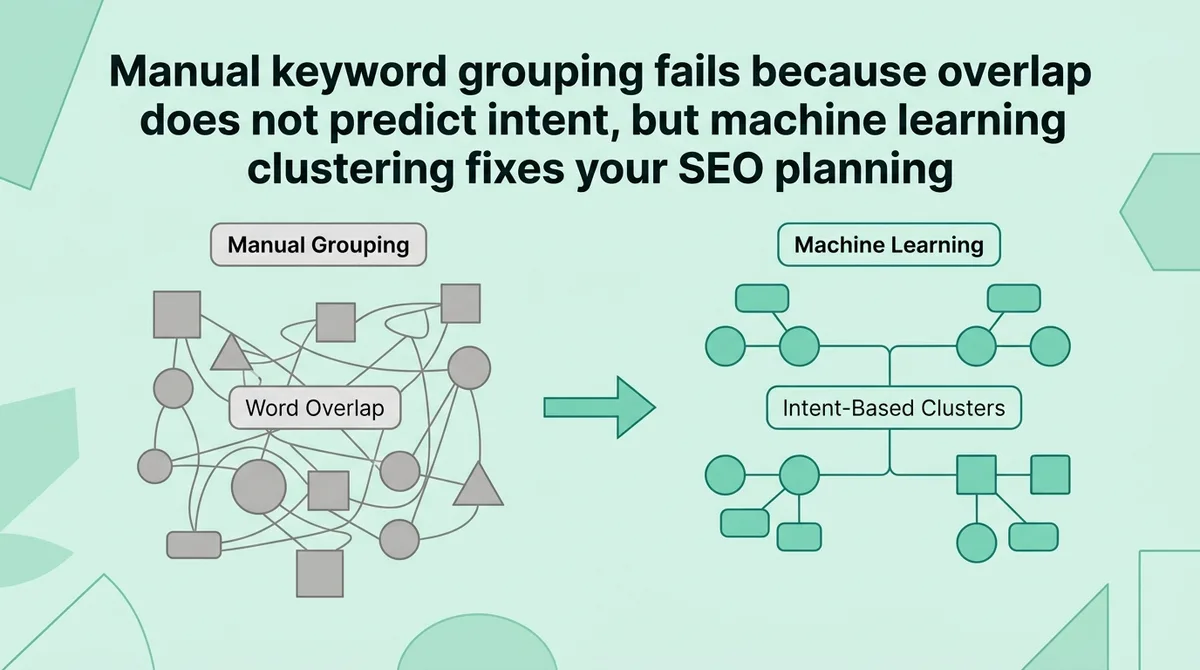
Grouping keywords by hand fails because word overlap does not predict shared search intent. Two phrases can share zero words and still compete for the same ranking position. Manual methods cannot detect that. They produce clusters that either split traffic across too many thin pages or collapse too many topics onto one overloaded URL.
Keyword clustering with machine learning fixes this by comparing which URLs actually rank for each term simultaneously. When two keywords share ranking URLs, they belong to the same intent cluster. This article walks content leads and agency operators through the full workflow: how clusters form, how to validate each one against five measurable checks, and how cluster decisions determine page structure before a single brief gets written.
What does keyword clustering with machine learning mean for SEO content planning?
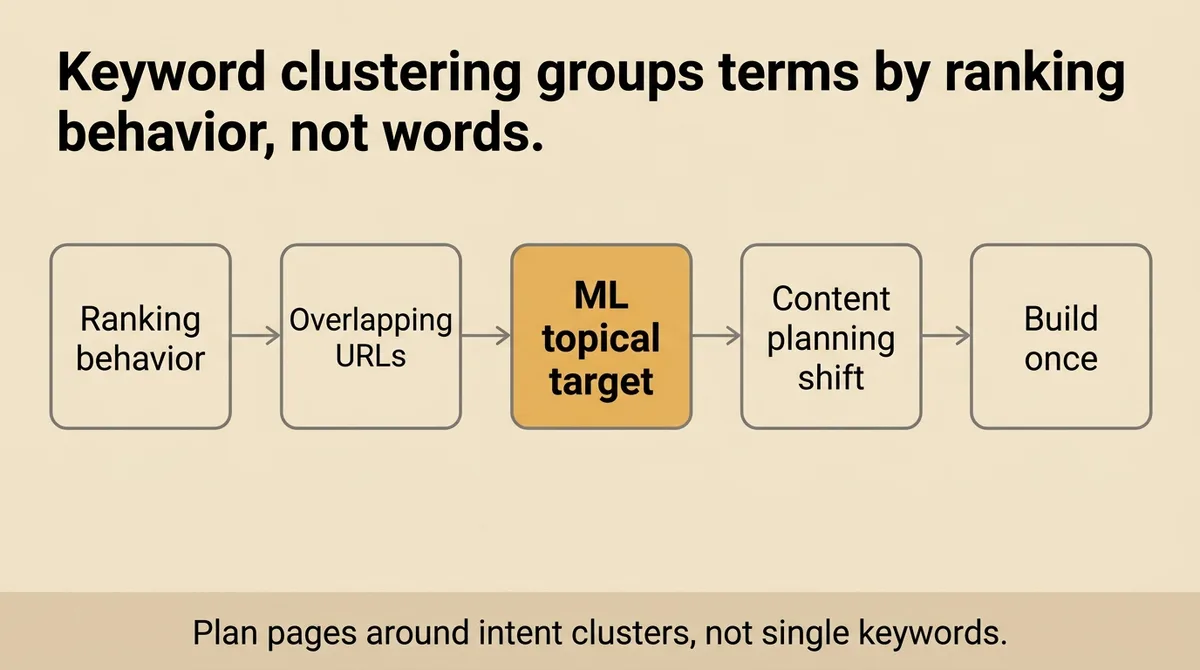
Keyword clustering with machine learning groups search terms by shared ranking behavior, not word similarity. When two keywords consistently return overlapping URLs in search results, an ML model treats them as one topical target. This shifts content planning from chasing individual terms to building pages that satisfy a full intent cluster at once.
How Machine Learning Groups Keywords by Intent, Not Just Similarity
Most keyword grouping tools sort alphabetically or match on shared root words. That is rule-based clustering. It is fast, but it clusters the wrong signals.
ML-based clustering compares SERP behavior directly. The system checks which URLs appear in the top 6 ranking positions [1] for keyword A and which URLs appear for keyword B. If significant overlap exists between those two result sets, the system assigns both keywords to the same cluster. Some tools extend this to the top 10 results [1] to catch broader overlap patterns.
Stop treating word overlap as a proxy for intent. Start using ranking URL overlap as your clustering signal.
Here is why this matters with a concrete example. The phrases “best project management software” and “top project management tools” share very few words. A rule-based tool might split them. An ML tool checks both SERPs and finds 7 of the top 10 ranking URLs are identical. Those two phrases belong to one cluster. One page should address both.
Factor | Rule-Based Clustering | ML Clustering |
|---|---|---|
Signal used | Shared words or root terms | SERP URL co-occurrence |
Accuracy | Low for intent detection | High for intent detection |
Scalability | Fast but brittle at scale | Handles thousands of terms |
The practical consequence is significant. A rule-based system might produce 400 clusters from 800 keywords. An ML system might produce 180 clusters from the same list, because it collapses phrase variations that share the same search intent into single targets. Fewer clusters means fewer pages, more focused content, and less cannibalization risk.
You Are Probably Targeting the Wrong Cluster Size , Here Is Why That Costs You Rankings
Cluster size is the calibration problem most content plans ignore entirely.
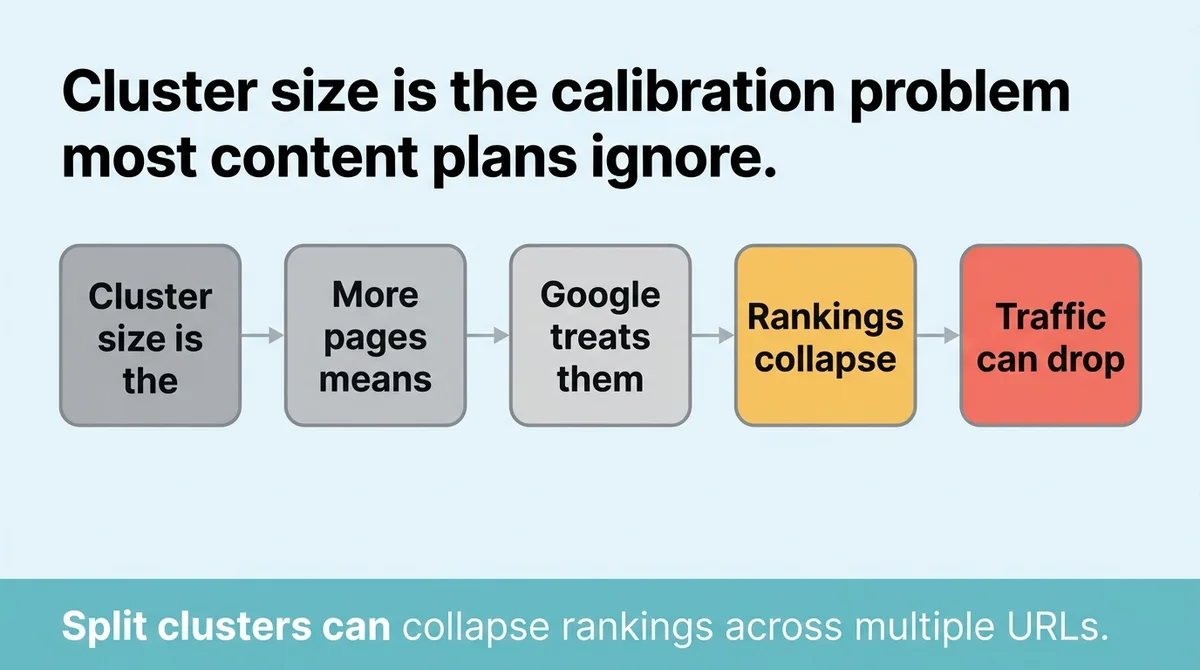
The false assumption: more pages covering more keyword variations means more ranking opportunities. This is wrong. When 50 keyword variations target separate URLs, Google resolves them as competing signals for one topic. Rankings collapse across all of them instead of concentrating on one strong page. That traffic loss can reach 30% [1] when clusters that Google treats as a single topic get split across multiple URLs.
The opposite error is equally costly. Over-consolidation pushes 70% of your keyword variations [1] onto a single page that cannot realistically cover the full intent range. One URL trying to rank for research queries, comparison queries, and purchase queries simultaneously will rank well for none of them.
The calibration rule that fixes both errors is the Cluster Scope Rule: match the number of supporting pages to the genuine subtopic count, not to your keyword count.
Here is how that plays out in practice. A content team at a 40-person SaaS company built 22 separate landing pages targeting variations of “project management for remote teams.” Rankings across all 22 pages declined over six months. They consolidated into one pillar page with four supporting cluster pages built around distinct subtopics. Organic sessions to that topic group recovered within 10 weeks. The page count dropped. The rankings improved.
Pillar cluster structures typically need 3 to 5 supporting subtopic pages [1]. Broad topic clusters covering wider intent ranges require 5 to 8 supporting pages [1] before the structure becomes architecturally sound. Below those thresholds, you are either splitting content that belongs together or leaving subtopics without dedicated coverage.
The Cluster Scope Rule gives you a structural decision point before you brief a single writer. If your candidate cluster has 1 subtopic, it is a spoke page. If it has 3 to 5, it is a standard hub structure. If it has more than 5, it warrants a dedicated pillar with its own supporting cluster.
The Five-Step Validation and Gap Detection Workflow
A cluster that passes ML grouping is not automatically worth a page. Grouping tells you what belongs together. Validation tells you whether to act on it.
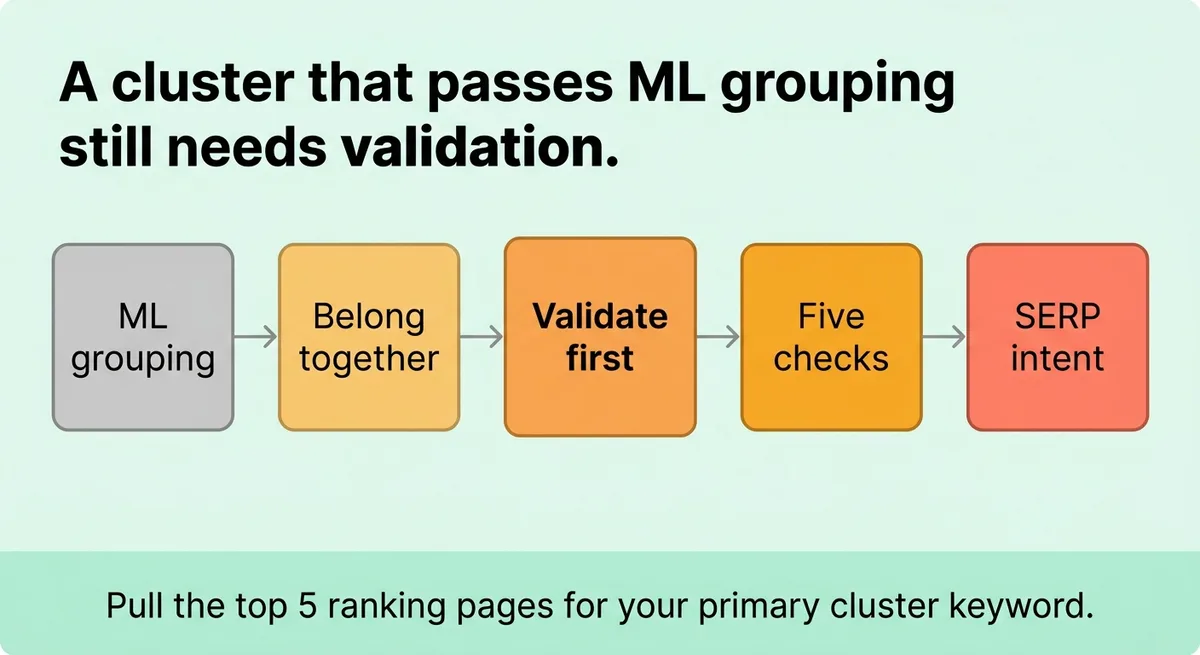
Run five validation checks [2] on each candidate cluster before assigning it to a brief. This sequence replaces the judgment calls that slow down content planning.
1. SERP intent confirmation. Pull the top 5 ranking pages for your primary cluster keyword. Check the content type: are they listicles, product pages, how-to guides, or comparison articles? If the content type does not match what you planned to create, either adjust your format or reconsider the cluster assignment.
2. Demand threshold. Add the monthly search volume for all keywords in the cluster. Set a minimum combined volume that justifies a standalone page for your site’s traffic baseline. One keyword with 50 searches per month rarely warrants its own page. A cluster of 12 related keywords with 50 searches each does.
3. Coverage gap. Check whether existing content on your site already addresses this cluster. A gap exists when demand is confirmed but no current URL ranks in positions 1 through 20 for any keyword in the cluster. No gap means consolidate, not create.
4. Cannibalization audit. Search your existing URLs for any page already ranking for 3 or more keywords from this cluster. If one exists, adding a new page will split ranking signals. The correct move is to strengthen the existing page, not publish a competitor.
5. Content depth signal. Check the average word count of pages currently ranking in positions 1 through 5 for your cluster’s primary keyword. If ranking pages average over 3,000 words [1], your brief needs to match that depth. Clusters where ranking pages average around 1,500 words [1] require a mid-depth treatment. Clusters where top results average near 1,000 words [1] are optimized for concise coverage. Use the SERP’s actual depth signal as your target. Do not apply a generic best practice.
Run this checklist before any brief gets written. Skipping it means your writers produce content for clusters that already have coverage, lack sufficient demand, or compete internally with existing pages.
Translating Validated Clusters Into Site Architecture and Automated Internal Linking
Validated clusters are structural decisions, not just content assignments. Each cluster tells you exactly where a page lives in your site hierarchy before you write a word.
Every validated cluster maps to one of three architectural roles.
A cluster with one primary keyword and minimal subtopic variation becomes a spoke page. It lives at the edge of a topic hub and handles one specific intent.
A cluster with 3 to 5 confirmed subtopics [1] becomes a hub-and-spoke structure. The pillar page addresses the broad topic. Each subtopic page handles one supporting angle. Internal links connect outward from the pillar and inward from each spoke.
A cluster with 5 to 8 subtopics [1] warrants a full topic silo. This means a dedicated pillar page, multiple cluster pages beneath it, and spoke pages beneath those. The Cluster Scope Rule determines which structure applies. Apply it during validation, not after the site is already built.
The common mistake is building site architecture first and then retrofitting keyword research into it. That sequence forces keywords into a structure designed without them. Cluster data must drive structure. Structure should not be renegotiated around cluster data after the fact.
Automated page-building tools use cluster membership to pre-populate internal link anchors. When two pages belong to the same cluster, the system identifies them as link candidates and suggests anchor text derived from shared cluster keywords. This removes the manual link audit step entirely.
The scale effect is concrete. An ecommerce site with 200 validated clusters can generate over 600 internal links by mapping cluster-to-cluster relationships before a single page goes live. No link audit required. No spreadsheet tracking which pages reference which. The cluster data already encodes the relationship.
One implementation caveat worth naming: automated internal linking built on cluster data only works if clusters were validated correctly. A misclustered keyword assigned to the wrong pillar creates an internal link that misleads crawlers and dilutes topical authority. The validation workflow in the previous section is the quality gate that makes automation safe to run.
Why cluster decisions must drive site structure before you write
Most content operations build a site map, pick a CMS template, hire writers, and then ask where the keywords fit. That sequence produces orphaned pages, cannibalized rankings, and internal link structures that do not reflect how the audience searches.
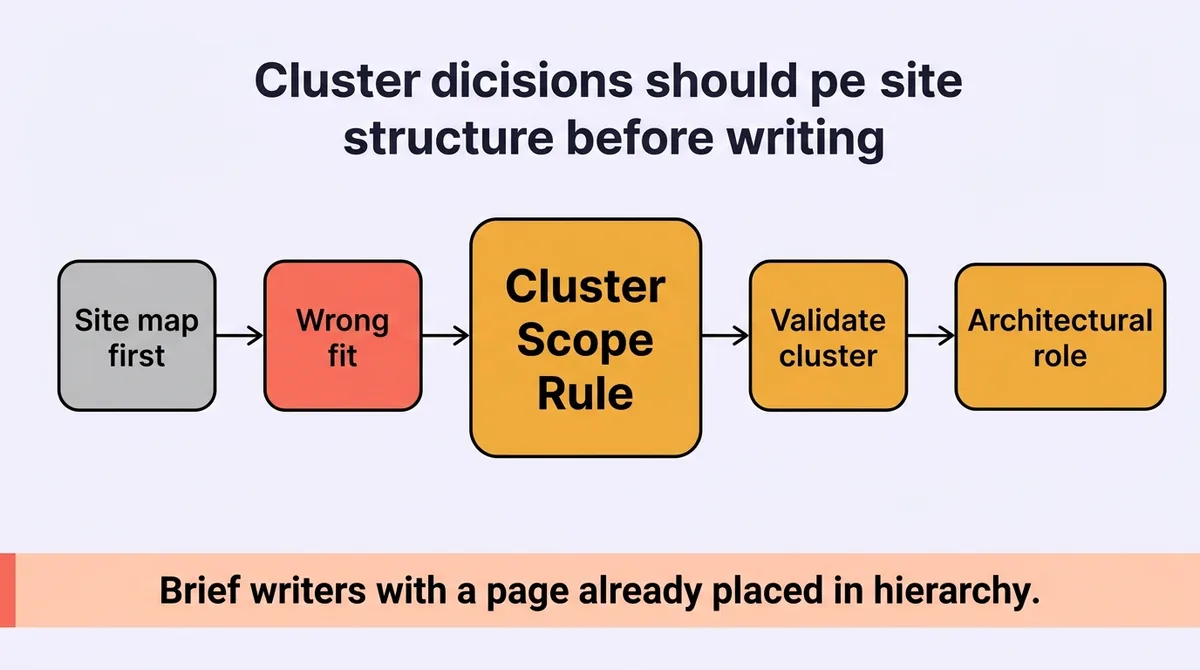
The Cluster Scope Rule gives you a different starting point. Validate the cluster first. Confirm the subtopic count. Assign the architectural role. Then brief the writer with a page that already has a defined position in your site hierarchy, pre-mapped internal links, and a depth target derived from actual SERP data.
This is not a publishing workflow improvement. It is a structural decision made before the publishing workflow begins. Cluster data determines your pages. Your pages determine your links. Your links determine your authority distribution. Build in that order.
References and Citations
[1]https://infranodus.com/docs/keyword-clustering-seo
[2]https://similar.ai/guides/keyword-clustering-ecommerce/
FAQ
Machine learning keyword clustering groups terms by shared ranking URL overlap in search results, while rule-based grouping sorts terms by shared words or root matches, which is a far weaker signal for search intent. A rule-based tool might split ‘best project management software’ and ‘top project management tools’ into separate clusters because the words differ, while an ML tool checks both SERPs, finds 7 of the top 10 ranking URLs are identical, and correctly assigns them to one cluster. The practical result is that an ML system typically produces far fewer clusters from the same keyword list, for example 180 clusters instead of 400 from 800 keywords, reducing cannibalization risk and focusing content effort on pages that can rank.
When you split keyword variations that Google treats as one topic across multiple separate URLs, rankings collapse across all of them rather than concentrating on one strong page, and that traffic loss can reach 30%. The signal gets diluted because Google sees competing pages on the same site targeting the same intent, so none of them accumulate enough authority to rank well. The fix is to validate cluster scope first: count the genuine subtopics, then match your page count to that number, not to your keyword count.
Validate a keyword cluster by running five sequential checks: confirm SERP intent matches your planned content type, verify the cluster’s combined monthly search volume clears your traffic threshold, identify whether a coverage gap exists on your site, audit for cannibalization by finding any existing URL already ranking for three or more cluster keywords, and check average word count of pages ranking in positions one through five to set your depth target. Skipping these checks means writers produce content for clusters that already have coverage, lack demand, or compete internally with pages already on your site. Platforms like Zelitho build clustered topic selection into the workflow before a draft is generated, so these structural decisions happen upstream rather than after content is already written.
Validated keyword clusters should determine your site architecture before any content is written: a cluster with one primary keyword and minimal subtopics becomes a spoke page, a cluster with three to five confirmed subtopics becomes a hub-and-spoke structure, and a cluster with five to eight subtopics warrants a full topic silo with a pillar page. The common mistake is building a site map first and then retrofitting keywords into it, which creates orphaned pages and cannibalized rankings. Zelitho applies this cluster-first logic by mapping topic relationships and internal link structure as part of its planning workflow, so each article is assigned a position in the site hierarchy before drafting begins.
A standard pillar cluster structure needs three to five supporting subtopic pages, and broad topic clusters covering a wider intent range require five to eight supporting pages before the architecture becomes sound. Below those thresholds you are either splitting content that belongs together or leaving genuine subtopics without dedicated coverage. Use the Cluster Scope Rule to make this decision during cluster validation: count your confirmed subtopics, then assign the matching architectural role before briefing any writer.