
What Is Content Pipeline Management? A Practical Guide to Better Workflow, Governance, and Quality

TL;DR
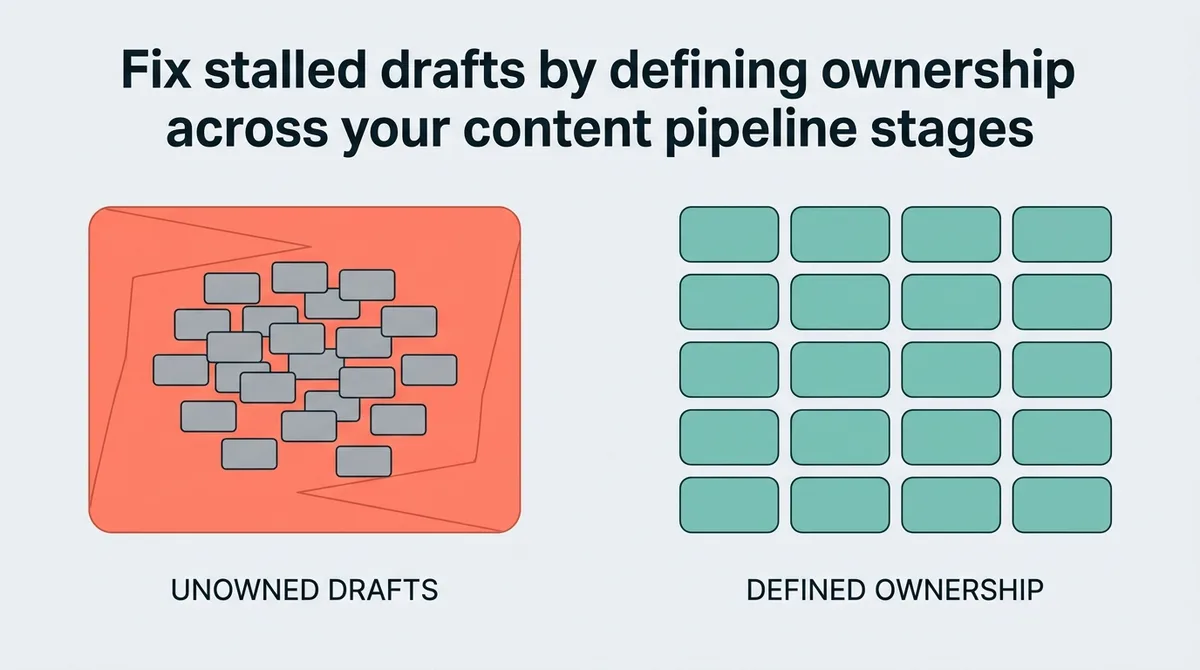
Your blog has a Notion board with 14 articles in “In Progress.” Three of them have been there for six weeks. A freelancer submitted a draft. Someone left a comment. Nobody merged the edits. Nothing shipped.
The common fix is to add another tool, another Slack reminder, or another weekly sync. That approach fails because the bottleneck is not effort. It is undefined ownership at the moments work changes hands.
The Content Flow System is a structured approach to moving content from idea to live URL with a named owner at each stage. It uses decision points, tiered review, and explicit completion signals to cut late-stage rework. This guide is written for content leads and agency founders managing multiple blogs with thin margins and no room for wasted cycles.
What does content pipeline management mean in practice?
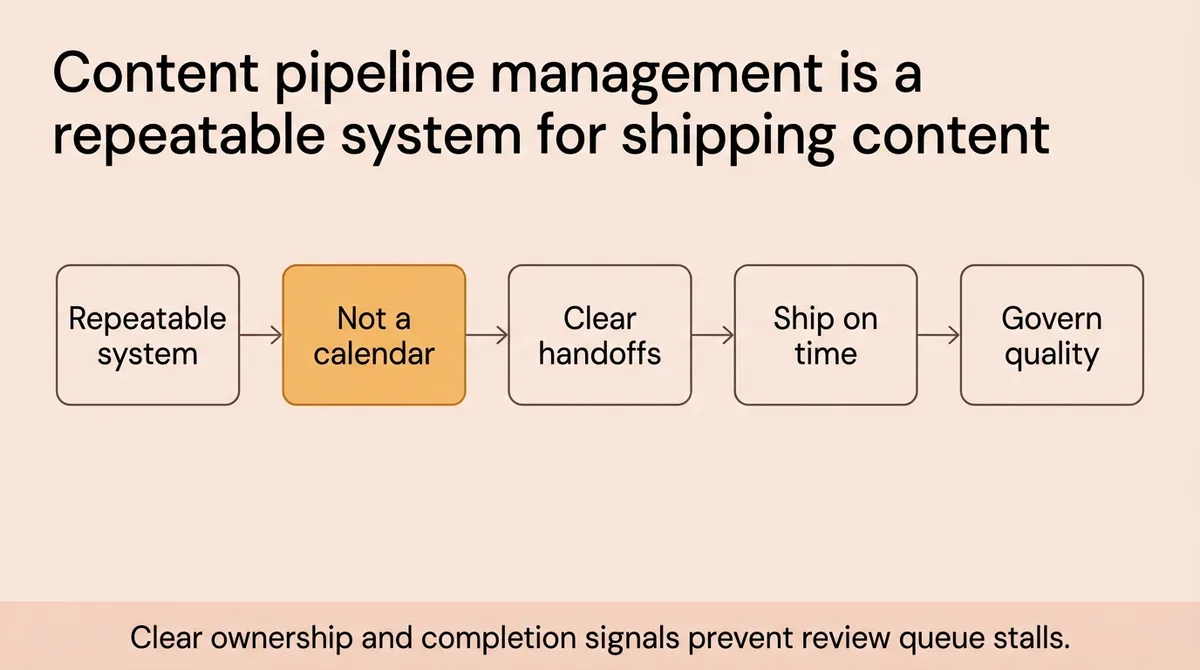
Content pipeline management is a repeatable operating system for moving content through defined stages, with clear ownership and completion signals at every handoff. It is not a calendar. It is the structural logic that determines whether a piece ships on time or stalls in a review queue for a month.
What a Content Pipeline Actually Is (And What People Get Wrong About It)
A content calendar tells you what you plan to publish and when. A content pipeline tells you how the work actually moves.
Most teams treat these as the same thing. That is the first design error.
A pipeline is a system with defined inputs, outputs, and handoff points. At each stage, something specific enters, something specific happens to it, and something specific signals that the work is ready to move forward. Without that structure, the team operates on good intentions and Slack messages, and both run out at inconvenient times.
Stop treating your editorial process as a task list. Start designing it as a system with explicit completion signals at every stage.
Here is what a concrete six-stage pipeline looks like in practice:
Stage | What Enters | What Exits | Completion Signal |
|---|---|---|---|
Ideation | Topic request or brief prompt | Approved topic + angle | Topic owner signs off |
Briefing | Approved topic | Detailed brief with intent | Brief reviewed by editor |
Creation | Brief | Full draft | Draft marked “ready for review” |
Review | Draft | Revised, approved copy | Reviewer clears final version |
Production | Approved copy | Formatted, linked CMS draft | Producer marks “ready to publish” |
Publication | CMS draft | Live URL | URL confirmed and distributed |
Each row is a handoff. Each handoff requires one named owner. When that owner is missing, the stage collapses into ambiguity and work stalls.
The popular fix is to add a project management tool. Teams move from spreadsheets to Asana to Notion to Linear, and the blog still stalls. The tool is not the problem. The missing piece is ownership definition at each handoff point. A new tool with undefined ownership is just a more expensive version of the same broken process.
This is the foundation of what this guide calls the Content Flow System: a structured approach to stage design, handoff clarity, and governance routing. Each section below maps one layer of that system.
The Five Stages Where Work Gets Stuck , and Why Handoffs Are the Real Problem
Work rarely stalls because writers are slow or editors are lazy. It stalls because nobody defined who owns the moment when the draft leaves one person’s hands and enters another’s.
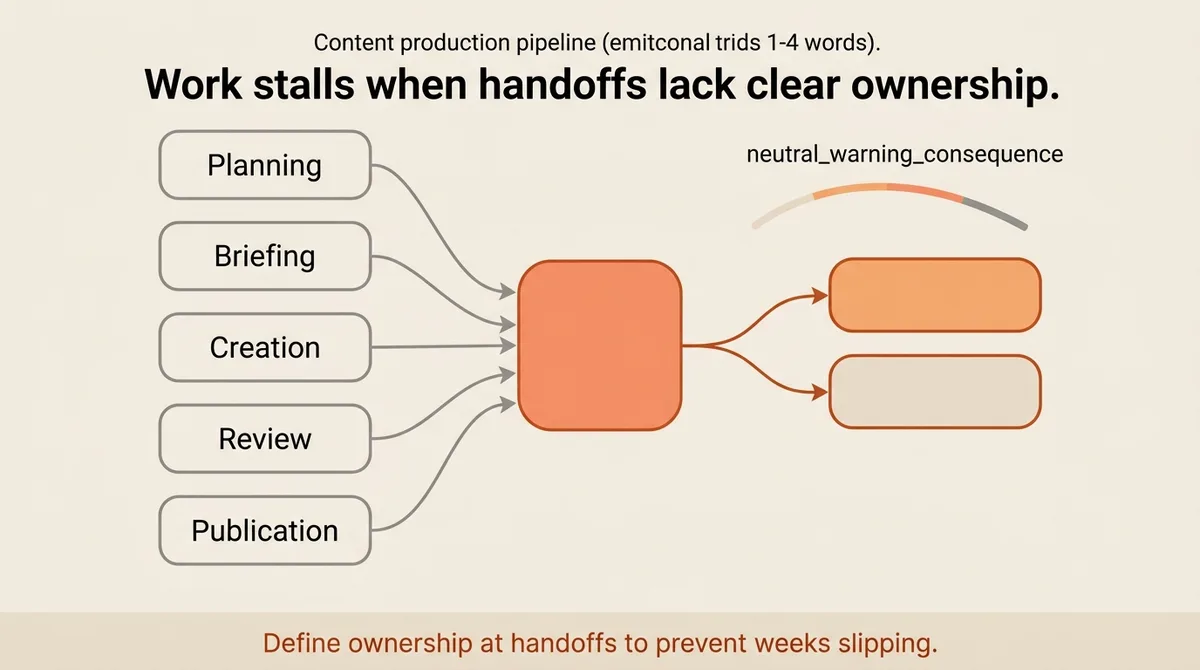
That invisible gap is where weeks disappear.
The five core stages are: planning, briefing, creation, review, and publication. Each one has a distinct failure mode.
Planning fails when topics get approved without assigned owners. The idea lives on the board. Nobody picks it up.
Briefing fails when briefs skip audience intent. A brief that says “write about onboarding” gives a writer no entry point, no angle, and no success criteria. The resulting draft misses the mark. The editor rewrites it. The writer revises again. Three rounds of feedback on a piece that a sharper brief would have shipped in one.
Creation fails when the writer has no deadline signal. “When it’s ready” is not a signal. It is an invitation to deprioritize.
Review fails when there is no named approver. This is the most common and most expensive failure mode. Without a defined reviewer, drafts collect comments from multiple people, generate conflicting feedback, and create version-control chaos. One content team launching a product campaign found the review stage undefined across four stakeholders. Six weeks passed before the campaign piece published. The product launch window closed before the content appeared.
Publication fails when the CMS handoff is informal. Copy gets pasted without formatting rules. Links get skipped. Metadata goes unfilled. The piece goes live incomplete.
Here is how healthy handoffs differ from broken ones:
Handoff Attribute | Healthy Signal | Broken Signal |
|---|---|---|
Ownership | One named person per stage | Multiple people, unclear lead |
Completion trigger | Explicit status change | Verbal confirmation or assumption |
Input quality | Defined entry criteria | “Send it when ready” |
Feedback loop | Structured, time-bound | Open-ended, asynchronous drift |
The table above does not describe ideal teams versus struggling ones. It describes the same team, before and after they defined their handoffs.
Here is the uncomfortable read: if your content process feels slow, your team is probably not the bottleneck. Your process is. Specifically, the moments between stages, where nobody owns what happens next.
That is where redesign should start. Not with a new tool. Not with a team retrospective. With a question: who owns this piece the moment it leaves the brief stage?
Governance Without Gatekeeping: How to Build Review Controls That Don’t Slow Everything Down
Governance means decision rights, not approvals.
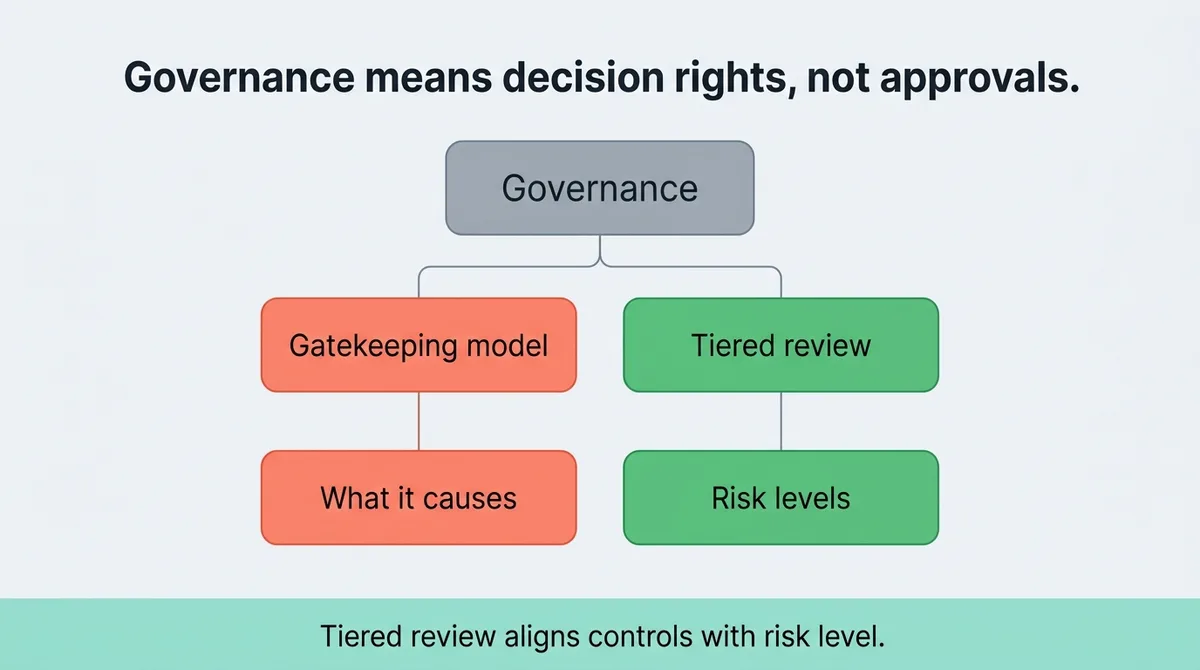
That distinction matters. A gatekeeping model routes every piece through every stakeholder. It feels thorough. It produces slow throughput, diluted ownership, and a review queue that creates more confusion than clarity. More reviewers do not produce better content. They produce longer turnaround and shared accountability, which functions like no accountability.
A tiered review model routes content based on risk level. Tactical blog posts carry low brand risk. Campaign content carries medium risk. Brand-level assets, legal disclosures, or executive-voiced pieces carry high risk. Each tier gets a different review path.
Here is a concrete three-tier structure:
Content Tier | Example | Reviewers Required | Target Review Window |
|---|---|---|---|
Tier 1: Tactical | Weekly blog post, how-to guide | 1 editor | 24 hours |
Tier 2: Campaign | Launch content, gated asset | Editor plus campaign lead | 48 hours |
Tier 3: Brand or legal | Executive post, compliance content | Editor, legal, leadership sign-off | 5 business days |
Most pieces are Tier 1. Most teams treat them like Tier 3. That mismatch is where pipeline velocity dies.
The Content Flow System’s governance layer integrates directly with the five stages from the previous section. Review is not a single stage. It is a routing decision made at the end of the creation stage. The brief should specify which tier the piece belongs to. The creator should know before writing who will review the finished draft and within what window.
Every review checkpoint must answer three questions. Is this accurate? Is this on-brand? Is this approved to publish? If a reviewer cannot answer all three, the piece returns to creation with specific notes. It does not sit in limbo.
That structure protects quality. It does not slow publication. It gives reviewers a defined job, a defined scope, and a defined exit condition.
How to Optimize the Pipeline Without Losing Oversight
Optimization is not about moving faster. It is about removing the moments where the system asks a question nobody is prepared to answer.
Two structured decision points do more to cut rework than any deadline pressure. The first sits at the end of the briefing stage: the post-brief check. Before creation begins, the editor confirms the brief covers audience intent, scope, and format. A five-minute check at this stage prevents a three-hour rewrite at the review stage.
The second decision point sits at the end of the first draft: the post-draft check. The creator reviews the draft against the brief before submitting it for review. Not for polish. For structural fit. Does it answer the brief? If not, it goes back to the creator, not to the reviewer.
Adding these two checkpoints shifts where problems surface. Problems caught at the brief stage cost minutes. Problems caught at the review stage cost days. Problems caught after publication cost credibility.
There are two models for pipeline optimization, and they fit different contexts:
Model | Priority | Fits Best When |
|---|---|---|
Volume-optimized | Throughput, frequency | Large teams, commodity content, high-cadence channels |
Consistency-optimized | Quality control, brand fidelity | Small teams, high-stakes content, complex approval chains |
An agency managing ten client blogs with three writers runs a volume-optimized pipeline. A B2B SaaS team producing six pieces per month with heavy brand standards runs a consistency-optimized pipeline. Both need the same structural layer. They tune the decision points differently.
The Content Flow System applies to both models. Stage design remains the same. Handoff clarity remains the same. Governance routing changes by tier and by team size.
Here are three diagnostics to run on your current pipeline. Pull your last five published pieces. For each one, identify where it stalled. Not “it took a while in review.” The exact stage. Then identify who owned each handoff. Name the person. If you cannot name one person per stage, that stage has no defined owner. Flag any stage that has no explicit completion signal. No status label. No trigger. No confirmation. Those gaps are where your next six weeks of delay will come from.
Run the audit once. Fix the gaps in order of frequency. The stage that stalled most often is your rebuild priority.
Build the system once and let the work move itself
The Content Flow System has three layers: stage design, handoff clarity, and governance routing. Each layer answers a different question.
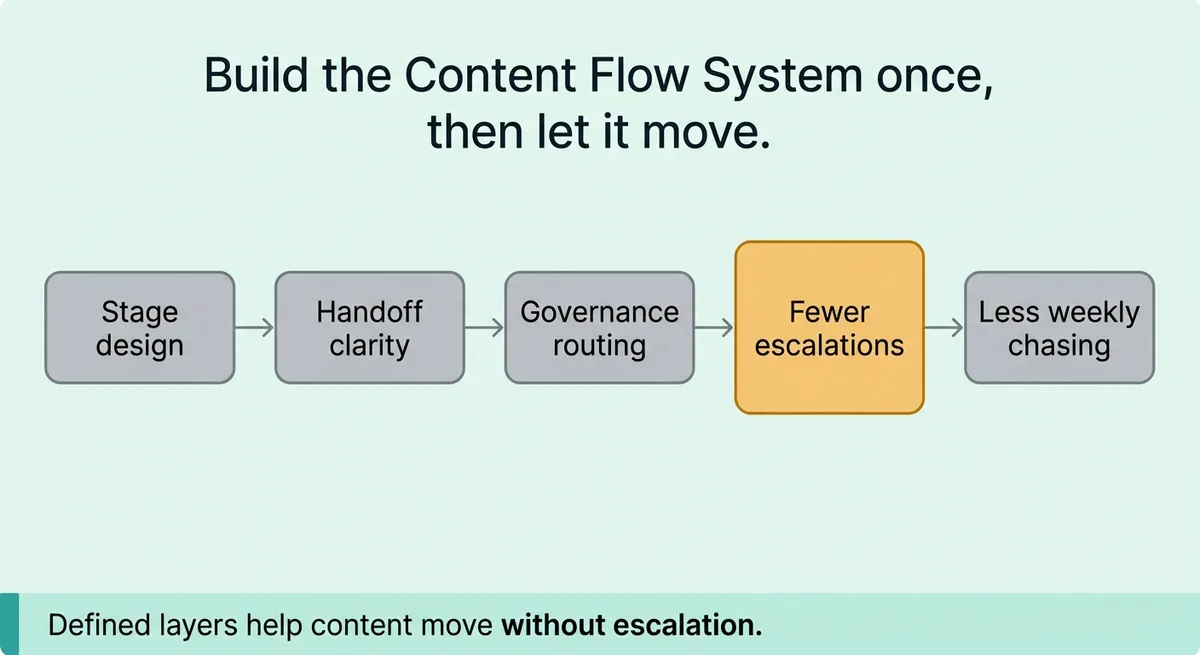
Stage design asks: what are the defined inputs and outputs at each step?
Handoff clarity asks: who owns the work the moment it leaves each stage?
Governance routing asks: what review path does this content type require?
When all three layers are defined, content moves without escalation, without ambiguity, and without the weekly “where is that piece” conversation. The team stops managing work and starts executing it.
A blog that ships on cadence is not the result of a motivated team. It is the result of a process that tells each person exactly what they own and exactly when to hand it off.
Build the system. The work moves itself.
FAQ
The most common reason content stalls in review is the absence of a single named approver, which turns one review stage into a multi-stakeholder comment thread with conflicting feedback and no clear exit condition. Without a defined reviewer, drafts collect opinions from multiple people, generate version-control chaos, and sit in limbo until someone escalates. The fix is structural: assign one owner per stage, set a time-bound review window, and require reviewers to answer three specific questions before the piece can advance.
You improve a content management process by defining explicit ownership and completion signals at every stage handoff, not by switching tools or scheduling more syncs. Most pipeline slowdowns trace back to the gap between stages, where nobody has been named responsible for what happens next. A practical starting point is a three-question audit: pull your last five published pieces, identify the exact stage where each stalled, and name the person who owned each handoff. Platforms like Zelitho address this structurally by connecting topic selection, drafting, editing, and CMS publishing inside one workflow, removing the handoff gaps that separate tools create.
A tiered content review model routes each piece through a different approval path based on its risk level, rather than sending every piece through every stakeholder. Tier 1 tactical content like a weekly blog post needs only one editor and a 24-hour window, while Tier 3 brand or legal content requires editor, legal, and leadership sign-off with a five-business-day window. Most pieces fall into Tier 1, but most teams treat them like Tier 3, and that mismatch is where pipeline velocity dies.
Each content stage handoff should have one named owner, an explicit status change as the completion trigger, defined entry criteria for the next stage, and a structured, time-bound feedback loop. The difference between a healthy handoff and a broken one is not team quality but whether those four attributes are defined in writing before the work begins. Verbal confirmations and open-ended async drift are the two patterns most likely to turn a two-day review into a two-week stall.
For a small team or agency managing multiple blogs, a content pipeline is a six-stage system covering ideation, briefing, creation, review, production, and publication, with one named owner and one explicit completion signal at each stage. Agencies running high volume typically tune toward throughput, using lightweight Tier 1 review paths and strict brief standards to reduce late-stage rewrites. Zelitho is built specifically for this context, consolidating keyword discovery, draft generation, on-page editing, and direct CMS publishing into one workflow so agencies can maintain cadence across multiple client blogs without managing separate tool stacks and handoffs.