
What Is an SEO Content Workflow?

TL;DR
You opened your CMS last Tuesday and counted six posts sitting in “Draft.” Three had briefs. Two had ChatGPT copy that nobody edited. One had a title and nothing else. The blog hasn’t published in 11 weeks.
A content calendar does not fix this. Neither does hiring another freelancer. The problem is structural: tasks exist, but stages do not. Without defined inputs, owners, and outputs at each phase, production stalls at every handoff.
The Six-Stage Content Engine is a repeatable operating system that connects keyword planning, brief creation, writing, on-page optimization, publishing, and measurement into one coordinated process. Each stage has a named owner and a clear deliverable. Marketing leads at B2B SaaS companies and agency founders managing multiple client blogs use it to ship on cadence without rebuilding the process from scratch each month.
What does an SEO content workflow include, start to finish?
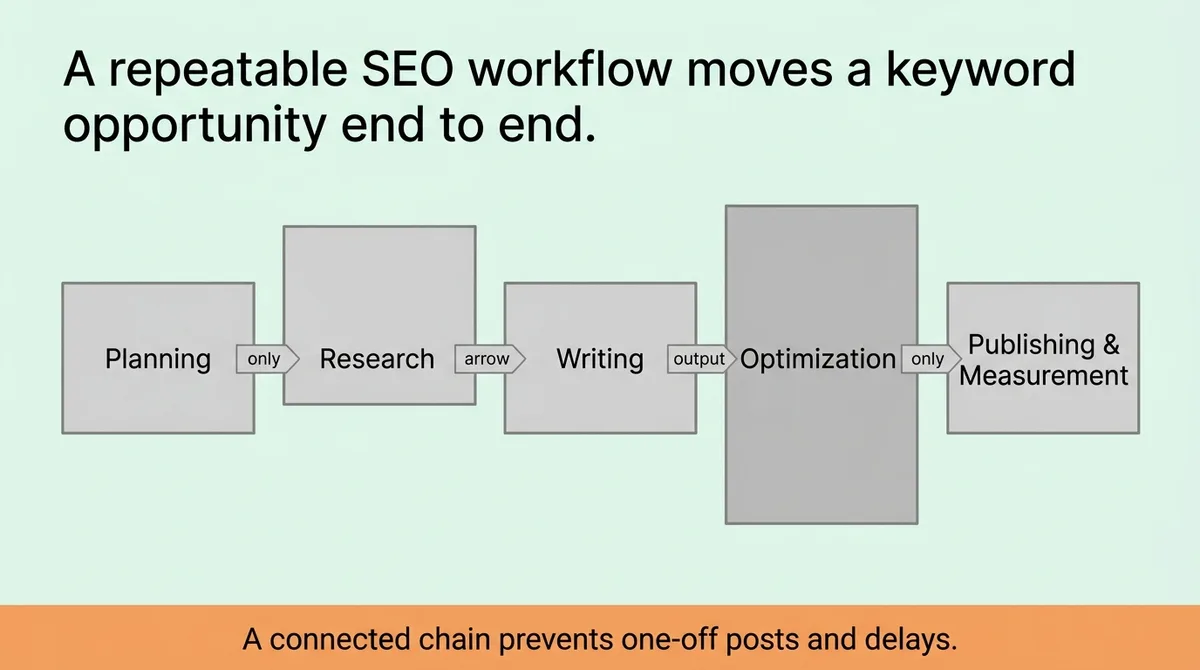
An SEO content workflow is a repeatable system that moves a keyword opportunity through planning, research, writing, optimization, publishing, and measurement. Each stage produces a specific output that feeds the next. Without that chain, teams treat each post as a one-off project, which compounds delays and creates inconsistent quality across the entire content program.
The Six-Stage Operating System Every SEO Content Team Needs
There are exactly six stages where content either advances or stalls. Miss one, and work piles up downstream.
According to Monday.com, a structured workflow has 6 essential components [2]. That number holds because each component maps to a distinct decision type: strategic, research-based, creative, technical, operational, and analytical. Collapsing them into fewer stages forces the wrong person to make the wrong call at the wrong time.
Here is how the Six-Stage Content Engine maps across a real production cycle:
Stage | Owner | Input | Output |
|---|---|---|---|
1. Strategy and keyword planning | SEO lead or head of content | Business goals, competitor gaps | Prioritized keyword list |
2. Research and brief creation | Content strategist | Target keyword, SERP data | Detailed brief with outline |
3. Writing and editing | Writer, then editor | Approved brief | Polished draft |
4. On-page optimization | SEO specialist or editor | Polished draft | Optimized, publish-ready file |
5. Publishing and distribution | Content ops or CMS manager | Optimized file | Live URL, distribution sent |
6. Measurement and iteration | SEO lead or analyst | Live URL, rank tracking | Performance report, update queue |
Realistic production timelines matter here. Research and brief creation typically takes 3-5 days per asset [2]. Writing and editing adds another 3-5 days [2]. A single piece, done properly, runs 6-10 working days from brief to publish-ready file.
That timeline is not a problem. It is a planning input. Teams that ignore it schedule more content than they can produce, then wonder why drafts stall.
Each stage in this system needs one named owner. Not a team. One person accountable for the output moving forward. That single rule eliminates most handoff failures before they start.
Why Most Teams Already Have a Process , and Why It Still Fails Them
Here is the false assumption worth naming early: publishing regularly means you have a workflow.
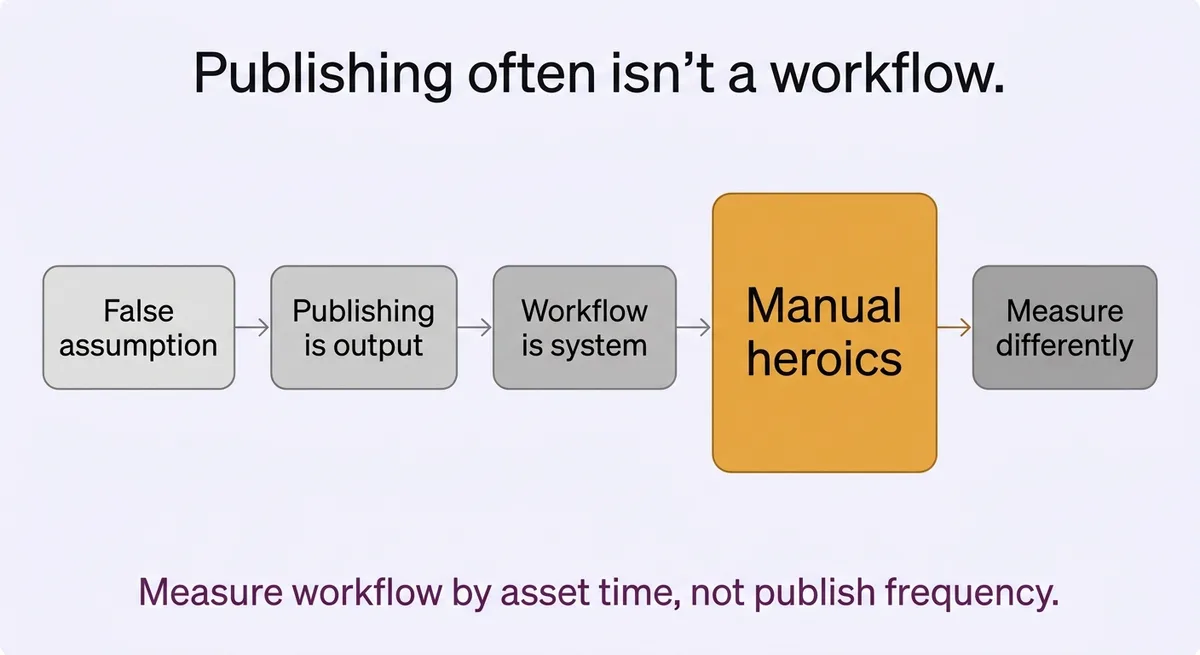
Publishing is an output. A workflow is the system that produces outputs with defined ownership, quality gates, and stage transitions. You can publish 3 blog posts per week [2] and still have no workflow at all, just a series of manual heroics that repeat differently every cycle.
Stop measuring workflow maturity by publish frequency. Start measuring it by how long a single asset takes from brief to live URL, and how often that number varies.
The variation is where the debt hides. Unstructured keyword research alone consumes 2-3 hours per piece [2]. When that task has no defined endpoint or handoff trigger, it bleeds into writing time, delays brief reviews, and compresses the editing window. A mishandled handoff between research and writing can stall an asset for 2+ weeks [2]. In a team producing four posts per month, one stalled asset costs 25% of monthly output.
A content calendar does not prevent this. A calendar shows what to publish and when. It does not define who owns each stage, what the acceptance criteria are, or what happens when a draft comes back from a freelancer without proper SEO structure.
Most teams operate with a partial system: they have a calendar, a writing tool, and a shared drive. They call that a workflow. The gaps between those tools are where posts go to stall.
One team running a four-client agency tracked every piece for 30 days. The average brief sat unreviewed for 9 days before any writing started. They added a single rule: no brief moves to a writer until the strategist marks it approved in the project tool. Average time-to-first-draft dropped by 6 days. Nothing else changed.
The lesson is not about tools. Ownership gaps break workflows, not software gaps.
Where Human Judgment Ends and Automation Should Begin
Automation does not threaten content quality. Automating the wrong stages does.
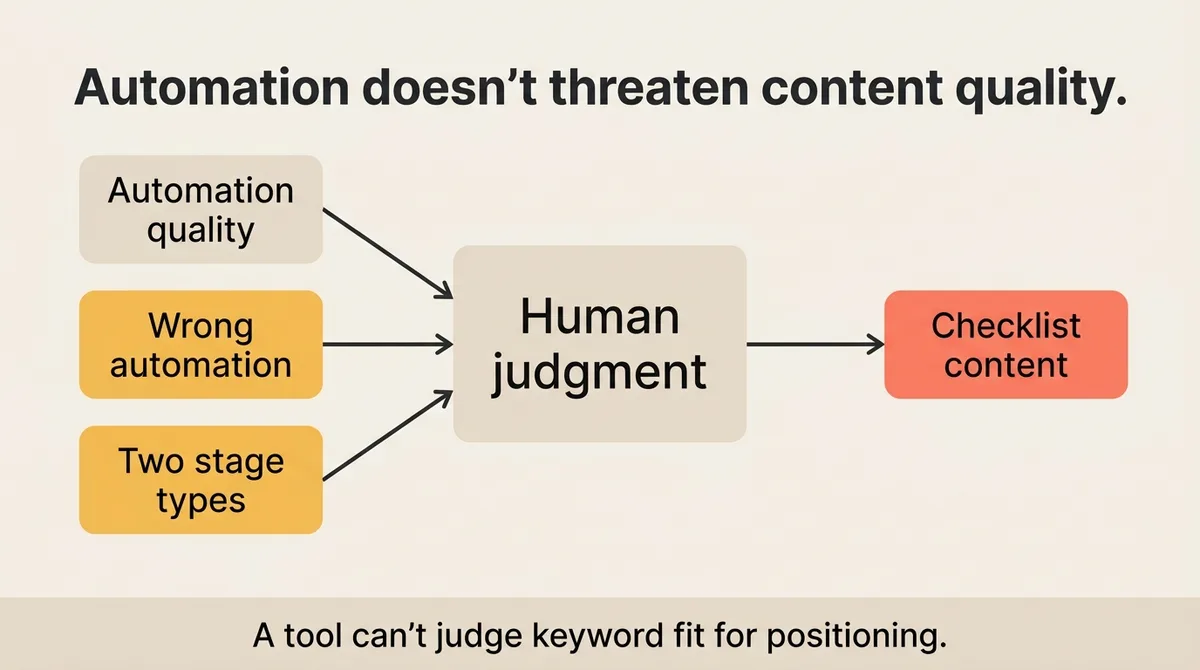
The Six-Stage Content Engine has two kinds of stages: judgment-dependent and pattern-executable. Mixing them up produces content that ranks poorly and reads like it was assembled by a checklist, because it was.
Human judgment must own strategy, brief review, editorial decisions, and performance interpretation. These stages require contextual reasoning. A tool cannot decide whether a keyword fits your positioning. An AI cannot catch when a draft misrepresents your product’s use case. An algorithm cannot interpret why a six-month-old post started losing rank last week.
The stages where automation earns its cost are different. Keyword clustering, SERP feature analysis, internal link suggestions, meta description generation, and publishing schedules are strong candidates. Manual keyword research takes up to 8 hours [1]. Automation compresses that same cycle to roughly 3 hours [1], a reduction of about 50% [1] in research time per piece. That recovered time should go toward brief quality and editorial review, not more volume.
Here is a direct breakdown:
Human-owned steps:
- Keyword prioritization based on business context
- Brief review and approval
- Structural and voice-level editing
- Performance interpretation and content update decisions
Automatable steps:
- Keyword clustering and grouping
- SERP analysis and feature identification
- Internal link recommendations
- Publishing schedule management
- First-pass meta description drafts
The implementation caveat most teams miss: automation works best inside a defined stage. Dropping an AI tool into an undefined process does not speed things up. It produces faster clutter. Map the stage first. Then add automation to the repeatable tasks within it.
Stop buying tools to fix a workflow problem. Start defining stages, then automate the tasks those stages contain.
How to Measure Whether Your Workflow Is Actually Working
Publication is not the finish line. It is the starting gun.
Most teams track rankings. Few track the workflow signals that predict ranking outcomes before they appear. Rankings surface six months later [2], which makes post-publish reporting nearly useless for improving production decisions. By the time you see a ranking drop, the brief that caused it is six months old.
The signals that matter are inside the workflow itself. They reveal whether your system is functioning before search engines confirm it.
Four workflow metrics worth tracking:
- Average days from brief to publish. A stable number means your stages are consistent. A rising number means a stage is breaking.
- Revision cycles per piece. More than two revision rounds usually signals a brief quality problem, not a writing problem.
- Percentage of content hitting target structure on first draft. Low percentages point to brief gaps or writer misalignment.
- Time-to-first-ranking-signal. How long after publishing does a piece appear in Search Console impressions? Unusually long delays often indicate technical or indexing gaps in Stage 5.
Monthly site updates [2] should trigger a structured content audit, not just a metrics review. That audit feeds directly back into Stage 1 of the Six-Stage Content Engine. Keywords that underperformed re-enter the planning queue with new context. Posts that gained traction get earmarked for expansion or internal linking.
Measurement closes the loop. Without it, the system runs open-ended. Each planning cycle starts from scratch instead of building on what the previous cycle produced.
One operational note: do not build a measurement dashboard before your workflow has three months of clean data. Track manually first. Patterns will surface within 60 days. Then automate the reporting.
Build the system once, then let it compound over time
The Six-Stage Content Engine is not a project. It is infrastructure.
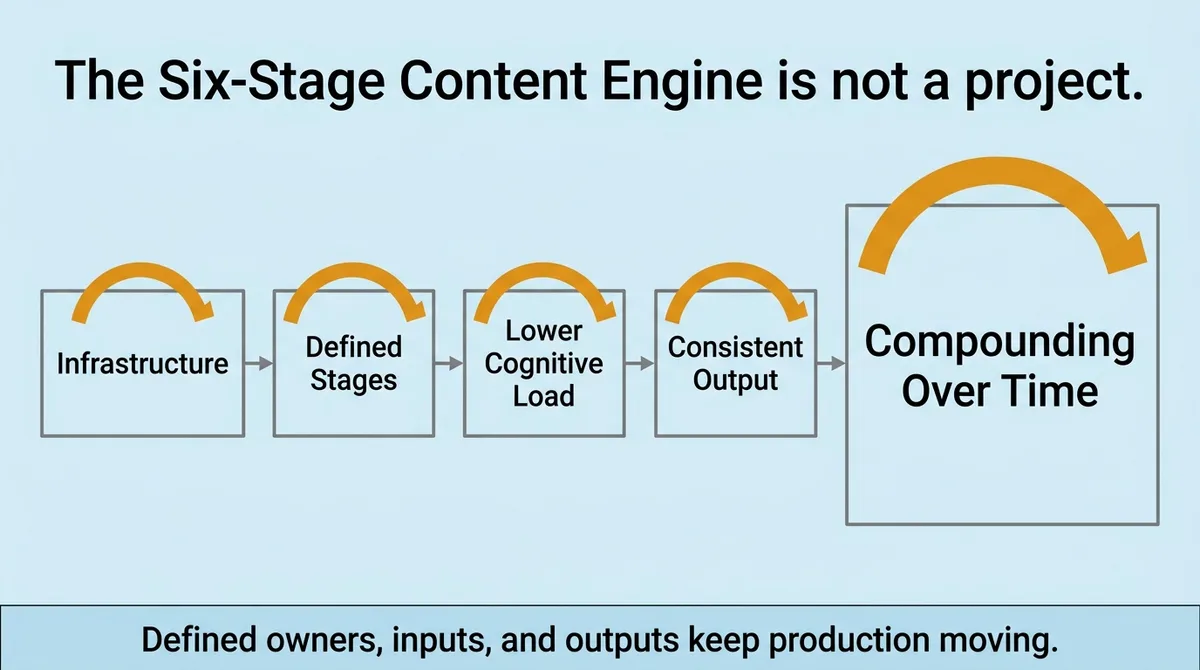
Teams that treat each content piece as its own creative problem rebuild the process every month. They spend coordination time instead of production time. Briefs vary. Quality varies. Timelines vary. Output collapses under its own inconsistency.
A standardized system does the opposite. Once each stage has a defined owner, a clear input, and a required output, the cognitive load drops. Writers know what a brief looks like before they start. Editors know what a draft needs before they open it. Publishers know what an optimized file contains before it hits the CMS.
That consistency compounds. Faster cycles produce more data. More data sharpens keyword prioritization. Better briefs raise first-draft quality. Lower revision rates free up editorial hours for strategy.
Build the Six-Stage Content Engine. Name every stage. Assign every owner. Measure cycle time from day one.
The blog that ships on cadence in month six is built in month one.
References and Citations
[1]https://www.marketermilk.com/blog/best-seo-automation-tools
[2]https://monday.com/blog/marketing/seo-workflow/
FAQ
A complete SEO content workflow has six stages: strategy and keyword planning (owned by the SEO lead), research and brief creation (content strategist), writing and editing (writer then editor), on-page optimization (SEO specialist or editor), publishing and distribution (content ops or CMS manager), and measurement and iteration (SEO lead or analyst). Each stage needs one named person accountable for the output, not a team, because shared ownership is the most common cause of handoff failure. A single piece run properly through all six stages typically takes 6-10 working days from brief to publish-ready file, which is a planning input, not a bottleneck.
Blog drafts stall because teams have tasks but not stages: there are no defined inputs, owners, or acceptance criteria at each handoff point, so work piles up between steps rather than moving through them. A brief sitting unreviewed for 9 days before writing starts, for example, can cost a four-post-per-month team 25% of their monthly output from a single stalled asset. The fix is structural: map every stage, name one owner per stage, and set a clear trigger that moves work forward. Platforms like Zelitho address this by connecting topic selection, draft generation, optimization, and CMS publishing inside one system, removing the tool-switching handoffs where drafts most commonly stall.
Keyword clustering, SERP feature analysis, internal link recommendations, meta description drafts, and publishing schedule management are strong candidates for automation, while strategy, brief review, editorial decisions, and performance interpretation must stay with human judgment. Automating keyword research can compress a cycle that manually takes up to 8 hours down to roughly 3 hours, freeing that recovered time for brief quality and editorial review rather than added volume. The critical caveat is that automation only works inside a defined stage: dropping a tool into an undefined process produces faster clutter, not faster results. Zelitho is built around this principle, handling the pattern-executable steps like research-backed draft generation and CMS publishing while keeping scope confirmation and editorial review in the hands of the team.
You measure a working SEO content workflow by tracking four internal signals: average days from brief to publish, revision cycles per piece, the percentage of first drafts hitting target structure, and time-to-first-ranking-signal in Search Console after publishing. Ranking data alone is a lagging indicator that surfaces roughly six months after publication, making it nearly useless for improving production decisions in real time. More than two revision rounds per piece typically signals a brief quality problem, not a writing problem, and a rising brief-to-publish average means a specific stage is breaking. Track these metrics manually for the first 60 days before building any dashboard, because patterns surface quickly and clean data makes automation of reporting far more reliable.
A content calendar shows what to publish and when, while an SEO content workflow defines who owns each production stage, what the acceptance criteria are, and what triggers the handoff to the next step. You can publish three blog posts per week and still have no workflow at all, just a series of manual heroics that repeat differently every cycle. The calendar is an output-tracking tool; the workflow is the operating system that produces the outputs reliably. Teams that want to move from calendar-only scheduling to a connected system, where keyword selection, drafting, optimization, and CMS publishing all happen in one place, often turn to a platform like Zelitho to replace the gap-filled stack of separate tools.