
What Is AI Search? A Clear Explanation of How AI-Powered Search Works

TL;DR
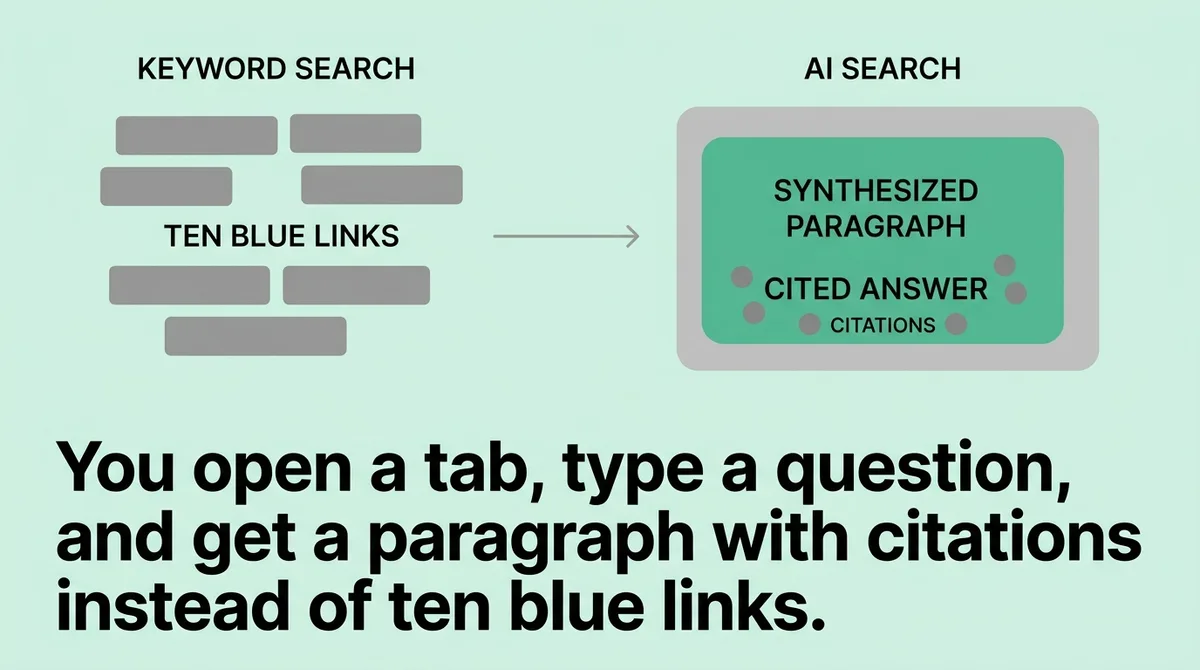
You open a tab, type a question, and get a paragraph with citations instead of ten blue links. That shift feels minor. It is not.
Keyword search ranks documents by relevance signals. AI-powered search interprets what you meant, pulls from multiple source types, and writes a synthesized answer before you click anything. The old model assumed you would do the reading. The new model does it for you, which sounds helpful until you realize the answer may not be fully supported by the sources attached to it.
The system behind this is called the Interpret-Retrieve-Generate Pipeline. It runs in three steps: parse your intent, retrieve supporting content, generate a grounded answer. Understanding each step tells you when to trust the output and when to verify it. This article is for anyone who consumes AI search results and for anyone whose content gets cited inside them.
Traditional Search Gave You a List. AI Search Gives You an Answer.
You have used keyword search for over two decades. Google built that system across 25 years [1], indexing the web by matching query tokens to document signals. Type a phrase, get a list of links. The assumption was always that you would click through, read the source, and form your own answer.
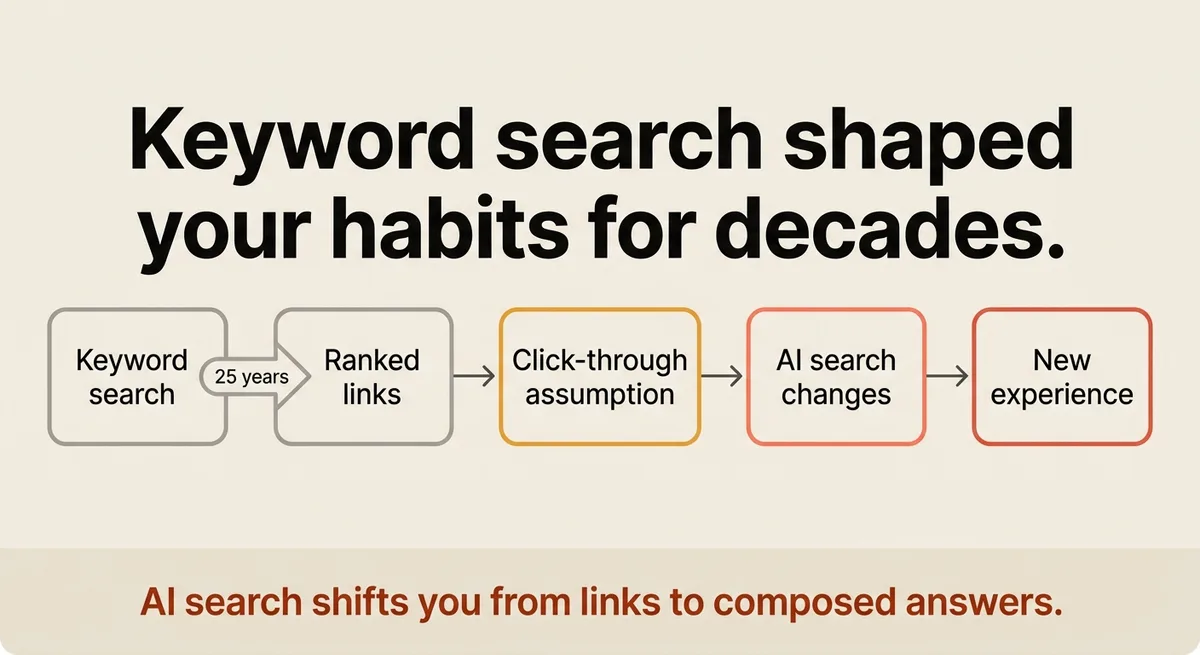
That assumption no longer holds.
AI-powered search returns a composed paragraph instead of a ranked list. Ask “best way to treat a minor burn at home” in a traditional search engine and you get ten links, some from medical sites, some from lifestyle blogs. Ask the same question in an AI search system and you get a ranked set of steps written in prose, with source tags attached. You may never click any of them.
This is not a cosmetic update to the same system. It is a different output format built on a different process. That process has a name: the Interpret-Retrieve-Generate Pipeline, or IRG Pipeline. It replaces token matching with intent parsing, replaces a single ranked index with multi-source retrieval, and replaces a list with a generated answer. The IRG Pipeline runs every time you type a query into an AI-powered search interface.
Traditional search has been used billions of times [1], which means most people carry a strong mental model of what search output looks like. A list. Links. A title and a snippet. That expectation creates friction when the output changes to a paragraph with footnotes. Users trained on list behavior now receive answer behavior, and the difference affects how much they trust the result, how far they read, and whether they ever reach the original source.
Attribute | Traditional Search | AI Search |
|---|---|---|
Output format | Ranked list of links | Synthesized prose answer |
Source visibility | Title and URL per result | Inline citation tags |
Click requirement | Required to get the answer | Optional, often skipped |
Intent handling | Token matching | Semantic intent parsing |
The IRG Pipeline does not just change the interface. It changes the relationship between a question and an answer. The system no longer points you toward information. It delivers a version of that information directly, already assembled.
The Three-Step Pipeline That Turns Your Query Into a Cited Answer
Every AI search result you read passed through three distinct operations. Knowing what each one does tells you where accuracy can hold and where it can slip.
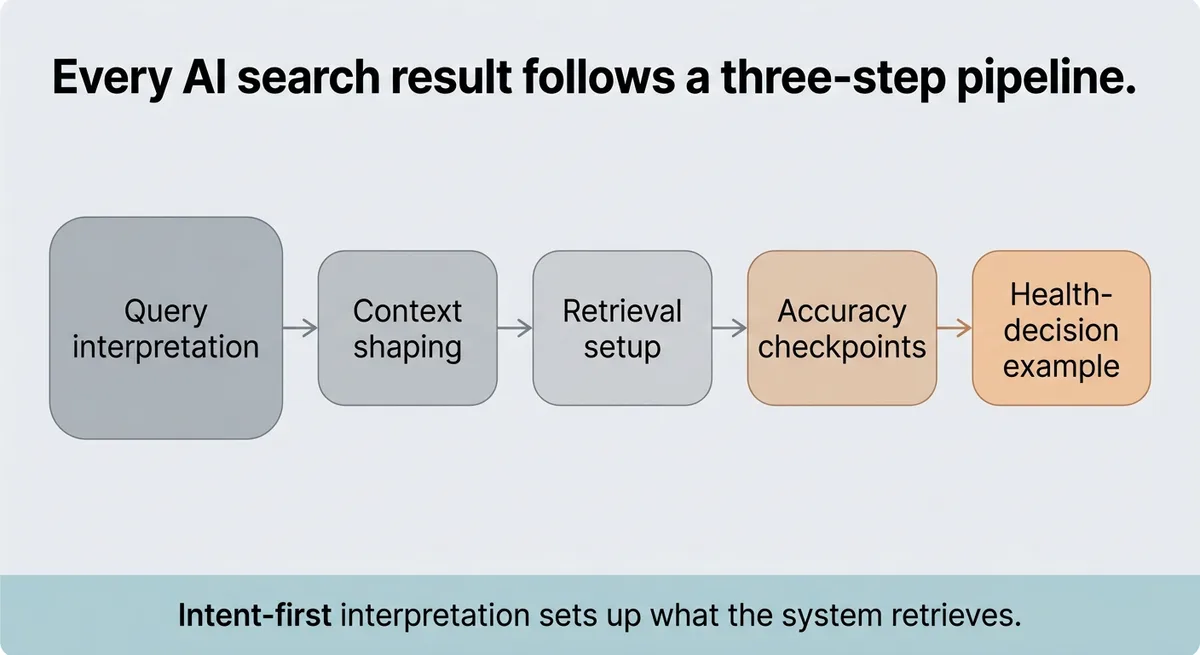
Step 1: Query interpretation. The system reads your query for intent, not just tokens. A search for “is it safe to run with shin pain” is not processed as a keyword cluster. The system identifies it as a health-decision question, assigns context about the type of answer expected, and shapes the retrieval step accordingly. The query is parsed before any content is fetched.
Step 2: Semantic retrieval. The system pulls content from multiple knowledge source types rather than a single ranked index. Azure AI Search names 8 distinct knowledge source types in its architecture [4], including structured data, vector stores, and document indexes. That multi-source design means the system is not reading one database. It is assembling fragments from several simultaneously, which increases breadth and introduces inconsistency.
Step 3: Answer generation. A language model takes the retrieved content and writes a response in prose. It attaches source grounding, the citations you see at the end of a sentence or paragraph. Four core components shape how visibility products evaluate this generated output [2]. The generation step is where synthesis happens. It is also where the retrieved content and the final answer can diverge.
The IRG Pipeline is operational, not theoretical. Each step performs a specific action:
- Parse intent from the query.
- Retrieve relevant content from multiple source types.
- Generate a written answer grounded in that content.
Stop thinking of AI search as a smarter Google. Start treating it as a writing system that uses your query as a prompt and the web as its draft material. That framing changes what questions you ask about the output.
The system setup matters because each step introduces its own failure mode. Misread intent in step one and the retrieval pulls the wrong content. Pull from a low-quality source in step two and generation synthesizes bad input. Generate a fluent answer in step three and the reader assumes accuracy that was never guaranteed. The pipeline moves fast. The errors move with it.
You Probably Think Source Citations Make AI Search Trustworthy , Here Is Why That Belief Needs Pressure
A citation in AI search does not mean what most readers assume it means.
When you see a footnote attached to a sentence in a generated answer, the instinct is to read it as confirmation. The source checked the claim. The system verified the content. That instinct is wrong, and the data is clear about how wrong it is.
A 2025 audit found that 30% to 90% of responses from multiple web-enabled AI systems were not fully supported by their cited sources, depending on the system tested [3]. That is not a rounding error across a small sample. It is a documented range across real systems that users trust daily. The lower bound alone, 30% of answers partially unsupported, should shift how you read any AI-generated result.
The reason is structural. Generation and grounding are separate steps in the IRG Pipeline. The language model writes the answer. It attaches citations to the content it retrieved. Those two actions do not confirm each other. The model can write a fluent sentence, attach a real URL, and still produce a claim the source does not support. The citation signals retrieval, not verification.
Compound that with how users actually behave. Zero-click searches climbed from 56% to 69% between May 2024 and May 2025, after AI Overviews launched [3]. More than two-thirds of searches now end without a click to the original source. That means most users are accepting the generated answer as complete without checking what the cited source actually says.
Treat cited AI answers the way you treat an attributed quote in a news article. Verify before you repeat it. If the answer informs a decision that carries real cost, financial, medical, or legal, click through to the source. Read the original. The citation tells you where the system looked. It does not tell you whether what it wrote matches what it found.
Citation presence is a transparency mechanism. It is not an accuracy guarantee.
What AI Search Changes for You, the Publisher, and the Discovery Loop
The behavioral change is already priced in. Enterprise spending on generative AI reached $37 billion in 2025, more than triple the prior year [3]. That number signals commitment at scale. AI search is not a pilot program at large companies. It is funded, deployed, and running at volume.
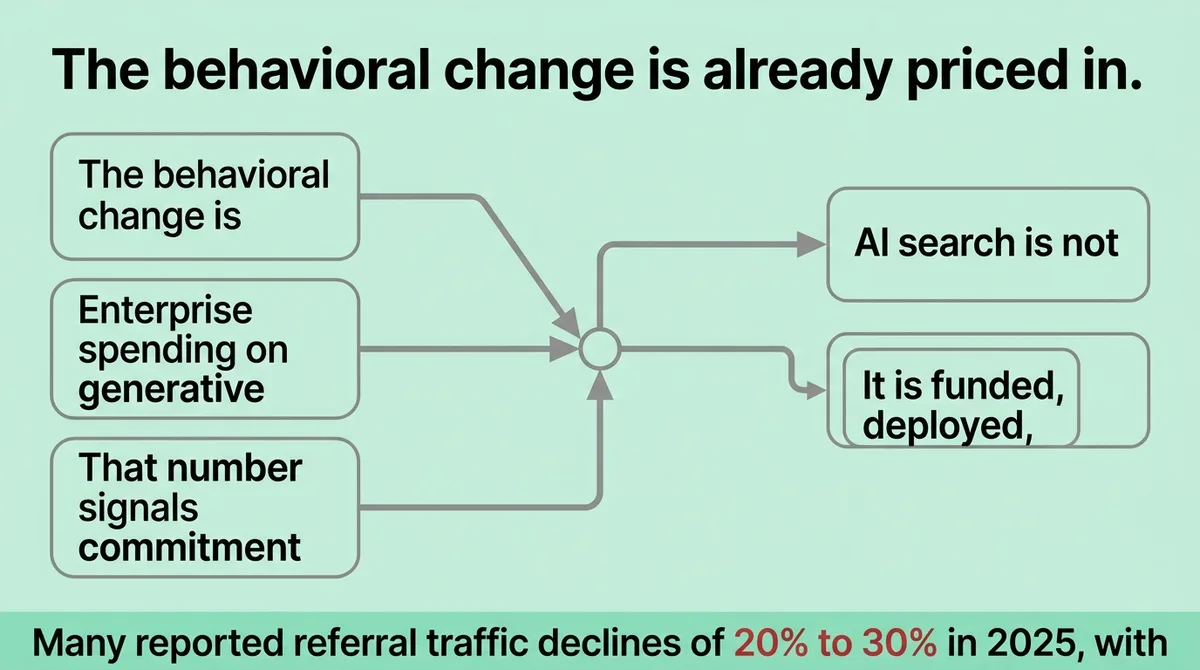
For publishers, the consequence is direct and measurable. Many reported referral traffic declines of 20% to 30% in 2025, with some limited cases reaching 90% [3]. Picture a content team that spent two years building a blog strategy around organic search traffic. In 2025, inbound referrals dropped by a quarter, with no algorithm update to diagnose, no penalty to appeal, no clear fix to execute. The IRG Pipeline answered the questions their articles used to answer. The reader never needed to click.
That is not an edge case. It is the default direction of the ecosystem.
For the person reading AI search results, the discovery loop compresses. Traditional search assumed a multi-step journey: search, scan, click, read, form an opinion, maybe search again. AI search collapses that into one step. The system delivers a synthesized answer and suggests follow-up questions it will also answer. The reader stays inside the system. Exploration becomes AI-directed instead of reader-directed.
That compression has a practical cost. You do not discover the sources you would have found by clicking through. You do not notice when the answer is partial. You do not encounter the secondary article that would have changed your conclusion. The efficiency feels real. The information loss is invisible.
One operational habit worth building: for any AI search answer that informs a real decision, click at least one cited source before acting. This is not about distrust. It is about confirming that the citation says what the generated answer claims it says, given the 30% to 90% grounding gap documented in 2025 [3].
The IRG Pipeline runs the same way regardless of the stakes of your question. It does not flag low-confidence answers differently than high-confidence ones. The output looks identical whether the grounding is tight or loose. Readers carry the responsibility for knowing the difference.
Why the Pipeline Behind AI Search Changes Every Answer You Trust
The shift from list to answer is not cosmetic. It changes who does the synthesis, where accuracy is assumed, and what happens when the synthesis is wrong.
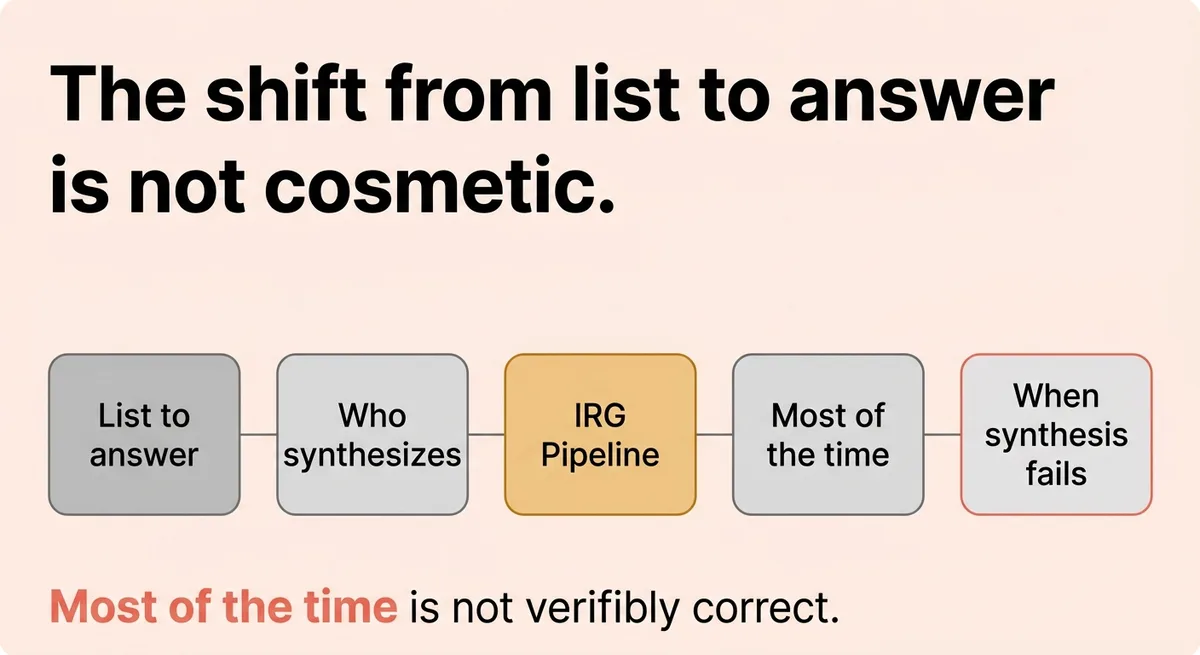
The IRG Pipeline, interpret, retrieve, generate, runs at scale across billions of queries. Each step functions correctly most of the time. The problem is that “most of the time” is not “verifiably correct every time,” and the output format does not signal the difference.
For readers, the practical change is simple: an answer with a citation attached deserves the same scrutiny as an answer without one. The citation shows the system’s source. It does not show whether the generated sentence reflects that source accurately.
For publishers and content creators, the change is structural. If your content answers questions that AI search now answers directly, your traffic model from two years ago no longer applies. The pipeline retrieves your content and uses it. Whether the reader ever arrives at your page is a separate question.
This is exactly the gap Zelitho was built to close. Instead of writing content and hoping the IRG Pipeline picks it up correctly, Zelitho structures every article for retrieval from the start — research-backed drafts built from real sources (not filler), schema and structured-answer blocks injected automatically, and citation-friendly formatting that gives AI systems something clean to ground an answer in. Founders using it have seen citation shifts in ChatGPT and Perplexity within 2–4 weeks of publishing — the same window this pipeline runs on. If your blog already ranks but isn’t getting cited, the problem usually isn’t the writing. It’s that nothing on the page was built for a retrieval step to grab cleanly.
Read the citations. Click the sources that matter. The answer is a starting point, not a final word.
References and Citations
[1]https://blog.google/products-and-platforms/products/search/generative-ai-google-search-may-2024/
[2]https://aisearch.similarweb.com/
[3]https://www.databricks.com/blog/ai-search
[4]https://azure.microsoft.com/en-us/products/ai-services/ai-search
FAQ
AI search works in three steps: it interprets your query for intent, retrieves content from multiple source types simultaneously, and then generates a written answer in prose with inline citations. This process is called the Interpret-Retrieve-Generate Pipeline, or IRG Pipeline, and it replaces the old keyword-matching system that returned a ranked list of links. Understanding each step matters because each one has its own failure mode: misread intent pulls the wrong content, low-quality retrieval pollutes the answer, and fluent generation can sound accurate even when the underlying sources do not fully support the claim.
Citations in AI search results signal where the system looked, not whether the generated sentence accurately reflects what the source says. A 2025 audit found that 30% to 90% of responses from web-enabled AI systems were not fully supported by their cited sources, depending on the system tested. Treat every cited AI answer the way you would treat an attributed quote: verify before repeating it, and click through to the original source for any decision that carries real financial, medical, or legal stakes.
Traditional search returns a ranked list of links matched by keyword tokens, expecting you to click through and form your own answer. AI search returns a synthesized prose answer with inline citations, produced by a three-step pipeline that parses your intent, retrieves from multiple source types, and generates a written response before you click anything. The practical difference is that the click is now optional, and most users skip it: zero-click searches climbed from 56% to 69% between May 2024 and May 2025 after AI Overviews launched.
AI search directly reduces referral traffic to publishers because the IRG Pipeline answers questions that blog articles used to answer, removing the need for readers to click through to the source. Many publishers reported referral traffic declines of 20% to 30% in 2025, with some limited cases reaching 90%, and no algorithm update to diagnose or appeal. For marketing teams managing blog production, this means content strategy must account for citation-level visibility inside AI answers, not just ranked link position. Platforms like Zelitho are built to address this by producing research-backed, citation-ready articles structured for visibility across both traditional search and AI answer surfaces.
Content teams need to produce articles that are structured, well-cited, and directly answer specific questions, because the IRG Pipeline retrieves fragments from multiple sources and uses them as draft material for generated answers. That means the unit of value is no longer just a ranked page but a quotable, grounded passage that an AI system will pull and cite. Zelitho addresses this directly by combining keyword discovery, research-backed draft generation with citations, and on-page optimization into one connected workflow, so teams can publish at the cadence and structure that AI retrieval systems favor without managing separate tools for each step.