
What Is AI-Powered Marketing? A Simple Definition and Basic Explanation

TL;DR
You just got a piece of content ranking. Now someone in the room is asking whether AI should be running more of your marketing. You are not sure what that actually means, and the vendor demos have not helped.
Most teams adopt AI tools before defining what problem the tool should solve. The result is a stack of software producing outputs nobody checks against real business goals. Budget moves. Results do not.
AI-powered marketing uses software that learns from data to automate, predict, and personalize marketing decisions. The Three-Function Model covers the core of what these tools do: customer understanding, task automation, and personalization. Marketers using these tools complete 25.1% more tasks faster and report 40% higher quality results. [2] This article explains how the system works, where human judgment is still required, and what limits to expect before you commit to any tool.
What is AI in marketing in simple words?
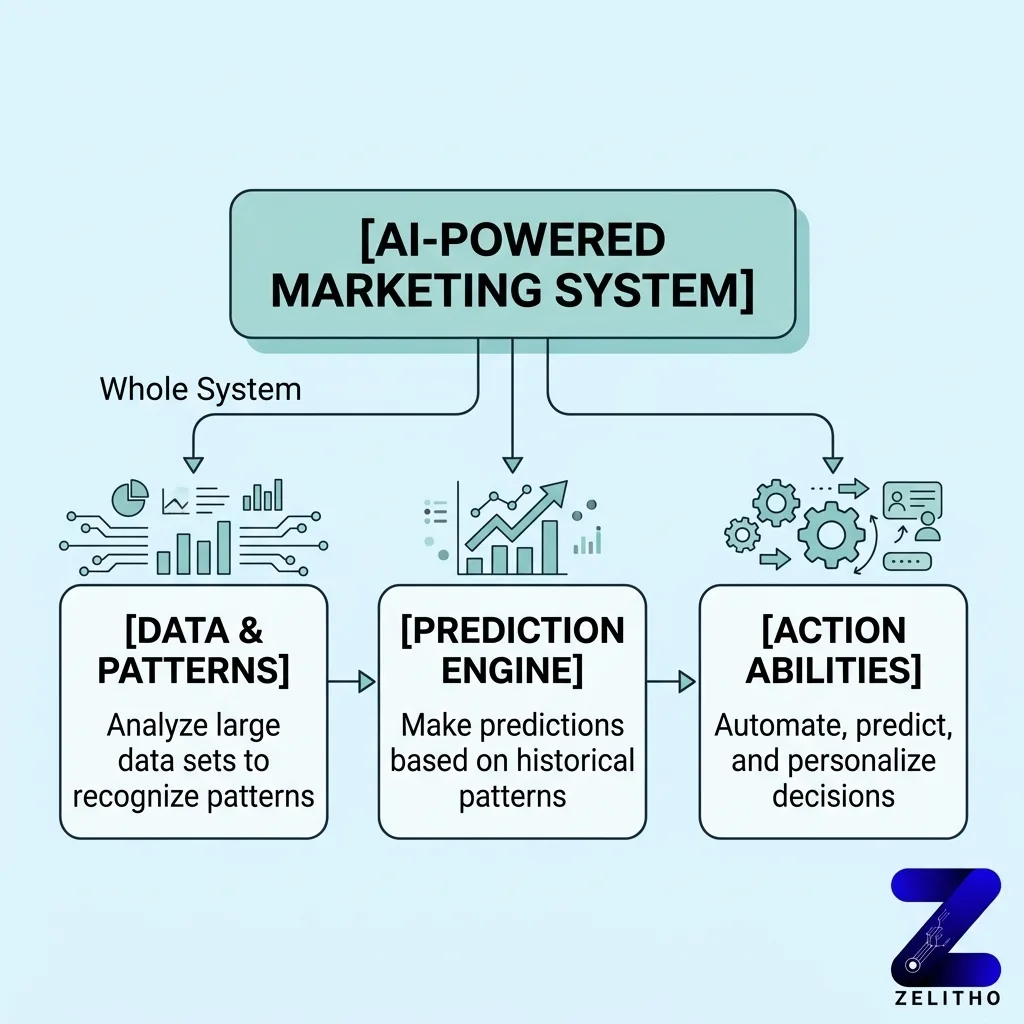
AI-powered marketing is the use of software that learns from data to automate, predict, and personalize marketing decisions.
That is the one-sentence definition. Everything else in this article builds on it.
The word “AI” causes confusion because it suggests human-like thinking. That is not what these tools do. They recognize patterns in large data sets and make predictions based on those patterns. They do not reason, set goals, or understand context the way a person does.
Here is a concrete example. A customer browses a product twice but does not buy. An AI-enabled email platform detects that behavioral pattern, cross-references it against conversion data from similar users, and sends a discount automatically. No human manually triggers that email. The system learned that this pattern predicts buying intent.
That is pattern recognition and prediction, not intelligence.
What AI-Powered Marketing Actually Means (A Plain-Language Definition)
The measurable function matters more than the label.
Marketers using AI tools complete 12.2% more tasks on average, finish work 25.1% faster, and report 40% higher quality results. [2] Those numbers describe what the software actually does: it removes friction from repetitive decisions so humans can spend time on fewer, higher-stakes ones.
The distinction worth holding: AI tools execute instructions at speed and scale. They do not write the instructions. A platform that automatically adjusts email send times is making predictions based on historical open data. Someone still had to decide that email was the right channel, that the list was the right audience, and that the offer was worth sending.
Stop thinking of AI as a brain. Start thinking of it as a very fast pattern-matching system that needs a human to aim it.
This article does not treat AI as magic. It treats it as a set of tools with specific functions and real limits. That framing will serve you better than any vendor pitch.
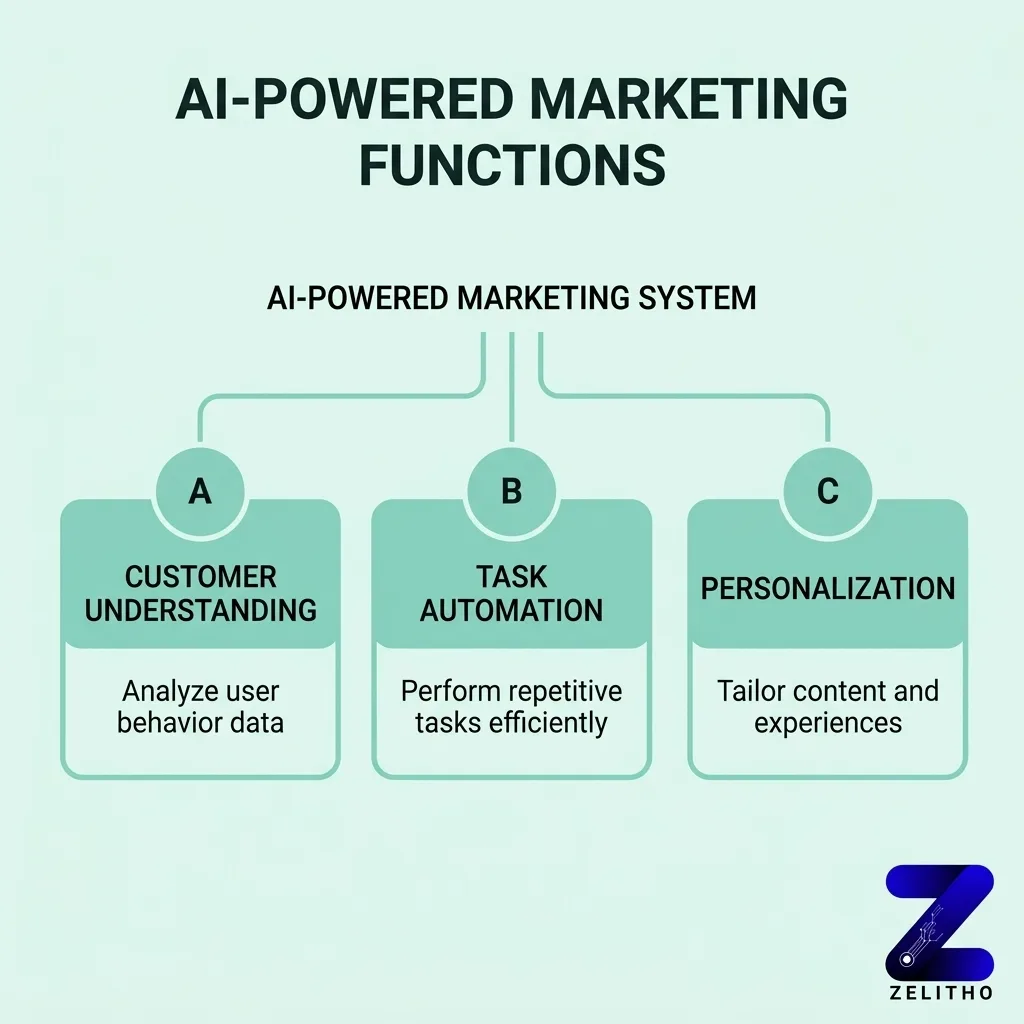
The Three Core Functions That Make AI Marketing Work
Most AI marketing tools perform one of three jobs. Knowing which job a tool does helps you evaluate whether you actually need it.
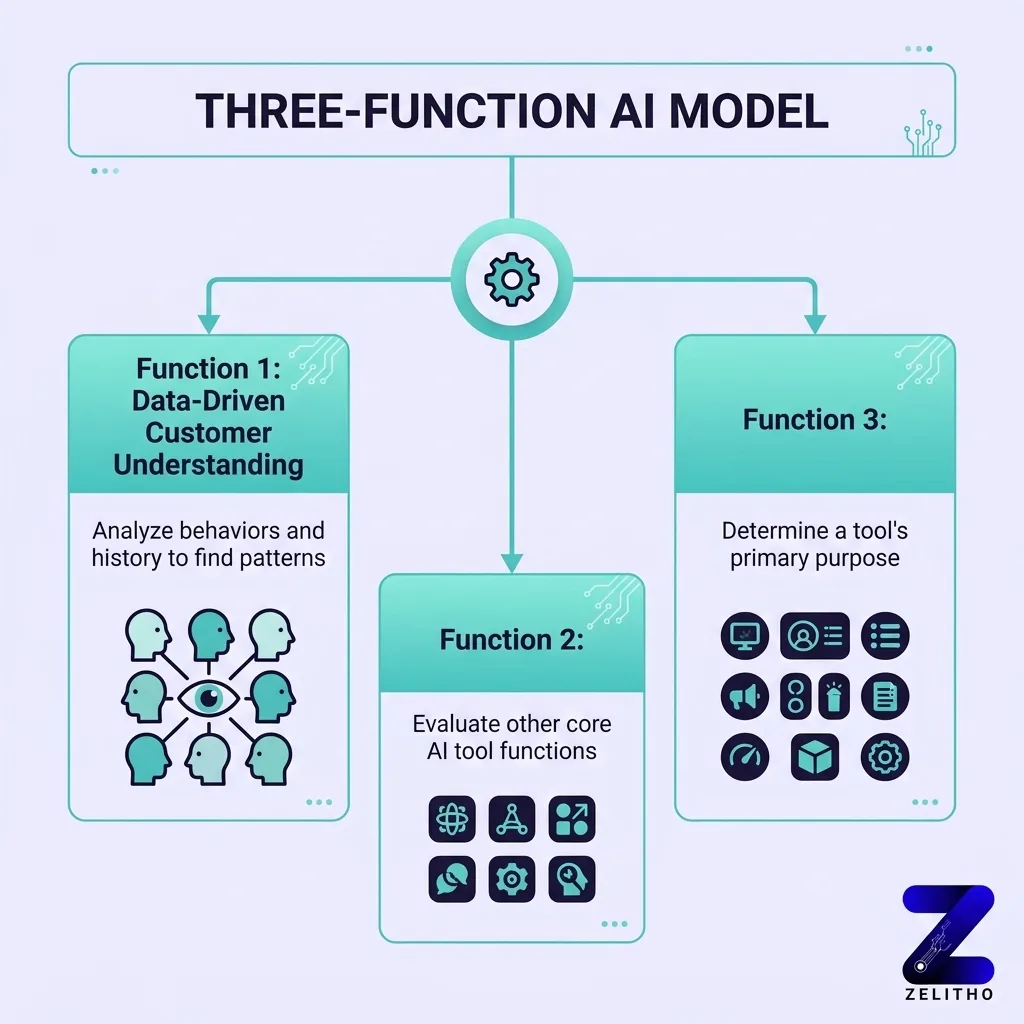
Call this the Three-Function Model. It covers what these tools do in practice, without the abstraction.
Function 1: Data-driven customer understanding. AI analyzes purchase history, browsing behavior, and engagement signals to find patterns humans would miss at scale. A team of analysts cannot manually process behavioral data across 50,000 users in real time. Software can. That pattern recognition tells you who is likely to buy, when, and at what price point.
Function 2: Automation of repetitive marketing tasks. Ad bidding, send-time optimization, and A/B test selection run without manual input. The software makes micro-decisions continuously, based on live performance data. This is where the time savings accumulate. Teams that deploy automation correctly see campaign costs drop by 30%. [2]
Function 3: Personalization across channels. Emails, ads, and website content adapt to individual users based on behavioral data. A returning visitor sees different content than a first-time visitor. A user who clicked a pricing page gets a different follow-up than one who only read a blog post. This is not dynamic content for its own sake. It is relevance at scale. AI-assisted personalization drives a 35% lift in sales revenue for teams that implement it correctly. [1]
The Three-Function Model is worth writing on a whiteboard before you evaluate any tool. If a platform does not clearly map to one of these three jobs, the use case is unclear.
Here is a direct comparison of what changes when you move from manual to AI-assisted marketing:
Area | Manual Marketing | AI-Assisted Marketing |
|---|---|---|
Speed | Hours to days per decision | Seconds to minutes |
Scale | Limited by team size | Runs across millions of data points |
Personalization depth | Segment-level at best | Individual behavioral triggers |
The table is not an argument for replacing manual processes entirely. It shows where the gap exists and where AI tools fill it.
One practical note: 78% of marketers report that AI saves them time on tasks they were already doing manually. [1] That is the entry point, not the full picture.
You Probably Think AI Replaces Strategy. Here Is Why That Belief Will Cost You.
Here is the false assumption worth naming directly: adopting AI tools is not the same as having an AI strategy.
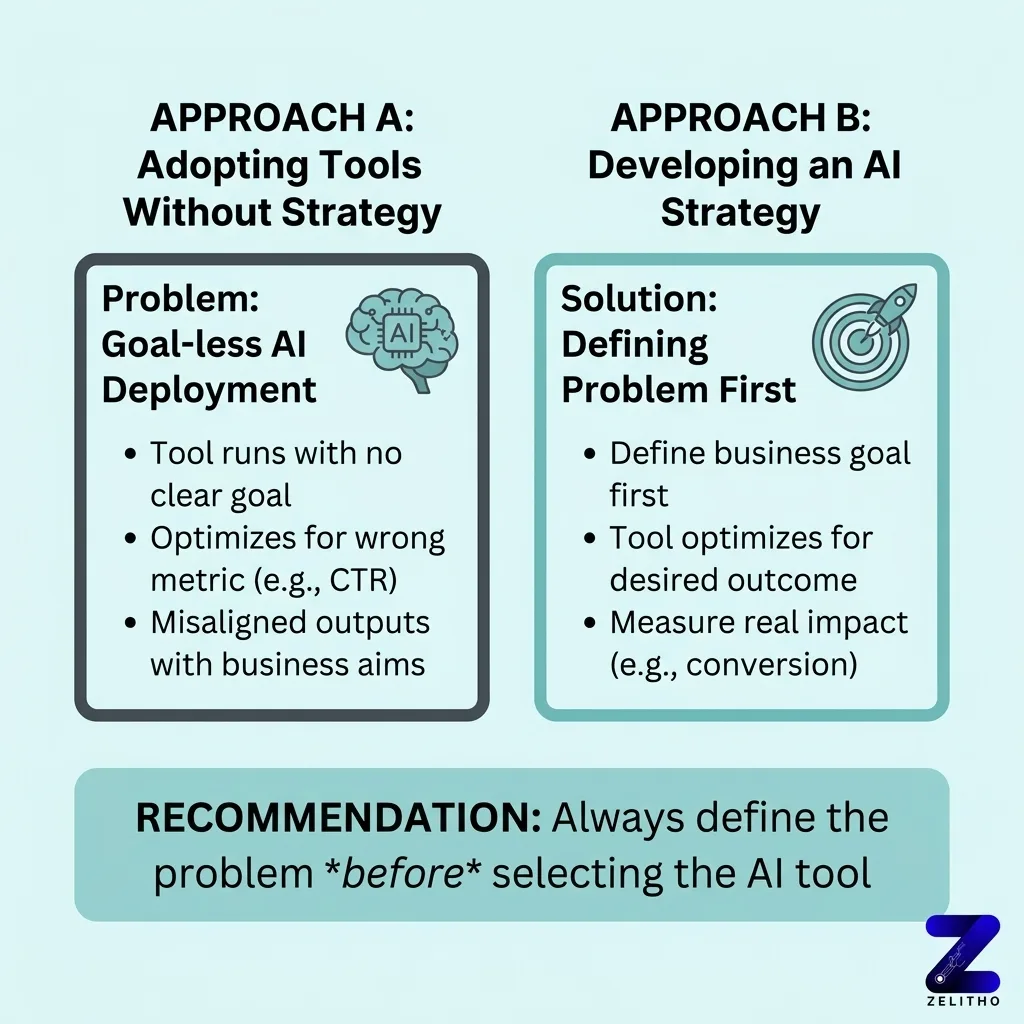
A tool that runs without a goal will optimize for the wrong thing. That is not a limitation of the software. That is a failure of setup.
Consider a concrete example. A team deploys an AI platform and sets it to optimize for click-through rate. CTR climbs. The reports look good. Nobody checks conversion data for eight weeks. When they do, revenue has dropped 30% because the tool found high-click, low-intent audiences and spent the budget there. The machine did exactly what it was told. It was told the wrong thing.
This is where human judgment is still required: goal definition, metric selection, and output review. AI executes on the direction it receives. It does not correct a bad direction.
Only 22% of marketing leaders have fully integrated AI into their strategy with clear goal alignment. [2] That means most teams are using tools without the governance layer that makes those tools produce useful results. The tool is not the problem.
Roles are shifting because of this. Nearly 6 out of every 10 current marketing specialist and analyst jobs may be affected by marketing technology. [3] Read that carefully. The roles most at risk are execution-only roles, where the work is repetitive and rule-based. Strategic roles, where someone sets the goal and interprets the output, are not at risk. They are becoming more important.
When teams combine clear human direction with AI execution, productivity rises by 30%. [2] That number comes from teams where a human defined the objective before the automation ran.
The practical rule: define the goal before you automate anything. If you cannot write the goal in one sentence, the tool will not help you find it.
Practical Limits You Should Know Before You Start Using AI Marketing Tools
The question most people do not ask before buying an AI marketing tool: what does this break if I set it up wrong?
Three real constraints matter here.
Constraint 1: Data quality. AI learns from your data. If your data is incomplete, duplicated, or uncleaned, the predictions it produces will reflect that. Garbage in, garbage out is not a cliche here. It is the mechanism. A model trained on 18 months of email data from a list that was never properly segmented will generate targeting recommendations based on bad signal. The tool runs confidently on wrong conclusions.
Constraint 2: Setup timeline. Results typically take 3 to 6 months to stabilize after implementation. [1] This is not a flaw. Machine learning models need enough behavioral data to identify reliable patterns. Teams that expect week-two ROI and abandon the tool at week six are the most common failure case. Set a 90-day minimum before drawing conclusions from any AI-driven campaign.
Constraint 3: Privacy and compliance. Collecting behavioral data requires clear consent practices. GDPR and CCPA apply to the signals these tools depend on. Personalization that violates consent is not just a legal risk. It damages the audience relationship that makes personalization valuable in the first place. Check what data your tool collects and how it stores and uses it before deployment.
When setup is done correctly, the returns are measurable. One documented implementation produced 99.5% time savings on specific reporting tasks, translating to $119,328 in annual savings from that function alone. [2] That number comes from a real-world operational deployment, not a vendor estimate.
The practical guidance that most beginner content gets wrong: do not automate everything first and optimize later. That approach creates a system running at speed in the wrong direction. Start with one function from the Three-Function Model. Configure it cleanly. Measure it against a business outcome, not a tool metric.
One implementation caveat most guides skip: AI platforms report their own performance metrics, and those metrics are not neutral. An ad platform will surface the numbers that make the platform look useful. Your job is to connect those numbers to revenue, pipeline, or whatever outcome actually matters to your business. Disconnecting platform metrics from business outcomes is where most early-stage AI marketing deployments quietly fail.
What AI-Powered Marketing Is, and What It Is Not
AI-powered marketing is not a trend to chase or a threat to fear. It is a set of tools that perform specific functions well when pointed in the right direction. The Three-Function Model covers most of what these tools do in practice: customer understanding, task automation, and personalization. The measurable gains are real. Teams complete tasks 25.1% faster. [2] Campaign costs drop by 30% when automation is deployed correctly. [2] Annual savings in the range of $119,328 are documented for specific operational functions. [2]
Those gains depend on one thing most beginner guides skip: a human who sets clear goals, monitors outputs, and knows when to override the machine.
Start with one function. Define your goal before you automate anything. Measure what actually matters to your business, not just what the tool reports back.
The Three-Function Model is a decision filter, not a checklist. Use it to evaluate any tool before you buy it. If the tool does not clearly perform one of the three functions, the use case is not clear enough to proceed.
Measure what actually changed in your business after 90 days.
Read more: How to Use AI in Your Marketing Strategy: Goals, Tools, and Implementation Considerations
FAQ
AI in marketing is software that learns from customer data and uses that learning to make or suggest marketing decisions automatically. It handles tasks like deciding when to send an email, which ad to show a specific user, or which customers are most likely to buy. The software does not think. It recognizes patterns and acts on them.
The United States currently leads in AI research output, private investment, and large-scale commercial AI deployment. China ranks second by most measures, particularly in applied AI and government-funded development. Rankings shift depending on the metric used, whether that is patents, funding, talent concentration, or published research.
A retail brand’s email platform detects that a user browsed a product page twice without purchasing. The system automatically sends a personalized email with a limited discount within four hours of the second visit. No human triggers that email. The platform learned that this behavioral pattern predicts buying intent and acts on it without manual input.
AI is software that gets better at a task the more data it sees. Instead of following a fixed set of rules, it identifies patterns in past data and uses those patterns to make predictions about new situations. In marketing, that means predicting which customers are likely to buy, which messages they respond to, and when to reach them.
References and Citations
[1]https://www.averi.ai/learn/what-is-ai-marketing-a-beginner-s-guide-to-ai-powered-marketing
[2]https://improvado.io/blog/what-is-ai-marketing
[3]https://www.marketingevolution.com/marketing-essentials/ai-markeitng