
What Is AI Marketing? A Clear Guide to How It Works in Digital Marketing


TL;DR
You opened a campaign report last week. The numbers looked acceptable. But you could not explain why one segment converted and another did not. That uncertainty is the real problem, not your tools.
Most teams treat AI as a way to move faster through the same decisions. That framing caps what the technology can actually do. Faster bad decisions are still bad decisions.
The Connected Decision System is a framework that links audience analysis, adaptive personalization, and governed execution into one continuous loop. Instead of speeding up your current workflow, it changes the quality of choices your team makes at every stage. Senior marketers, founders scaling content, and agency owners managing multiple clients all benefit when the system connects, rather than just accelerates, what their marketing does.
What Is AI Marketing and How Is It Different from Automation?
AI marketing is the practice of using machine learning and behavioral data to improve how decisions get made across a marketing workflow, from audience selection through message delivery to performance review. It is not a content scheduler. It is not a chatbot.
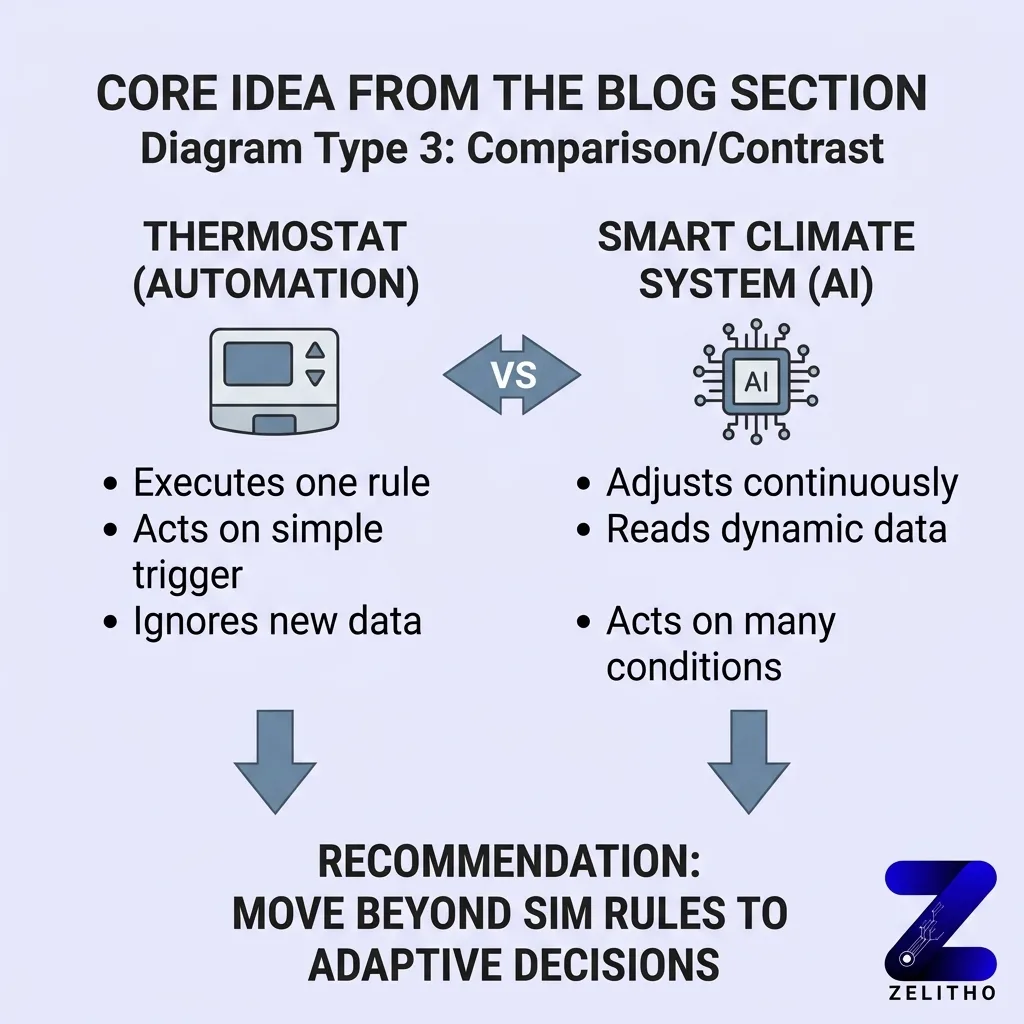
The difference from automation is the difference between a thermostat and a smart climate system. A thermostat executes one rule. A smart climate system reads room conditions, occupancy patterns, and forecast data, then adjusts continuously. One acts on a schedule. The other acts on signals.
What AI Marketing Actually Is, And Why the Automation Label Misses the Point
Stop thinking of AI as a task-replacement tool. Start accepting that your current decision quality, not your execution speed, is the actual bottleneck.
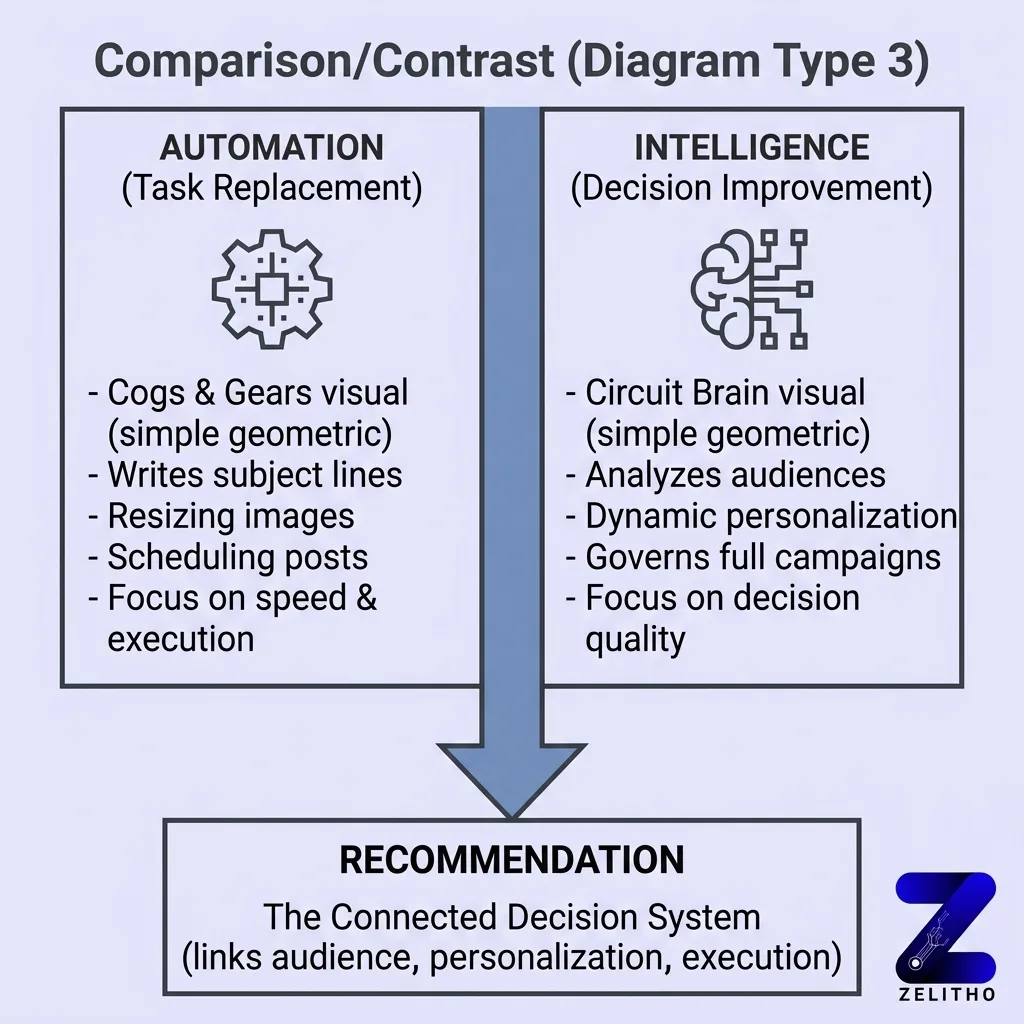
Most marketing teams adopt AI by pointing it at repetitive work: writing subject lines, resizing images, scheduling posts. That is automation. Useful, yes. Transformative, no. The teams getting the clearest results are using AI to change how decisions get made before, during, and after a campaign runs.
This distinction has a name worth keeping: the Connected Decision System. It describes an approach where AI links audience data, campaign execution signals, and performance feedback into one continuous loop. The goal is not to save hours. The hours saved are a byproduct. The goal is to make each marketing decision better informed than the last.
Data from Marketing Brew shows campaign launches moving up to 8x faster when AI is integrated this way [1]. That speed is not the result of cutting corners. It comes from removing the lag between signal and response. The system acts on live data. The team stops waiting for the next reporting cycle to know what is working.
One caveat before going further: this article is not a tool guide. It does not argue that AI replaces marketers. It argues that marketers using AI only for content generation or task scheduling are working with a fraction of what the system can do.
Dimension | Automation | Connected Decision System |
|---|---|---|
What it acts on | Predefined tasks | Live signals and data patterns |
When it acts | On a schedule | Continuously, based on feedback |
What improves | Speed of execution | Quality of decisions made |
The table above is not semantic. It changes how you scope your next AI investment. If the system you are evaluating only affects the first column, you are buying a faster conveyor belt.
You Probably Know Your Audience Less Precisely Than You Think
Here is the uncomfortable assumption most marketing teams carry: because they built their personas carefully, those personas are accurate.
They are often not. Careful construction and data accuracy are different things. Personas built from survey responses, sales team intuition, and platform demographic filters reflect who your team believes is the audience. AI analysis of behavioral, contextual, and transactional data often reveals a different picture entirely.
Consider a concrete scenario. A brand targets 35 to 44-year-old professionals based on firmographic logic and past campaign performance. AI clustering of actual conversion behavior reveals that the highest-converting segment is 28 to 32-year-old first-time managers, a group buying for the first time, not repurchasing. This changes three things immediately: budget allocation shifts toward acquisition messaging, creative framing moves away from authority and toward confidence-building, and channel mix adjusts because the two groups behave differently across platforms.
Published research from Park University in June 2025 places this kind of behavioral pattern detection at the center of how AI changes marketing practice [2]. The operational shift is not about switching tools. It is about auditing whether your current segments are built from assumption or from pattern detection in real behavior data.
The audit question to ask your team is direct: when did you last validate your primary segment against actual conversion behavior, not reported preference or demographic filter? If the answer is more than two quarters ago, the segments are running on assumption.
Most teams will find at least one meaningful gap. A brand that spent eight months optimizing creative for the wrong segment lost not just budget but the data that correct targeting would have generated. That is the real cost: not just wasted spend, but missing signal.
Personalization at Scale Is Not About More Variations, It Is About Smarter Ones
The most common personalization mistake is treating it as a production problem. Teams build 30, 50, sometimes 80 static variations of an ad or email. They assign segments to each. They launch. They wait.
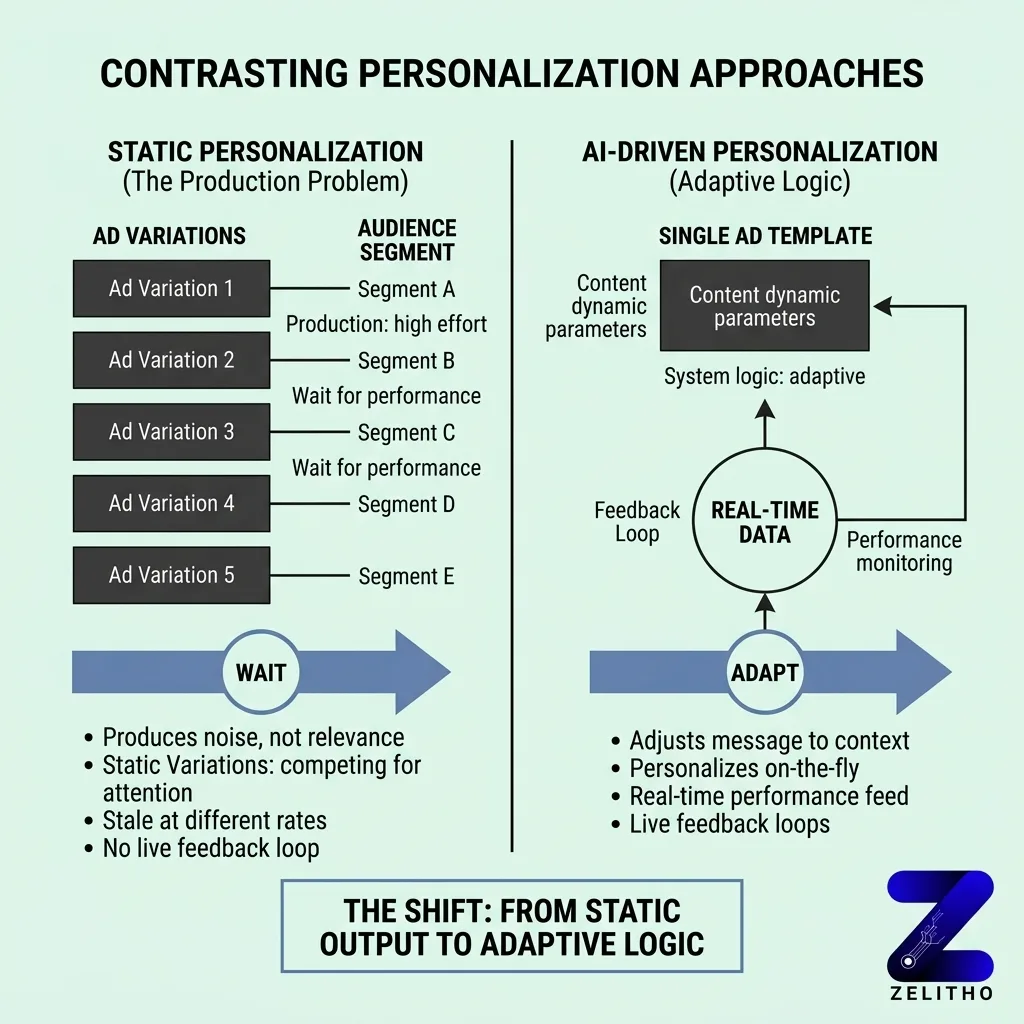
That approach produces noise, not relevance. Fifty static variations competing for attention without a live feedback loop do not get smarter over time. They just get stale at different rates.
The real gain from AI-driven personalization is adaptive logic. This means the system adjusts which message, channel, and timing combination appears based on live signals, not pre-built rules. The variation count often goes down. The match rate between message and moment goes up.
Harvard DCE research from 2024 frames this as a strategic shift in how marketing teams think about the relationship between content and context [3]. The logic is straightforward: a message shown at the right moment to someone exhibiting a specific behavioral pattern outperforms a perfectly written message shown at the wrong time to a broadly defined segment.
The operational audit question here is equally direct: does your current personalization system update automatically based on performance signals, or does a human need to manually adjust rules after reviewing a report? If it is the latter, you have a reporting workflow, not a personalization system.
This capability is the second component of the Connected Decision System. Audience detection feeds message selection. Message selection generates new behavioral signals. Those signals update the model. The loop closes. Without this loop, every campaign starts from scratch with the same assumptions the last one had.
A friend-advice version of this: stop building more variants. Start building feedback mechanisms. One adaptive rule informed by live data outperforms ten static rules built on last quarter’s averages.
Adopting AI Without Governance Is How Teams Build Problems They Cannot See Until They Are Expensive
Fast AI adoption feels productive. Output increases. Timelines compress. Stakeholders see dashboards they like. The problems are invisible until they are not.
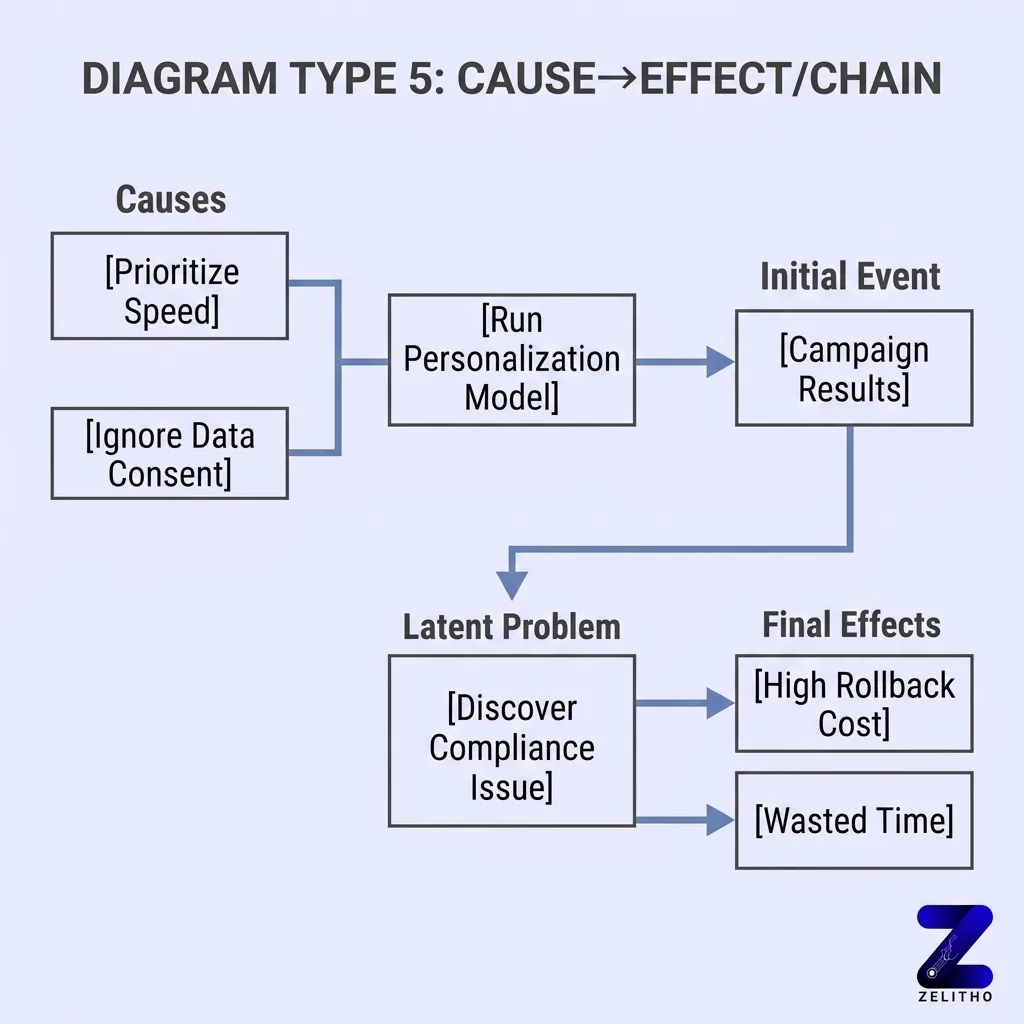
A personalization model trained on data that violated consent rules does not fail loudly. It runs. It produces results. Then it surfaces as a compliance issue six weeks into a scaled campaign. The rollback costs more time than the prior quarter saved. This is not a hypothetical pattern. It is the governance failure mode that teams consistently underestimate.
Marketing Brew tracked AI adoption patterns from January 2025 through May 2025, identifying governance gaps as a recurring constraint during rapid integration [1]. A follow-up observation from October 2025 noted that teams who invested in governance structures earlier avoided the rollback costs that others absorbed later [1]. The timeline matters because it shows the gap between adoption speed and governance readiness is a known, recurring problem, not an edge case.
Three constraints are worth naming specifically, without collapsing them into a vague checklist.
First:data governance and consent boundaries. Every AI model your team uses is trained on data. Know what data. Know whether that data was collected with consent for the use you are applying it to. If you cannot answer both questions, the model should not be in production.
Second: human review checkpoints for high-stakes decisions. Not every AI decision needs human review. But budget reallocation above a certain threshold, audience suppression decisions, and any output that shapes what a customer sees about pricing or availability should pass through a review checkpoint. Define the threshold before you need it.
Third: transparency with your audience. People are increasingly aware that AI shapes what they see. Teams that acknowledge this build more durable trust than teams that obscure it. This is not a compliance issue yet in every market. It is a trust issue everywhere.
The Connected Decision System includes governance as a structural component, not an afterthought. Before scaling any AI-driven campaign system, document three things: which decisions are made by the model, which decisions require human review, and what data the model is trained on. If that document does not exist, the system is not ready to scale.
Read More: How to Use AI in Your Marketing Strategy: Goals, Tools, and Implementation Considerations
AI marketing earns its value when it functions as a Connected Decision System, not a collection of shortcuts. Each capability covered here, sharper audience understanding, adaptive personalization, and governed adoption, feeds into the others. When those pieces are disconnected, you get faster outputs with the same old decision quality. When they are connected, your marketing gets measurably smarter over time. The next step is not choosing an AI tool. It is identifying which part of your current workflow is making the weakest decisions and asking whether better data or better feedback loops would change the outcome. Start there.
FAQs
The most widely cited version is: market to others the way they want to be marketed to. This means understanding what your audience actually needs before designing a message or campaign. In AI-assisted marketing, this principle requires that personalization serves the customer’s intent, not just the platform’s optimization metric.
The three C’s are customer, company, and competition. Customer refers to understanding who you are selling to and what they need. Company refers to your own capabilities, positioning, and offer. Competition refers to what alternatives your customer can choose. Strategic marketing decisions account for all three before any campaign runs.
Recommendation engines are among the clearest examples. When a streaming platform shows you content based on your watch history, or an e-commerce site surfaces products based on browsing behavior, that is personalization running in real time. These systems analyze behavioral data continuously and adjust recommendations for each individual user without human involvement.
References and Citations
[1] Marketing Brew , AI in Marketing: The Shift from Novel to Necessary. https://www.marketingbrew.com/stories/linkedinads/ai-in-marketing-the-shift-from-novel-to-necessary
[2] Park University , The Role of AI in Marketing. https://www.park.edu/blog/the-role-of-ai-in-marketing/
[3] Harvard DCE , AI Will Shape the Future of Marketing. https://professional.dce.harvard.edu/blog/ai-will-shape-the-future-of-marketing/