
What Is a Short Blog Post? How to Write One That Stays Clear and Useful

TL;DR
You opened a Google Doc last Tuesday, pasted a ChatGPT draft, and stared at 600 words that covered everything and resolved nothing. The post never shipped.
Most short posts fail before the first sentence. Writers choose a topic too broad for the format, then cut words instead of scope. The result is a post that feels incomplete, not brief.
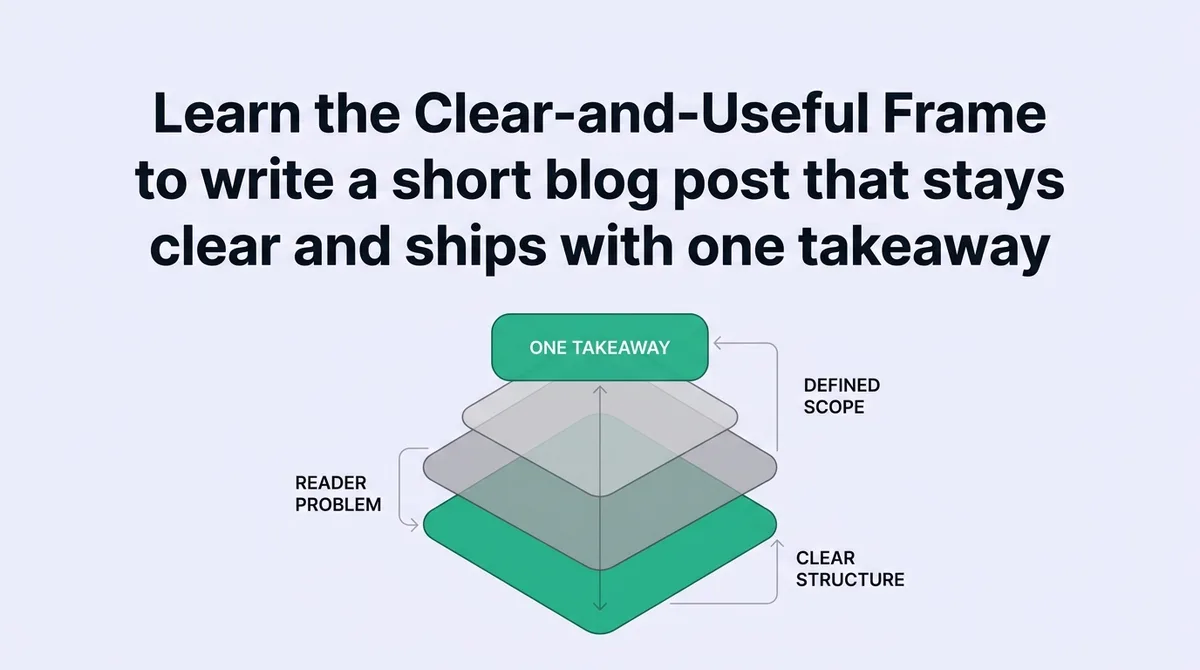
The Clear-and-Useful Frame fixes this. It gives you a three-part structure built around one takeaway, one reader problem, and a defined stopping point. You scope the topic before writing, not after. You check three usefulness signals before publishing, not by instinct.
This guide is for content leads and agency operators who need posts that ship on cadence and hold their value. Follow the frame and your short posts will be complete, not just compact.
What does a short blog post need to do?
A short blog post answers one specific reader question with enough support to be credible. It does not introduce a topic. It resolves a narrow problem and stops.
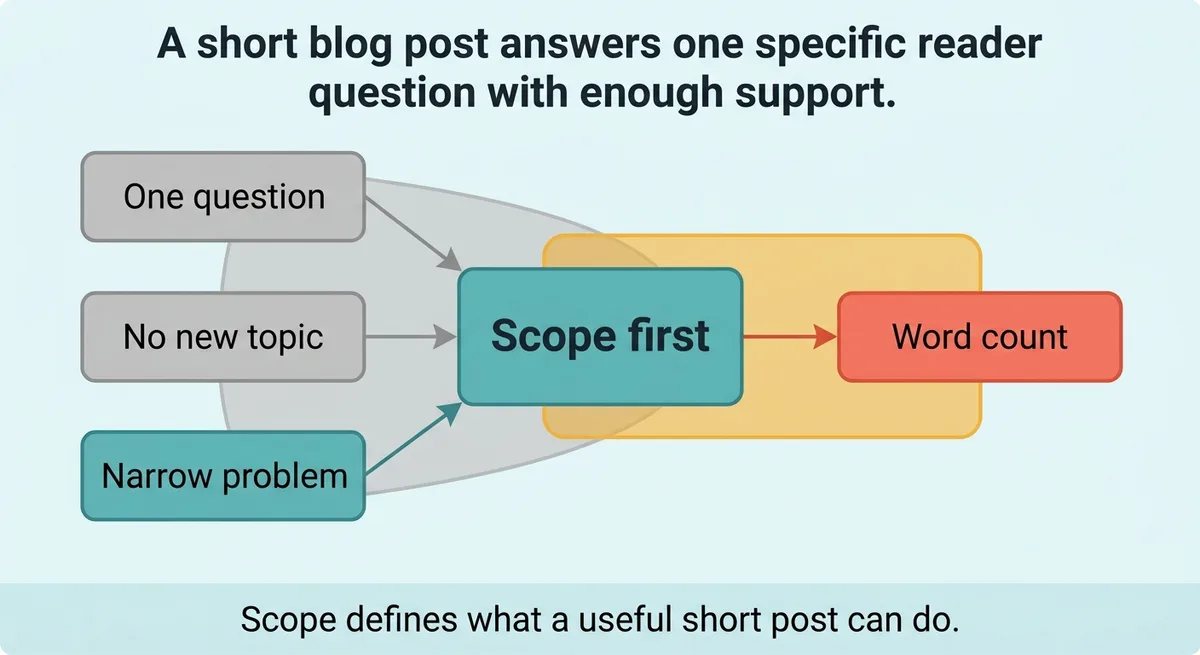
Scope defines a useful short post. Word count is a side effect of good scoping, not the goal.
What a Short Blog Post Actually Is , and What It Is Not
Short does not mean easy to write. It means harder.
Every sentence in a 400-word post carries more weight than a sentence buried in a 2,000-word piece. You have no room to warm up, no room to repeat yourself, and no room to leave a point half-made. That constraint is the discipline.
Effective posts make at most two or three focused points [1]. That is not a stylistic preference. It is a structural rule. A post that tries to make five points in 500 words makes zero points well.
Here is the distinction that most writers miss: short and thin are not the same thing.
A thin post makes a claim without support. A short post makes two or three focused points with just enough evidence to be credible and actionable. A 400-word post that answers one specific question is short and complete. A 400-word post that introduces a topic without resolving it is thin and forgettable.
Signal | Short Post | Thin Post |
|---|---|---|
Scope | Defined before writing | Vague or undefined |
Takeaway | One clear takeaway | No clear takeaway |
Support | Light but present | Missing entirely |
Stop thinking shorter means less work. Start recognizing that one tight post with two supported points outperforms three thin posts that gesture at ideas.
A thin post wastes the reader’s time. A short post respects it.
You Are Probably Picking the Wrong Topic for a Short Format
The topic is the problem, not the draft.
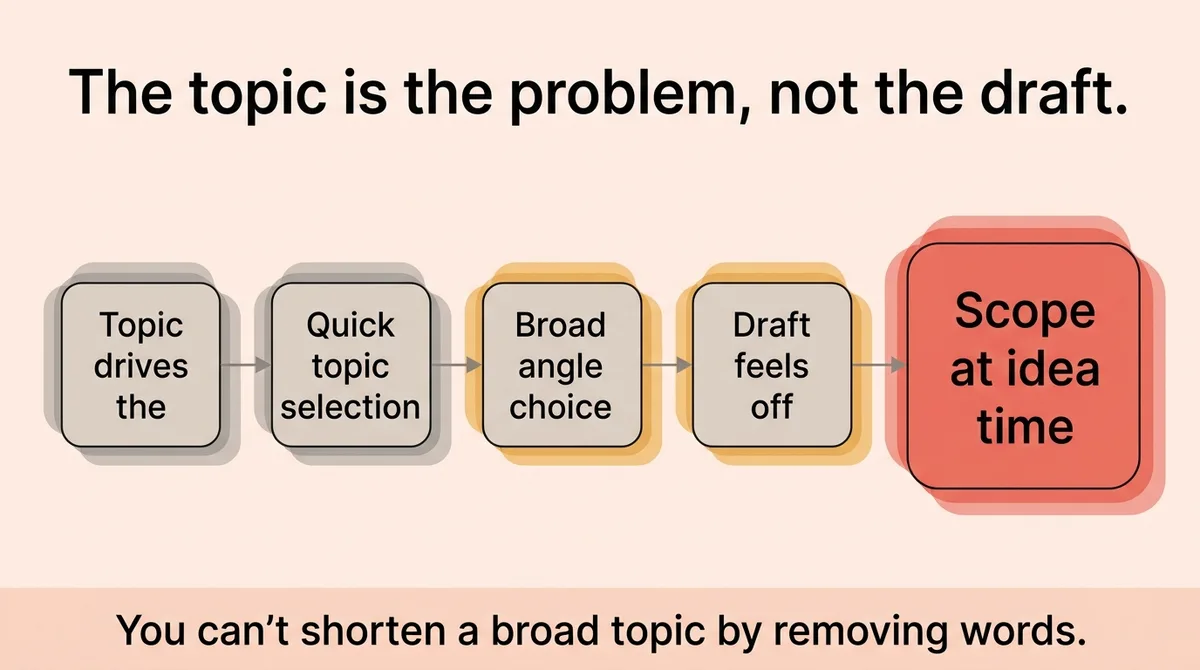
Most writers treat topic selection as a quick step. They pick something broad, start writing, and then spend hours cutting or padding to hit a target length. The post ends up feeling incomplete or bloated. Neither version ships with confidence.
The real filter is scope at the idea stage. You cannot shorten a broad topic by removing words. You can only fix a broad topic by choosing a narrower angle before you write the first sentence.
Headlines should be ten words or fewer [1]. Use that as your first scoping check. If your headline needs eleven or more words to say what the post covers, the topic is too wide for a short format. Rewrite the headline first. The post will follow.
Here is a three-question decision path. Run every topic through it before opening a document.
Question 1: Can you state the reader’s problem in one sentence?
Question 2: Can you resolve it with two or three points?
Question 3: Does the reader need to act after reading?
If any answer is no, the topic needs to be split or narrowed. Some topics require long-form treatment. A full how-to guide, for example, can run to thirteen or more steps [3]. That is not a short post topic. That is a long-form project wearing a short-post costume.
Writers who skip topic scoping spend six or more hours on a post that eventually needs to be split into two pieces anyway. That is six hours of momentum lost, plus the cost of rewriting the structure from scratch.
Write the headline first. Treat it as a scoping tool, not a finishing touch. A tight headline forces a tight topic. A tight topic produces a post that ships.
The Three-Part Structure That Keeps Short Posts Clear and Scannable
Freeform writing produces freeform posts. Readers get lost and leave.
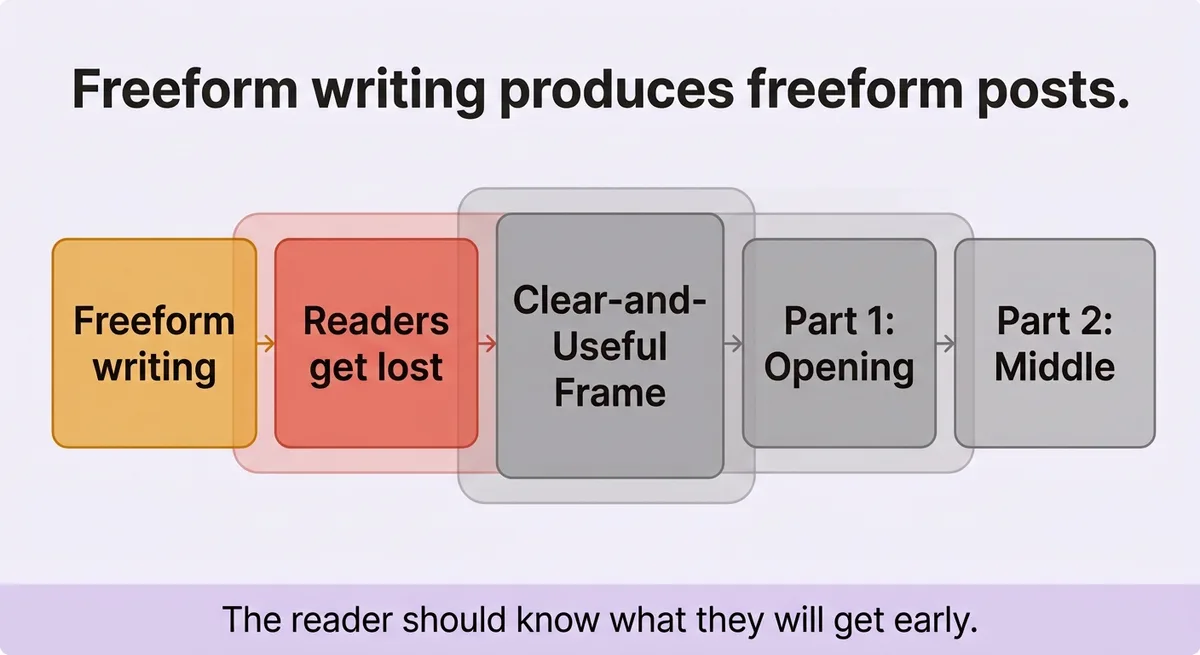
The Clear-and-Useful Frame is a three-part structure for every short post. Use it every time. Name it for your team so everyone builds from the same logic.
Part 1: Opening. State the reader’s problem and your answer in two or three sentences. No windup, no context-setting paragraph. The reader should know what they will get before they finish the first section.
Part 2: Middle. Two to three sections, each making one point with one supporting detail or example. A how-to post broken into eight focused steps shows that even short instructional content needs internal structure [2]. A listicle built around six specific items shows that scannable formats help readers move through content without losing the thread [2].
Part 3: Close. One sentence that tells the reader what to do or take away. Not a summary. A directive.
Scannability signals that hold the frame together:
One subheading per section
Paragraphs capped at three sentences
Each paragraph front-loaded with its main point
Consider a post about choosing a blog length. It could have three sections: what short means, when to use it, and how to write it. That is the Clear-and-Useful Frame running in a live post. Each section makes one point. Each point connects to the reader’s problem. The post ends when the problem is resolved.
That structure is not accidental. It is repeatable. Build it once, use it every time, and your posts will stay coherent whether you write them yourself or hand the brief to a freelancer.
How to Know When Your Short Post Is Actually Useful
Beginners often do not know when to stop editing. They keep adjusting sentences because they have no external signal that the post is done.
Three usefulness signals replace that guesswork.
Signal 1: Clarity. Can a stranger read the first sentence and know exactly what they will get from the post? If the answer is no, the opening needs a single, plain statement of the reader’s problem and your resolution.
Signal 2: Relevance. Does every section connect to the reader’s stated problem? If a section exists because it felt interesting rather than because it serves the reader’s question, cut it.
Signal 3: Light support. Is there at least one example, data point, or comparison per main point? A post that makes claims without any grounding is a thin post wearing a short post’s length.
A post that fails the clarity signal loses most readers in the first ten seconds. They leave before reaching the content that could help them. That is not a formatting problem. It is a scoping and opening problem.
Two free keyword tools are enough for beginners to confirm that real readers search for the topic [3]. Usefulness starts at the topic level. If no one searches for the question you are answering, the post cannot reach the reader who needs it.
Posts with tight focus and clear framing earn sustained traffic. One tightly framed post reached nearly one million visits [1]. Length did not drive that number. Relevance and clarity did.
Run the three-signal check before any formatting or SEO work. Checking signals after you format wastes time because formatting does not fix a post that fails on clarity or relevance. Fix the substance first.
A post is useful when it changes what the reader does next. Not when it covers every angle. Not when it hits a word count. When it produces a clear next action for the specific reader it was written for.
Short posts earn their keep one clear takeaway at a time
The Clear-and-Useful Frame is not a writing trick. It is a decision path.
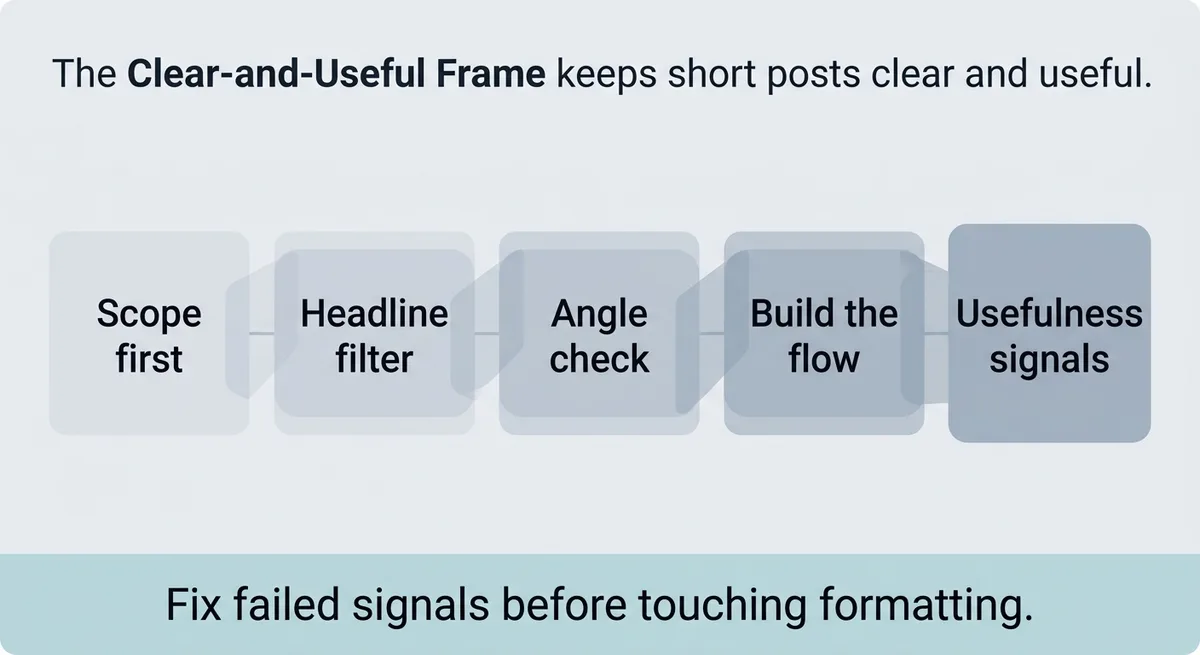
Scope the topic before you write. Use the headline as your filter. Run the three-question check on the angle. Build the post with a defined opening, two or three supported middle sections, and a single closing directive.
Then run the three usefulness signals on the draft. Check clarity first, relevance second, support third. If one signal fails, fix it before touching formatting.
Brief posts that follow this path ship faster, hold their value longer, and resolve reader problems instead of gesturing at them.
Write the headline. Scope the topic. Build the frame. Ship the post.
References and Citations
[1]https://writing.wisc.edu/handbook/writingblogpost/
[2]https://www.typeface.ai/blog/5-blog-post-examples-and-using-ai-to-create-them
[3]https://www.wix.com/blog/how-to-write-a-blog-post-with-examples
FAQ
A short blog post makes two or three focused points with enough evidence to be credible and actionable, while a thin post makes claims without any supporting detail. The key distinction is scope: a short post has a defined topic and one clear takeaway, whereas a thin post introduces a subject without resolving it. Length alone does not determine quality; a 400-word post that fully answers one specific question is short and complete, not thin.
Scope a topic before writing by running three questions: can you state the reader’s problem in one sentence, can you resolve it in two or three points, and does the reader need to act after reading? If any answer is no, split or narrow the topic before drafting a single word. Writing the headline first, kept to ten words or fewer, acts as a practical scoping filter because a tight headline forces a tight topic. Platforms like Zelitho build this scoping step into the workflow by requiring title and scope confirmation before a draft is ever generated.
A short blog post should follow a three-part structure: an opening that states the reader’s problem and your answer in two or three sentences, a middle with two to three sections each making one point with one supporting detail, and a close that delivers a single directive rather than a summary. Each paragraph should be capped at three sentences and front-loaded with its main point, with one subheading per section to aid scanning. This structure is repeatable enough to hand off to a freelancer or automate via a brief without losing coherence.
A short blog post is ready to publish when it passes three usefulness signals: a stranger can read the first sentence and know exactly what they will get, every section connects to the reader’s stated problem, and each main point is grounded by at least one example, data point, or comparison. Run these three checks before any formatting or SEO work, because formatting cannot fix a post that fails on clarity or relevance. A post is truly useful when it changes what the reader does next, not when it hits a word count.
Teams using separate tools for topic selection, drafting, editing, and CMS publishing face compounding handoff delays that stall cadence and produce inconsistent output, often causing writers to spend six or more hours on a single post that eventually needs to be restructured anyway. The root problem is that scope decisions, keyword context, and structural rules are not shared across the toolchain, so each step starts from scratch. Zelitho addresses this by connecting keyword discovery, title and scope confirmation, research-backed drafting, on-page editing, and direct WordPress or Webflow publishing into one workflow, so the decisions made at the scoping stage carry through to the live article.