
What Is a Content Marketing Workflow? A Step by Step Guide to Structuring It

TL;DR
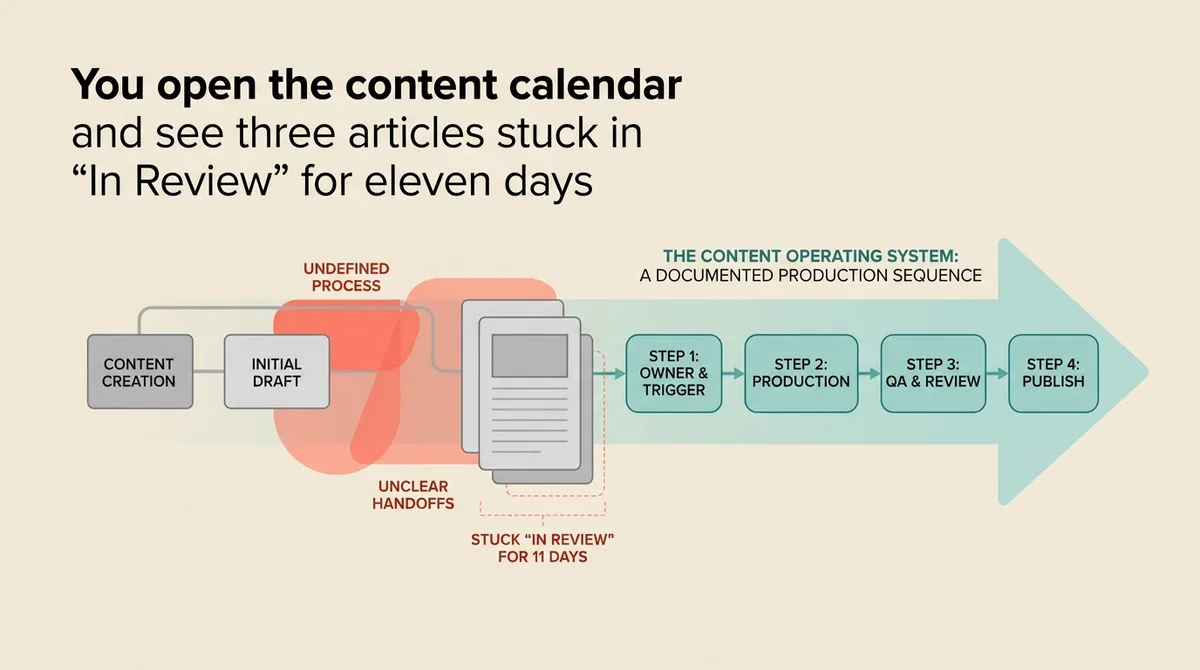
You open the content calendar and see three articles stuck in “In Review” for eleven days. No one moved them. No one knows who owns the next step.
The common fix is to hire another writer or try a new tool. That does not work because the bottleneck is not output. The bottleneck is that no one wrote down who does what, in what order, and what triggers the next handoff.
The Content Operating System is a documented production sequence with named owners, defined transitions, and decision rules at every stage. It replaces informal coordination with a repeatable structure. Companies with a documented content strategy report 33% higher ROI than those without one [1]. That gap is not a talent gap. It is a definition gap. This article shows you how to close it, stage by stage.
Why does content marketing fail?
Most content workflows fail because they were never built. They were assumed. Someone assigned a writer, someone else handled publishing, and the steps in between lived inside Slack threads and individual memory. The moment one person gets busy, the whole chain stalls.
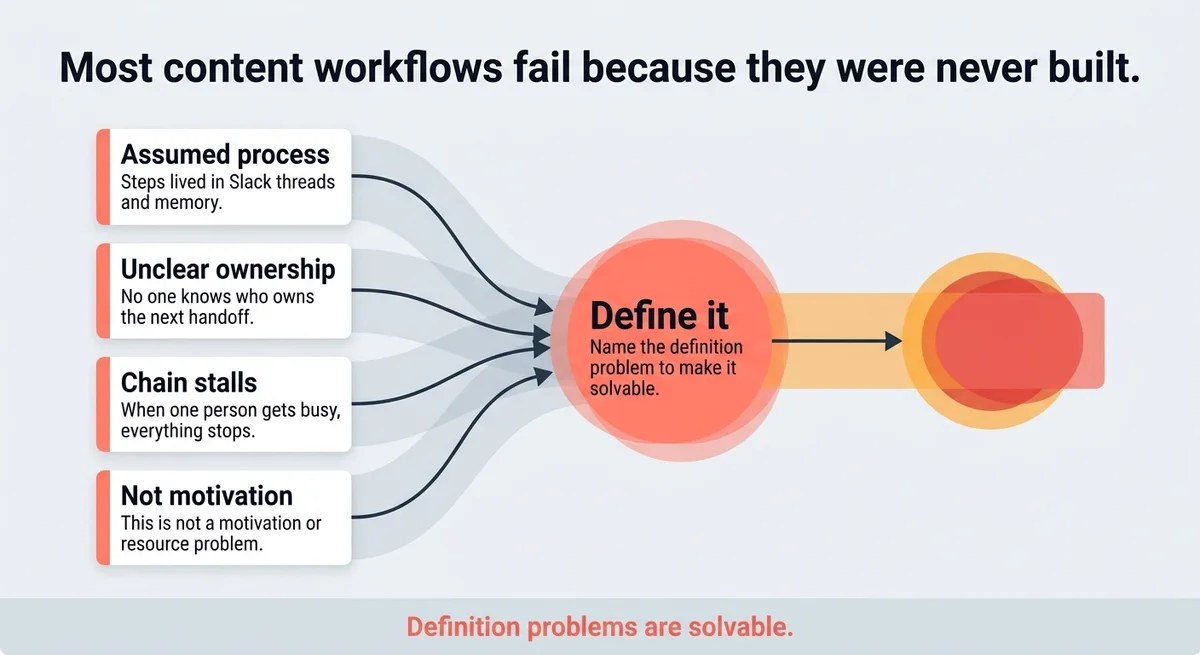
The fix starts with naming the problem accurately. This is not a motivation problem or a resource problem. It is a definition problem, and definition problems are solvable.
Why your content process keeps breaking at the same invisible points
Your team does not have a workflow. They have a habit. Habits break under pressure. Workflows do not, because workflows have rules.
Six common failure reasons appear repeatedly across content programs [1]. Missed handoffs, unclear ownership, inconsistent briefs, no defined approval gate, no repurposing plan, and no feedback loop back into strategy. None of those are talent failures. They are structural gaps.
The pattern looks like this. A topic gets approved in a meeting. Someone drafts it, usually in a Google Doc. That doc sits while the person who needs to review it waits for a notification that never arrives. Days pass. The draft gets stale or the reviewer rewrites from scratch. A two-day task becomes a ten-day delay. Multiply that across six articles per month and you lose a quarter of your planned output before a single piece publishes.
The invisible points are always transitions. The moment a task moves from one person to the next is where definition collapses. Not because people are careless. Because no one defined what “done” looks like at each stage, what triggers the handoff, or who checks it arrived.
Stop assuming shared context. Start writing down every transition rule before production begins.
What an undefined process actually costs you in time, output, and compounding delay
A content program typically needs six to eight months before its production rhythm stabilizes [1]. Meaningful results from that program can take up to eighteen months [1]. That window assumes you are running a consistent cadence. An undefined process cuts that consistency by a fraction every single week.
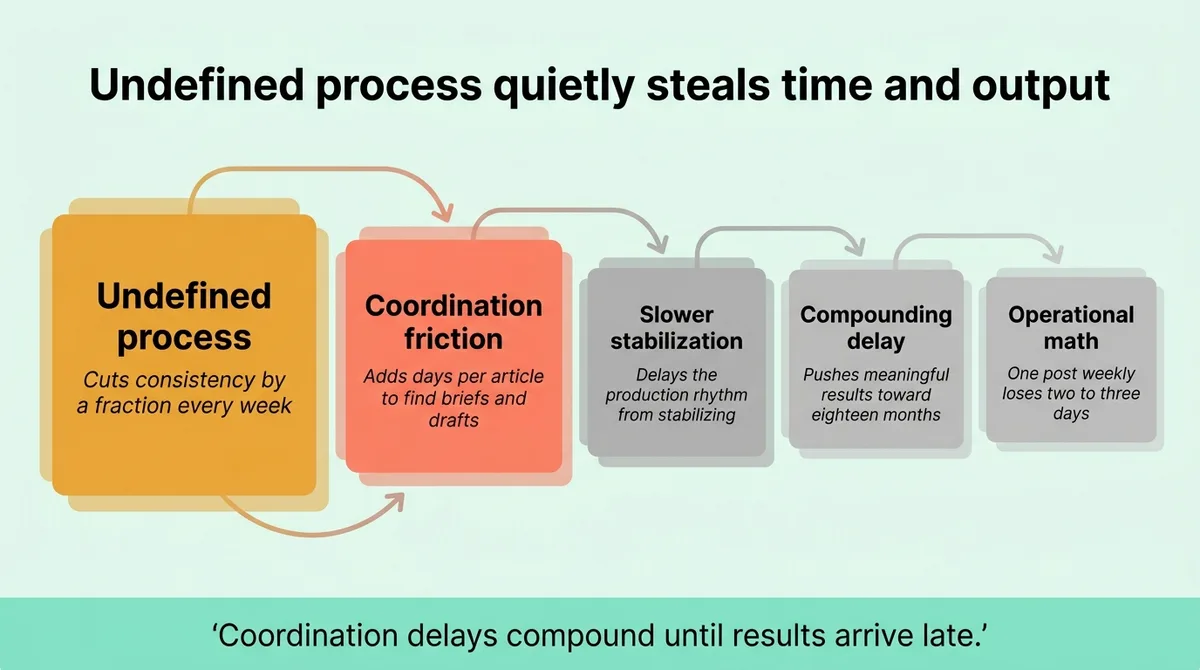
The operational math is straightforward. A team producing one blog post per week loses two to three days per article to coordination friction. That is coordination: finding the brief, chasing the draft, confirming the publish date. Over a quarter, that friction consumes roughly 24 to 36 working days across the team. Those are days not spent improving content quality, building internal links, or analyzing what is already ranking.
The compounding problem is worse. When output drops below cadence, indexed content thins. Thin indexed content produces fewer signals for search engines to cluster around. Fewer clusters mean fewer rankings. Fewer rankings mean fewer leads entering the funnel. The delay in month two becomes a traffic deficit in month five.
Workflow Stage | Cost of No Definition | Operational Signal |
|---|---|---|
Brief creation | Writer starts from wrong assumptions | Drafts require full rewrites |
Draft to review | No trigger, no deadline, no owner | Review takes 7–14 days instead of 2 |
Approval to publish | CMS handoff skipped or duplicated | Articles publish late or not at all |
One article repurposed across three channels produces compounding reach from a single production effort [1]. Teams with undefined workflows rarely reach repurposing. They spend all available time just shipping the original piece. The leverage is there. The process to capture it is not.
The Content Operating System: how to map every stage, owner, and handoff rule before you write a single word
The Content Operating System is a documented production sequence. It assigns one owner to each stage, defines what “complete” means at that stage, and names the exact trigger that moves the task forward. It is not a project management tool. It is a decision map. The tool is just where you store it.
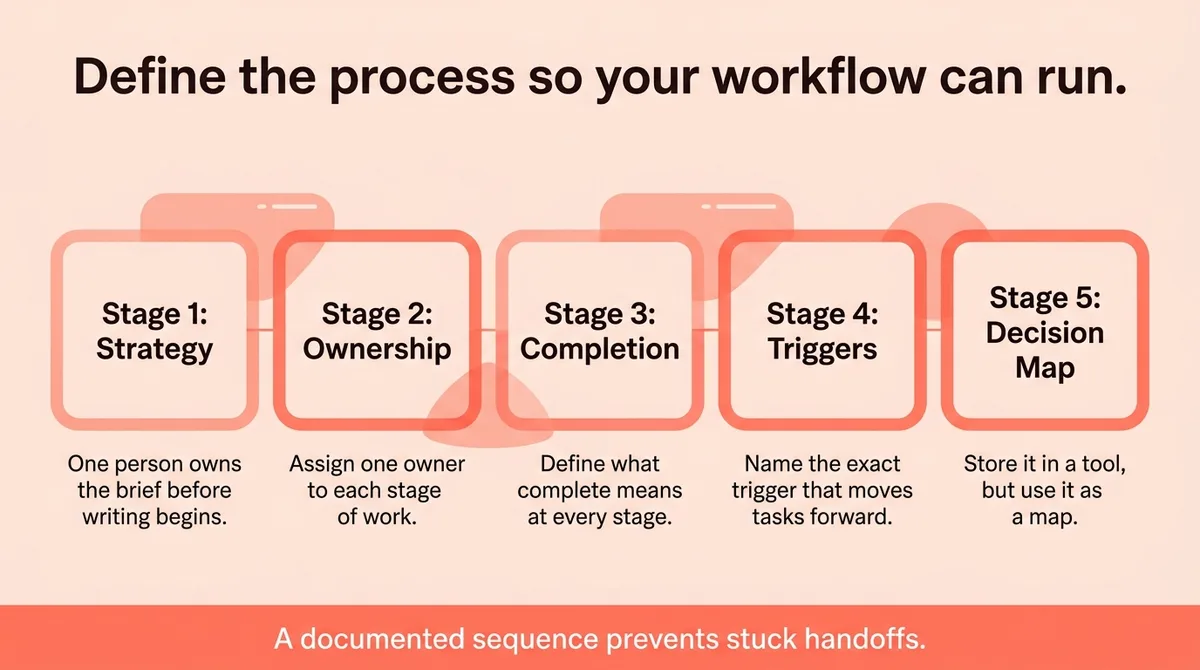
Build it in five stages.
Stage 1: Strategy input. Before any writing begins, one person owns the brief. The brief includes the target query, the intended reader, the core argument, the word count range, and the internal links to include. If that document does not exist before a writer opens a blank page, the process has already failed.
Stage 2: Draft production. The writer works from the brief, not from memory or a verbal summary. The deliverable is a complete draft, not an outline. Define complete: introduction through conclusion, all headers present, no placeholder text. The trigger for handoff is a status change in your project tool, not a Slack message.
Stage 3: Editorial review. One editor, one pass, defined turnaround. If your review cycle involves two people at this stage, one of them is redundant. Define what the editor is checking: argument clarity, factual accuracy, brief alignment. Not personal preference. The reviewer marks it “clear to publish” or sends it back with specific revision notes, not general feedback.
Stage 4: CMS preparation. One person handles formatting, meta description, internal links, and image placement. This is not the writer’s job after they already wrote the piece. It is a separate task with a separate owner and a separate checklist. The checklist lives in the same document as the rest of the workflow.
Stage 5: Publish and distribute. One person publishes. One person sends the distribution checklist: email list, LinkedIn, repurposing queue. The repurposing queue is not aspirational. It is a named list of three derivative assets, a LinkedIn post, an email excerpt, and a short-form pull quote, and it ships within five days of the original publish date [1].
A team we observed ran all five stages through one person’s inbox. That person managed client relationships, strategy, and production simultaneously. Removing stage ownership from their inbox and placing it in a shared workflow board cut average article cycle time from fourteen days to six. No new hires. No new tools. One definition pass.
The Content Operating System works because it removes the need for anyone to hold the process in their head. Every question about “what happens next” has a written answer. That is not bureaucracy. It is cognitive load reduction at scale.
Why documenting the process once is not enough and how to make it self-correcting
Documenting the process once gets you to a working system. It does not keep you there.
Workflows decay. A new writer joins and learns the process from the person next to them, not from the document. A tool changes. A client adds a step. Six months later, the documented process and the actual process are different things. The document becomes decorative.
The 19% year-over-year drop in cost per lead through content marketing [1] assumes the program is running correctly over time. A decaying workflow erodes that improvement year by year. You do not notice it in week three. You notice it in month eight when output has dropped and no one can explain why.
Build the review mechanism into the workflow itself. Schedule a thirty-minute process audit every ninety days. One question drives it: does the documented process match what the team actually does? If the answer is no, update the document before the next production cycle starts.
The audit is not a retrospective. It is a calibration. Three questions cover it. Where did handoffs break in the last quarter? Which stage took longer than its defined window? What changed in the team or tools that the document does not yet reflect?
Assign the audit to one person. Not the team. One person owns the document and keeps it current. Everyone else flags discrepancies in a shared channel as they appear. That channel feeds directly into the quarterly calibration, not into a backlog that never gets reviewed.
A self-correcting workflow also builds feedback from published performance back into the brief stage. If an article ranked and drove leads, the brief template that produced it becomes the default. If an article missed, the brief gets reviewed for gaps before the template is used again. This closes the loop between execution and strategy without requiring a separate strategy meeting every month.
The Content Operating System does not run itself. It runs because one person owns it, the review cadence is fixed, and the update rule is written down.
Build the system once and stop rebuilding execution from scratch
Every quarter spent coordinating production by hand is a quarter your indexed content falls further behind the competitor who systematized this eighteen months ago.
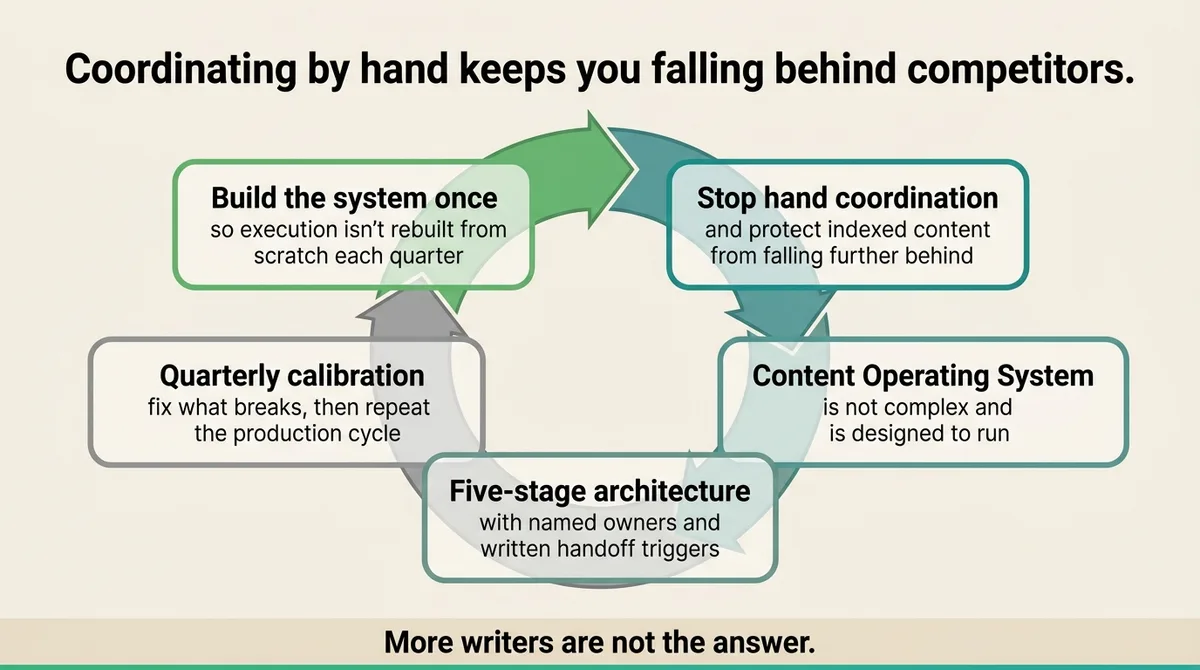
The Content Operating System is not complex. Five stages, named owners, written handoff triggers, one quarterly calibration. That is the full architecture. Build it once from a blank document this week. Run one full production cycle through it. Fix what breaks in the calibration. Repeat.
More writers are not the answer. A better CMS is not the answer. A process that does not depend on anyone remembering what happens next is the answer.
Write it down. Assign it. Ship on cadence.
References and Citations
[1]https://blog.littlebirdmarketing.com/6-reasons-your-content-marketing-isnt-working
FAQ
The four common errors are: no documented strategy, no defined ownership at each production stage, no feedback loop from performance back into planning, and no review cadence to keep the process current. Each one compounds the others over time.
The 3 C’s are Clarity, Consistency, and Continuity. Clarity means every brief is specific enough that a writer can execute without guessing. Consistency means the same process runs every cycle. Continuity means the program does not restart from scratch each quarter.
Most people fail because they treat content marketing as a creative task rather than an operational one. They focus on producing good writing while leaving the production system undefined. Good writing inside a broken workflow still fails to ship on cadence, and cadence is what drives compounding results.
Content marketing most often fails because the production process is informal and undocumented. Teams rely on shared assumptions about who owns each step, and those assumptions break the moment workload increases. Research identifies six common failure reasons, all structural, not creative [1].
The primary reason is inconsistent output caused by an undefined production sequence. Without a documented workflow, social content gets deprioritized when other work competes for attention. The content that does ship arrives without a strategy connecting it to a broader content program.
The four core marketing processes are strategy, production, distribution, and measurement. Most teams invest in strategy and production but leave distribution and measurement informal. A documented workflow covers all four stages with defined owners and triggers.
The biggest operational problem is the gap between content planned and content published. That gap is almost always a workflow problem. Teams produce a brief, assign a writer, and assume the rest will coordinate itself. It does not