
What Does SEO Mean in Blogging?

TL;DR
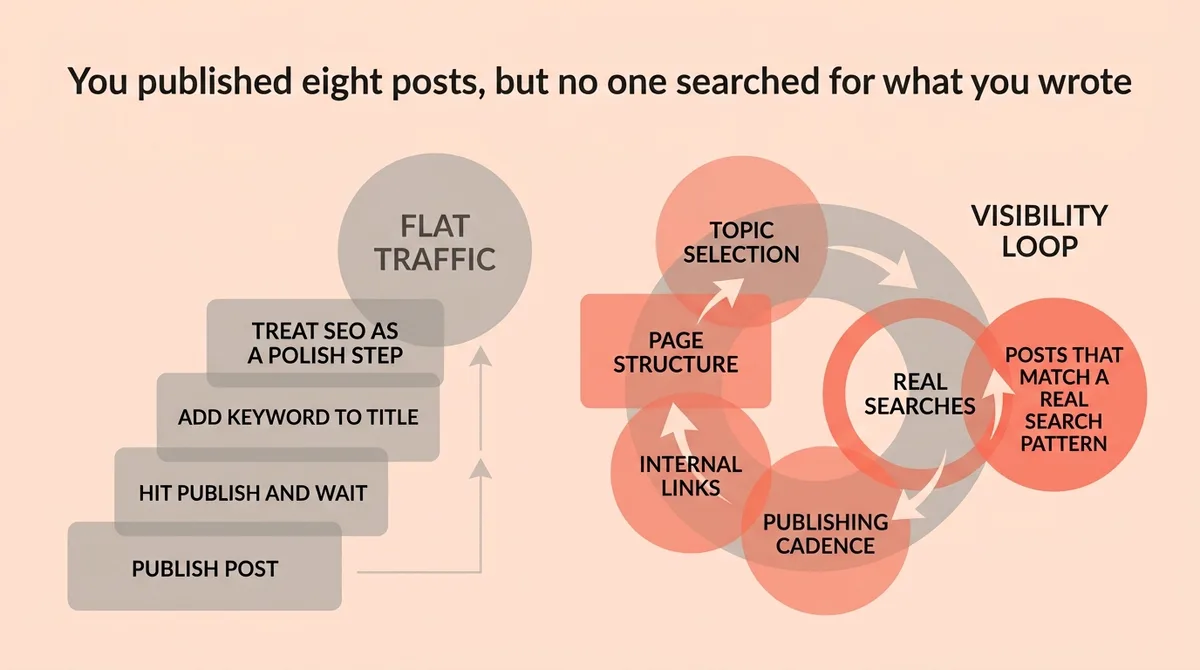
You published eight posts. Three months passed. Traffic stayed flat. The problem is not the writing quality. The problem is that no one searched for what you wrote about.
Most bloggers treat SEO as a polish step applied after writing. They add a keyword to the title, hit publish, and wait. That sequence produces nothing because search engines rank posts that match a real search pattern from the first sentence, not posts that mention a keyword somewhere in the body.
The Visibility Loop fixes this. It runs four steps in order: pick a topic people search for, format the post so Google can parse it, add internal links that connect related posts, and publish on a schedule you can hold. Beginner bloggers and content leads managing stalled editorial calendars both benefit from running this sequence without skipping a step.
What SEO Actually Means When You Are Blogging
Picture this: it is Tuesday afternoon, and you are staring at a Google Analytics dashboard. You published four posts last quarter. Each one took two days to write. Organic traffic is 190 sessions. You open the posts and realize none of them contain a phrase any real person would type into a search bar.
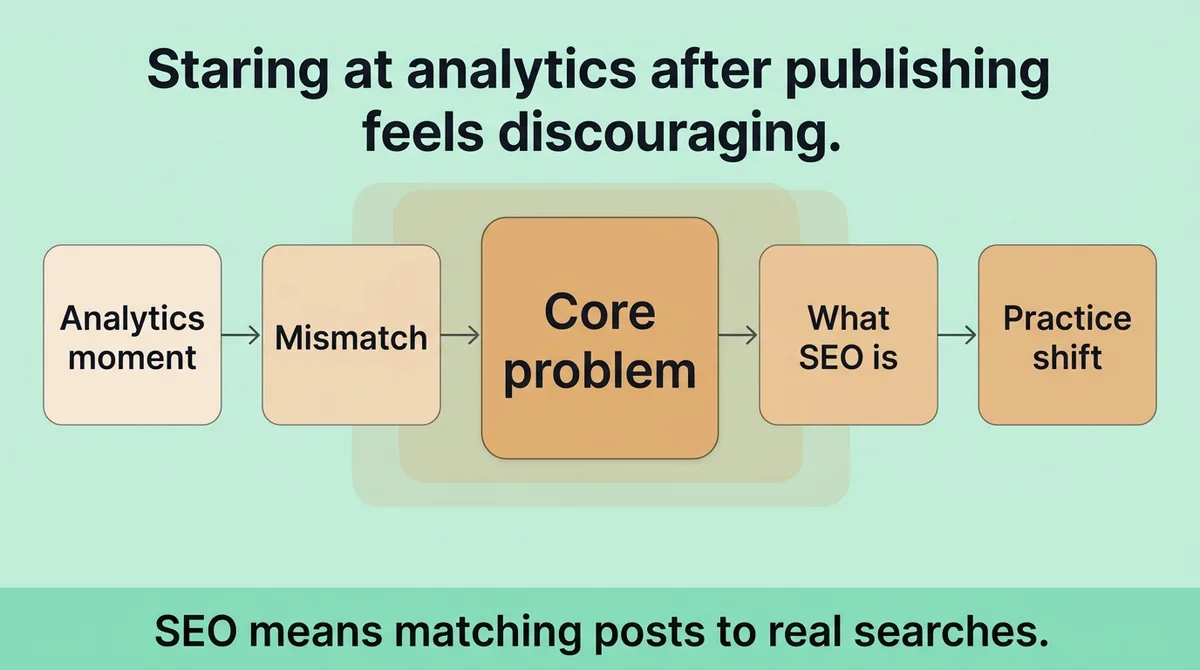
That is the core problem. SEO in blogging is not a plugin setting or a technical audit. It is the practice of writing posts that match real search patterns, formatted so search engines can read them, published often enough to build authority over time.
Blogs rank as the third most important traffic source for websites [2]. That ranking exists because search engines treat blog posts as answers to specific questions. When a post matches a question well, it gets shown. When it does not match, it stays invisible regardless of writing quality.
A sharp point worth stating plainly: Google does not rank good writing. It ranks writing that matches what people searched for. These are different things, and confusing them is the reason most blogs stall.
The definition of SEO for bloggers has three layers. First, topic selection: choosing subjects that people actively search for. Second, on-page structure: formatting the post so search engines can identify its topic. Third, publishing cadence: posting often enough to signal that your site is active and growing. The Visibility Loop connects all three into a repeatable sequence. Miss one layer, and the other two produce less.
Informational keywords make up 52% of the keyword landscape in content-heavy industries [3]. That means more than half of all searchable queries are questions someone wants answered. Blog posts are the natural format for those answers. The opportunity is large. The execution gap is where most blogs fall apart.
You Are Probably Writing About the Wrong Topics and Here Is Why That Matters
Stop writing what feels interesting to your team. Start writing what matches how real people search.
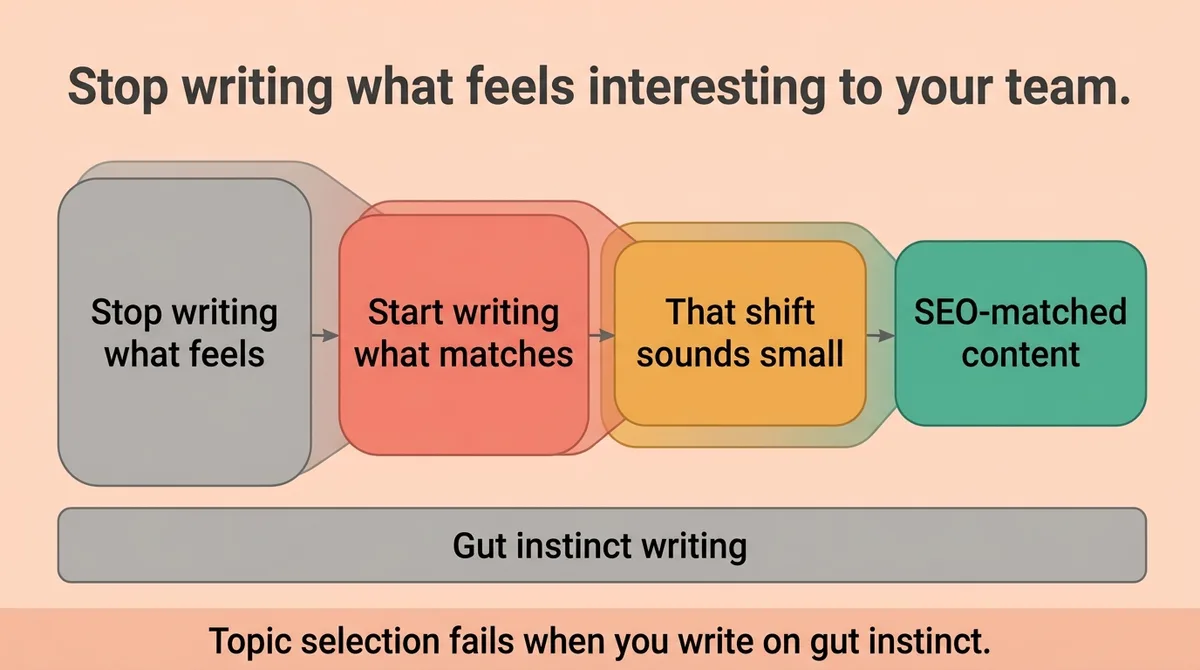
That shift sounds small. The traffic difference is not. A blog that ran SEO-matched content for one year saw a 95% increase in organic search traffic [3]. A blog writing on gut instinct for the same period saw nothing change.
The reason topic selection fails most bloggers comes down to one behavior: they write about their product features or their industry opinions. Both are useful internally. Neither matches how someone types a question into Google.
Each post should target one keyword [2]. Not a theme. Not a category. One specific phrase that someone would type into a search bar. When a post tries to rank for five loosely related terms, it ranks for none of them. Search engines read relevance through repetition and structure. A post scattered across five ideas registers as weak on all five.
Here is a concrete example of what wrong topic selection costs. One search query can return 5 million Google results [2]. A post written on a generic topic with no specific keyword target competes against all 5 million of those results with no structural advantage. A post written around one specific, lower-competition phrase competes against a fraction of that number and wins more often.
Topic Approach | Example Post Title | Likely Search Match |
|---|---|---|
Gut instinct | “Why We Love Our Product Roadmap” | Zero searches |
Industry opinion | “The Future of B2B Content Strategy” | Low, broad competition |
Search-matched | “What Does SEO Mean in Blogging” | Specific, answerable query |
The table above shows why the third approach wins. A specific answerable query maps to how someone actually types. The first two formats exist for internal satisfaction, not search visibility.
One implementation caveat: targeting a keyword with high volume but high competition produces the same result as no keyword at all. A small or mid-sized blog will not outrank a domain that has published 1,000 posts over ten years. Start with specific, lower-competition queries. Build domain authority. Move toward broader terms later.
How Page Structure and Internal Links Tell Google What Your Post Is About
Choosing the right topic gets your post into the right race. Page structure determines where you finish.
Search engines read posts differently than humans do. They scan heading tags, check word count, look at which other pages on your site you linked to, and assess whether the post answers the query it claims to answer. Two posts on the same topic, written with equal quality, will rank differently based on structure alone.
Headings run from H1 to H6 [4]. In a blog post, the H1 is your title. H2s break the post into sections. H3s break sections into sub-points. This hierarchy tells Google what the post covers and in what order. A post with no H2s looks like a wall of text to a search engine. It cannot extract structure, so it cannot confidently rank it for a specific query.
Word count carries weight because it signals depth. Posts that rank well average around 1,890 words [1]. That number is not a target for padding. It reflects that posts covering a topic thoroughly tend to be longer. A 300-word post on a complex question leaves too many gaps. Google reads those gaps as incomplete answers.
Blogs that publish regularly have 434% more indexed pages than static sites [4]. More indexed pages means more entry points for searchers. Each entry point is a post that answered a question well enough to rank.
Internal links are where most bloggers leave significant ground uncovered. Each post should contain between 5 and 10 internal links pointing to other pages on the same site [2]. Those links serve two purposes. They help readers find related content. They also help search engines map your site’s topic structure. A post about keyword research that links to your post on topic selection tells Google those two subjects live on the same authoritative site.
Here is a real-feeling sequence many content teams repeat. A team publishes 20 posts with no internal links between them. Traffic is flat. They add 5 to 10 internal links per post across the archive. Within 60 days, pages that had no indexed neighbors start appearing in search results. The posts did not change. The connectivity did.
Running a Readability Score of 70 or higher on your posts keeps sentences clear enough for both readers and crawlers [1]. Dense academic prose does not rank well for most search queries. People search in plain language. Posts written in plain language match better.
The Visibility Loop depends on structure as much as topic selection. A well-targeted post with poor structure still loses to a moderately targeted post with clean headings, appropriate length, and connected internal links.
Why Consistency Beats Perfection and What Skipping Posts Actually Costs You
Here is a false assumption worth naming directly: publishing a great post once a month builds more authority than publishing a good post every week. It does not.
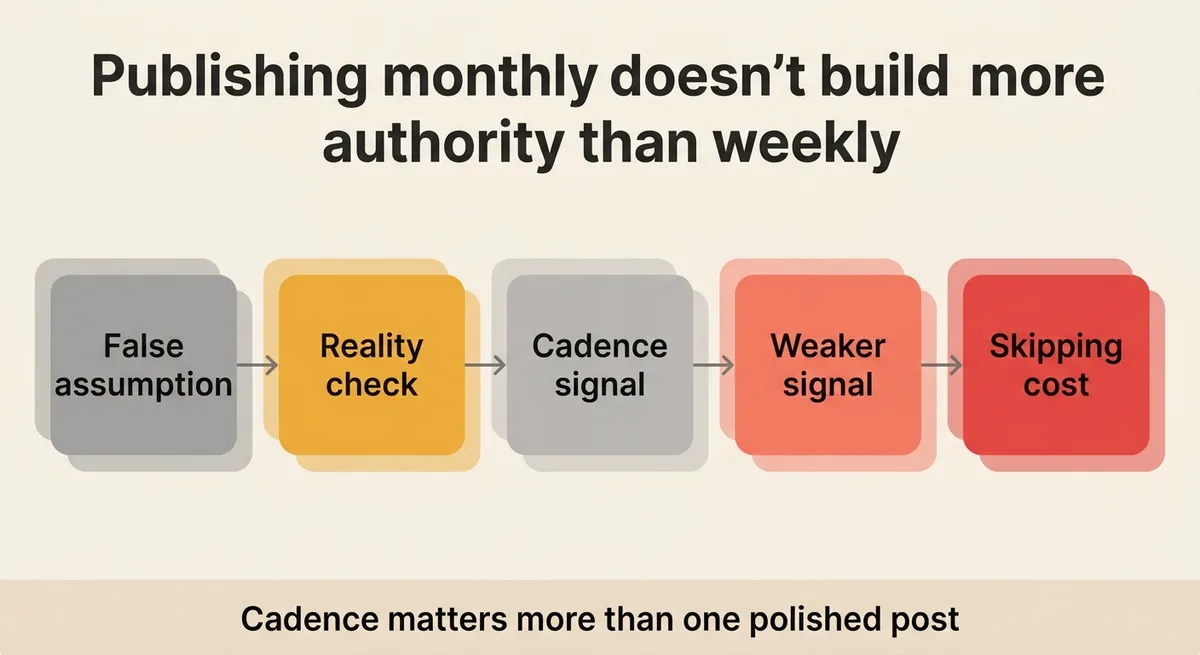
Search engines treat publishing cadence as a signal of site health. A site that publishes once a week [1] tells search engines it is active, updated, and growing. A site that publishes one polished post every five weeks sends a weaker signal, regardless of that post’s quality.
The math of skipping posts is concrete. Building meaningful search authority takes 6 to 12 months of consistent publishing [1]. That clock resets when you go dark for six weeks. A blog that publishes steadily for four months, then stalls for two months, does not have four months of authority. It has a fragmented signal that search engines weigh cautiously.
Fifty blog posts represent a rough threshold for a site to start generating consistent organic traffic [1]. At that volume, a site has enough indexed content to rank for enough queries to compound. Below that number, any given post carries the full burden of visibility alone. Above it, posts support each other through internal links and topic overlap.
The cadence question comes down to what you can hold without breaking. Two to three posts per week [1] accelerates authority faster than one. One post per week held consistently beats two posts per week held for six weeks then abandoned.
Publishing Pattern | Posts After 6 Months | Expected Authority Signal |
|---|---|---|
2 per week, consistent | 52 posts | Strong, compounding |
1 per week, consistent | 26 posts | Moderate, building |
1 per month, consistent | 6 posts | Weak, early stage |
Irregular, high quality | Varies | Unpredictable |
The table shows the compounding effect of frequency. The site publishing twice a week hits 52 posts in six months and crosses the threshold where posts start reinforcing each other. The irregular publisher stays below the threshold regardless of post quality.
One content-specific consequence: teams that depend on freelancers or ChatGPT drafts without a fixed publishing system lose an average of 20% of their draft-to-publish momentum per missed week [1]. Drafts pile up. CMS handoffs stall. The editorial calendar becomes a wish list instead of a schedule. The delay does not just feel bad. It pushes your ranking timeline out by weeks for every week you miss.
The practical fix is not a better content brief or a better freelancer. It is a shorter, fixed publishing cycle with a post format simple enough that anyone on the team can execute it. Pick a cadence. Hold it. Adjust quality upward once the cadence is stable.
This is exactly where most teams break the loop — not on any single step, but on holding all four (topic, structure, links, cadence) at once without a dedicated system. Zelitho was built around that specific failure point: it starts every article at a real search-matched keyword, structures the draft with proper headings and internal linking suggestions automatically, and keeps the publishing cadence running by pushing straight to WordPress or Webflow — so the loop doesn’t depend on a freelancer, a stalled Google Doc, or a founder remembering to hit publish.
The Visibility Loop Works Only When You Repeat It Without Skipping Steps
The Visibility Loop has four steps. Pick a topic someone searches for. Format the post so Google can read it. Add internal links that connect the post to your existing content. Publish on a schedule you can hold.
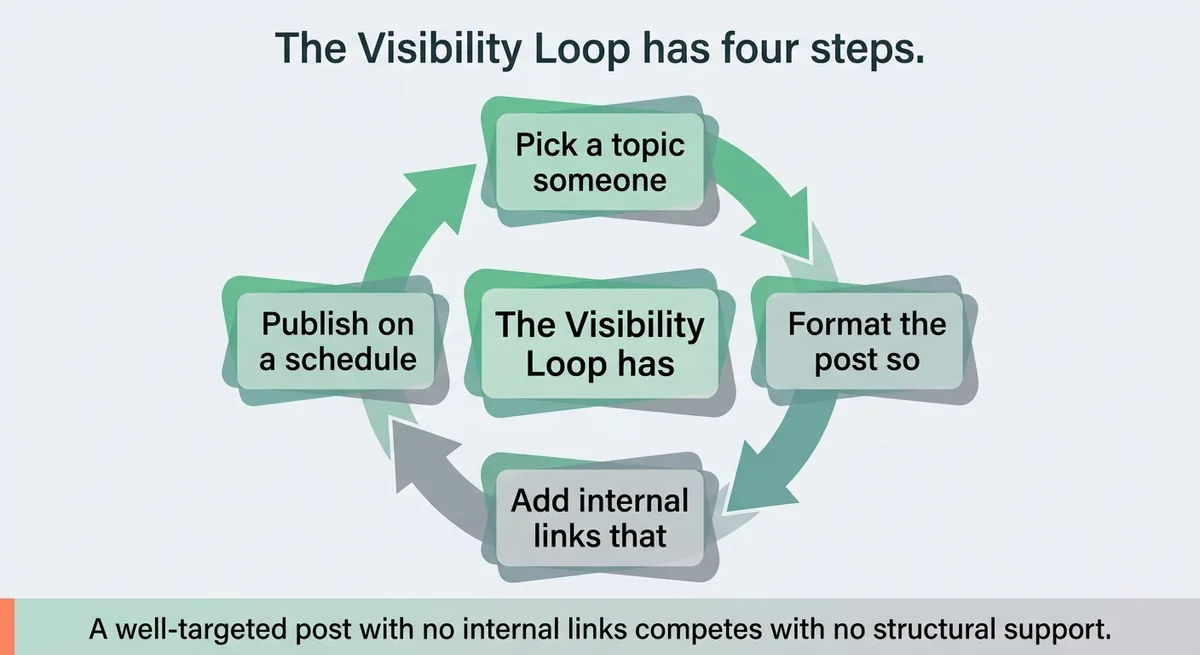
Each step depends on the one before it. A perfectly formatted post on the wrong topic still ranks for nothing. A well-targeted post with no internal links competes with no structural support. A well-structured, well-linked post published once every two months builds authority too slowly to compound.
Beginners do not need technical expertise to run this system. They need a checklist and a calendar. Run the checklist before every post. Hold the calendar every week. At six months, audit what ranked and repeat those patterns at higher volume.
The Visibility Loop is not a launch strategy. It is a publishing discipline. Run it without skipping steps.
References and Citations
[1]https://drewduboff.com/what-does-seo-mean-in-blogging/
[2]https://backlinko.com/hub/content/blog-seo
[3]https://www.takeflyte.com/blog/reasons-to-do-seo-blogging
[4]https://www.wix.com/blog/blog-seo
FAQ
Building meaningful search authority through consistent blog publishing typically takes 6 to 12 months. That timeline assumes you are publishing regularly, because the clock resets when a site goes dark for several weeks. The compounding effect also depends on volume: around 50 indexed posts is the threshold where posts begin reinforcing each other through internal links and topic overlap, rather than each post carrying the full visibility burden alone.
Each blog post should contain between 5 and 10 internal links pointing to other pages on the same site. Those links serve two purposes: they help readers find related content, and they help search engines map the topic structure of your site. Teams that add internal links across an existing archive of posts often see previously unindexed pages begin appearing in search results within 60 days, without changing the post content itself.
The most common reason a blog produces no organic traffic despite regular publishing is topic selection: the posts are not written around phrases real people type into search engines. Google does not rank good writing; it ranks writing that matches a specific search query, formatted so the search engine can identify the topic. A platform like Zelitho addresses this directly by starting the workflow at keyword and topic discovery, so every post is matched to a real search pattern before a single sentence is drafted.
Posts that rank well average around 1,890 words, not because length is rewarded directly, but because covering a topic thoroughly tends to require that depth. A 300-word post on a complex question leaves gaps that search engines interpret as an incomplete answer. The goal is not to hit a word count target but to answer the query fully, which for most informational search topics means well over 1,000 words.
The most reliable fix for a fragmented blog workflow is consolidating keyword discovery, drafting, optimization, and CMS publishing into one connected process rather than passing work across separate tools and handoffs. Each handoff point is where momentum is lost: drafts pile up, publishing cadence breaks, and the authority timeline gets pushed out by weeks for every missed post. Zelitho is built specifically for this problem, running the full path from seed keyword to live article inside one system with direct publishing to WordPress or Webflow.