
What Causes Blog Publishing Bottlenecks in Handoff Workflows?

TL;DR
Blog publishing bottlenecks in handoff workflows usually come from unnamed owners and wait time between stages, not slow writing. Name an owner and a response window at each transition so calendar lag stops stacking.
Your blog isn’t stalled because the writing is slow. It’s stalled because each stage of your workflow inherits wait time from the stage before it. A 1,500-word draft takes 3 to 4 hours to produce, but the surrounding workflow tasks add 3 to 5 days of elapsed time before anything publishes [1].
Most teams diagnose this as a single delay. They automate drafting, hire another freelancer, or switch CMS tools. None of those fix the actual constraint, because the constraint shifts by stage. That is why blog handoffs slow down publishing more than drafting ever does.
The mechanism is simple: separate steps that require human judgment from steps that are purely mechanical, then route each differently. One vendor write-up reports that agentic approval workflows average 1.8 days to completion versus 4.7 days for manual routing [2]. That 2.6x difference doesn’t come from removing review. It comes from stopping mechanical steps from sitting in judgment queues. Content leads and agency operators with stacked client pipelines benefit most from this distinction.
How Delay Accumulates Stage by Stage Instead of All at Once
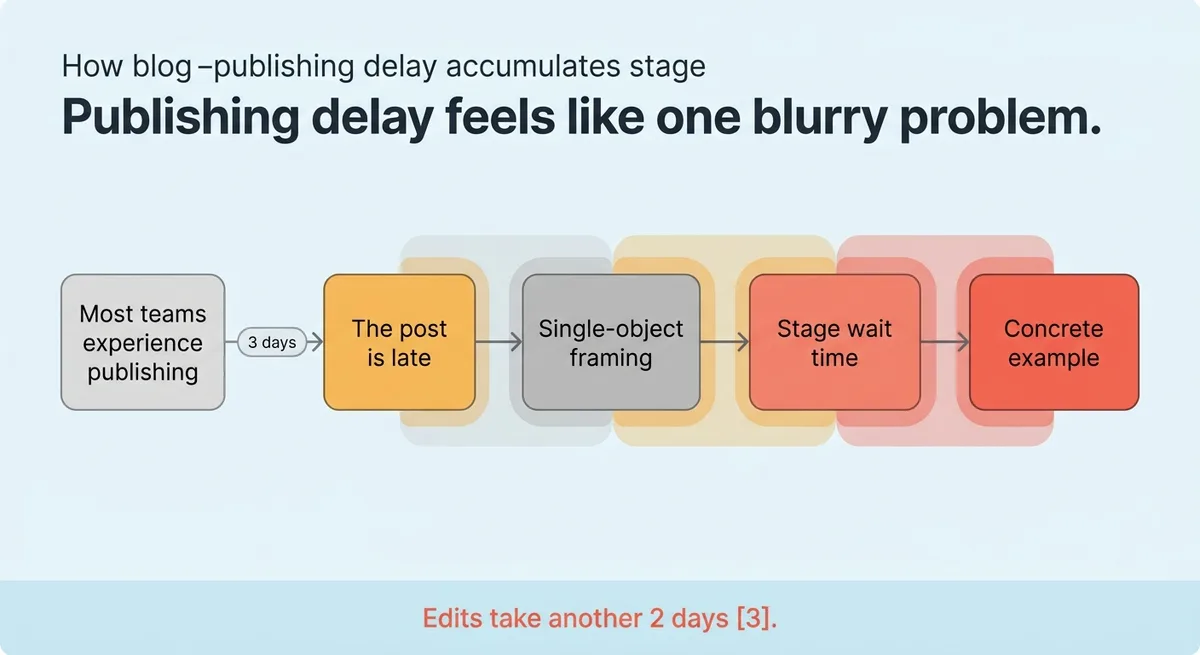
Most teams experience publishing delay as one blurry problem. The post is late. Nobody is sure exactly why.
That framing makes the problem unfixable, because it treats the workflow as a single object instead of a sequence of distinct stages, each with its own wait time.
Consider a concrete example: a first draft takes 3 days [1]. Then the post sits 4 days waiting for an SEO review [1]. Edits take another 2 days [1]. By the time that post publishes, the next one is already 9 days behind [1]. No single step looks catastrophic in isolation. Combined, they create a backlog that doesn’t recover.
A 1,500-word draft takes 3 to 4 hours to actually produce [1]. The surrounding workflow tasks, handoffs, status checks, format adjustments, and approval pings, consume 3 to 5 days of real calendar time [1]. Publishing one post well involves 11 distinct workflow steps [1]. Each step carries its own wait state.
The real problem: your drafting process is not the bottleneck. Your handoff process is.
Teams that publish 4 posts per month instead of the 16 they planned are usually not short on content ideas or writing capacity. They are short on routing clarity. A post stuck waiting for review is not a writing problem. It’s a queue problem.
Delay accumulates because workflow stages are treated as one shared responsibility. Nobody owns the transition between stages. The draft lands in a shared folder. Someone eventually opens it. That gap between “delivered” and “opened” is where most publishing time disappears.
Mapping the actual stages, not the idealized version of them, exposes which step holds the most elapsed time. That step is the real constraint.
Why Ownership Gaps and Unclear Routing Create More Rework Than Bad Writing Does
Bad writing gets blamed for slow publishing. The actual cause is usually missing ownership at transition points.
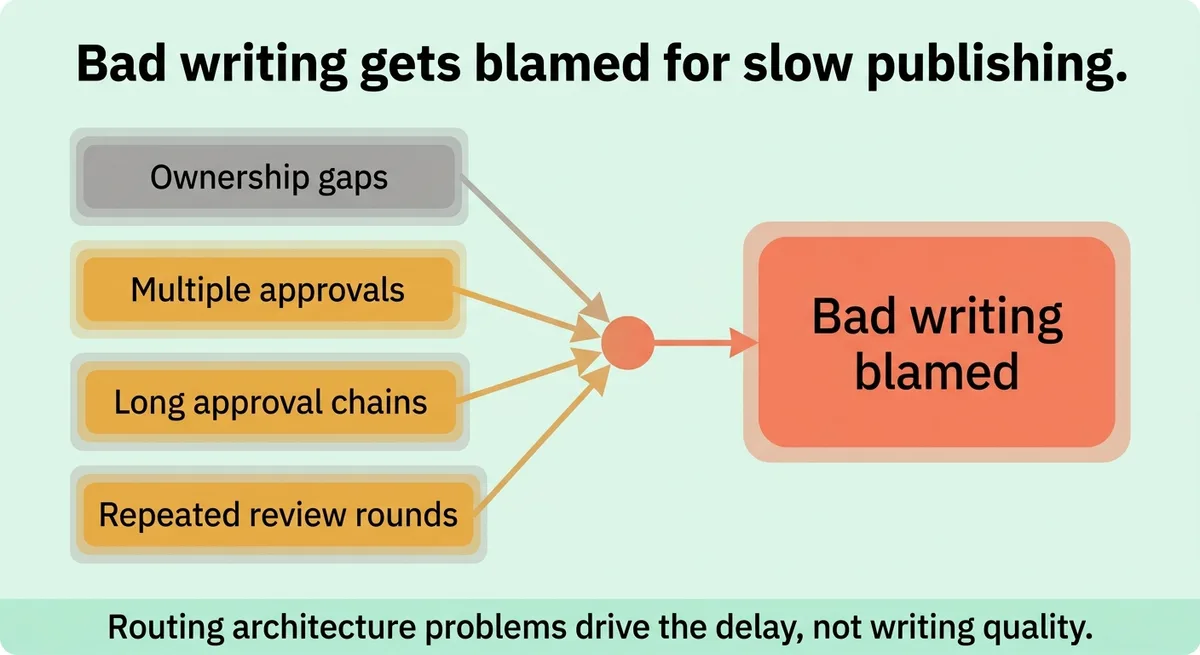
74% of content goes through multiple stakeholder approvals before publishing [2]. The average approval chain involves 4.2 people [2]. Posts go through an average of 2.9 review rounds before they publish [2]. None of those numbers describe a writing quality problem. They describe a routing architecture problem.
For example, imagine a content lead at a 30-person SaaS company. She routes every draft to a Slack channel tagged to three reviewers. Two reviewers assume the third will respond first. The third assumes the same. The draft sits untouched for four days. She follows up. One reviewer had already approved it mentally but never commented. This is not a quality failure. It’s a routing failure.
Stop assuming that more review rounds mean better output. Start assigning one named owner per transition point with a defined response window.
Each unnecessary review round adds elapsed time that the next stage inherits. Rework compounds the same way delay does. A post returned for a third round of edits is not a signal of poor writing. It’s a signal that the routing didn’t specify what the first review was supposed to evaluate.
One vendor write-up reports that agentic approval workflows with clear routing rules average 1.8 days to completion, while manual routing without defined ownership averages 4.7 days [2]. That 2.6x gap does not come from AI doing the thinking. It comes from removing the ambiguity about who acts next and when.
Ownership gaps create a specific failure pattern: the right person reviews the wrong thing at the wrong stage. A legal reviewer catches a structural argument problem that an editor should have flagged two rounds earlier. That restarts the clock. Routing design prevents that restart by specifying who evaluates what at each stage, not just who is on the approval list.
The Belief That All Review Steps Slow You Down Is the Wrong Diagnosis
Here is the assumption that keeps most publishing workflows broken: review is the enemy of speed.
That assumption produces a predictable overcorrection. Teams cut approval steps. Posts publish with errors. Errors require corrections. Corrections cost more time than the review would have.
The correct distinction is between mechanical review steps and judgment-required review steps. These are not the same thing. Treating them as one category is the misdiagnosis.
AI-assisted drafting can bring a post 60% of the way to publishable quality in under 20 minutes [1]. The remaining 40% still requires a human reviewer [1]. That 40% is not a failure of the tool. It’s the portion of the work that requires genuine editorial judgment: does this argument hold, does the tone match the brand, does the claim need a source?
That review step should be protected. It should also be the only step that sits in a judgment queue. Every other step before and after it can move faster.
For example, formatting a post for CMS upload is mechanical. It follows a template. It does not require editorial opinion. Routing it through the same approval chain as fact-checking wastes a reviewer’s attention and adds days of queue time for a task that takes 20 minutes to execute.
Structured content approval frameworks separate stages clearly: brief and creation, internal review, stakeholder review when genuinely required, and final scheduling [2]. That four-stage structure works because it routes mechanical steps away from judgment queues. Stakeholder review only triggers when the content type or risk level warrants it, not as a default stop on every post.
One vendor write-up reports up to 50% faster time to market in publishing operations from this kind of routing clarity [4]. It does not come from removing oversight. It comes from routing oversight to the steps that actually need it.
A Stage-by-Stage Decision Map for Separating Fixable Friction from Necessary Review
Auditing a workflow stage requires one question: does this step require a decision, or does it require execution?
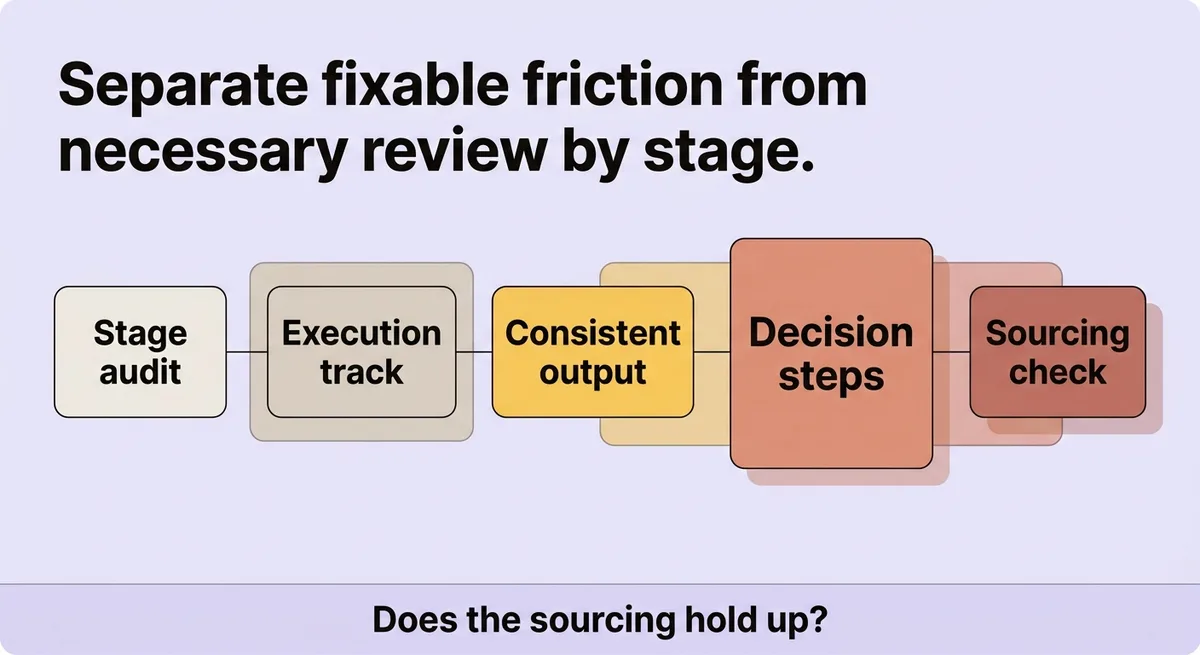
Execution steps follow a rule. They produce the same output every time if the rule is applied correctly. Format the draft. Upload the images. Set the meta description. Check the internal links. These steps belong in a mechanical routing track with clear templates and assigned executors.
Decision steps require interpretation. Does this section argue the right point? Does the sourcing hold up? Is the tone appropriate for the target reader? These steps belong in a judgment queue with a named reviewer and a defined scope.
A 15-minute pre-publish checklist handles the mechanical execution track reliably [1]. Running 20 posts per month through that checklist removes 5 to 6 hours of formatting work per month [1]. That time does not disappear by working faster. It disappears by removing the step from the judgment queue entirely and giving it a defined mechanical owner.
| Workflow Stage | Step Type | Routing Rule |
|---|---|---|
| Brief creation | Judgment | Named owner, defined template |
| First draft | Execution + Judgment | Drafting tool or writer, scoped brief |
| SEO check | Mechanical | Template-based rule, no approval queue |
| Editorial review | Judgment | One named reviewer, defined scope |
| Stakeholder review | Judgment (conditional) | Trigger only when content type warrants it |
| CMS formatting | Execution | Template, assigned executor |
| Final scheduling | Execution | Checklist, no review required |
The table above is an audit tool, not a prescription. Apply it to your actual workflow by listing each step you currently run, labeling it execution or judgment, then checking whether its current routing matches that label.
Most workflows reveal the same pattern: mechanical steps sitting in judgment queues, and judgment steps with no defined owner or scope. Both slow the pipeline for different reasons.
A four-stage approval flow, brief and creation, internal review, conditional stakeholder review, and final scheduling, gives every step a lane [2]. Steps that don’t need a decision don’t wait for one. Steps that do need a decision reach the right person without passing through three others first.
The 48-hour feedback window assigned to each review stage [3] works because it applies only to judgment steps. Mechanical steps don’t have a feedback window. They have a completion rule. Treating those two categories the same way is what turns a 3-day post into a 9-day post.
One implementation caveat: this audit only works if you map the workflow you actually run, not the one you intend to run. Most documented workflows skip the informal steps, the Slack message asking if the draft is ready, the email checking whether the reviewer saw the file, the manual CMS copy-paste that was supposed to be automated six months ago. Those informal steps carry real elapsed time. They belong on the audit list.
Where Your Next Publishing Delay Is Already Hiding Right Now
Your next late post is not stuck in drafting. It’s waiting in a handoff with no named owner and no routing rule.
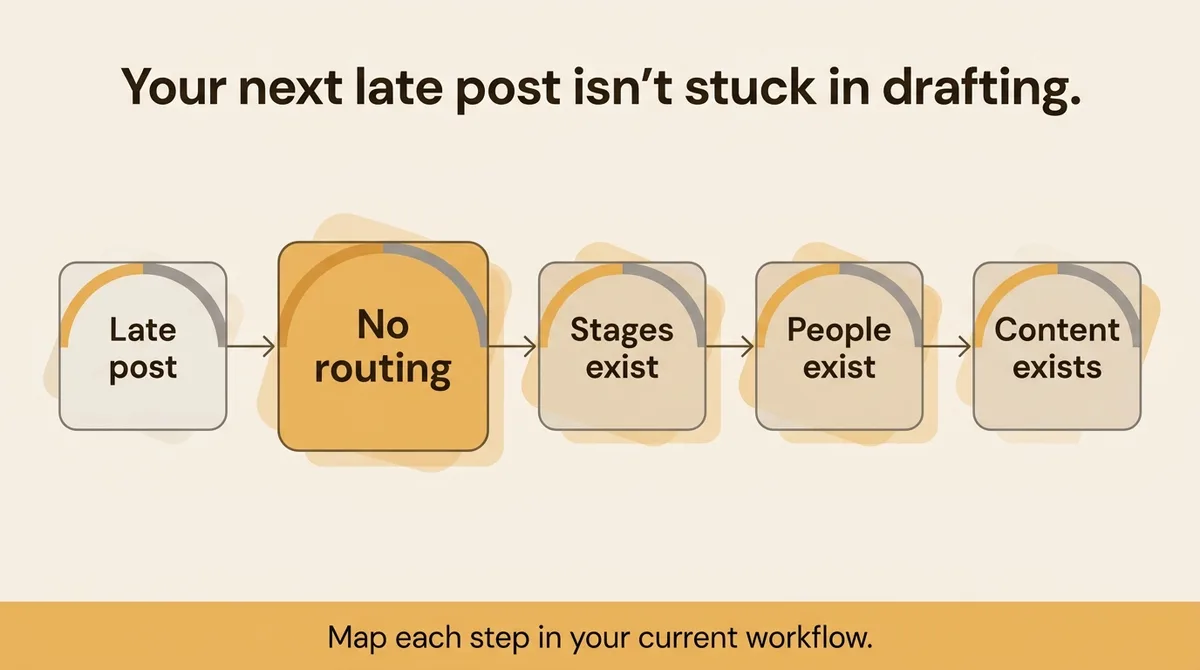
The stages exist. The people exist. The content exists. What’s missing is a decision about which steps require human judgment and which steps require someone to follow a rule. That gap is mechanical, not creative. It doesn’t require new tools or a larger team.
Map each step in your current workflow. Label it. Route it accordingly. The delay you’ve been treating as a content problem will show itself as a routing problem.
Check which step in your pipeline currently has the longest average wait time. That step is your real constraint. Fix the routing there first.
Your next publish date is already set by the slowest unnamed handoff in your queue.
References and Citations
[1]https://ranksector.com/blog/best-ai-tools-for-high-volume-blog-publishing-2026
[2]https://theaicmo.com/blog/content-approval-workflows
[3]https://mygomseo.com/blog/the-approval-bottleneck-why-great-content-still-misses-its-publish-date
[4]https://www.straive.com/blogs/scaling-publishing-operations-with-agentic-ai/
FAQ
Blog publishing stalls after drafting because each handoff stage inherits wait time from the stage before it, and those gaps accumulate faster than any single step suggests. A 1,500-word draft takes 3 to 4 hours to produce, but the surrounding handoffs, status checks, format adjustments, and approval pings consume 3 to 5 days of real calendar time. The bottleneck is not writing speed; it is the absence of named owners and routing rules at each transition point between stages.
Ask one question for each workflow stage: does this step require a decision, or does it require execution? Execution steps like CMS formatting, image upload, and meta description entry follow a fixed rule and belong in a mechanical track with a checklist and an assigned executor, not an approval queue. Judgment steps like editorial review and stakeholder sign-off require interpretation, so they belong in a named-owner queue with a defined scope, and those are the only steps that should carry a feedback window.
One vendor write-up reports that agentic approval workflows average 1.8 days to completion versus 4.7 days for manual routing, a 2.6x difference in elapsed time. That gap does not come from removing human review; it comes from stopping mechanical steps from sitting in judgment queues alongside decisions that actually need a person. Platforms like Zelitho are designed to help here by connecting topic selection, drafting, optimization, and CMS publishing inside one system, so formatting and handoff steps are less likely to re-enter a review queue.
When no single person owns the transition between workflow stages, reviewers assume someone else will act first, drafts sit untouched for days, and the wrong reviewer ends up catching problems that should have been fixed two rounds earlier. That pattern restarts the clock at each stage and compounds rework in the same way delay does. Assigning one named owner per transition point with a defined response window reduces the ambiguity that causes this failure, not the review itself.
Small teams can recover most of their lost publishing time by auditing each workflow step, labeling it execution or judgment, and routing it to a mechanical checklist or a named reviewer accordingly, without adding headcount or removing oversight. A 15-minute pre-publish checklist for mechanical steps alone removes 5 to 6 hours of formatting work per month across a 20-post pipeline. Zelitho is designed to help in this situation, combining keyword selection, draft generation, on-page optimization, and direct WordPress or Webflow publishing into one connected workflow so that mechanical handoffs between separate tools can be reduced rather than just sped up.