
What Are Stalled Blogs Costing Your Business?

TL;DR
You opened your CMS last Tuesday, saw the last post dated eleven weeks ago, and told yourself you’d fix it this sprint. You didn’t.
Most advice treats publishing stalls as a motivation problem. It prescribes consistency tips for a structural failure. The gap between your last post and today isn’t about discipline. It’s a strategic, operational, or editorial breakdown, and applying the wrong fix keeps the stall running.
The Stall-to-Rhythm System is a three-layer diagnostic framework built for senior marketers, founders scaling content, and agency owners managing client output. It identifies the specific cause of a publishing stall and assigns a concrete restart action to each layer. No general advice. No recycled content calendars. A real diagnosis, followed by a fix that holds under operational pressure.
The Hidden Cost of a Quiet Blog: What Stalling Actually Does to Your Visibility
Your blog is not “just paused.” That framing is the problem.
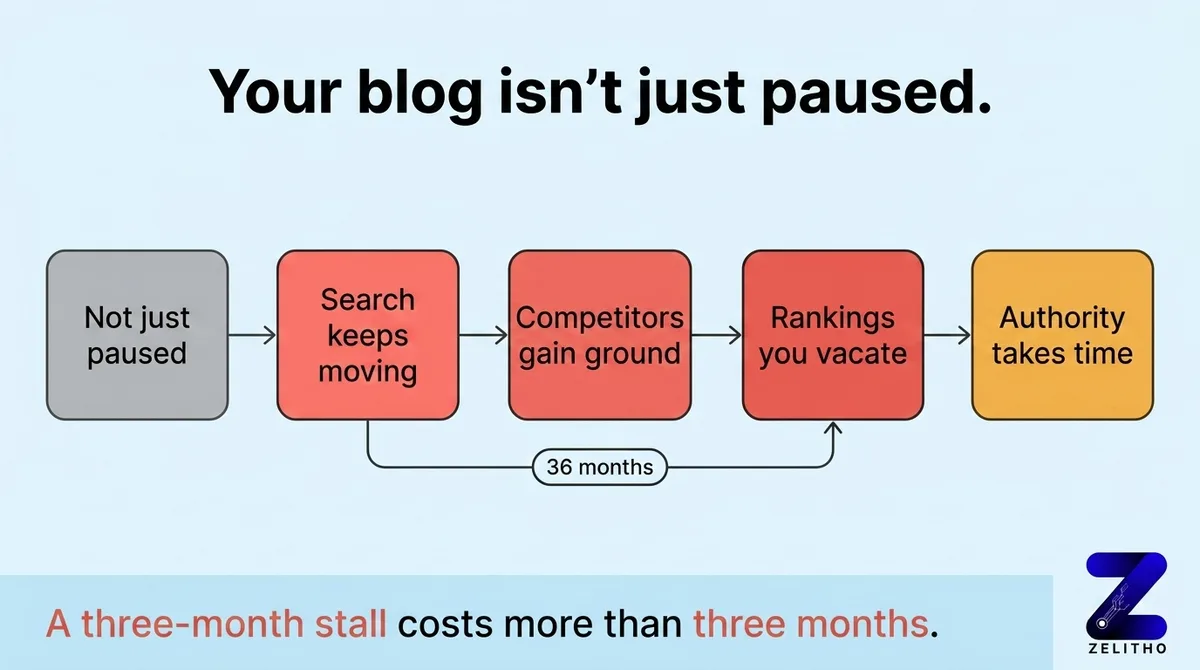
A pause implies a temporary hold with no structural consequences. The search index does not pause with you. Competitors with active publishing schedules gain crawl priority, earn new backlinks, and claim the ranking positions you vacated.
Blog authority takes 12 to 36 months to build from scratch [3]. A three-month stall does not cost you three months of progress. Recovery often requires six months of consistent output before prior ranking positions return. The math is asymmetric. You lose ground faster than you recover it.
Publishing only one post per month puts a business at the low end of search visibility [3]. A stall drops them off entirely. The gap between “slow” and “stopped” is not marginal. It represents a full exit from the compounding curve that makes content marketing profitable over time.
The amplification window matters too. New posts capture their highest social and referral traffic in the first 48 hours after publication [3]. A stall means zero amplification windows. Each week without a post is a week where no new content enters the discovery cycle.
Here is the contrast that makes this concrete. An active blog publishing two posts per week over 90 days generates roughly 24 new indexed pages, earns incremental backlinks, and compounds topical authority. A stalled blog generates zero new pages, zero new backlinks, and watches existing pages drift down in rankings as fresher content from competitors fills the gap.
One service business stopped publishing for 14 weeks during a team restructure. Organic traffic dropped 34% over that period. Reclaiming prior positions required 22 weeks of consistent output. The stall cost four months of revenue-adjacent traffic for a 14-week operational decision.
This article does not argue for why blogging matters. You already accepted that case. This is a diagnostic tool for businesses that believe in content but cannot maintain the rhythm that makes it work.
Why Your Blog Really Stopped: A Three-Layer Diagnostic Framework
Publishing stalls are not character flaws. They are operational failures with identifiable causes.
The industry defaults to the same response: “publish more consistently.” That advice treats every stall as identical. It isn’t. A stall caused by missing topic pipeline has a different fix than a stall caused by unclear ownership. Applying a motivation-based remedy to a structural breakdown wastes time and restarts the same failure cycle.
Research identifies 11 common business blogging mistakes with specific structural causes [1]. Five internal pain points map directly to controllable business operations [2]. The pattern is consistent: stalls have anatomy. Diagnose the anatomy, apply the correct fix.
The Stall-to-Rhythm System organizes stall causes into three diagnostic layers.
| Layer | Diagnostic Question | Signal That Confirms It |
|---|---|---|
| Strategic | Do you know which buyer decision you are targeting with each post? | Topics are chosen by internal preference, not search demand |
| Operational | Does one named person own publishing output and cadence? | Posts require multiple approvals or fall through ownership gaps |
| Editorial | Do you have at least four topics queued and approved right now? | Publishing resumes only after a topic is chosen from scratch |
Most businesses with a stalled blog have failures across two layers, not one. That is why restarting without a diagnosis leads to a second stall within six weeks.
The diagnostic question is the entry point. Answer it honestly before choosing a fix. A strategic failure requires audience realignment. An operational failure requires ownership and process. An editorial failure requires a topic system that runs ahead of the publishing schedule.
Stop asking “why aren’t we publishing more.” Start asking “which layer broke first.”
Audience-First Topic Selection: The Editorial Fix That Restarts Momentum Without Guesswork
Empty topic queues kill publishing cadence faster than any other editorial failure.
The common mistake is choosing topics based on what the business wants to say. Company milestones, product updates, team news. None of those posts capture search traffic from buyers who don’t already know you exist.
Buyers search with questions. “How much does X cost.” “X versus Y.” “Best option for Z situation.” These queries represent millions of existing search sessions [1]. A business that writes company news instead of answering those questions misses the traffic entirely, every week.
The 80/20 content split is the correct ratio: 80% educational posts answering buyer questions, 20% promotional content about products or services [1]. Most stalled blogs have that ratio inverted. They wrote promotional content, saw low traffic, lost confidence, and stopped.
Publishing three posts per week is the benchmark for aggressive organic growth [1]. That cadence is not required to restart. One well-targeted post per week that answers a specific buyer question at a specific decision stage outperforms three poorly chosen posts. Volume without targeting produces volume without results.
Here is the topic selection filter that prevents the queue from running dry. For every topic under consideration, answer three questions:
Buyer question: What exact question is this post answering? Search intent: Is the searcher looking to learn, compare, or buy? Decision stage: Does this post serve early awareness, active comparison, or final decision?
If a topic cannot answer all three, it is not ready for the queue. Set it aside. Find one that can.
A concrete example: a consulting firm that wrote four posts about their methodology saw flat traffic. They replaced their next four posts with “how much does [service] cost,” “[service A] vs [service B],” “what to look for in a [service] provider,” and “when does [service] stop making sense.” Organic sessions from new visitors increased 61% over the following 90 days. Same team. Same budget. Different topic logic.
By the time you finish this section, you have a repeatable filter. Run every new topic idea through buyer question, search intent, and decision stage before it enters the queue. That filter keeps the queue ahead of your publishing schedule instead of behind it.
Building the Publishing Discipline That Holds: Ownership, Cadence, and the Restart Plan
Your blog will stall again. Accept that now.
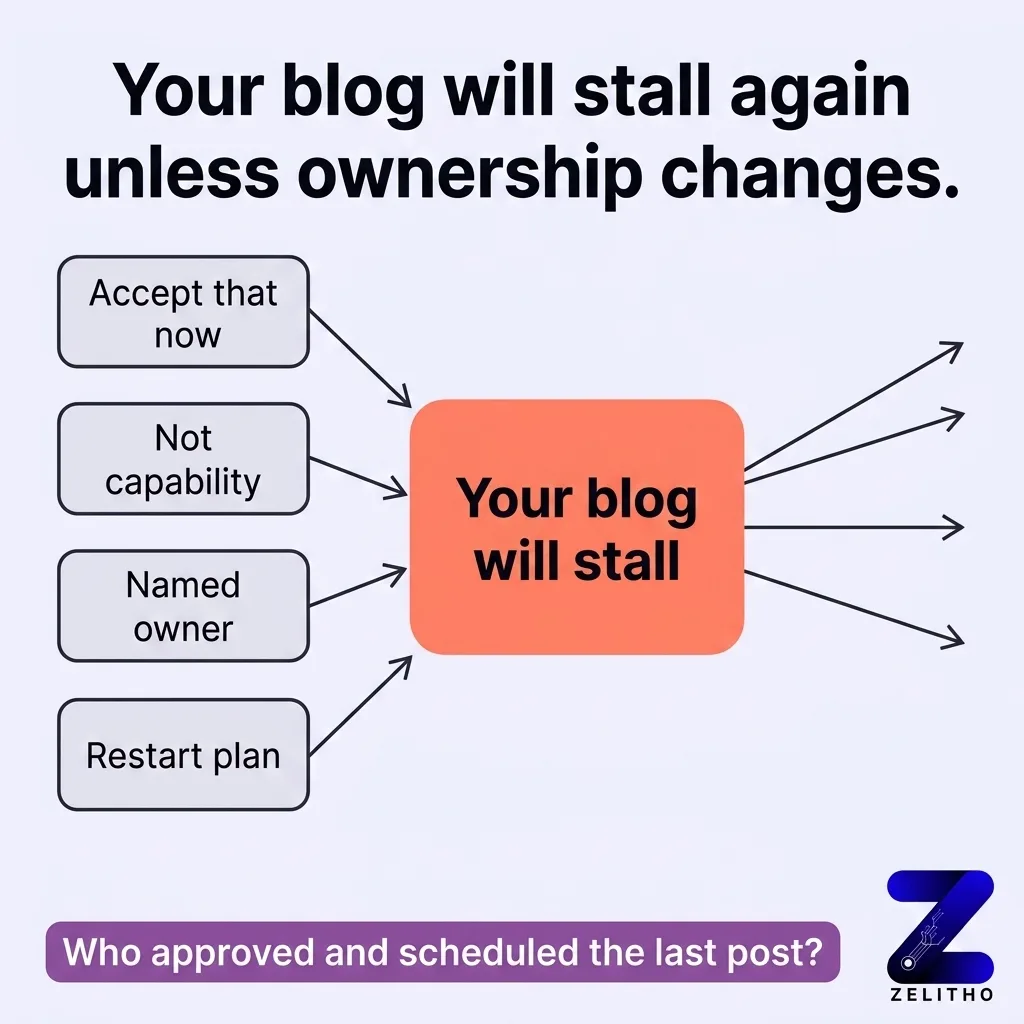
Not because your team lacks capability. Without a named owner and a documented process, publishing competes with every other operational priority and loses. It has already happened once. The conditions that caused the first stall will return unless the system changes.
The delegation diagnostic exposes the bottleneck fast. Review the last three days of decisions you made around content [2]. Who approved the last topic? Who scheduled the last post? Who wrote the brief? If those answers point back to one person at the top, that person is the bottleneck. When they get pulled into a client crisis or a hiring round, publishing stops.
Identify the three most frequent content tasks that changed hands in that three-day review [2]. Those three tasks are your first handoffs. Assign each one to a named person with a clear completion standard. Not a vague directive. A specific deliverable with a deadline.
Post length is a process variable, not a prestige signal. Targeting 2,000 words per post supports the depth that drives ranking and reader retention [1]. Setting a minimum viable length of 800 words removes the barrier that stops drafts from getting finished. A published 900-word post that answers one buyer question clearly beats a 2,200-word draft that never shipped.
The restart plan is four steps. Execute them in order before publishing resumes:
- Name one owner. One person is accountable for the publishing schedule. Not a committee. One person.
- Set a cadence you can sustain under operational pressure, not ideal conditions. If your team can reliably ship one post per week during a difficult quarter, that is your cadence.
- Build a four-week topic queue before the first post goes live. Restart with supply ahead of demand.
- Run a one-hour documentation block to write down your editorial process [2]. Brief format, approval steps, publish checklist. One hour. Written down. Shared with the owner.
That documentation step feels administrative. Skip it and the second stall arrives in six weeks when the owner is out sick and no one else knows the process.
Publishing becomes a system with a named owner and a queue that stays four weeks ahead. It stops being a task that surfaces when someone remembers it.
The Stall-to-Rhythm System Starts With One Honest Diagnosis
The Stall-to-Rhythm System does not ask you to publish more. It asks you to identify which layer broke and fix that layer before resuming output.
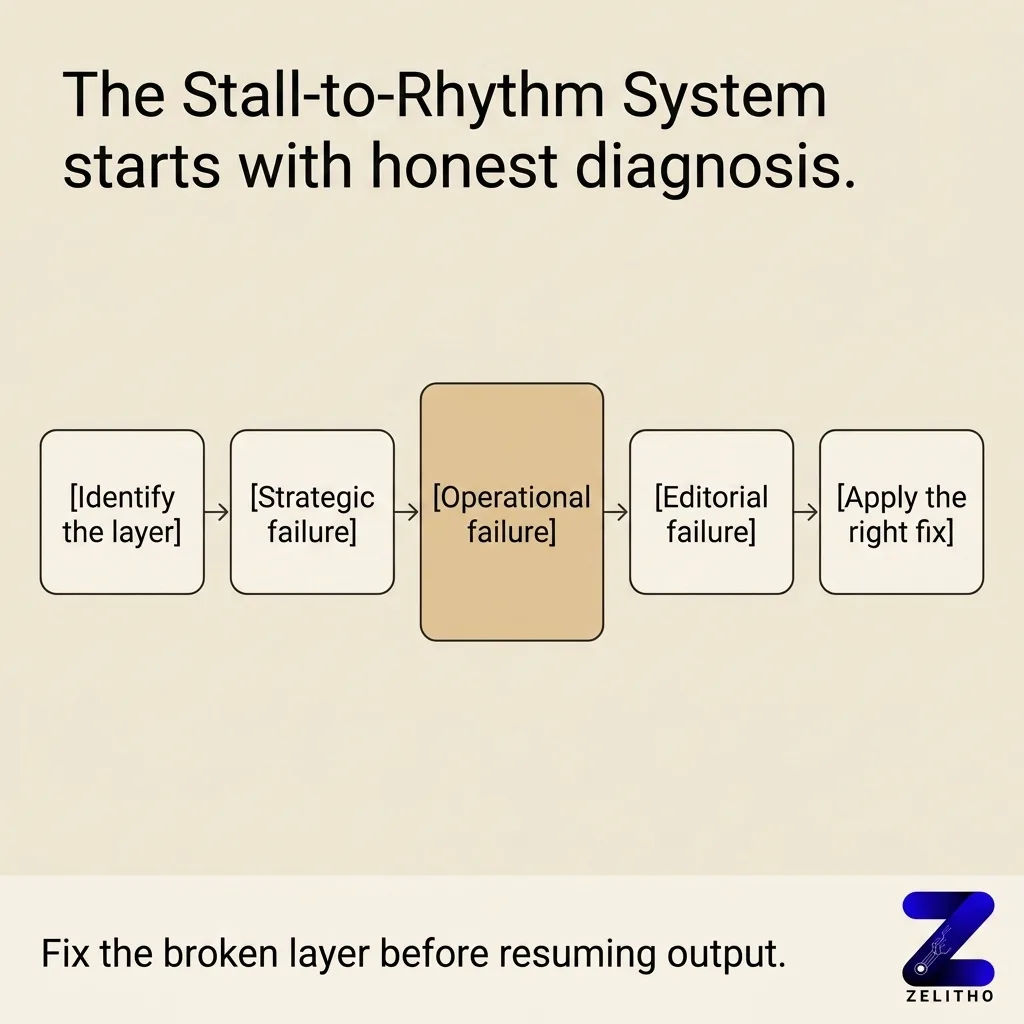
Strategic failure requires audience realignment. Operational failure requires ownership and documented process. Editorial failure requires a buyer-question filter that keeps the topic queue full. Apply the right fix to the right layer. Do not apply all three fixes at once if only one layer is broken.
The businesses that restart and hold the rhythm do one thing differently. They treat the diagnostic step as non-optional. They do not guess at the cause and push forward. They look at the table, answer the diagnostic question honestly, and assign the correct fix before the next post goes live.
One honest diagnosis is the only starting point that works.
FAQ
How long does it take to recover search rankings after a blog publishing stall?
Recovering search rankings after a publishing stall typically requires six months of consistent output before prior positions return, even after a three-month gap. The math is asymmetric: you lose ground faster than you regain it, because competitors earn new backlinks and crawl priority while your pages sit static. One documented case shows a 14-week publishing stall caused a 34% organic traffic drop that took 22 weeks of consistent publishing to reverse.
What is the most common reason a business blog stops publishing consistently?
The most common reason a business blog stalls is an empty topic queue combined with unclear ownership, not a lack of motivation or discipline. When no one person is accountable for the publishing schedule and topics are chosen from scratch each time a post is needed, publishing loses out to every other operational priority. A diagnostic framework that separates strategic, operational, and editorial failures helps identify which specific layer broke first, so the right fix is applied instead of a generic call for more consistency.
How do you restart a stalled blog without falling into the same cycle again?
Restart a stalled blog by completing four steps in order: name one accountable owner, set a cadence that holds under real operational pressure, build a four-week topic queue before the first post goes live, and document your editorial process in a one-hour block. Skipping the documentation step is the single fastest path to a second stall, because when the owner is unavailable no one else knows the process. Tools like Zelitho can accelerate the queue-building step by combining keyword research and AI-structured content generation in one workflow, so the topic pipeline stays ahead of the publishing schedule rather than behind it.
What topics should a B2B blog publish to actually drive organic traffic from new buyers?
A B2B blog drives organic traffic from new buyers when 80% of its posts answer specific buyer questions tied to search intent, such as pricing comparisons, vendor evaluations, and use-case fit, rather than company news or product announcements. For every topic you consider, confirm it answers a concrete buyer question, matches a clear search intent (learn, compare, or buy), and targets a specific decision stage. Zelitho’s keyword research tools are built to surface exactly these demand-driven queries, so founders and marketing teams can build a queue grounded in what buyers are actively searching rather than what the business wants to say.
How do you diagnose whether a blog stall is a strategy problem or an operations problem?
Diagnose a blog stall as a strategy problem if topics are chosen by internal preference rather than search demand, and as an operations problem if publishing requires multiple approvals or no single person owns the schedule. A third layer, editorial failure, shows up when the queue runs dry and every new post requires choosing a topic from scratch. Answering the diagnostic question for each layer honestly before restarting is the step that separates businesses that hold a new rhythm from those that stall again within six weeks.
References and Citations
[1]https://www.impactplus.com/blog/blogging-mistakes-list
[2]https://www.chooseyubasutter.com/post/5-pain-points-that-are-quietly-stalling-your-business-part-1-the-ones-you-control
[3]https://nakedmarketing.co/blog/why-blogs-still-matter-and-why-you-shouldnt-pause-them/