
What Are AI Content Creation Tools, and How Do They Work?

TL;DR
Your team just got access to a shiny new AI writing tool. You ran a test. The output was usable but slightly off-brand. Someone rewrote it. That cycle repeated twelve times last month.
Most teams pick AI content tools from a demo, a LinkedIn post, or a vendor comparison chart. None of those sources tell you what stage of production the tool was built for. That mismatch is where quality breaks down.
This guide introduces the Content Stage Matching System: a method for mapping each tool type to a specific production stage before you buy or deploy it. It applies to senior marketers managing content at scale, founders building a repeatable publishing operation, and agency owners delivering consistent output across client accounts. Match the task first. Then select the tool.
What Does “Task Fit” Mean When Choosing an AI Content Tool?
Task fit means identifying the exact production stage a tool is designed to operate in, then confirming that stage matches your actual need. A tool built for long-form drafting does not perform ideation work. A tool built for image generation does not check brand voice. Task fit is not about features. It is about workflow position.
You Are Probably Picking Tools at the Wrong Stage of the Process
You opened a new tab. You searched for AI content tools. You saw a product with clean branding, a fast demo, and a pricing page that looked reasonable. You signed up.
Six weeks later, your team is producing more content but re-editing almost all of it.
That is not a tool failure. That is a stage mismatch.
More than 80% of enterprises are projected to have used generative AI APIs or deployed generative AI applications by 2026 [5]. That pace creates pressure to adopt fast. Pressure creates shortcuts. The most common shortcut is skipping the question: what stage of content production does this tool actually serve?
There are seven workflow stages involved in using AI for content creation [3]: research, ideation, outlining, drafting, editing, governance review, and distribution. Each stage has a different job. Each job requires a different tool type. Most teams treat all seven stages as one activity called “writing,” then wonder why output quality is unpredictable.
Here is the concrete case: a B2B marketing team bought a long-form generation tool after seeing a walkthrough on social media. Their real bottleneck was ideation. They needed a tool that mapped audience questions to content angles. The generation tool they bought assumed a brief already existed. For six weeks, their writers kept feeding the tool weak prompts because no ideation layer existed upstream. Output was technically complete and editorially hollow. They backtracked. They built the ideation step manually. Then they bought a second tool.
Two tools. Six weeks of misaligned output. One process gap that should have been visible before any purchase.
This is what the Content Stage Matching System corrects. Before evaluating any tool, you map your production stages. Then you identify which stage has the actual gap. Then you evaluate tools designed for that specific stage. Category labels like “AI writing tool” or “AI content platform” do not tell you where in the process the tool belongs. Stage mapping does.
This article does not rank tools or compare pricing. It teaches stage fit. That is the only evaluation skill that reduces rework and produces consistent output quality over time.
What Each Type of AI Content Tool Is Actually Built to Do
Stop treating every AI writing tool as a faster version of the same thing.
A drafting tool is not a strategy tool. A generation tool is not an editing tool. The category names vendors use in their marketing tell you almost nothing about where the tool fits in your workflow.
Three core technologies power every AI content tool: large language models, which generate text by predicting the next word based on patterns in training data; machine learning, which adjusts model behavior based on examples and feedback; and natural language processing, which gives tools the ability to read, interpret, and respond to text inputs [3]. These technologies combine differently in each tool type, which is why the outputs are so different.
Broadly, AI content tools operate across three format categories: written content, images, and video [3]. Inside each format category, there are tools designed for generation and tools designed for refinement. Generation tools create from a prompt. Refinement tools improve what already exists. A fourth functional layer sits across all format types: editing and governance tools. These check accuracy, consistency, and compliance after content is created.
Here is how each type maps to the production workflow:
Tool Type | Primary Job | Where It Fits in Workflow | What It Cannot Do |
|---|---|---|---|
Ideation and research tools | Surface topics, gaps, and audience questions | Stages 1 and 2: research and ideation | Generate final-ready copy |
Long-form generation tools | Produce structured drafts from a brief | Stages 3 and 4: outlining and drafting | Define strategy or set brand tone |
Image generation tools | Create visual assets from text prompts | Stage 4 parallel: visual drafting | Confirm brand compliance without training |
Video generation tools | Convert scripts or prompts into video formats | Stage 4 parallel: video drafting | Handle narrative structure or review |
Editing and governance tools | Check tone, accuracy, and consistency | Stages 5 and 6: editing and review | Write new content or generate ideas |
The most common misuse pattern: teams use long-form generation tools at the strategy stage. A generation tool needs a brief. A brief requires a strategy. Using the generation tool to create the strategy does not compress the timeline. It skips the thinking step, which produces content with weak angles, thin differentiation, and no clear reader benefit.
Stop buying generation tools before you have a brief-writing process. Start with the stage where your output falls apart, not the stage that looks most impressive in a demo.
One operational rule applies before any tool evaluation. Write one sentence describing the specific task this tool will own in your workflow. If you cannot write that sentence, you are not ready to buy the tool. You are still figuring out your process, and no tool will fix that for you.
The Real Cost of Skipping Task Fit When You Choose a Tool
Choosing the wrong tool for a stage is not just inconvenient. It creates measurable output problems that compound over time.
AI-assisted planning tools are associated with a 50% reduction in content planning time [1], but that reduction only materializes when the tool matches the planning stage. Applied at the wrong stage, a planning tool adds review cycles instead of removing them. Your team spends time feeding the tool inputs it was not designed to receive, interpreting outputs it was not designed to produce, and correcting errors that only exist because the tool was doing the wrong job.
The AI content market is projected to reach $356 billion by 2030 [1]. As that market grows, the number of available tools grows with it. More selection decisions, not fewer. Teams that do not build a stage-matching evaluation process will repeat the same mismatched purchase at a larger scale and a higher cost. That is a scaling problem, not a vendor problem.
Here is a directional signal for teams publishing at volume. A team publishing 20 pieces per month that uses a general-purpose generation tool in place of a brand-voice-specific one will spend roughly 30% of their editing hours correcting tone inconsistencies. The tool was not wrong. It was misapplied.
The hidden worry most marketers carry: “If I chose wrong, will my content quality suffer publicly?” The honest answer is yes. And it may already be happening. Readers notice when brand voice shifts between articles. They notice when content makes claims that do not hold up to a quick search. They notice when a resource they trusted starts producing content that reads like it was finished in a hurry. Rework hours are internal. Trust erosion is external. One of those is harder to recover from.
Name the cost clearly: mismatched tool selection produces rework hours, inconsistent brand voice across channels, and reader trust erosion when published quality drops. These are not abstract risks. They show up in editing queues, in content calendars that slip, and in performance metrics that plateau without a clear cause.
Where Human Review Fits and Why No Tool Removes That Step
ChatGPT reached 5.24 billion monthly visits as of June 2025, making it the fifth most visited website on the internet [1]. That volume means AI-generated content is everywhere. The bar for quality differentiation is higher now, not lower. If every team is publishing AI-assisted content, the teams that add rigorous human review are the ones whose content stands out.
A survey base of nearly one million consumers across 50+ markets [4] confirms that audience expectations for accuracy are real and measurable. Readers identify factual errors. They share corrections. They stop returning to sources they stopped trusting. That behavior does not care whether the error came from a human writer or an AI tool. The error is the error.
The Content Stage Matching System includes a validation layer that no tool replaces. Human review sits at every stage transition. It is not a single final check at the end of production. It is a designed checkpoint that confirms stage output is accurate, on-brand, and ready to move forward.
Here is what a human reviewer must check that no current AI tool handles reliably:
- Factual accuracy: Does every claim in the content hold up against a verifiable source? AI tools hallucinate. A confident-sounding output is not a confirmed fact.
- Brand tone: Does the content sound like the brand, or does it sound like a competent stranger describing the brand? These are different things.
- Source attribution: Are referenced data points, quotes, or studies accurately cited? AI tools cite sources that do not exist.
- Ethical flags: Does any part of the content misrepresent, stereotype, or create legal exposure? A tool does not catch these consistently.
Assign a named person to each review checkpoint in your workflow. Not a team. Not a role title. A person with a name, a deadline, and a defined scope of review. If no person is named, the checkpoint does not exist. An unnamed checkpoint is a gap that AI-generated content will eventually fall through.
The Content Stage Matching System works only when human oversight is treated as a designed production step. It is not overhead. It is the mechanism that separates publishable content from content that simply exists. Every stage in the system produces output. Human review confirms that output is ready.
And then there are tools like Zelitho – which helps you show up right where your buyers are looking for you. Zelitho’s Content Automation Platform operates right from the keyword research stage to direct publishing on your website and then goes beyond normal traffic to monitoring your brands AI Visibility. It helps you create well researched, fully SEO and AEO optimised blog content and then with your team in the loop, you can easily edit the content, tone, etc., to match your brand tone and personalize your content which can directly be published to your website.
Match the Tool to the Task and the Task to the Person
The Content Stage Matching System is a three-part habit. Identify the production stage with the actual gap. Evaluate tools designed to operate at that specific stage. Assign a named human to the review checkpoint that follows.
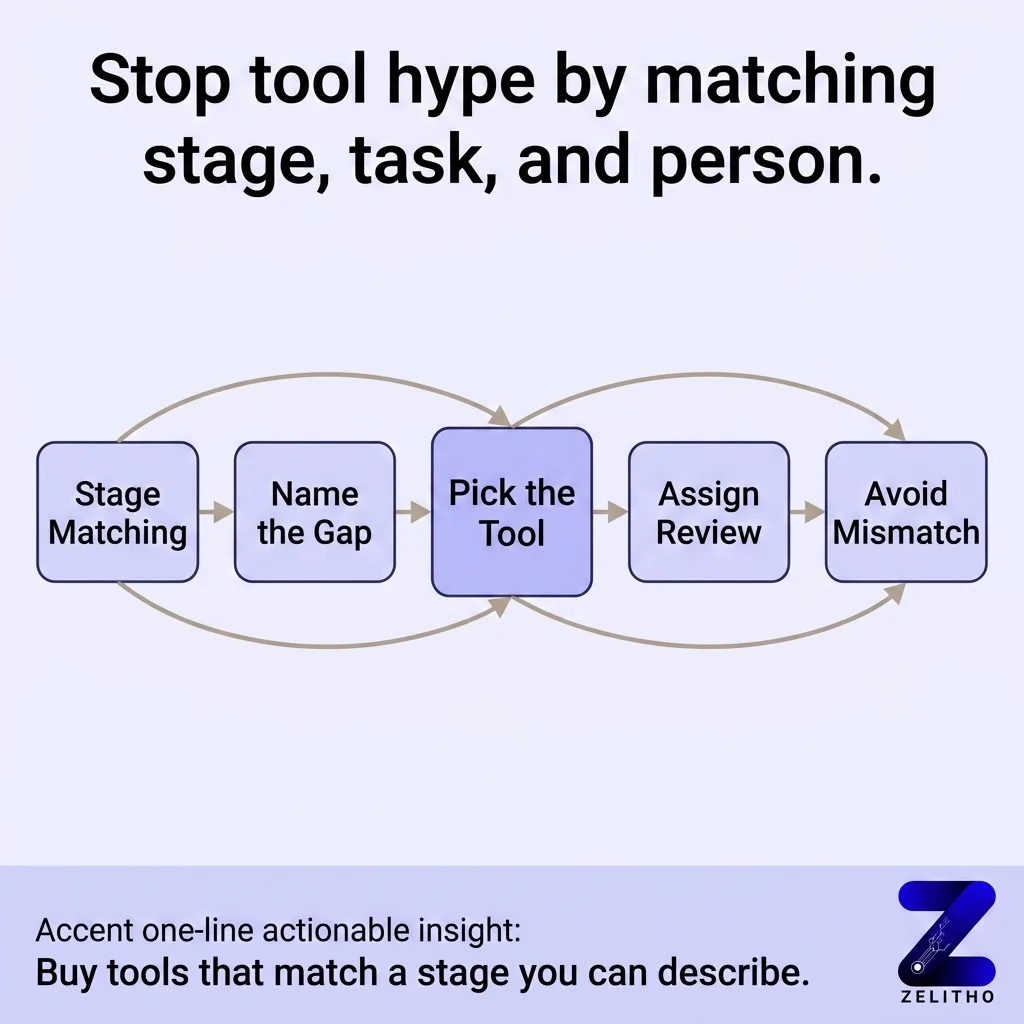
Teams that skip step one buy tools they do not need. Teams that skip step three publish content they should not. The system only holds when all three parts are in place.
Buy tools that match a stage you can describe in one sentence. Assign review to a person you can name right now.
References and Citations
[1]https://tenhats.com/how-businesses-are-using-ai-for-content-creation/
[3]https://www.grammarly.com/blog/ai/ai-for-content-creation/
[4]https://www.gwi.com/blog/free-ai-tools-for-content-creation
[5]https://kontent.ai/resources/the-role-of-ai-in-streamlining-content-creation/
FAQs
Constant rewriting is almost always a stage mismatch problem, not a tool quality problem: your team is using a tool at the wrong point in the production workflow. Most AI content tools are built for a specific stage, such as ideation, drafting, or editing, and when you deploy a drafting tool at the strategy stage, or a generation tool without a brief-writing process upstream, the output is technically complete but editorially hollow. The fix is to map your production stages first, identify which stage actually has the gap, and then evaluate tools designed for that specific stage rather than buying based on a demo or a vendor comparison chart.
Before evaluating any AI content tool, write one sentence describing the specific task that tool will own in your workflow; if you cannot write that sentence, you are not ready to buy. The right evaluation process has three steps: map your production stages, identify which stage has the actual gap, then evaluate only tools designed to operate at that stage. Platforms like Zelitho are built around this workflow logic, pairing keyword research and content generation with AI visibility tracking so each tool covers a named stage rather than claiming to do everything.
AI content tools fall into five functional types, each built for a different stage of production: ideation and research tools surface topics and audience questions, long-form generation tools produce structured drafts from a brief, image generation tools create visual assets from text prompts, video generation tools convert scripts into video formats, and editing and governance tools check tone, accuracy, and consistency after content is created. Generation tools create from a prompt; refinement tools improve what already exists; and governance tools sit across all format types to catch factual errors, brand voice drift, and compliance issues. The critical point is that no single tool handles all seven workflow stages, so treating them as interchangeable is what causes unpredictable output quality.
AI-assisted planning tools are associated with a 50% reduction in content planning time, but that reduction only materializes when the tool is matched to the planning stage it was built for. Applied at the wrong stage, the same tool adds review cycles instead of removing them, because your team spends time feeding it inputs it was not designed to receive and correcting outputs it was not designed to produce. Tools like Zelitho are designed to compress the workflow from keyword discovery through content creation and AI visibility tracking in one suite, which reduces the handoff friction that quietly consumes planning hours.
Yes, publishing AI-generated content without human review can erode reader trust, because readers notice when brand voice shifts between articles, when claims do not hold up to a quick search, and when a source they trusted starts producing content that reads as if it was finished in a hurry. Rework hours are internal, but trust erosion is external, and trust is harder to recover from. Human review is not optional overhead; it is a designed production step that sits at every stage transition, checking factual accuracy, brand tone, source attribution, and ethical flags that no current AI tool handles reliably.