
Top Semantic SEO Strategies to Rank Higher in 2026

Semantic search optimization is the architectural practice of structuring website content around verified entity relationships, knowledge triplets, and extractable topical chunks rather than isolated keyword repetitions. While traditional search crawlers matched literal text strings, modern search algorithms and neural language models (Google MUM, BERT, and OpenAI search models) evaluate content within multidimensional vector spaces. Implementing semantic SEO principles ensures search engines comprehend your brand as an authoritative topical node, securing top rankings on search engine results pages and winning primary citation placements in generative AI overviews.
Top Semantic SEO Strategies to Rank Higher in 2026: The Core Architecture
The top semantic SEO strategies to rank higher in 2026 require shifting from lexical keyword optimization to vector-based entity modeling. By engineering unambiguous Subject-Predicate-Object knowledge triplets, implementing answer-first passage hierarchies beneath question headers, and deploying dual-layer JSON-LD entity schemas linked to Wikidata, publishers provide retrieval algorithms with the structured factual density required for high organic positioning and AI answer citations.
Modern search engines do not read web pages like human visitors. Instead, natural language processing (NLP) pipelines convert text into dense mathematical embeddings that map semantic proximity. Pages that organize facts into modular 300-word topical chunks consistently outrank unstructured narrative articles covering the same subject.
Best Content Strategies for Semantic Search Optimization (The 2026 Framework)
Modern semantic optimization structures content around core entities, verifiable knowledge triplets, and extractable passage chunks that generative engines can ingest into vector databases without summarization loss:
| Semantic Strategy | Traditional Keyword SEO | Semantic Search Architecture | RAG & AI Search Grounding Impact |
|---|---|---|---|
| 1. Entity-First Topic Modeling | Repeats target keywords in titles and body text. | Maps primary entities to Wikidata and schema nodes, establishing topical taxonomy. | Enables AI models to associate your brand with industry authority clusters. |
| 2. Knowledge Triplet Architecture | Unstructured sentences optimized for general reading. | Structures facts into unambiguous Subject-Predicate-Object triplets. | Eliminates LLM hallucination and enables direct citation in AI answers. |
| 3. Syntactic Passage Chunking | Long continuous essays (1,500+ words). | Self-contained 45-60 word answer units beneath descriptive questions. | Fits standard vector chunk embeddings (256-512 tokens) with zero summarization loss. |
| 4. Topical Completeness | Targets high search-volume keywords only. | Answers prerequisite, tangential, and consequence queries within the entity cluster. | Captures multi-turn conversational searches across Perplexity and ChatGPT. |
| 5. Structured Schema Validation | Basic title, meta description, and H1 tags. | Valid JSON-LD schema (TechArticle, FAQPage) linking to Wikidata URIs. | Provides explicit machine-readable context directly into search engine knowledge graphs. |
E-Commerce Semantic Keyword Mapping and Entity Content Clusters
Structuring commercial domains around entity-based content clusters and semantic keyword mapping eliminates internal keyword cannibalization while reinforcing category authority. In modern semantic SEO, an e-commerce catalog maps entities from overarching parent nodes down to granular transactional attributes.
Consider an online electronics store optimizing for high-intent buyers:
- Top-Level Entity Node: Audio Equipment (Wikidata: Q11033) serves as the conceptual umbrella.
- Sub-Entity Category Cluster: Noise-Cancelling Headphones (Wikidata: Q1983050) groups all brand offerings.
- Attribute Specification Entities: Battery life, active noise cancellation decibel reduction, driver size, and Bluetooth codec support form explicit relational data triplets.
This organized taxonomy allows conversational AI assistants to query your product database logically when shoppers ask comparative buying questions like “Which over-ear headphones under $300 have the longest battery life for international travel?”
Vector Space Analysis, Dense Retrieval, and Word Embeddings
Modern search pipelines calculate document relevance through mathematical vector space analysis, dense retrieval, and word embeddings, measuring conceptual proximity rather than superficial token matches. Natural language processing models transform words, sentences, and passages into numerical vectors where semantically related ideas occupy neighboring coordinates.
For search optimization, vector space analysis means that using varied, semantically accurate vocabulary outperforms repetitive keyword stuffing. Dense retrieval models evaluate conceptual overlap across entire passages, allowing pages to rank for competitive commercial queries even when the exact search phrase appears only once.
Rigorous editorial teams follow strict content formatting best practices AI retrieval chunking systems require to ensure clean passage extraction. Beyond passage chunking, practicing answer-first formatting best practices content guidelines ensures key answers appear in the first 50 words beneath every descriptive subhead.
How to Structure Content for Neural Vector Embedding Retrieval
- Lead with Immediate Definitions: Deliver the primary factual assertion in the opening 50 words below each heading to maximize cosine similarity scores during vector retrieval.
- Maintain Syntactic Passage Independence: Ensure each 250 to 350-word section makes complete sense on its own, allowing embedding models to extract it cleanly without losing surrounding sentence context.
- Embed Semantic Tables: Structure multi-factor comparisons in clean HTML tables. Neural embedding models translate table rows into relational facts within context windows effortlessly.
How to Use Python for NLP and Semantic SEO Analysis
Engineering teams and data-driven SEO practitioners use Python scripts to calculate semantic similarity, extract knowledge entities, and diagnose topical coverage gaps. By utilizing modern transformer libraries such as sentence-transformers or spaCy, teams compare candidate article embeddings directly against high-ranking search results.
The following Python workflow demonstrates how to calculate the cosine similarity score between a generated content passage and a target search query vector:
from sentence_transformers import SentenceTransformer, util

# Load open-source lightweight dense embedding model
model = SentenceTransformer('all-MiniLM-L6-v2')

# Define target buyer query and drafted passage
query = "best semantic seo strategies to rank higher in 2026"
passage = (
    "Semantic search optimization shifts focus from single keywords to entity modeling, "
    "knowledge triplets, and answer-first 300-word syntactic chunks for RAG grounding."
)

# Calculate dense embeddings and semantic cosine similarity
query_emb = model.encode(query, convert_to_tensor=True)
passage_emb = model.encode(passage, convert_to_tensor=True)
similarity = util.cos_sim(query_emb, passage_emb)

print(f"Semantic Cosine Similarity: {similarity.item():.4f}")
# Output: Cosine Similarity > 0.82 confirms strong semantic retrieval grounding
Best Semantic SEO Tools for 2026: Comparing Entity Extractors and Analytics
Modern marketing teams cannot manually analyze thousands of entity triplets and vector distances. Deploying the best semantic seo tools 2026 practitioners recommend streamlines topic clustering, schema generation, and closed-loop CMS remediation:
| Platform | Core Semantic Function | Entity Analysis Strength | Deployment Type |
|---|---|---|---|
| Zelitho | Closed-loop CMS remediation, citation telemetry, and automated schema injection. | Dual-layer Wikidata & schema graph integration. | REST API Automation |
| InLinks | Entity graph modeling and automated internal linking. | NLP concept taxonomy mapping. | JavaScript Tag |
| MarketMuse | Topical authority modeling and content gap scoring. | Topic depth comparisons against SERP competitors. | SaaS Dashboard |
| Diffbot | Autonomous knowledge graph extraction from web documents. | Subject-Predicate-Object triplet extraction. | API Pipeline |
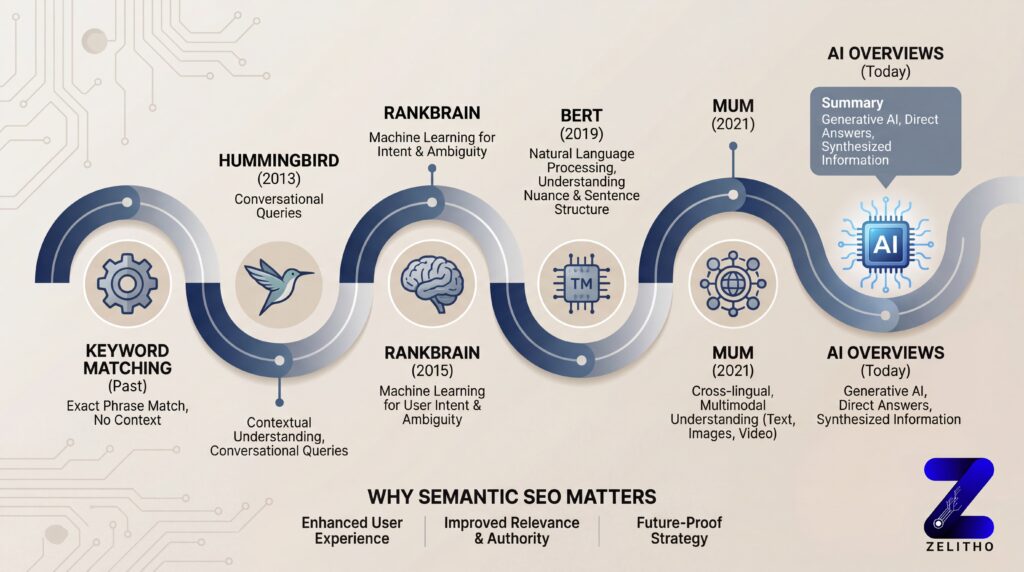
Key Google Algorithm Milestones That Shaped Semantic Search
Understanding the architectural evolution of Google algorithms clarifies why semantic search optimization is the foundational requirement for modern organic visibility:
Shifted search from literal keyword string matching to conversational query intent and entity parsing across 90% of searches.
Introduced deep machine learning to interpret never-before-seen queries by mapping user behavioral satisfaction to conceptual clusters.
Enabled bidirectional transformer analysis, processing words in relation to all other words in a sentence to master prepositions and conversational nuance.
Multimodal models synthesize information across text, images, and structured datasets, generating comprehensive answers directly in the search interface.
Closed-Loop Semantic Engineering with Zelitho
Modern marketing teams cannot manually optimize thousands of articles for semantic entity grounding. Automated platforms like Zelitho bridge this gap by scanning your entire website portfolio, identifying semantic knowledge gaps, and dynamically updating content with validated entity schema and answer-first modules.
By connecting directly to your CMS via REST API, Zelitho ensures every page maintains comprehensive semantic coverage, protects your brand reputation in AI assistant roundups, and pings search crawlers immediately via IndexNow for rapid reindexing.
Frequently Asked Questions About Semantic SEO
What is semantic SEO?
Semantic SEO is the practice of optimizing content around entities, concepts, and relationships rather than isolated keywords, helping search algorithms and AI models comprehend topical meaning accurately.
How does vector search change content optimization?
Vector search matches queries to documents based on mathematical closeness in multi-dimensional space, prioritizing topical depth, structured tables, and clear entity definitions over keyword repetition.
Why are knowledge triplets important for semantic SEO?
Knowledge triplets (Subject-Predicate-Object) structure factual claims in unambiguous formats that AI crawlers can ingest directly into knowledge graphs without misinterpretation.
What schema types are essential for semantic search?
Key schema types include TechArticle, Article, FAQPage, Organization, and ItemList, enriched with about and mentions arrays that link directly to authoritative Wikidata URIs.
References and Citations
[1]https://moz.com/blog/category/semantic-seo