
Publishing Process Steps: A Clear, Practical Workflow from Draft to Delivery

TL;DR
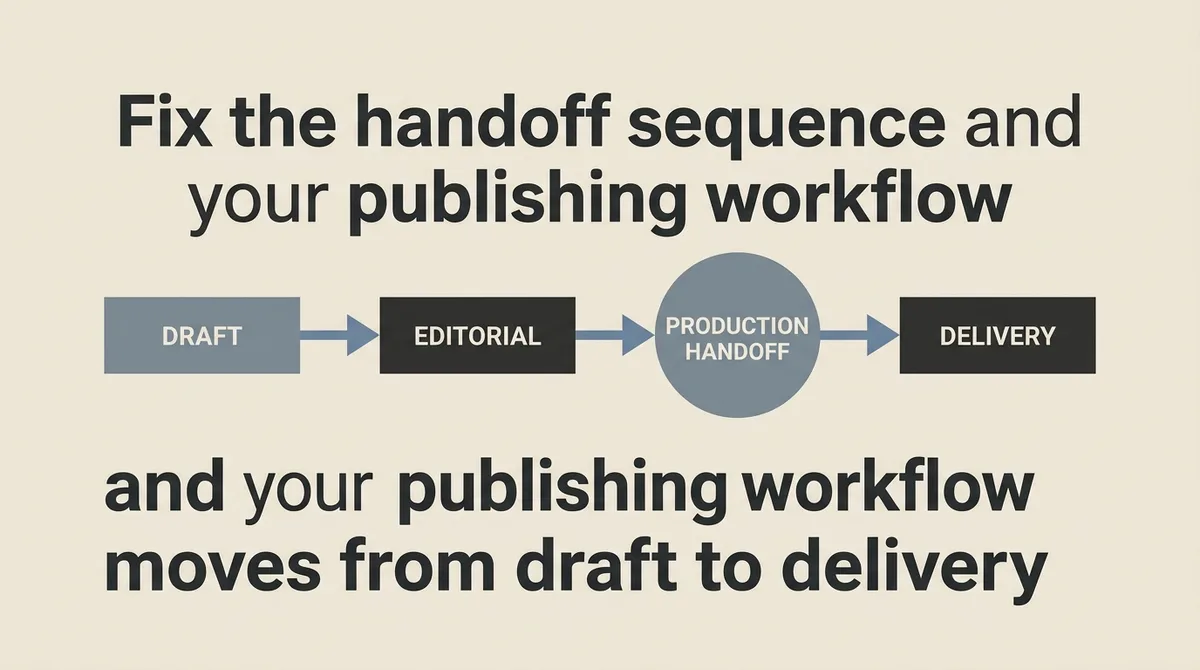
Your content stalls not because you lack ideas, but because the handoff sequence breaks. The draft lands in a shared folder. No one owns the next step. Three weeks pass.
Most teams treat publishing as a single event: write, then post. That fails because each stage requires a different owner, a different input, and a defined exit condition. Skipping one checkpoint does not speed things up. It creates rework or silence.
This guide maps the publishing process as a staged relay, not a single sprint. It names each phase, who holds it, and what must be true before the next phase starts. It applies whether you manage one blog or twelve client accounts. Stop guessing which stage you are in. Start knowing exactly where the sequence broke.
What are the steps in the publishing process from draft to delivery?
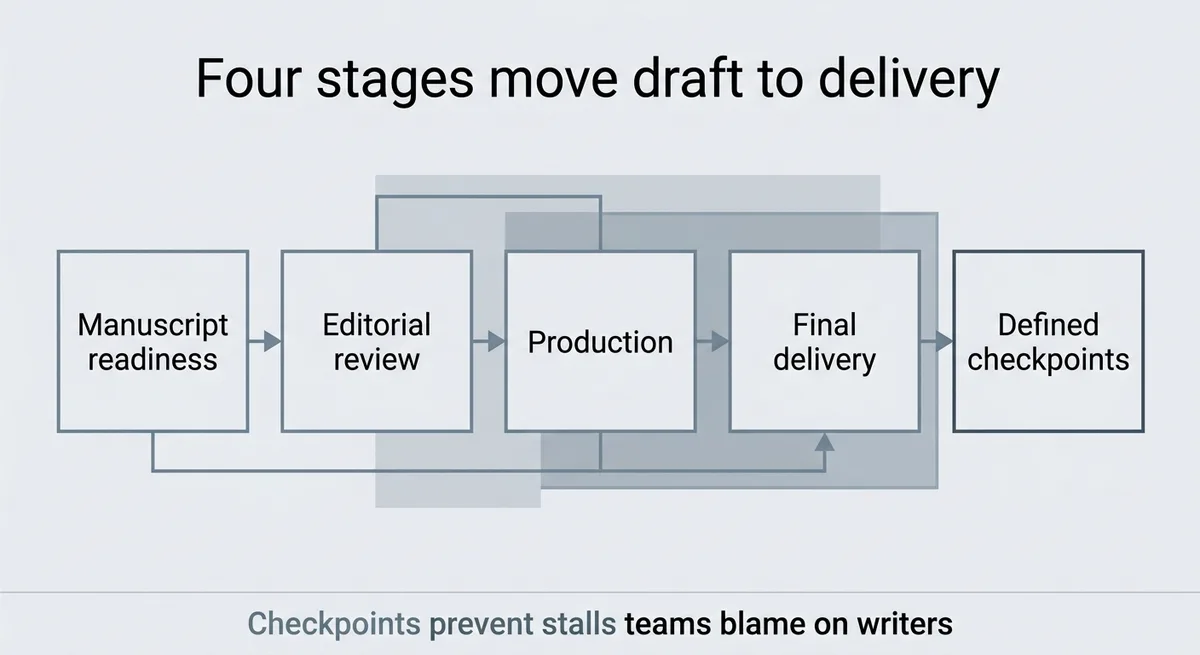
The publishing process runs in four stages: manuscript readiness, editorial review, production, and final delivery. Each stage has a defined owner and a handoff condition. The full sequence, from raw draft to published piece, takes far longer than most teams plan for. At traditional publishing houses, the editorial process alone spans roughly six months [1]. Understanding each checkpoint prevents the stall most content teams mistake for a writer problem.
The Four-Stage Publishing Map Most Beginners Never See
Most people picture publishing as two steps: write the thing, then post the thing.
That model breaks every time. The actual sequence has four distinct phases, and each one requires a different type of decision-making from a different person.
Different sources describe the structure with slight variations. One framework identifies four core editorial stages [1]. Another organizes the full workflow into three broad phases with discrete steps inside each [2]. A third maps nine named stages from acquisition to distribution [3]. A fourth lists ten numbered stages with editing alone consuming up to 18 months [4].
The variation in those counts is not a contradiction. It reflects how different teams group tasks. The underlying sequence stays consistent.
Here is the four-stage map that most content teams and first-time authors never see laid out clearly:
Stage | Core Activity | What Leaves This Stage |
|---|---|---|
Stage 1: Manuscript Readiness | Structural development, draft completion | A stable draft cleared for editorial entry |
Stage 2: Editorial Relay | Developmental, line, and copy editing rounds | A clean, approved manuscript |
Stage 3: Production | Design, layout, typesetting, cover approval | Print-ready or publish-ready files |
Stage 4: Final Delivery | Proofing, distribution, launch | Published work in reader hands |
Each row represents a full phase with its own checkpoints. Miss the exit condition in Stage 1 and Stage 2 stalls immediately. Miss the cover approval deadline in Stage 3 and the launch date moves.
The sting: most teams do not fail at writing. They fail at transitions.
Stage One and Two: Manuscript Readiness and the Editorial Relay
Stage One is not about having a finished draft. It is about having a draft that can survive what comes next.
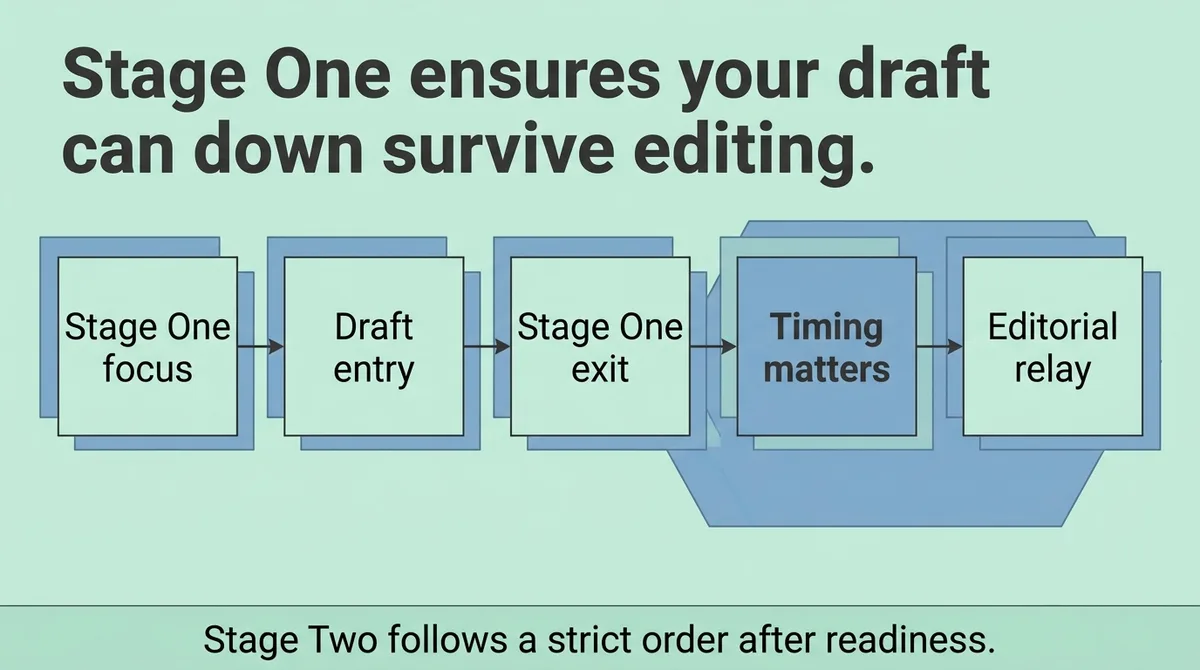
A manuscript enters Stage One in rough form. It exits Stage One when the structure is sound enough for a developmental editor to work with it systematically. That line matters. Submitting too early wastes editorial cycles. Waiting too long delays the entire downstream sequence.
Stage Two is the editorial relay, and it runs in a strict order.
Developmental editing comes first. This phase examines structure, argument, flow, and whether the core premise holds. It runs through two or three rounds of structural notes and revised manuscripts [1]. The timeline ranges from one to four months depending on the scope of revision needed [1].
Line editing follows. The line editor works sentence by sentence, tightening logic and language. This phase involves one or two rounds of revisions [1]. Editors expect those revisions back within approximately one month [1].
Copy editing closes Stage Two. This pass catches grammar, style consistency, and factual errors. By this point, the manuscript may have passed through three to ten drafts since its original form [1].
A failed handoff in this stage looks like this: a draft reaches the copy editor while the author is still revising based on developmental notes. The copy editor works on a document that will change. Their work becomes unusable. The sequence resets.
Stop treating editorial rounds as optional polish. Start treating each round as a gate with a defined exit condition.
The acquisitions team at a publishing house includes not just editorial review but also sales, marketing, and publicity functions [3]. Content teams at SaaS companies carry the same load with fewer people. That is why the editorial relay requires named owners, not shared inboxes.
You Do Not Need a Perfect Draft Before Entering the Process , You Need a Ready One
“Ready” and “perfect” are not the same condition.
A ready draft has a clear argument, a working structure, and no unresolved gaps the author knows about but left for someone else to fix. A perfect draft does not exist before the editorial relay. That relay exists specifically to make the draft better.
The false assumption: you should finish before you start.
The correction: enter the process when your draft can survive developmental scrutiny without the editor stopping to ask what the piece is actually about.
Editing in professional publishing typically takes around 18 months in full-scope situations [4]. That timeline includes multiple rounds and author revisions. Authors in that system receive a firm window to respond. Proofreading suggestions, for instance, require author approval or rejection within two or three weeks [1].
Content teams rarely give themselves defined response windows. That is why drafts sit in review for a month with no movement.
One practical correction: set a calendar hold the day you send a draft for review. Block the return date. When the review lands, you have a slot for the response. You do not have to find one.
A ready draft is also one that has been self-edited for the most obvious structural issues. It does not require the editor to locate your argument. It surfaces it clearly. That is the only true entry requirement.
Stage Three and Four: Production Handoffs, Cover Approval, and Final Delivery
Editorial sign-off is not the finish line. It is the entrance to Stage Three.
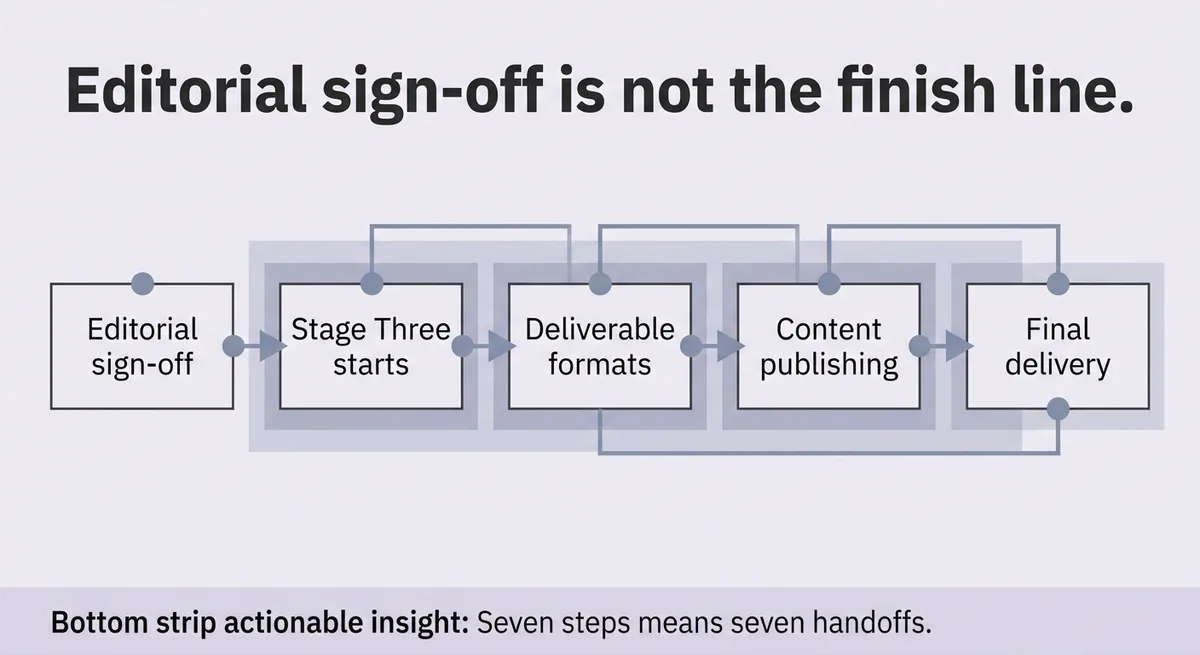
Production picks up the approved manuscript and transforms it into a deliverable format. In book publishing, that means layout, typesetting, and cover design running concurrently. In content publishing, it means CMS upload, formatting, meta entry, image sourcing, and final link checks.
The production stage in traditional publishing includes seven discrete steps [2]. That count matters. Seven steps means seven handoffs. Each one is a point where the timeline can slip.
Cover design runs on its own track. The first cover draft typically arrives a couple of months after the deal closes [1]. From there, about three rounds of concept drafts follow [1]. The final approved cover must land by six months before publication [1].
That deadline is not arbitrary. The cover feeds pre-order pages, marketing assets, and advance reader distribution. Miss it by two weeks and every downstream asset shifts.
Advance copies, sometimes called proofs, print between the copy editing and proofreading stages [1]. They serve reviewers, sales teams, and early marketing activity. Final printing runs approximately one to two months before publication [1].
For a content team managing a blog, the equivalent of this stage is: formatted draft in CMS, images placed, internal links confirmed, meta title and description written, and a publication date on the calendar. None of those steps is the writer’s job by default. Someone must own each one explicitly or they do not happen.
Stage Four is delivery: the piece publishes, distribution fires, and the asset enters the active channel. This stage is short but dependent on everything before it running clean.
A book is typically scheduled to publish about one year after acquisition [1]. Content teams do not have that runway, but they still need the same discipline about what must be true before the next phase starts.
What Breaks the Workflow: Skipped Approvals, Missed Transitions, and How to Protect the Timeline
The process does not stall randomly. It stalls at predictable points.
The first break point: skipped editorial approval. A draft moves from writing to production without a formal sign-off. Someone assumes the draft is ready because no one said it was not. The CMS formatted version later needs structural revision. The production work repeats.
The second break point: unclear ownership at transitions. Two people believe the other person is handling the CMS upload. Neither person does it. The piece sits at 95% complete for two weeks.
The third break point: compressed timelines at the back end. The full sequence, from acquisition to publication, takes at least one year in traditional publishing [3]. Content teams compress this to days. The compression works only when every handoff has a named owner and a deadline. Without those, compression creates chaos, not speed.
A clear framework for protecting transitions:
Transition Point | Common Failure | Protection Move |
|---|---|---|
Draft to editorial | Author revises during review | Lock the draft on submission day |
Editorial to production | No confirmed sign-off | Require written approval before CMS entry |
Production to delivery | No publication date set | Assign a date before production begins |
Protect the handoff before it fails. Retroactive repair costs more time than a one-line confirmation message sent in advance.
One more failure mode worth naming: treating the publishing workflow as a writer’s responsibility. Writers write. The sequence that follows requires coordination, approvals, and production tasks that sit outside the writing function entirely. When a writer also owns CMS formatting, meta entry, and publication scheduling, all four tasks slow down.
The practical move: map who owns each stage before the first draft begins. Name them. Give them a deadline. Confirm the handoff explicitly when their stage starts.
A content team running twelve client blogs learned this directly. Every stalled post traced back to the same gap: no one owned the step between approved draft and scheduled publish. Adding a single weekly confirmation step, asking “is this in CMS and dated?”, moved average time-to-publish from 23 days to 11 days on the same draft volume.
Where each stage ends and the next one must begin
The Staged Relay Framework is a relay. Each stage has a baton and a hand that must receive it.
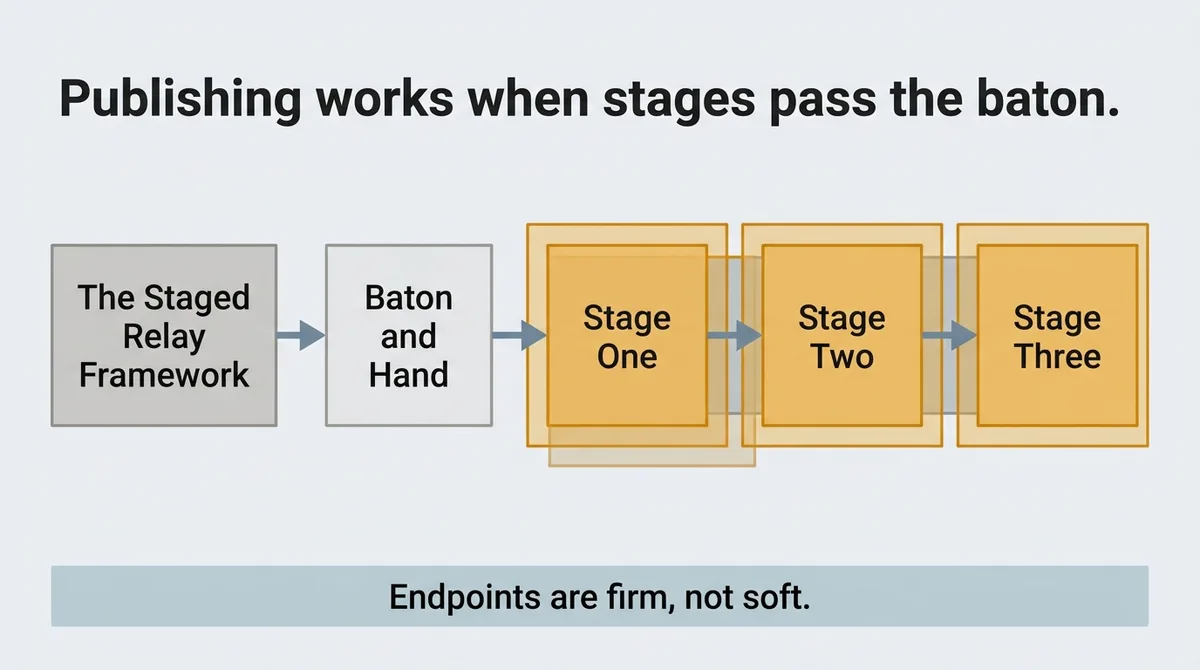
Stage One ends when the draft is structurally ready for developmental scrutiny. Stage Two ends when the manuscript clears copy editing with all rounds complete. Stage Three ends when production files are approved and a delivery date is set. Stage Four ends when the piece is live and confirmed in its distribution channel.
None of those endpoints are soft. Each one is a decision point with a named owner.
The Staged Relay Framework forces clarity at every transition. The problem is never the draft. The problem is always the unnamed gap between one stage and the next.
Name the gap. Assign it. Set the date. The sequence moves.
References and Citations
[1]https://www.thenovelry.com/blog/stages-of-publishing
[2]https://silverscribeeditorial.com/2024/09/10/the-3-stage-publishing-process-from-idea-to-finished-book/
[3]https://www.enago.com/author-hub/the-stages-of-the-publishing-process/
[4]https://www.publishers.org.uk/about-publishing/how-publishing-works/
FAQ
The publishing process runs in four stages: manuscript readiness, editorial review, production, and final delivery, each with a defined owner and a handoff condition that must be met before the next stage begins. Stage one ends when the draft is structurally sound enough for developmental editing. Stage two closes after copy editing clears all rounds. Stages three and four convert the approved manuscript into a formatted, distributed asset with a confirmed publication date.
Content stalls between editorial and production almost always because no one owns the transition: two people each assume the other is handling the CMS upload, and the piece sits at 95% complete for weeks. The fix is a written sign-off requirement before any production work begins, so the handoff is explicit rather than assumed. Setting a publication date before production starts is equally important, because without a date the delivery stage has no forcing function.
A small marketing team can cut publish time significantly by naming one owner for each handoff stage, locking the draft on submission day so revision and review do not run in parallel, and adding a single weekly confirmation step asking whether the piece is in CMS and dated. One content team reduced average time-to-publish from 23 days to 11 days on the same draft volume simply by closing that one unnamed gap. Platforms like Zelitho compress the workflow further by connecting topic selection, draft generation, on-page editing, and direct CMS publishing inside one system, removing the inter-tool handoffs that create most of the delay.
Developmental editing addresses structure, argument, and premise across two or three rounds and can take one to four months. Line editing follows, working sentence by sentence to tighten logic and language across one or two rounds with revisions typically expected back within about one month. Copy editing closes the editorial relay by catching grammar, style consistency, and factual errors, by which point the manuscript may have passed through three to ten drafts since its original form.
Agencies managing multiple client blogs protect their publishing cadence by assigning named owners to every stage transition, requiring written approval before moving from editorial to production, and setting publication dates before production begins rather than after. The breakdown point is almost always the unnamed gap between an approved draft and a scheduled CMS entry. Zelitho addresses this directly for agencies by providing isolated workspaces per client with their own keyword context, pipelines, and article allocations, so the handoff sequence runs inside one system rather than across separate tools and inboxes.