
Organic Content Marketing Strategy: Build a Sustainable Growth Engine

TL;DR
You opened your CMS dashboard this week and saw the last post dated 74 days ago. The draft folder has six ChatGPT outputs no one finished. That gap is not a motivation problem. It is a system problem.
Most teams treat organic content as a channel decision: pick a blog, add LinkedIn, maybe start a podcast. That framing skips the operational layer entirely. Content without a repeatable production and distribution sequence produces irregular output and invisible results.
This guide introduces the PPDM Loop, a four-stage operating system built for teams without a paid media budget. The stages are Plan, Produce, Distribute, and Measure. Each stage feeds the next. The system is built for content leads at growing B2B SaaS companies and agency founders managing multiple client blogs without adding headcount. Organic search results can take up to 12 months to appear [1], so the loop must be built to compound, not to spike.
What Organic Content Marketing Actually Is (And What This Guide Refuses to Do)
Most articles on this topic hand you a channel list. Blog. Email. Podcast. SEO. Social. Then they stop.
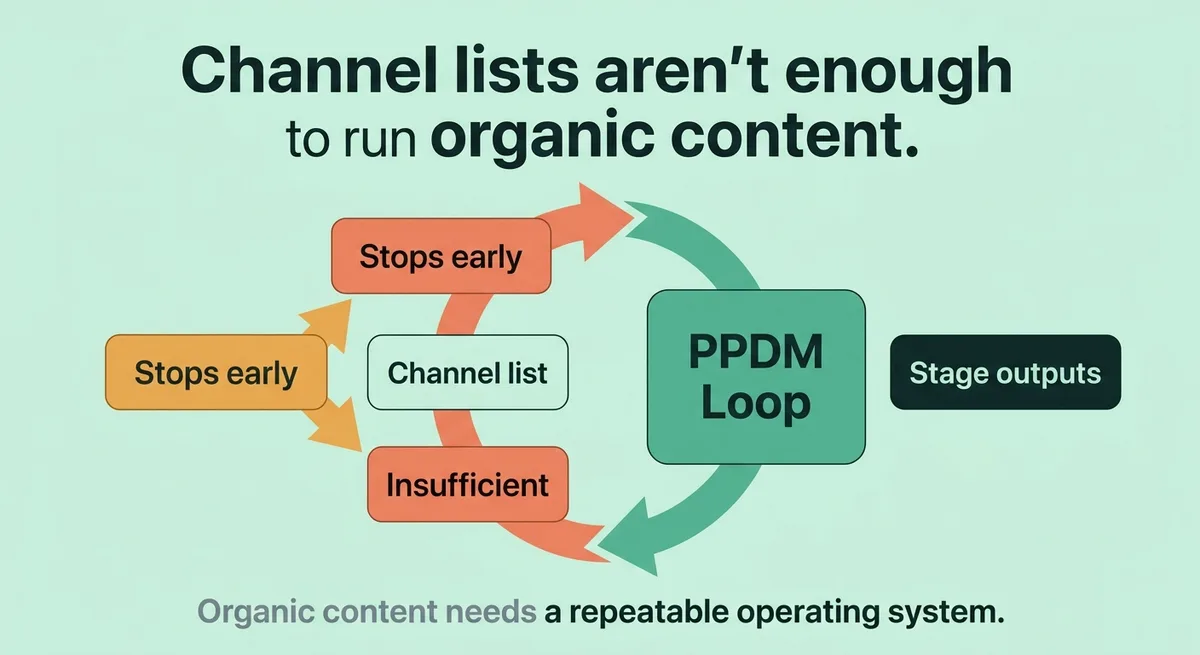
That format is not useless. It is just insufficient. Knowing the channels exist is not the same as knowing how to run them in sequence. This guide refuses to be a definitions article.
The PPDM Loop treats organic content as a four-stage operating system: Plan, Produce, Distribute, Measure. Each stage has an input and an output. The output of one stage becomes the input of the next. Run the loop once and it produces content. Run it consistently and it builds compounding reach.
Here is the sting: publishing more content does not solve a distribution problem. A team that posts three times a week with no distribution plan is just creating more unread files. Volume is not a substitute for sequence.
Organic search results can take up to 12 months to show measurable impact [1]. That single data point should change how you evaluate success. Anyone measuring this system at 30 days is using the wrong ruler. The PPDM Loop is built to compound across quarters, not spike across weeks.
Stop treating organic content as a content volume problem. Start treating it as a workflow design problem.
Stage One and Two: Build Your Audience Map Before You Write a Single Word
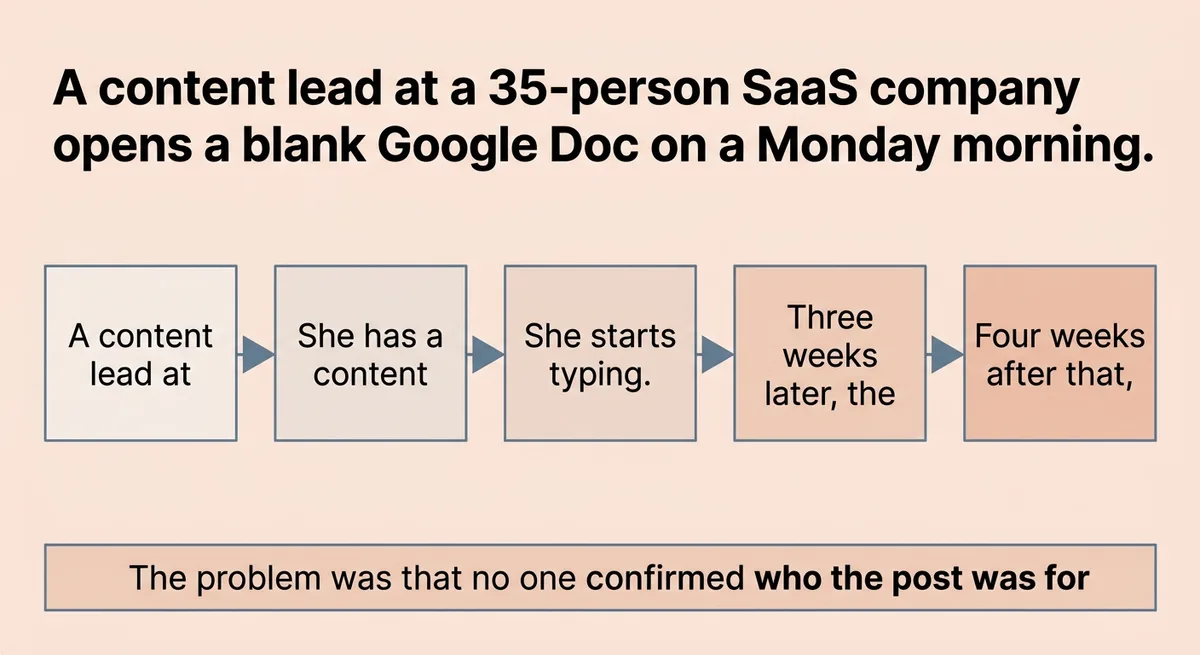
A content lead at a 35-person SaaS company opens a blank Google Doc on a Monday morning. She has a content calendar, a brief from the founder, and access to a freelance writer. She starts typing. Three weeks later, the post is published. Four weeks after that, it has 40 pageviews and no leads. The problem was not the writing. The problem was that no one confirmed who the post was for or where those people would find it.
Audience mapping runs before any writing starts. It answers three questions. Who is this for? What are they already searching for or asking? Where do they consume content right now?
The answers to those three questions determine format and channel. They do not come from instinct. They come from reading sales call transcripts, support tickets, and community forum threads. Keyword research confirms volume. Customer language confirms relevance.
A practical anchor from the small business context [1]: small business owners who are new to organic content tend to search for specific how-to answers, not brand content. They want to solve a named problem. That behavioral pattern shapes the format: a search-optimized post that answers one question specifically outperforms a broad thought piece every time.
Channel selection follows audience behavior, not personal preference. In the UK alone, 15.5 million people listen to podcasts monthly [1]. That number is useful only if your specific audience is among them. If your buyers are operations managers reading industry newsletters at 7am, a podcast is the wrong investment, regardless of how large the podcast market is.
Audience Type | Preferred Format | Primary Distribution Channel |
|---|---|---|
SMB founders | Short how-to blog posts | Organic search, email newsletter |
B2B ops managers | Long-form guides, case studies | Email, LinkedIn, search |
Agency clients | Video walkthroughs, templates | YouTube, direct email, Slack communities |
One clarifying point on this table: the format and channel columns are starting points, not rules. Validate them with real audience behavior before committing a production schedule.
The fear most beginners carry privately is that their niche is too small to build an audience. That fear is reasonable and also backward. A small, well-defined audience with a clear problem set converts at a higher rate than a broad, undefined one. Specificity is not a limitation. It is a distribution advantage. More channels do not produce more reach. Better channel-audience fit does.
Stage Three: The Distribution Habit That Most Content Plans Skip Entirely
A team that publishes 20 blog posts over six months with no distribution plan loses six to eight weeks of potential audience compounding. Each post sits on the blog. It earns a handful of organic impressions over time, maybe. It reaches no one through a second or third channel. The content existed. The audience never saw it.
Distribution is not promotion. It is the operational step that moves content from published to discovered. Most content plans describe what to publish. Almost none describe what happens in the 48 hours after publish.
The Post-Publish Distribution Sprint is a checklist that runs every time a piece of content goes live. It does not require a separate team. It requires a defined sequence.
Post-Publish Distribution Sprint:
Send the post or a summary to your email list within 48 hours of publishing.
Post a single-insight excerpt on one social channel where your audience is active.
Add an internal link from two existing posts that rank or receive consistent traffic.
Share in one relevant community forum or Slack group where sharing is appropriate.
Queue the post for a second send or reference in next month’s newsletter.
That fifth step reflects a real distribution pattern. Salesforce runs a monthly newsletter cadence [2] that revisits published content across cycles. Most subscribers do not open every email. A second send in a new context captures readers who missed the first.
The checklist should be added to your publishing workflow before content goes live, not after. Build it into the CMS handoff step. Make it part of the definition of “done.” A post is not published when it is live. It is published when the Sprint is complete.
For beginners choosing formats, the range of organic distribution options includes blog posts, email newsletters, LinkedIn posts, community forum replies, YouTube descriptions, podcast show notes, and template shares [1]. You do not need all of them. You need three that match your audience map from Stage One and Two.
The operational implication is direct: adding the Sprint checklist to your workflow takes 20 minutes to set up once. Skipping it costs you compounding reach across every post you publish from this point forward.
Stage Four: How to Measure a System Built for Trust, Not Just Traffic
Organic content has two jobs. The first is building visibility. The second is building conversion readiness. Most teams measure the first and ignore the second entirely.
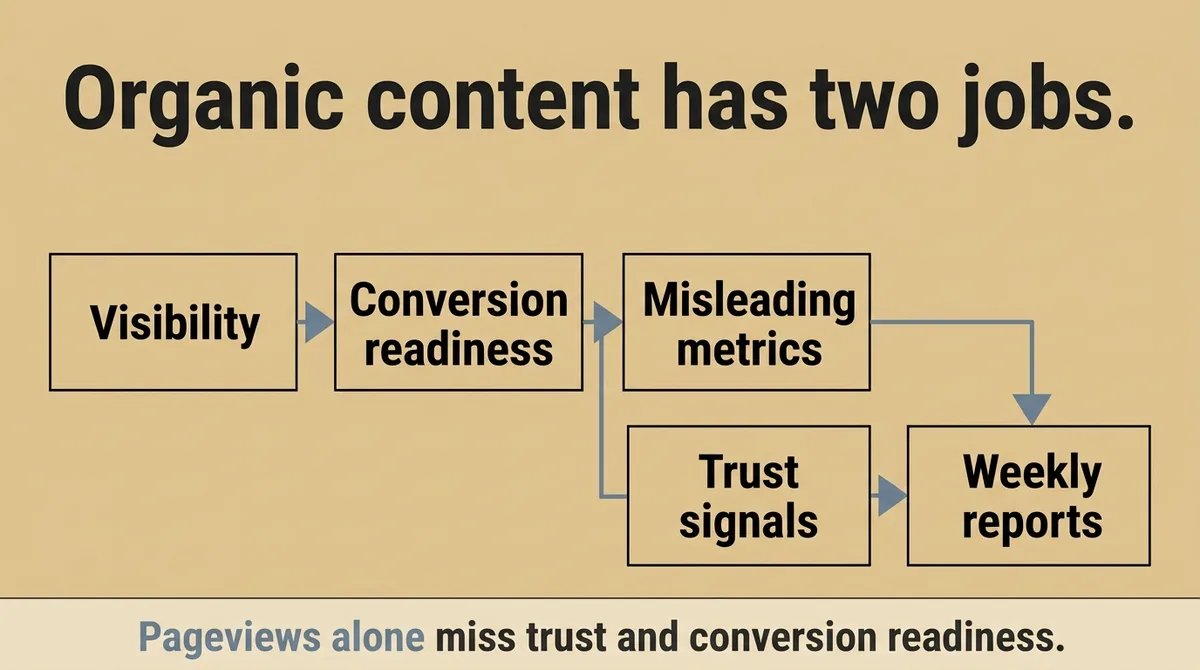
Pageviews are easy to pull. They are also the least useful signal for a system built on trust. A post can earn 2,000 pageviews from searchers who never return, never subscribe, and never convert. That number looks good in a weekly report. It tells you almost nothing about whether the content is working.
Three signals replace pageview-only reporting.
The reach signal measures whether the content is being found. Track search impressions in Google Search Console and newsletter open rates. These show discovery, not engagement.
The trust signal measures whether the content is creating return behavior. Track return visitor rate, email reply rate, and community engagement on posts. A reader who replies to an email or returns to the site three times is demonstrating trust. That behavior predicts conversion better than a single pageview ever will.
The conversion signal measures whether content is participating in revenue decisions. Track content-assisted conversions and lead form completions that occurred after a content touchpoint. Most CRMs and analytics platforms can show this as part of a multi-touch attribution view.
Vanity Metric | Signal Metric |
|---|---|
Total pageviews | Returning visitor rate |
Social impressions | Email reply rate |
Follower count | Content-assisted conversions |
Organic results take up to 12 months to compound [1], so measurement must track leading indicators, not just lagging ones. Return visitor rate and email reply rate are leading indicators. Revenue is a lagging one. Measuring only revenue at month three will misread a working system as a failing one.
Set a 90-day review cadence. Weekly measurement of an organic system produces reactive decisions. A 90-day review lets you assess the system’s direction: are reach signals improving, is trust behavior increasing, are conversion assists rising? Those three questions answer whether the PPDM Loop is working, not whether last Tuesday’s post performed.
Build the Loop Once, Then Let It Compound
The PPDM Loop is not complex. Plan with audience clarity. Produce content that answers a specific question. Run the Post-Publish Distribution Sprint after every publish. Measure three signals across a 90-day window.
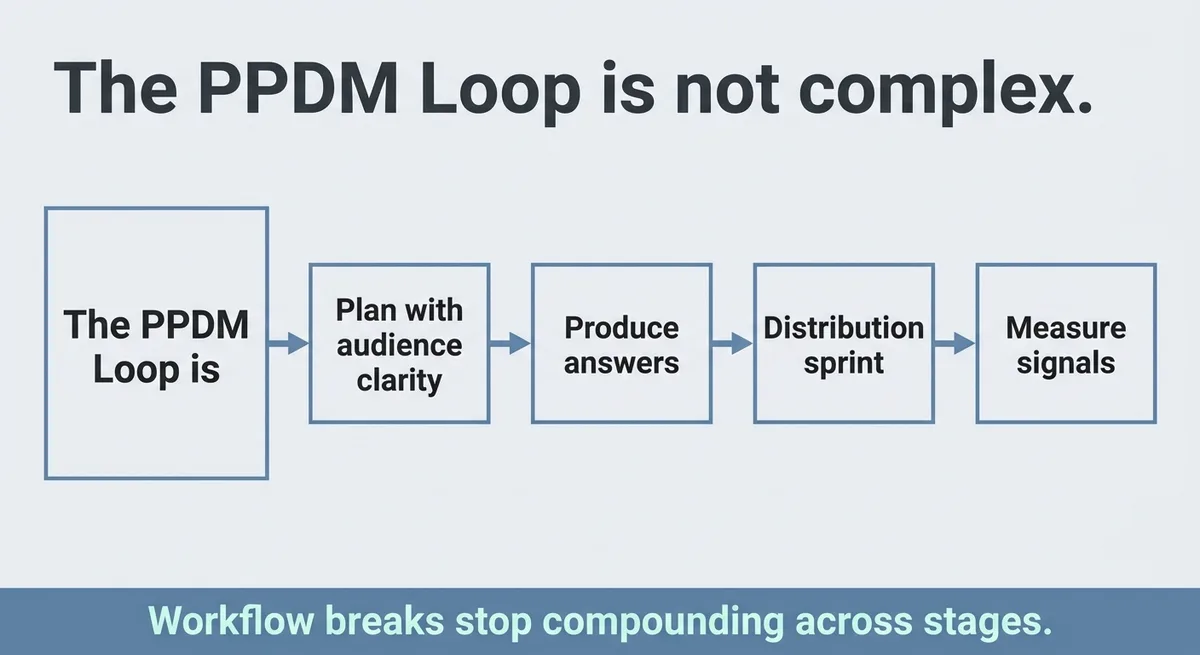
Most stalled blogs are not stalled because of bad writing. They stall because the workflow breaks between stages. The freelancer delivers a draft. The CMS handoff slips. Distribution never happens. Measurement never connects back to planning. Each stage runs in isolation, so nothing compounds.
Build the loop as a connected sequence. Document each stage in one place. Make the Sprint checklist part of every publish. Review signals every quarter, not every week.
Write the next post. Run the Sprint. Check the signals in 90 days.
References and Citations
[1]https://www.adobe.com/uk/express/discover/how-to/marketing/organic
[2]https://www.salesforce.com/au/marketing/organic-marketing/
FAQ
Organic content marketing typically takes up to 12 months to show measurable search results, which means success cannot be evaluated at 30 days. The PPDM Loop described here is built around this reality: it tracks leading indicators like return visitor rate and email reply rate in the early months, and treats revenue as a lagging signal reviewed on a 90-day cadence rather than week by week. Setting a 90-day review cycle prevents teams from misreading a working system as a failing one simply because revenue has not moved yet.
In the 48 hours after publishing, you should send the post or a summary to your email list, post a single-insight excerpt on one social channel where your audience is active, add internal links from two existing posts that already receive traffic, and share in one relevant community or Slack group. This Post-Publish Distribution Sprint is the operational step most content plans skip entirely, and running it consistently is what turns published content into discovered content. Platforms like Zelitho are built to reduce the friction between draft completion and CMS handoff, which makes it easier to attach a repeatable distribution checklist to every publish without managing separate tools.
Most content strategies stall because each stage of production runs in isolation: the freelancer delivers a draft, the CMS handoff slips, distribution never happens, and measurement never feeds back into planning, so nothing compounds. The problem is a workflow design failure, not a motivation or writing quality failure. Zelitho addresses this directly by connecting topic selection, article creation, optimization, and CMS publishing into one sequence so the handoff gaps that cause stalls are removed by default.
Beyond pageviews, organic content performance is better measured through three signals: reach (search impressions and newsletter open rates), trust (return visitor rate and email reply rate), and conversion (content-assisted conversions and lead form completions that followed a content touchpoint). Pageviews can show 2,000 visits from readers who never return and never convert, making them a poor proxy for whether content is actually building an audience. Return visitor rate and email reply rate are leading indicators that predict conversion months before revenue numbers move.
Choose content formats and channels based on where your specific audience already consumes content, not on personal preference or channel popularity. The right starting point is reading sales call transcripts, support tickets, and community forum threads to identify real buyer language, then using keyword research to confirm search volume. For example, SMB founders tend to prefer short how-to blog posts found through organic search, while B2B operations managers are more likely to read long-form guides through email or LinkedIn, so the same channel investment produces very different results depending on who you are trying to reach.