
Organic Content Funnel: A Practical Framework for Sustainable Growth

TL;DR
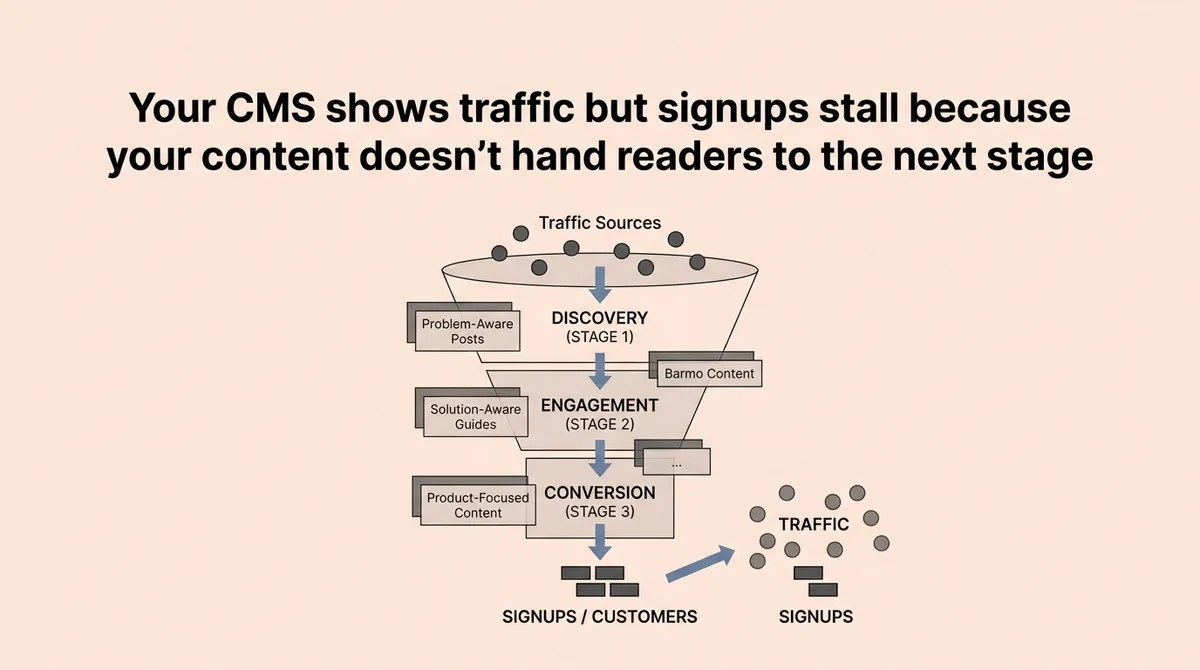
You open your CMS dashboard on a Tuesday morning. Forty-two published posts. Decent traffic. Zero movement in signups. The content exists. The system does not.
Publishing more posts will not fix this. Most content programs fail because every piece stands alone. No post hands the reader to the next stage. No stage connects to a conversion path. Each article starts from zero, earns some traffic, and stops there.
This guide walks through the Stage-Aligned Growth System: a three-stage framework that assigns each piece of content a specific job tied to where a reader sits in their decision process. It covers how reader intent shifts at each stage, what happens when you skip the middle, and how to wire the stages into a path that compounds over time. Built for marketing leads and agency founders managing multiple content programs with limited bandwidth.
Why Your Content Is Getting Traffic But Not Building Anything
The sting: an editorial calendar is not a content strategy.
A calendar tells you what to publish and when. A strategy tells you what job each piece of content performs and where the reader goes next. Most teams have the first and call it the second.
Here is what that looks like in practice. A founder spends six months publishing forty blog posts. Traffic climbs steadily. Organic sessions hit four figures per month. Signups stay flat. The reason is structural, not creative. Every post targets the same awareness-level reader. Someone finds the article, reads it, and leaves. No consideration content waits downstream. No conversion path exists. The reader has nowhere to go.
Stop measuring content success by publish frequency. Start measuring it by what the reader does after reading.
Each post that lacks a defined next step starts a new growth curve from zero. Traffic does not compound. Relationships do not build. The site accumulates content without accumulating trust.
The Stage-Aligned Growth System rejects this model. It treats the content program as a connected path, not a collection of posts. Each piece of content has a stage label, a reader intent match, and a clear handoff to the next stage. Publishing volume becomes secondary to stage coverage.
If your content is earning traffic but not building pipeline, the problem is almost certainly a missing middle stage and broken handoffs between what exists. That diagnosis matters before you commission a single new post.
The Three Funnel Stages and What Each One Actually Demands
An organic content funnel runs on three stages: awareness, consideration, and conversion [1]. Each stage requires different content intent, different formats, and a different call to action. Treating them as interchangeable is the root cause of most content programs that plateau.
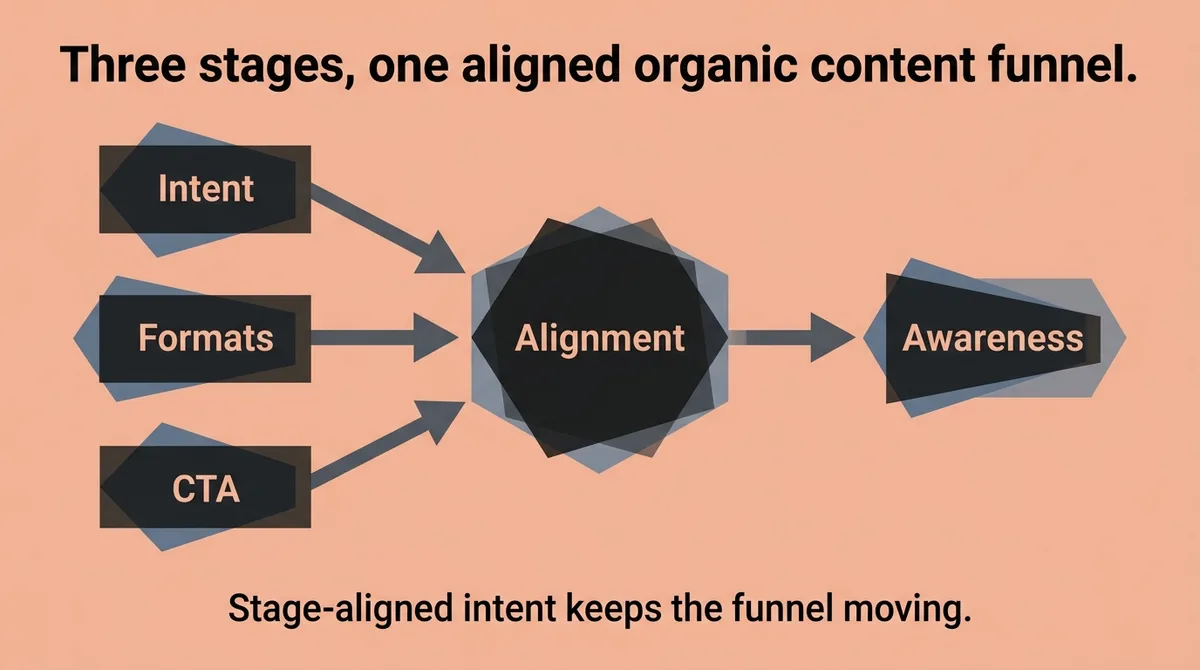
Awareness is where readers arrive before they know your brand exists. They are searching for an explanation, a definition, or a broad answer to a problem they have just named. Your job at this stage is to answer that question clearly and earn the next click.
Consideration is where readers evaluate whether your approach fits their situation. They already understand the problem. They are now comparing options, frameworks, and tools. Your job here is to show why your model works and build enough trust to earn a conversion action.
Conversion is where you remove the final barrier. The reader is ready to act. Your job is to give them a specific reason and a low-friction path.
Stage | Reader Intent | Content Format Example | Content Goal |
|---|---|---|---|
Awareness | Understand a problem or concept | Definition post, explainer | Earn attention, prompt next click |
Consideration | Compare approaches or solutions | Comparison guide, case study | Build trust, move reader forward |
Conversion | Decide and act | Audit template, offer page | Remove friction, prompt action |
A concrete sequence looks like this. An awareness post explains what a content funnel is. A consideration post compares two funnel-building approaches. A conversion page presents a specific offer with client proof attached. Each piece has a different reader, a different intent, and a different job.
Before writing anything new, assign it a stage label. Then confirm what the reader is meant to do after consuming it. If you cannot answer that question in one sentence, the content is not ready to be briefed.
What Happens When You Skip the Middle Stage
Most organic content programs collapse at consideration. Not because marketers ignore it intentionally, but because awareness content is easier to brief and conversion pages feel urgent. The middle gets deprioritized until the pipeline numbers force a conversation.
The cost is measurable. A site driving 5,000 monthly visitors from awareness content but converting at 0.2 percent is losing significant ground. A realistic conversion rate for a site with proper consideration content sits between 1 and 2 percent. That gap means 40 to 80 potential leads per month are leaving without a next step. Over a quarter, that is six to twelve weeks of compounding trust-building lost because no bridge exists between the awareness post and the signup page.
The reader arrives curious. They leave unconvinced. Not because your product is wrong for them. Because you sent them from a definition post directly to a pricing page and expected trust to appear on its own.
Consideration content does specific work. A detailed comparison post shows you understand the alternatives and can articulate tradeoffs. A case study proves results in a context the reader recognizes. A free tool or template gives the reader something useful before they commit. A how-to guide assumes the reader already understands the problem and helps them evaluate whether your approach fits their situation.
These are not nice-to-haves. They are the structural bridge between earning attention and earning action.
The practical move: pull your current content list and label every post by stage. If the consideration column is empty or has one entry, that is your first gap. Fill it before publishing more awareness content. More traffic arriving at a broken bridge does not improve your conversion rate. It compounds the waste.
How to Connect the Stages Into a Path That Repeats Without Starting Over
The Stage-Aligned Growth System works by making the handoff between stages explicit, not accidental. Awareness content links to consideration content. Consideration content leads to a conversion path. The conversion path feeds back into the system by surfacing questions new customers still had when they signed up.
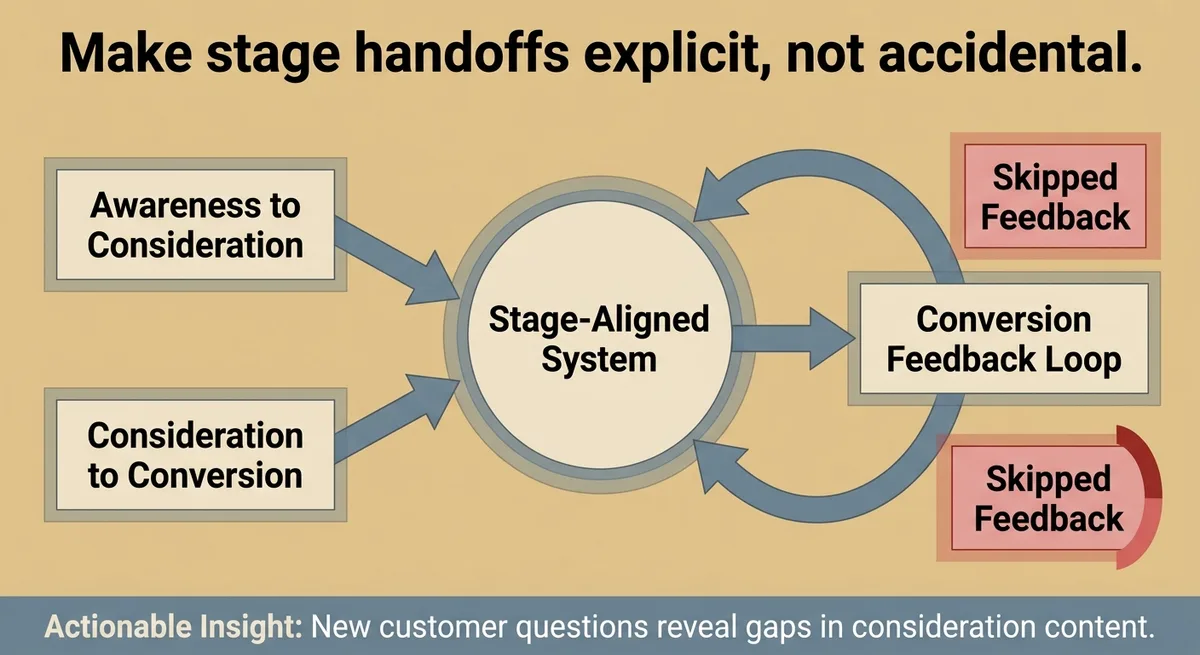
That last part is the one most teams skip. New customer questions are a direct signal about gaps in your consideration content. If ten new customers all asked the same thing during their sales call, that question belongs in a consideration post. The system loops.
A concrete path looks like this. A post titled “What is a content funnel” earns awareness traffic. It links in-body, not just in a sidebar, to a guide on choosing between funnel-building approaches. That guide links to a free content audit template or a consultation page. Each link is deliberate. Each step matches the reader’s next logical question.
Stop treating SEO and conversion rate optimization as separate budgets owned by separate teams. In an organic content funnel, search drives the top of the system, and conversion logic must be embedded at every downstream stage.
Splitting them into separate strategies is the structural flaw that keeps organic content from compounding. The SEO team publishes awareness content. The growth team optimizes the product page. Nobody owns the consideration layer between them. The system has a gap with no owner.
Fixing the connection does not require a content overhaul. It requires one audit pass.
Map every existing piece of content to the next logical step a reader should take. Add that link or call to action. Do it before publishing anything new. A connected set of twenty posts outperforms an isolated set of sixty every time, because each piece of content in the connected set does work beyond its own session.
The Stage-Aligned Growth System compounds precisely because each piece of content hands the reader forward. Awareness content earns the session. Consideration content earns the trust. Conversion content earns the action. The feedback loop earns the next brief.
One implementation caveat worth naming: internal linking must match reader intent, not just topic proximity. Linking an awareness post to another awareness post does not move the reader forward. It keeps them circling the top of the funnel. The link target must be one stage ahead, not laterally related.
We have seen teams audit thirty posts, add twelve targeted internal links across stage boundaries, and move conversion rates from 0.3 percent to over 1 percent within ninety days. The content did not change. The connections did.
The audit works, but it’s manual — someone has to label thirty posts, spot the missing stage, and go back and edit each one to add the link. That’s the part that quietly doesn’t get done at month two. Zelitho handles stage coverage upstream instead of after the fact: topic clusters get assigned a funnel stage at the planning step, so gaps in consideration content show up before a post is ever briefed, not after forty awareness articles are already sitting on the site with nowhere for the reader to go next.
Build the Path Once and Let Content Compound from There
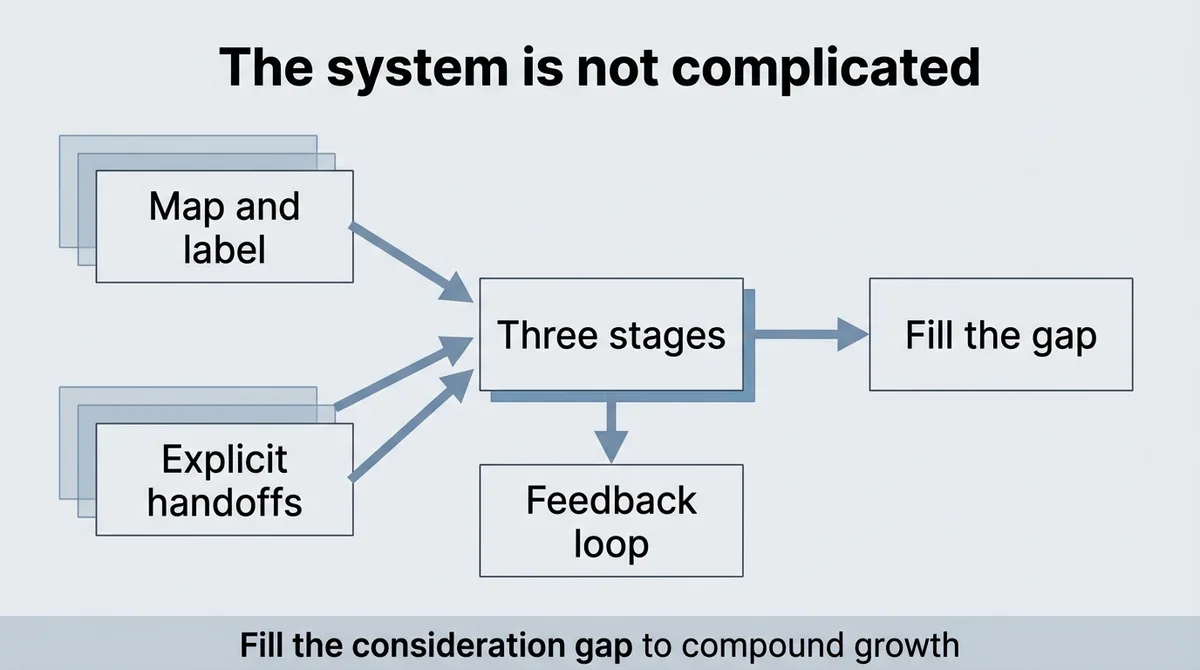
The system is not complicated. Three stages, each with a clear job. Handoffs that are explicit. A feedback loop that feeds new content briefs.
What makes it hard is discipline, not design. The temptation is to publish more awareness content because it is easier to brief and faster to rank. The result is a wider top of funnel pouring into the same gap.
Map what you have. Label each piece by stage. Find the consideration gap. Fill it. Then wire the internal links so each piece of content hands the reader to the next step.
The Stage-Aligned Growth System does not require more content. It requires connected content.
Build the path. Let the compound effect do the rest.
References and Citations
[1]https://npstrategy.com/how-to-get-more-people-into-your-sales-funnel-with-organic-social-media/
FAQ
Traffic without conversions almost always points to a missing consideration stage, where readers jump from an awareness post directly to a pricing page with no trust-building content in between. Every post that lacks a defined next step starts a new growth curve from zero, so the site accumulates sessions without accumulating intent. Auditing your existing content by funnel stage and adding deliberate internal links across stage boundaries, not just laterally between similar topics, is the structural fix before publishing anything new.
You build a compounding organic content funnel by assigning every piece of content a stage label (awareness, consideration, or conversion), defining the reader’s next logical step, and wiring explicit internal links across those stage boundaries so each post hands the reader forward. The system compounds because awareness content earns the session, consideration content earns the trust, and conversion content earns the action, with each customer’s unanswered questions feeding the next round of briefs. Platforms like Zelitho support this by connecting keyword discovery, clustered topic selection, and article production inside a single workflow, making it easier to plan stage-aligned content at scale rather than filling an editorial calendar at random.
Consideration-stage content is the bridge between an awareness post that explains a problem and a conversion page that asks for action, and its job is to build enough trust that a reader believes your approach fits their situation. Without it, readers leave after the awareness post unconvinced, which is why sites with proper consideration content typically convert at 1 to 2 percent while sites missing it often sit at 0.2 percent. Formats that do this work well include comparison guides, case studies, how-to content that assumes the reader already understands the problem, and free templates that give value before asking for commitment.
Pull your full content list and assign each post a stage label: awareness, consideration, or conversion, then look at which column is empty or underrepresented. If consideration is thin or missing, that is your gap, and publishing more awareness content before filling it only sends more traffic into a broken bridge. Teams that audit existing posts, add targeted internal links across stage boundaries, and fill the consideration layer have moved conversion rates from 0.3 percent to over 1 percent within 90 days without changing the content itself. Zelitho‘s clustered topic planning is designed to surface stage coverage gaps during the brief phase, so you can see where your topic map has holes before you commission new articles.
An editorial calendar tells you what to publish and when, while a content strategy defines the specific job each piece performs and where the reader goes next. Most teams have the first and call it the second, which is why it is common to see forty published posts, steady traffic, and flat signups all at the same time. A real strategy assigns each piece a funnel stage, matches it to reader intent at that stage, and makes the handoff to the next stage explicit rather than accidental.