
Mastering SEO Content: The Essential Guide to Long-Term Rankings

TL;DR
You published a page. It ranked. Then the traffic graph peaked in week two and started sliding. The keywords were there. The structure looked right. Something else broke.
Most guides respond with the same prescription: publish more, move faster, find lower-competition keywords. That approach produces volume. It does not produce durability. Rankings drop when a competitor refreshes their page and yours sits frozen at its original publish date.
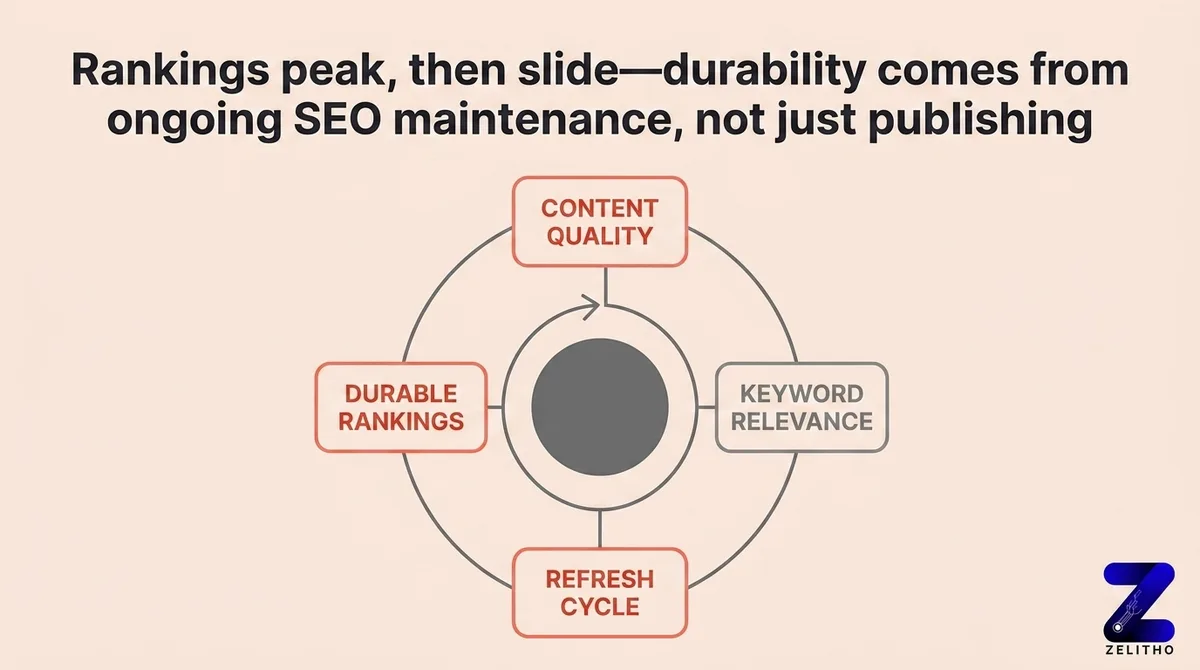
The Content Foundation System gives marketers, founders, and agency owners a repeatable structure built on three pillars: content quality, keyword relevance, and site maintenance. Apply it at the page level when you publish. Return to every page on a six-month cycle. That cycle is what separates content that holds its position from content that quietly disappears.
What Does It Take to Actually Rank and Keep Traffic from SEO Content?
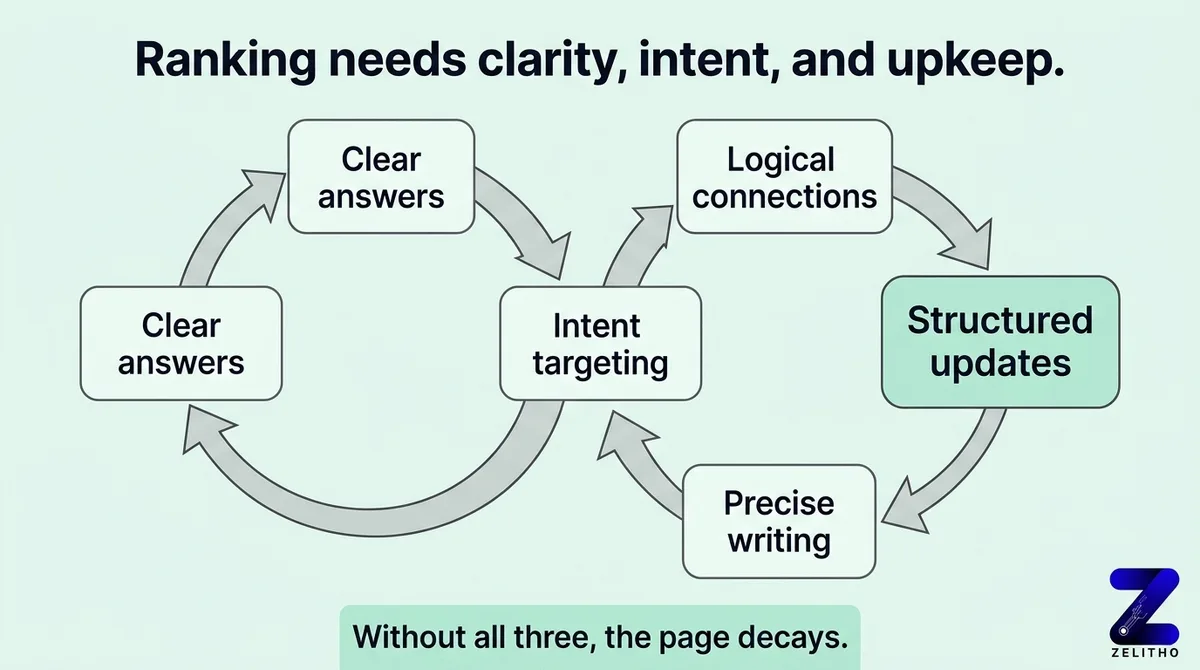
Ranking requires more than a keyword in your headline. Search engines reward pages that answer a specific question clearly, connect logically to related pages on the same site, and stay accurate over time. A single ranking page requires three things working together: precise writing, correct intent targeting, and a structured update cycle. Without all three, the page decays.
Why Your Rankings Drop After the Initial Spike (And What You’re Blaming Instead)
You are probably blaming the algorithm.
A page targeting “project management templates” ranked in week two. By month four, it had dropped off page one. No algorithm update touched it. Three competitors had quietly updated their pages with 2024 data, new examples, and refreshed internal links. The page stayed frozen. That was enough.
This is the hidden mechanism behind most ranking declines. The page did not get penalized. It got passed. Content that stays static after publication becomes a liability on a schedule. The competitors running update cycles are not smarter. They are just more disciplined about maintenance frequency.
Stop blaming external forces for a traffic drop. Start asking when the page was last touched and what changed on the competing pages since then.
A 30% traffic decline over three months from a single stale cornerstone page is realistic and common [1]. That number is not a worst case. It is what happens when a high-value page receives no attention after the publish date while the competitive landscape around it shifts.
Publishing is not a finish line. It is a starting point. The page you publish today begins competing against pages that will be updated next week, next month, and next quarter. If your process ends at publication, you are already behind on a clock you cannot see.
The “publish more” orthodoxy persists because volume feels like progress. More pages, more surface area, more chances to rank. That logic holds only if the pages you already have are holding their positions. When they are not, adding new pages does not fix the decay happening underneath.
The Content Foundation System: Three Pillars That Actually Hold
The Content Foundation System is not a publishing workflow. It is an accountability structure for every page on your site.
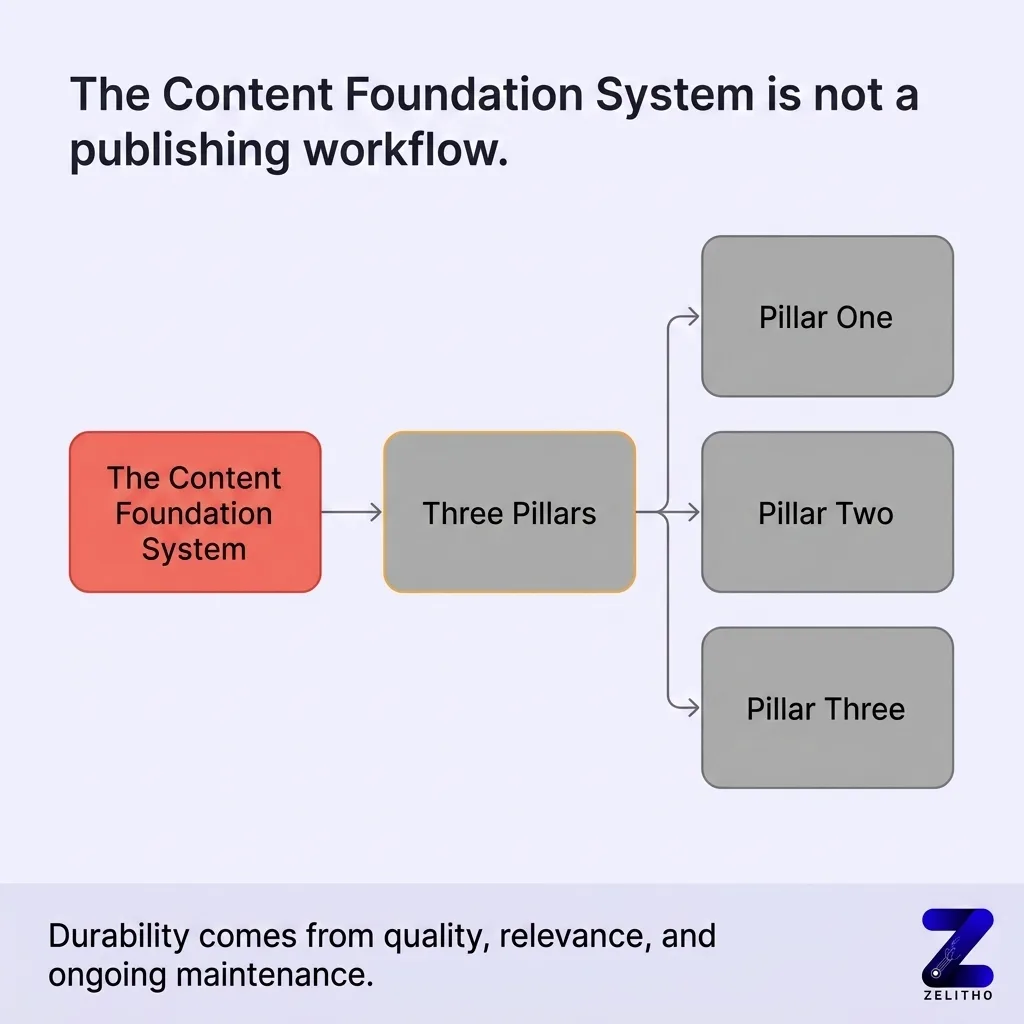
Each pillar has a job. Pillar one handles content quality: clear answers to specific questions, logical internal linking, and writing that serves the reader’s actual need rather than a keyword count. Pillar two handles keyword relevance: matching the page’s angle to the specific intent behind the search, not just the surface phrase. Pillar three handles site maintenance: keeping accuracy intact over time and running structured update cycles that prevent decay.
The table below shows what each pillar looks like when it is active versus when it has been neglected.
| Pillar | Active State | Neglected State |
|---|---|---|
| Content Quality | Specific answers, logical link structure, clear next step | Vague coverage, orphaned pages, no clear outcome |
| Keyword Relevance | Page matches the intent behind the search query | Keyword present but question unanswered |
| Site Maintenance | Scheduled reviews, updated data, accurate information | No update since publish date, outdated examples |
The Content Foundation System works because it distributes responsibility before a page goes live, not after traffic drops. Assign a pillar owner per page at publication. One person owns quality. One person owns relevance checks. One person owns the maintenance calendar. Doing this retroactively, after a ranking drops, costs twice as much effort for half the recovery.
Search-optimized content built on one or two pillars still ranks occasionally. It rarely holds. Ranking pages that sustain traffic over twelve months consistently operate on all three pillars. That is not a coincidence. It is the structure showing its value.
Keyword Relevance Is Not the Same as Keyword Presence
Here is the false assumption most content teams carry: if the keyword appears in the headline and the first paragraph, the page is optimized for that keyword.
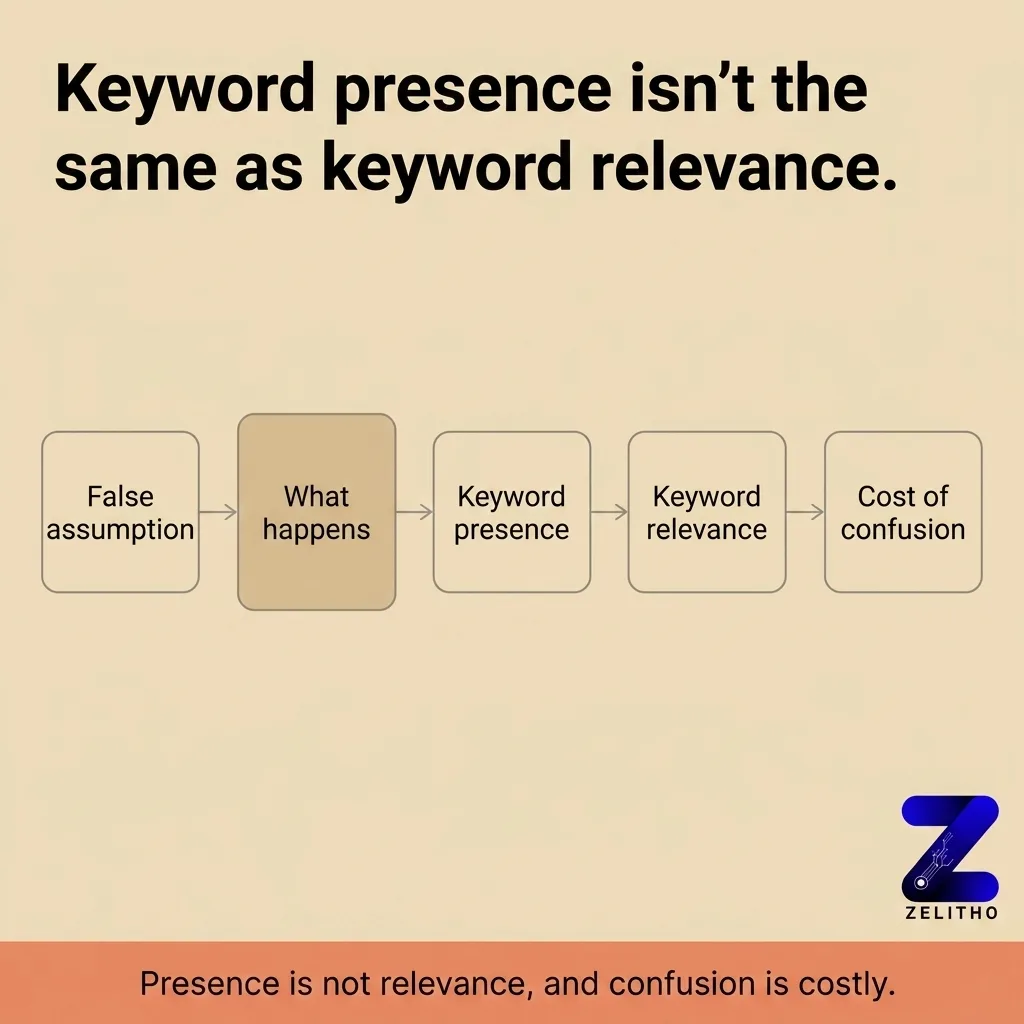
That belief produces pages that rank briefly and then fall. Keyword presence means the word appears. Keyword relevance means the page answers the specific question behind the search. Those are different conditions, and confusing them is expensive.
A page targeting “content audit checklist” that lists tools but never explains the audit process fails on relevance. The keyword is there. The density might be perfect. The intent is not served. A reader who searches that query wants to know how to run an audit, in what order, and what to do with the results. A tool list does not answer that. The page will show a bounce rate spike and low time-on-page. Search Console will surface queries that do not match what the page actually covers.
Five signals indicate a keyword-intent mismatch on a ranking page:
- Bounce rate climbs above your site average on a page with strong impressions.
- Average time-on-page is under 60 seconds for a long-form piece.
- Search Console shows impression volume but low click-through rate.
- Queries driving impressions do not match the page’s primary angle.
- The page generates no downstream clicks to related content.
Any one of these signals warrants a relevance audit. Two or more together mean the page’s angle needs to change, not its keyword density.
Keyword density as a metric is a relic. Teams still track it because it is easy to measure. Intent alignment is harder to measure and more consequential. A page with 0.8% keyword density that fully answers the search question outperforms a page with 1.5% density that partially answers it. Every time.
Stop counting keyword appearances. Start asking whether the page resolves the specific query that brings a reader to it.
The Six-Month Content Cycle: What to Review, What to Replace, What to Leave Alone
Most content teams update reactively. Traffic drops, someone notices, a refresh gets added to the backlog. By the time the refresh ships, the ranking has already moved and recovery takes months.
The six-month cycle inside the Content Foundation System is proactive. It runs on a calendar, not on a crisis [1]. Every page gets reviewed twice per year regardless of current performance. That cadence catches decay before it becomes a drop.
The cycle uses three categories. Each page falls into one.
Refresh: The page still serves the right intent. The data is dated, the examples are old, or the internal links point to pages that no longer exist. Update the data. Replace the examples. Fix the links. Do not rewrite the angle.
Replace: The search intent behind the keyword has shifted. The page’s original angle no longer matches what the query now means. A full rewrite is required. This happens more often than teams expect. Queries evolve. A page targeting “remote work tools” in 2021 may now be competing against a different content type entirely.
Leave alone: The page still ranks. Users engage with it. The information is accurate. Do not touch it. Unnecessary edits to performing pages introduce instability. This is the most underused category in most content audits.
Six weeks of delay on a planned refresh during a competitor’s update window can cost a top-three position. Recovering that position takes three to four months in most cases. The time cost of the delay far exceeds the time cost of running the review on schedule.
Build the six-month review into your content calendar as a standing recurring task. Not a quarterly initiative. Not an ad hoc project that gets deprioritized. A fixed, recurring commitment with assigned owners and a defined output for each reviewed page.
If you do not have a date on the calendar for reviewing every page you have published, you are running a content operation that grows debt faster than it grows traffic.
The Maintenance Cycle Is the Strategy Everything Else Depends On
The Content Foundation System does not produce results from a single pass. It produces results from repetition.
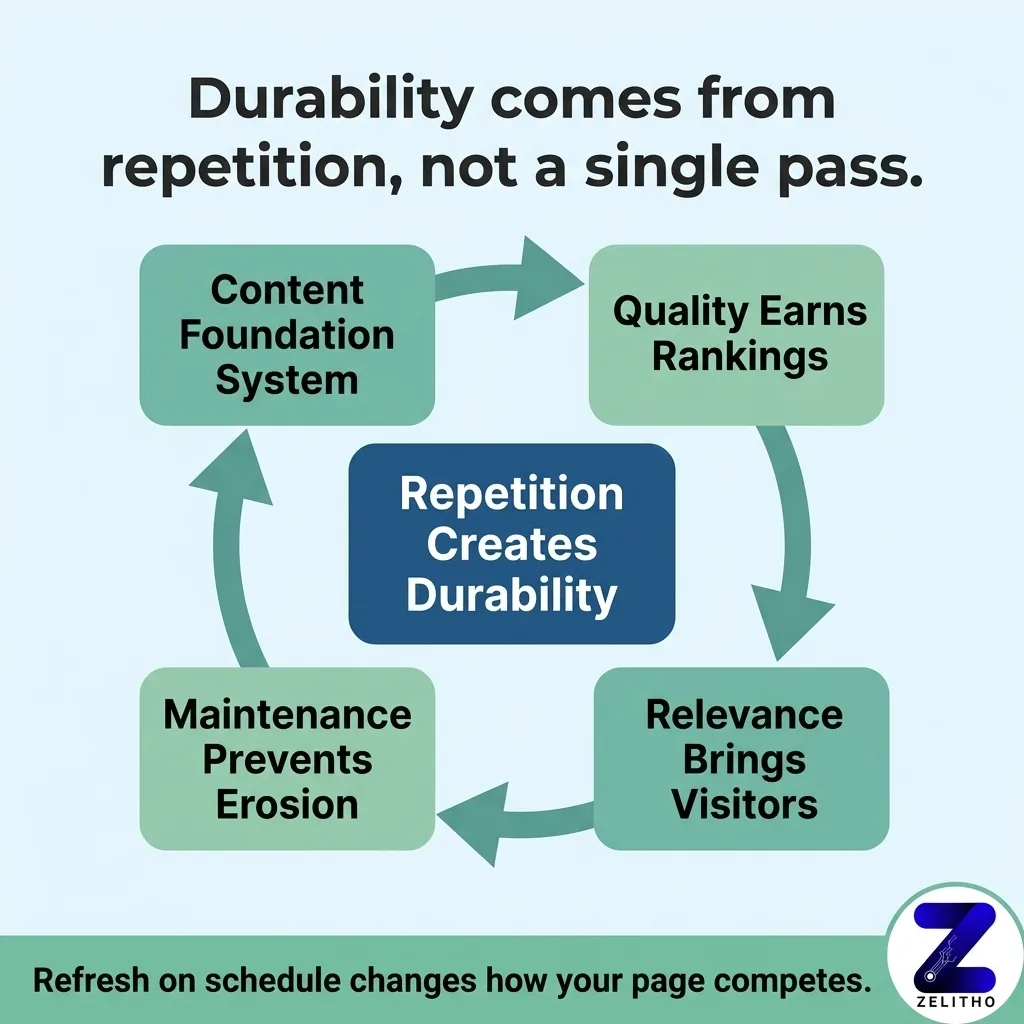
Content quality gets you a ranking. Keyword relevance gets you the right visitors. Site maintenance keeps both from eroding. Remove any one of the three pillars and the others weaken over time.
The six-month cycle is the mechanism that makes the system repeatable. A page you refresh on schedule competes differently than a page you abandon at publication. The difference is not visible in week one. It becomes measurable by month six and obvious by month twelve.
Teams that treat publishing as the end of the process lose ground to teams that treat it as the beginning. That gap compounds. Every month a page goes unreviewed is a month a competitor can move past it without you noticing.
Assign pillar owners before the page goes live. Run the six-month review without waiting for a traffic signal. Categorize each page accurately: refresh, replace, or leave alone. That process, repeated consistently, is what keeps ranking pages ranking.
The six-month cycle is not a maintenance chore. It is the active work of holding a position you already earned.
FAQ
How often should you update existing SEO content to maintain rankings?
You should review every page on your site on a six-month cycle, regardless of whether traffic has dropped. Proactive reviews run on a calendar, not on a crisis: waiting for a traffic signal means you are already months behind a competitor who updated their page while yours sat frozen. Each reviewed page falls into one of three categories: refresh the data and links, replace the angle entirely if search intent has shifted, or leave the page alone if it still ranks and engages.
What is the difference between keyword presence and keyword relevance in SEO content?
Keyword presence means the target word appears on the page; keyword relevance means the page fully answers the specific question behind the search, and they are not the same thing. A page can hit perfect keyword density and still fail to resolve the reader’s actual query, which produces high bounce rates, low time-on-page, and a ranking that fades within months. Intent alignment is harder to measure than density but far more consequential for long-term rankings.
Why do SEO rankings drop after the initial traffic spike?
Rankings drop after an initial spike primarily because competitor pages get updated while yours stays frozen, not because of algorithm penalties. A stale cornerstone page can lose 30% of its traffic over three months simply because competing pages added fresh data, new examples, and refreshed internal links. The page did not get penalized; it got passed, and the only fix is a structured maintenance cycle that keeps your content current.
What signals indicate a keyword-intent mismatch on a ranking page?
Five signals point to a keyword-intent mismatch: bounce rate above your site average on a high-impression page, average time-on-page under 60 seconds for a long-form piece, low click-through rate despite strong impressions in Search Console, queries driving impressions that do not match the page’s primary angle, and zero downstream clicks to related content. Any one of these warrants a relevance audit; two or more together mean the page’s angle needs to change, not just its keyword density. Platforms like Zelitho that pair content generation with keyword research can help teams catch these mismatches earlier by surfacing intent data alongside content drafts.
How do you decide whether to refresh, rewrite, or leave a piece of SEO content alone?
Decide based on three conditions: refresh when the intent is still correct but the data, examples, or internal links are outdated; replace when the search intent behind the keyword has shifted and the original angle no longer matches what the query now means; leave the page alone when it still ranks, users engage with it, and the information is accurate. Unnecessary edits to performing pages introduce instability, so restraint is a deliberate strategy, not laziness. Zelitho’s action dashboard is designed to turn exactly these kinds of audit findings into prioritized tasks, so the decision to refresh, replace, or hold gets tracked rather than lost in a backlog.
References and Citations
[1]https://www.zelitho.com/blog/how-to-create-and-optimize-seo-content-key-concepts-and-best-practices