
How Writing Cadence Works, and Why It Changes the Flow of Your Sentences

TL;DR
Your content queue has a draft in it right now. It has been sitting there for eleven days. The paragraph structure looks fine. The information is accurate. Yet every time you read it back, something feels wrong, and you cannot name what.
Most writers treat that feeling as a taste problem. They add transitions, swap words, read it again. The prose still drags. That approach fails because rhythm problems are structural, not lexical. Changing words does not fix sentence architecture.
Writing cadence is a system of four adjustable controls: sentence length, punctuation, repetition, and pause placement. Each one changes the speed and weight of your prose at the sentence level. This article defines each control, shows you what breaks when cadence fails, and gives you a repeatable revision sequence you can run on any draft today.
What does writing cadence mean in practical terms?
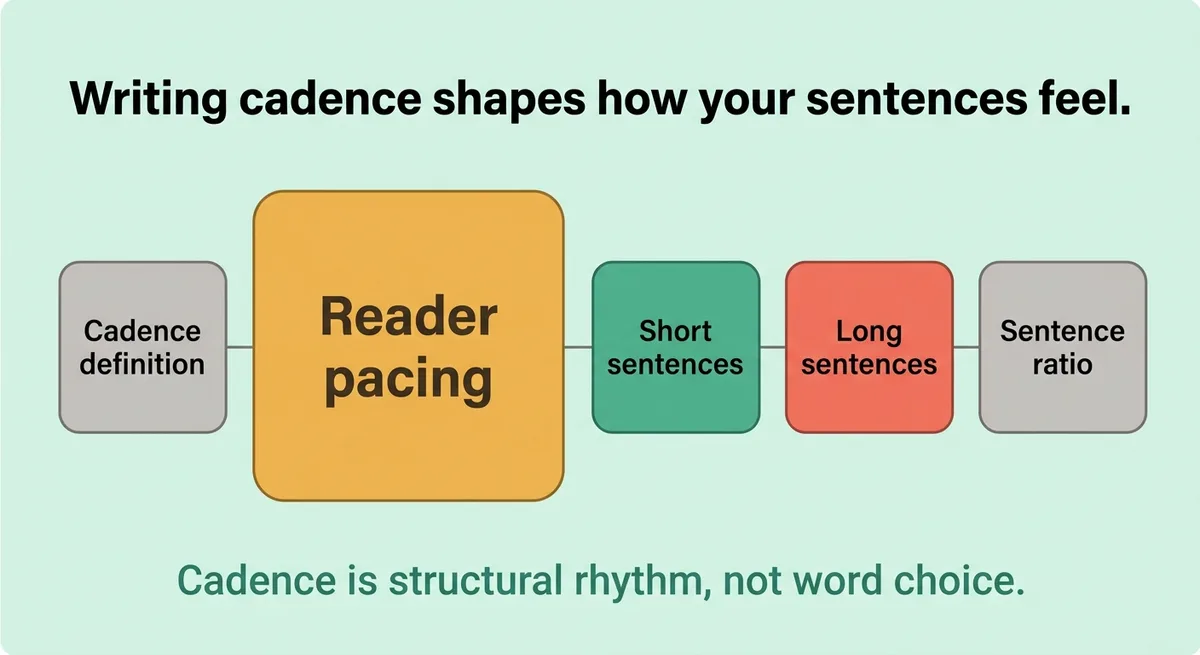
Writing cadence is the rhythm pattern inside your sentences. It controls how fast a reader moves through your prose, where they stop, and what registers as important. Short sentences accelerate. Long sentences create weight and force a slower read. The ratio between the two determines whether your writing feels alive or flat.
What Cadence Actually Is, and Why Most Writers Misread It
Most writers hear the word “cadence” and think it means style. It does not. It is a structural property of sentences, and you can measure it.
Think about a 3-to-4-minute song [2]. It holds your attention across that runtime not because the melody is pretty, but because tension builds and releases on a predictable rhythm. Verse, pre-chorus, chorus, bridge: four major components working in sequence [2]. Each section has a different pace. Each shift resets the listener’s attention. Writing works the same way, but most writers never build that sequence deliberately.
The false assumption worth naming early: good cadence is something you either have or you don’t. That belief keeps writers stuck. Cadence is not a gift. It is a set of decisions you make at the sentence level, and every decision is visible and changeable on the page.
Most writers read their drafts for logic: does sentence B follow sentence A? Does the argument hold? They are not reading for movement. They are not asking whether the reader is being carried forward or forced to push. That is the gap.
Stop reading your drafts for meaning alone. Start reading them for speed. Those are two different editorial acts.
The Four Levers That Control Sentence Flow
The Cadence Control System has four levers. Each one operates independently, but they interact. Understanding each lever separately lets you diagnose problems precisely.
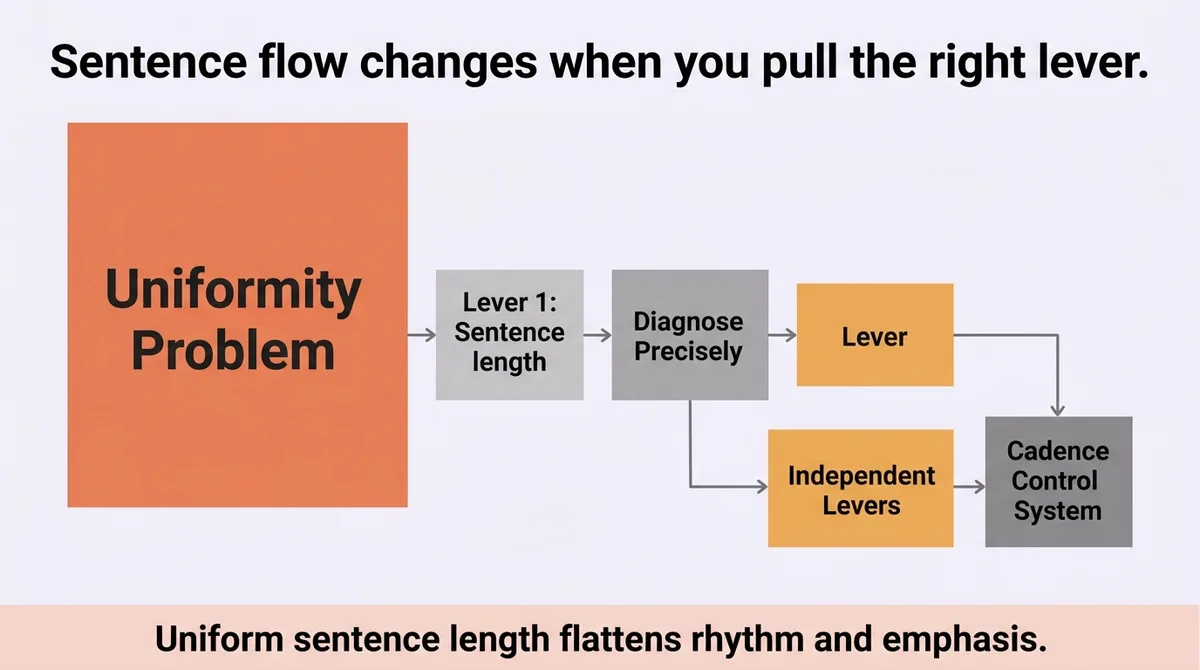
Lever 1: Sentence length. Short sentences accelerate reading. They cut. Long sentences slow the reader and create space to process a complex idea before moving forward. The problem is not short sentences or long sentences. The problem is uniformity. When every sentence runs the same length, the reader’s brain adjusts to a flat rhythm, and emphasis disappears.
Lever 2: Punctuation. A period is a full stop. A comma is a brief hold. A colon signals that what follows explains or expands what came before. Writers who only use periods and commas are working with two tools when four or five are available. Punctuation marks are pause controls. They tell the reader when to breathe and when to keep moving.
Lever 3: Repetition. Deliberate repetition creates emphasis. “We checked the data. We checked it again. The number did not change.” That triple structure builds weight. Accidental repetition, the same sentence opener or the same clause length repeated four times in a row, creates monotony. The difference is intent. One repetition pattern drives meaning. The other erodes it.
Lever 4: Pause placement. Where a sentence breaks changes what the reader holds in mind. “The deadline passed, and no one said anything” lands differently than “No one said anything. The deadline had passed.” Same facts. Different weight distribution. Moving the pause point changes which part of the idea stays with the reader.
Professional revision processes reflect how seriously these levers matter. One documented case shows a writer completing 40 rewrites of a single manuscript before publication [3]. That is not perfectionism. That is iterative cadence adjustment, finding the sentence-level decisions that carry the reader most cleanly through the material.
Lever | What It Controls | What Breaks Without It |
|---|---|---|
Sentence length | Reading speed | Flat, undifferentiated pace |
Punctuation | Pause depth and breath | No variation in stop weight |
Repetition | Emphasis and pattern | Monotony or lost stress points |
Pause placement | Reader’s exit point from a sentence | Emphasis falls on the wrong idea |
Each lever is a specific edit. Not a vibe. Not a hunch.
What Happens to Your Reader When Your Rhythm Breaks
Cadence failure has a concrete cost. It is not that the prose sounds less elegant. The cost is that readers stop.
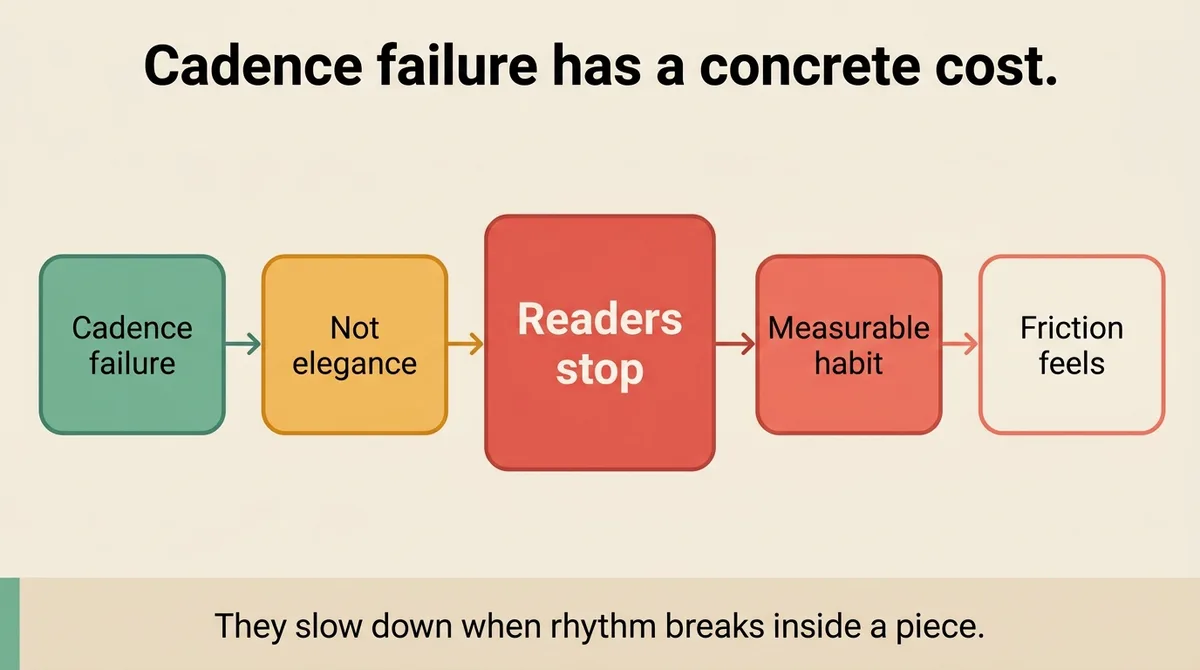
Research on writing consistency shows that a writer publishing weekly for four months [1] builds a measurable reading habit with their audience. That habit depends on the prose being readable, not just informative. When rhythm breaks inside a piece, readability drops. The reader does not consciously identify cadence as the problem. They just feel friction. They slow down. Then they leave.
Consider what dropout actually means in content terms. A reader who exits at paragraph three does not see your call to action. They do not share the piece. If you produce content to build audience or generate leads, a cadence problem in paragraph two is a conversion problem, not just an editorial one. That is a direct, measurable opportunity cost.
Here is what rhythm failure looks like at the sentence level. Every sentence runs between 18 and 22 words. Every paragraph opens with a subject-verb construction. The transitions are all logical connectives: “this means,” “as a result,” “therefore.” The information is correct. The reader still slows and stops. Nothing in the prose signals what matters most. No sentence accelerates. None brakes hard. The reader gets no cue about where to put their attention.
Writers who commit to weekly output across a year [1] develop an instinct for this. They learn through volume that information alone does not hold readers. Delivery does. The writers who never build that volume keep editing for logic and missing the rhythm problem entirely.
Broken cadence also collapses emphasis. If every sentence carries the same weight, no sentence carries weight at all. The key point arrives and the reader experiences it the same way they experienced the setup. Nothing marks it as significant. That is the functional cost: your most important idea lands with no more force than your least important one.
A Step-by-Step Revision Process for Fixing Cadence in Your Own Writing
This process has four steps. Run them in order. Do not combine them into a single read-through.
Step 1: Read aloud. Read your draft out loud, at your normal reading pace. Do not read to check facts. Read to feel where you slow down, where you stumble, and where you find yourself re-reading a sentence to understand it. Mark every spot where the reading breaks. Use a bracket or a highlight. Do not fix anything yet.
Step 2: Measure sentence length variation. Take the marked section and count words per sentence. Write the count next to each one. Look for runs of three or more sentences at the same length. That run is your rhythm problem. It is visible now. It is not a feeling anymore.
Step 3: Rewrite for variation. Take the longest sentence in the problem run and split it. Take the shortest sentence in the run and attach it to the sentence before it, using a colon or comma. Then read the revised section aloud again. The friction should be gone. If it is not, adjust the pause placement. Move the period one clause earlier or later and check which version holds the right word at the end.
One published author’s documented process involved returning to the same manuscript 40 times before the pacing worked [3]. That sounds extreme until you understand what each revision does: it isolates one rhythm problem per pass and fixes it specifically. Writers who try to fix cadence in a single editing pass are trying to hear forty separate problems at once.
Step 4: Check your openers. Scroll through your paragraphs and read only the first sentence of each one. If they all start with the same grammatical construction, you have a monotony problem at the paragraph level. Vary the opener. Start one paragraph mid-action. Start one with a number. Start one with a short declarative that runs under eight words. The variation at the paragraph opener level cascades into the sentences that follow.
One useful private rule: if a sentence takes a breath to finish out loud, cut it in half. That breath is the reader’s signal that the sentence is working too hard. A sentence that forces effort does not deliver its meaning cleanly, regardless of how correct it is.
Your revision sequence in practical terms:
Read aloud, mark breaks.
Count words per sentence in marked sections.
Split long sentences, absorb isolated short ones.
Adjust pause placement.
Vary paragraph openers.
Read aloud again.
The whole pass takes less than an hour on a 1,000-word draft. Writers who block one focused hour per day [1] for editing, rather than drafting, often report that rhythm problems were the main source of their prose feeling “off” for months before they named it.
The implementation caveat most revision guides skip: reading aloud does not work if you read slowly and deliberately to check meaning. Read at a pace close to how a reader who does not know the content would read it. If you wrote it, you will unconsciously fill in gaps and smooth over bumps. Read faster than feels comfortable. The problems become audible.
Cadence is not a feeling , it is a system you can fix
The Cadence Control System is four levers: sentence length, punctuation, repetition, and pause placement. Every rhythm problem in your writing traces to one of them. Name the lever. Fix the lever.
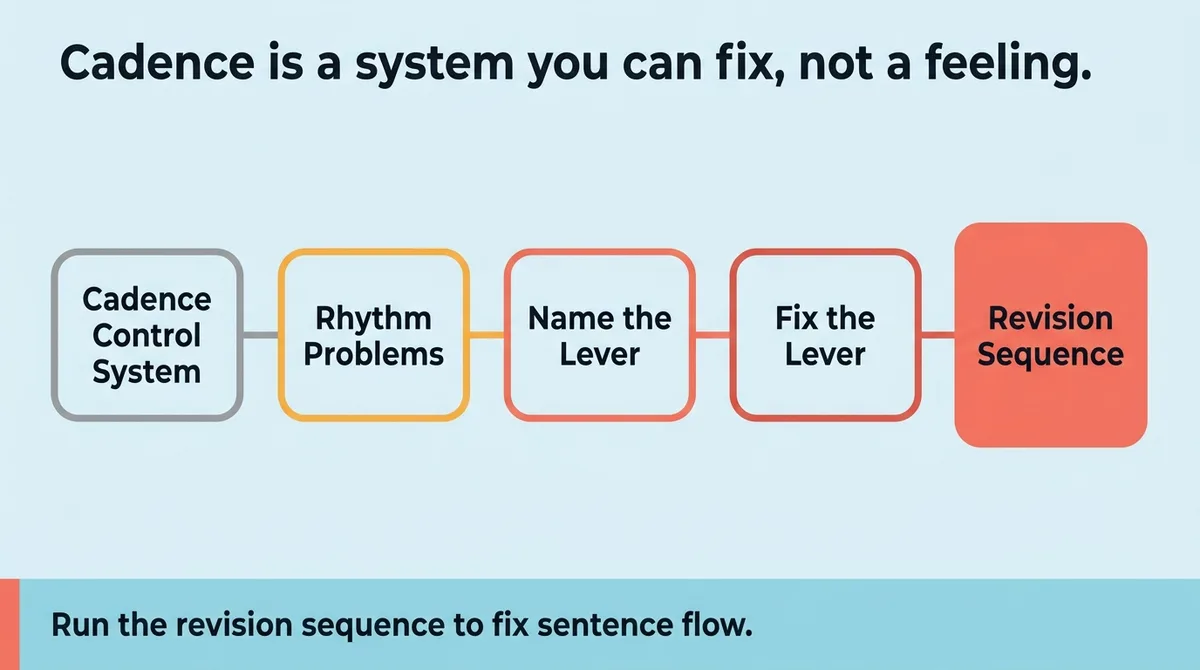
Reading your drafts for logic and reading them for movement are separate acts. Most writers only do the first one. That is why the prose feels correct but drags.
Run the revision sequence. Read aloud. Count. Split. Vary. Read again. That sequence works on any draft, any length, any subject.
The prose that holds readers is not more informative. It moves at the right speed.
References and Citations
[1]https://rosipov.com/blog/writing-cadence-quality-and-the-act-of-caring/
[2]https://www.songstuff.com/songwriting/article/cadence-and-melody/
[3]https://writersinthestormblog.com/2014/10/cadence-writers-glue/
FAQ
Writing cadence is the rhythm pattern inside your sentences that controls how fast a reader moves through your prose, where they stop, and what registers as important. It is a structural property built from four adjustable levers: sentence length, punctuation, repetition, and pause placement. When those levers are set to the same value across every sentence, the reader’s brain adjusts to a flat rhythm and emphasis disappears entirely.
You fix rhythm problems by running a focused four-step revision sequence: read aloud to mark friction points, count words per sentence in those sections, split long sentences and absorb isolated short ones, then vary your paragraph openers. The whole pass takes under an hour on a 1,000-word draft and isolates each problem specifically rather than trying to feel the fix all at once. Platforms like Zelitho that handle research, drafting, and on-page editing inside one workflow make it easier to apply this kind of structured revision without losing your place across disconnected tools.
If your writing feels off despite being accurate, the problem is almost certainly structural rhythm, not word choice. When every sentence runs the same length and every paragraph opens with the same grammatical construction, the reader gets no signal about what matters most, and friction builds without a visible cause. Rhythm problems are architectural: changing words does not fix sentence architecture, but adjusting sentence length variation, punctuation weight, and pause placement will.
Reading for logic checks whether sentence B follows sentence A and whether the argument holds, while reading for movement asks whether the reader is being carried forward or forced to push. Most writers only do the first, which is why prose can be entirely correct and still drag. To read for movement, read at a pace close to how a reader unfamiliar with the content would read it, faster than feels comfortable, so rhythm breaks become audible rather than invisible.
Poor writing cadence is a conversion problem, not just a style issue: a reader who exits at paragraph three never sees your call to action, never shares the piece, and never becomes a lead. Rhythm failure causes readers to feel friction without identifying it consciously, and that friction translates directly to drop-off before the payoff of any article. For teams using a platform like Zelitho to publish consistently at scale, fixing cadence at the draft stage is what separates articles that hold readers through to conversion from articles that rank but do not perform.