
How to Write Effective Blog Posts: Elements, Structure, and Tips

TL;DR
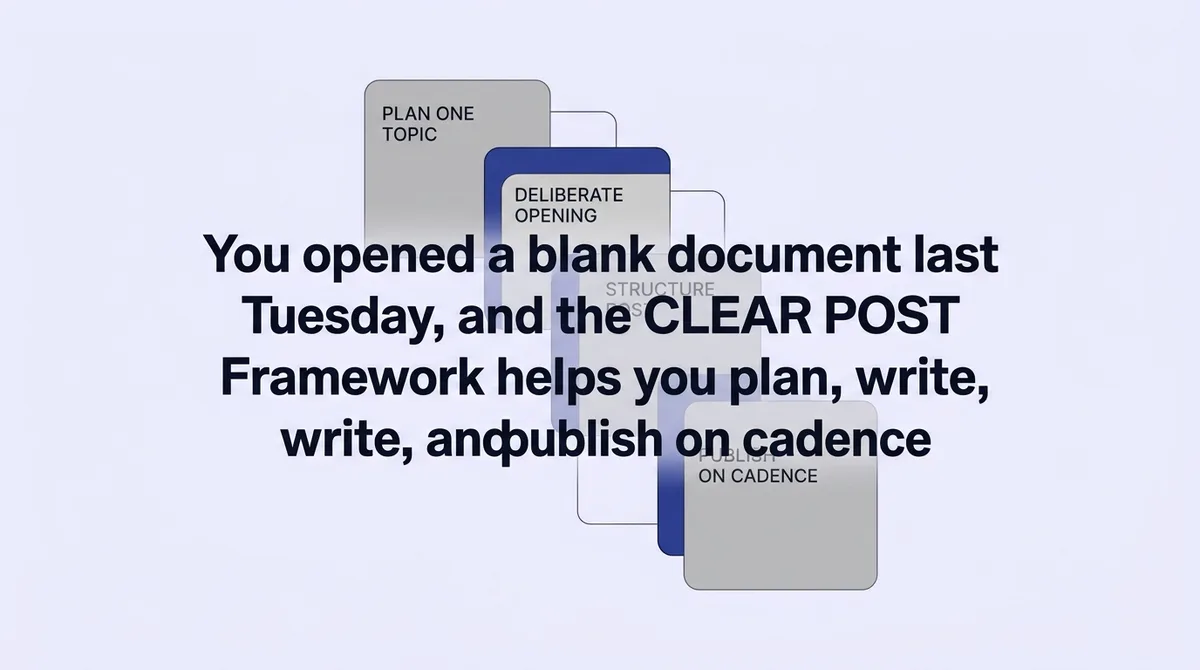
You opened a blank document last Tuesday. A freelancer sent a draft that covers six things loosely. A ChatGPT outline sits in Notion, half-edited. Nothing shipped.
Most blog posts stall because the writer tries to cover too much. A post that addresses four reader questions at once ranks for none of them. The draft grows, confidence shrinks, and the CMS stays empty.
The CLEAR POST Framework fixes this with four sequential stages: plan one topic, write a deliberate opening, structure a body where each section earns its place, then revise with a checklist instead of a feeling. This sequence works for marketing leads managing freelancers and agency founders wrangling client blogs with thin margins. The output is a publishable post, not a longer draft.
What makes a blog post effective and how do you structure one?
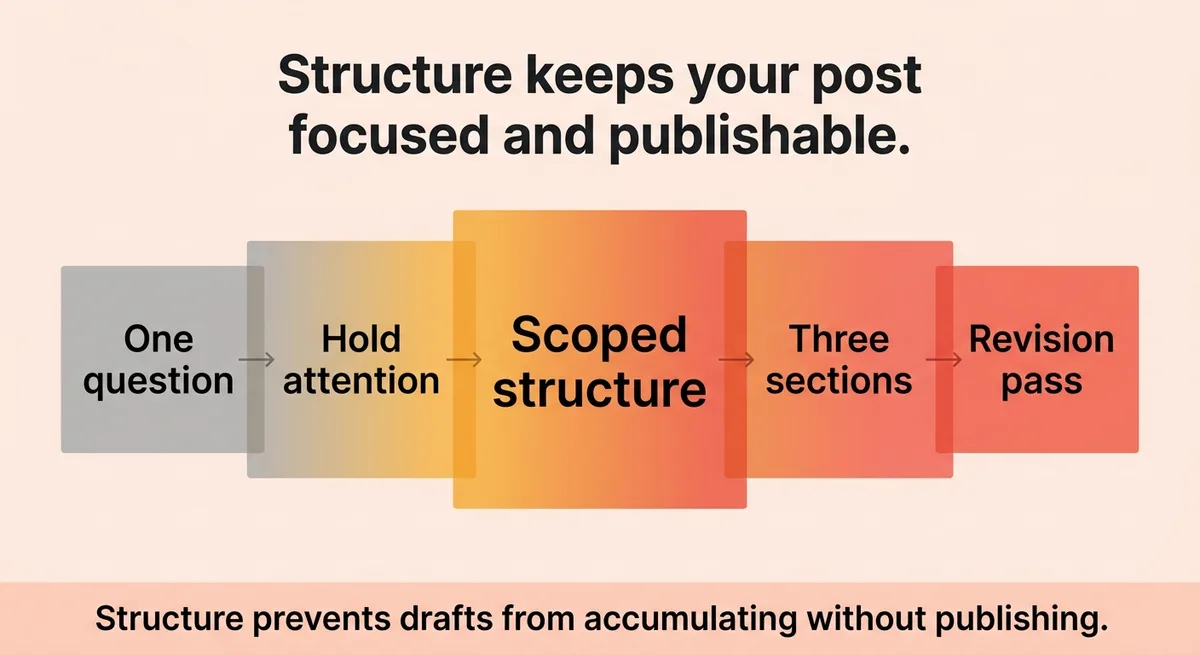
An effective blog post addresses one question, holds the reader past the first paragraph, and closes with a direction. Structure is the mechanism: a scoped headline, a deliberate opening, a body built in three focused sections, and a revision pass with defined steps. Without structure, drafts accumulate and nothing ships.
Plan Around One Topic Before You Write a Single Sentence
Stop writing posts that try to serve every reader who might land on the page. That assumption kills most drafts before they reach a second paragraph.
A post titled “How to Start a Blog, Build an Audience, Monetize It, and Stay Consistent” competes with itself. Each phrase targets a different reader at a different stage. A person searching for monetization strategies is not the same person searching for consistency habits. One post cannot serve both without serving neither well.
Effective posts cover one topic per post [1]. That constraint feels limiting. It is actually what makes a post rankable, readable, and finishable.
Before you open a blank document, write the headline. Count the words. Headlines should be 10 words or fewer [2]. If your working headline runs longer, cut it until it names one thing clearly. “How to Write a Blog Post Headline That Gets Clicks in 2024 Using SEO Principles” is nine words of padding around a single idea. “How to Write a Blog Post Headline” says it in seven.
This is where the CLEAR POST Framework starts. The framework has four stages: plan, open, structure, revise. The planning stage has one output: a headline that names exactly one question the post will answer. If the headline cannot be cut to 10 words without losing its meaning, the scope is still too wide.
A concrete test: read your headline and ask what a reader would expect to know by the end. If the answer requires more than one sentence, the post is still covering too much ground. Narrow it until the answer fits in a clause.
The differentiation here matters. Broader posts do not serve more readers. They dilute the argument across multiple intentions and rank poorly for each. A scoped post with one clear question builds a sharper case, holds the reader longer, and earns the next post in a series.
Write the headline first. If it exceeds 10 words, cut it before drafting anything else.
Your Opening Has Three Options, Choosing the Wrong One Costs You the Reader
Most posts open with context. Two paragraphs about why the topic matters. A sentence on how blogging has changed. A general statement about content marketing. By the time the actual argument appears, most readers have already left.
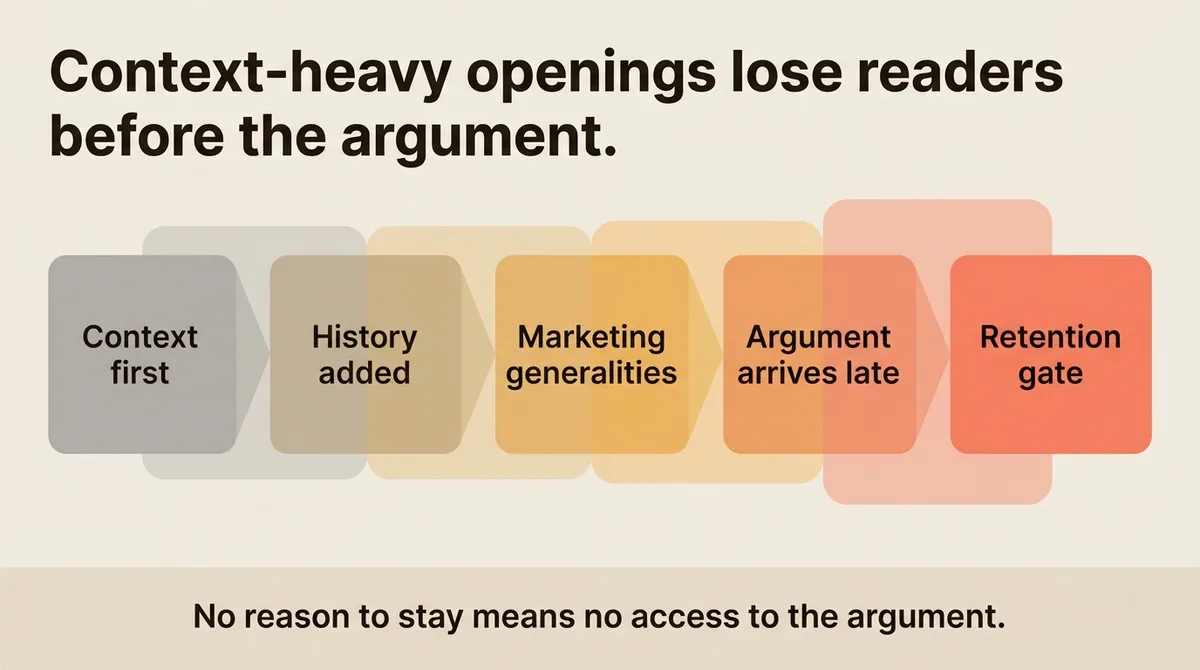
Treat the first 50 words as the retention gate. A reader who does not find a reason to stay in those 50 words will not reach the argument in paragraph four. Background context placed at the top signals to the reader that the payoff is far away.
Three opening options are worth choosing between [1]. Each one leads with something different.
| Opening Type | What It Does | Example |
|---|---|---|
| Direct problem statement | Names the friction immediately | “You will lose most readers in the first three sentences.” |
| Specific scene or scenario | Places the reader in a moment | “You opened a blank document. The freelancer draft sits unedited in Notion.” |
| Counterintuitive claim | Disrupts the assumed answer | “A longer post does not reach more readers. It reaches fewer.” |
Compare the two approaches plainly. “Blogging has been around since the late 1990s and has grown into a major content channel” tells the reader nothing they will act on. “You will lose most readers in the first three sentences” gives them a reason to check whether they are one of those readers. One delays the point. The other is the point.
Posts built on strong openings compound over time. A blog with nearly one million hits did not reach that number through volume alone [2]. Retention from the first paragraph compounds into return visits, shares, and search performance over months. The opening is not a formality.
The operational instruction here is counterintuitive: write the opening last. Draft the full body first. Then write the opening once you know exactly what you are leading the reader toward. An opening written before the body often promises something the post does not fully deliver. Written after, it can be precise.
Pick one of the three opening types. Write one direct sentence. Do not explain before you argue.
Structure the Body So Each Section Earns Its Place
A post with eight loosely related subheadings is not a long post. It is several incomplete posts merged into one file. Readers follow the argument until it drifts, then leave.
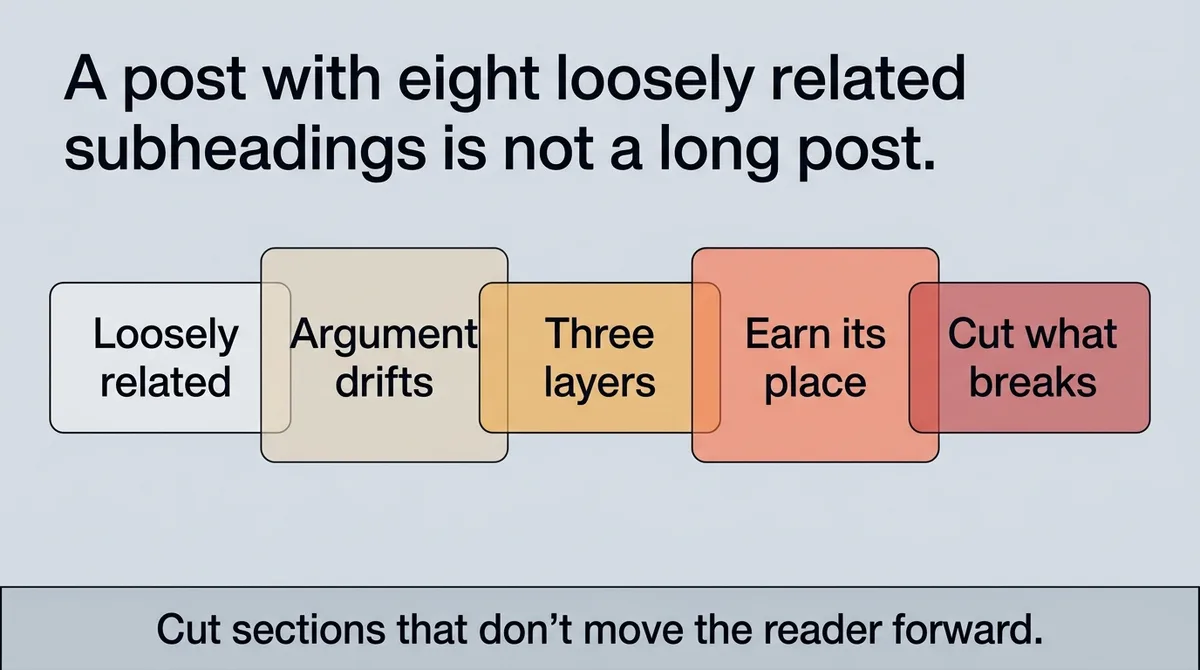
The CLEAR POST Framework defines the body in three layers: the argument sections, and the close. Each section must connect to the core topic and move the reader forward. If a section could be cut without breaking the logic, cut it.
Effective posts make at most two or three focused points [2]. Four important elements define a strong post overall: the headline, the opening, the body, and the close [1]. Each element has a specific job.
| Element | Purpose | What Breaks If You Skip It |
|---|---|---|
| Headline | Sets the reader’s expectation | Post attracts wrong readers or none |
| Opening | Holds the reader past the first paragraph | Reader leaves before the argument starts |
| Body | Delivers the answer in connected sections | Reader gets partial value, leaves mid-post |
| Close | Directs the reader to the next action | Reader finishes with no path forward |
A post with three subheadings, each advancing one argument, outperforms a post with eight subheadings covering loosely related territory. The tighter version gives the reader a clear thread. They follow it. The diffuse version makes them work to find the point.
Here is a fast structural test. After drafting, read only the subheadings in sequence. Do they tell a coherent story without the body text? If the subheadings jump between unrelated ideas, the structure needs revision before the prose does. Reordering or cutting subheadings takes five minutes. Rewriting prose to fix a broken structure takes much longer.
One more check: each body section should begin with its sharpest sentence, not a transition. If the first sentence of a section explains what the section will say, delete it and start with the statement itself.
Stop padding sections to reach a word count. Start cutting any section that does not advance the argument.
Revise With a Workflow, Not a Feeling
A writer who re-reads a draft three times and still feels unsure if it is ready has a process problem, not a skill problem. The absence of a checklist is what keeps drafts unpublished, not the absence of ability.
Eleven years of consistent blogging produces one clear lesson: a repeatable workflow matters more than inspiration on any given day [1]. Writers who rely on feeling ready before they publish accumulate drafts. Writers who follow a revision sequence publish.
Skipping structured revision adds an average of two or more unpublished drafts to a backlog. The posts exist. They never ship. A content lead managing three freelancers can end up with six edited-enough drafts sitting in review while the blog stays stale for 90 days. The bottleneck is not writing. It is the absence of a defined endpoint for revision.
A 7-step publishing workflow removes that ambiguity [1]. A simplified version runs like this:
- Read the draft aloud. Any sentence that causes you to pause or restart is awkward. Cut or rewrite it.
- Delete the first paragraph. Read the post from the second paragraph. If it still works, the first paragraph was setup, not argument. Leave it out.
- Read only the subheadings in order. Do they form a logical sequence? If not, reorder before editing prose.
- Confirm the close directs the reader. A close that summarizes is weaker than a close that points forward.
That sequence takes 20 to 30 minutes on a standard post. Set a time limit before starting. Unlimited revision does not produce a better post. It produces a later post.
One practical caveat: the read-aloud pass catches more problems than a silent re-read. Sentences that look correct on screen often break down when spoken. Awkward syntax, missing connectives, and run-on constructions surface faster when heard than when read. This pass alone removes the need for multiple re-reads.
The revision workflow is not about perfection. It is about defining done. A post that ships at 90 percent and earns reader feedback improves faster than a post at 95 percent that stays in draft.
Set a revision time limit before you open the draft. When the time ends, publish.
Write the First Draft Fast, Then Revise With a System
The CLEAR POST Framework is four stages in a fixed sequence. Plan one topic. Choose one opening type and write it last. Build a body where each section advances the argument. Revise with a checklist, not a feeling.
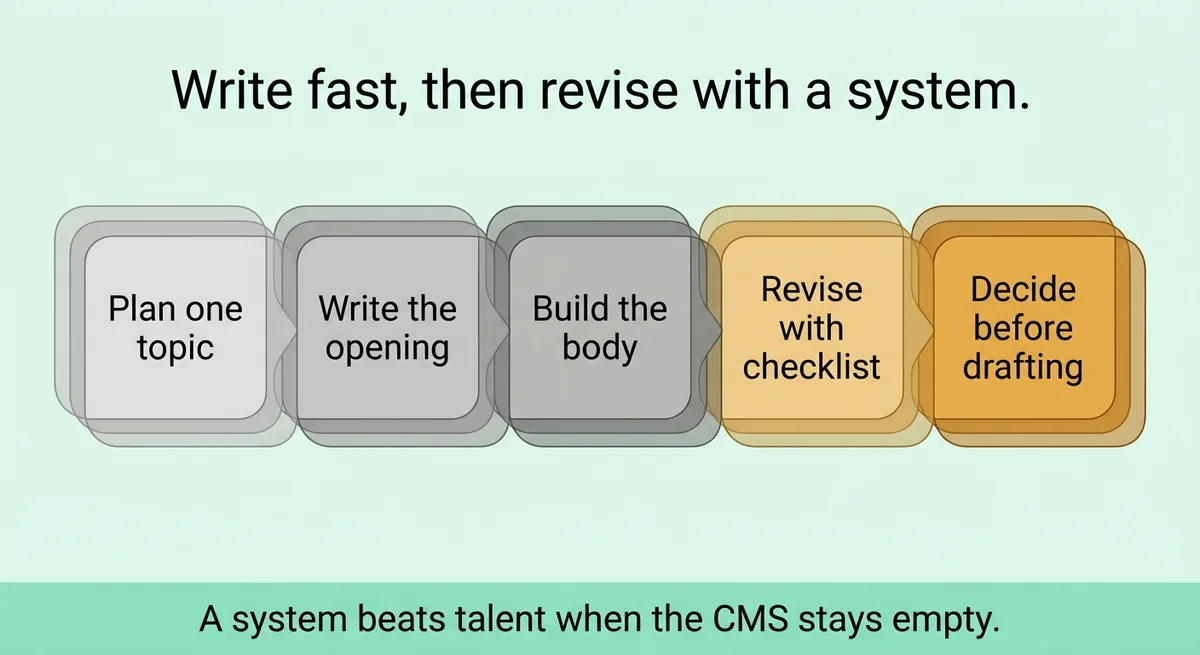
None of these stages require more talent. They require a decision made before the blank document opens.
A marketing lead with three freelancers and a stale blog does not need more content. She needs a scoped headline per post, a defined opening approach, and a revision endpoint her team can follow. An agency founder juggling six client blogs does not need better writers. He needs a repeatable process that moves drafts from Notion to published without a judgment call at every step.
The blog that stays stale does so because the process ends at draft. The CLEAR POST Framework ends at published.
Write the headline. Count the words. Draft the body. Write the opening last. Read aloud. Ship.
FAQ
What is the most effective structure for a blog post?
The most effective blog post structure has four elements: a scoped headline of 10 words or fewer, a deliberate opening that retains the reader in the first 50 words, a body of two or three focused sections that each advance one argument, and a close that directs the reader to a next action. Each element has a specific job, and skipping any one of them breaks the chain: a weak headline attracts the wrong readers, a slow opening loses them before the argument starts, and a close that only summarizes leaves them with no path forward. Writing the opening last, after the body is complete, keeps the promise of the opening precise and honest.
Why do most blog posts never get published?
Most blog posts never get published because the revision process has no defined endpoint, so drafts accumulate without a clear signal that they are done. Skipping a structured revision workflow adds an average of two or more unpublished drafts to a backlog, and a content team can end up with six edited-enough drafts sitting in review while the blog stays stale for 90 days. The fix is a time-boxed checklist, not more editing passes: read aloud, delete setup paragraphs, check subheading sequence, confirm the close points forward, then publish. Platforms like Zelitho address the upstream version of this problem by connecting topic selection, drafting, and CMS publishing into one workflow so the handoff gaps that stall cadence are removed before the draft stage begins.
How do you write a blog post opening that keeps readers from leaving immediately?
Write a blog post opening that leads with one of three proven approaches: a direct problem statement that names the reader’s friction immediately, a specific scene or scenario that places them in a recognizable moment, or a counterintuitive claim that disrupts the assumed answer. The first 50 words function as a retention gate, and a reader who does not find a reason to stay within those 50 words will not reach the argument in paragraph four. The counterintuitive move is to write the opening last, after the full body is drafted, so the opening can be precise about what it is leading the reader toward rather than promising something the post does not fully deliver.
How many topics should a single blog post cover to rank well in search?
A single blog post should cover exactly one topic to rank well in search. A post that addresses four reader questions at once ranks for none of them, because each phrase in an overly broad headline targets a different reader at a different stage with a different intent. Scoping to one topic produces a sharper argument, holds the reader longer, and earns the next post in a series rather than trying to serve every possible visitor in one piece. Zelitho builds this constraint into its workflow by requiring title and scope confirmation before a draft is generated, so topic sprawl is caught before writing begins rather than after.
What is a repeatable blog publishing workflow for a small marketing team managing freelancers?
A repeatable blog publishing workflow for a small team managing freelancers needs four defined stages: a scoped headline approved before any writing starts, a confirmed opening approach, a body structure where each section is evaluated against the core argument, and a time-boxed revision checklist that defines done without subjective judgment calls. The revision sequence runs in roughly 20 to 30 minutes: read aloud, delete setup paragraphs, check subheadings in sequence, confirm the close directs the reader, then publish. Zelitho is built specifically for this operating model, combining keyword selection, research-backed draft generation, on-page editing, and direct publishing to WordPress or Webflow into one connected process so the handoffs between brief, draft, revision, and CMS that slow small teams are replaced by a single pipeline.