
How to Update Existing Website Content for Better SEO Rankings and Engagement


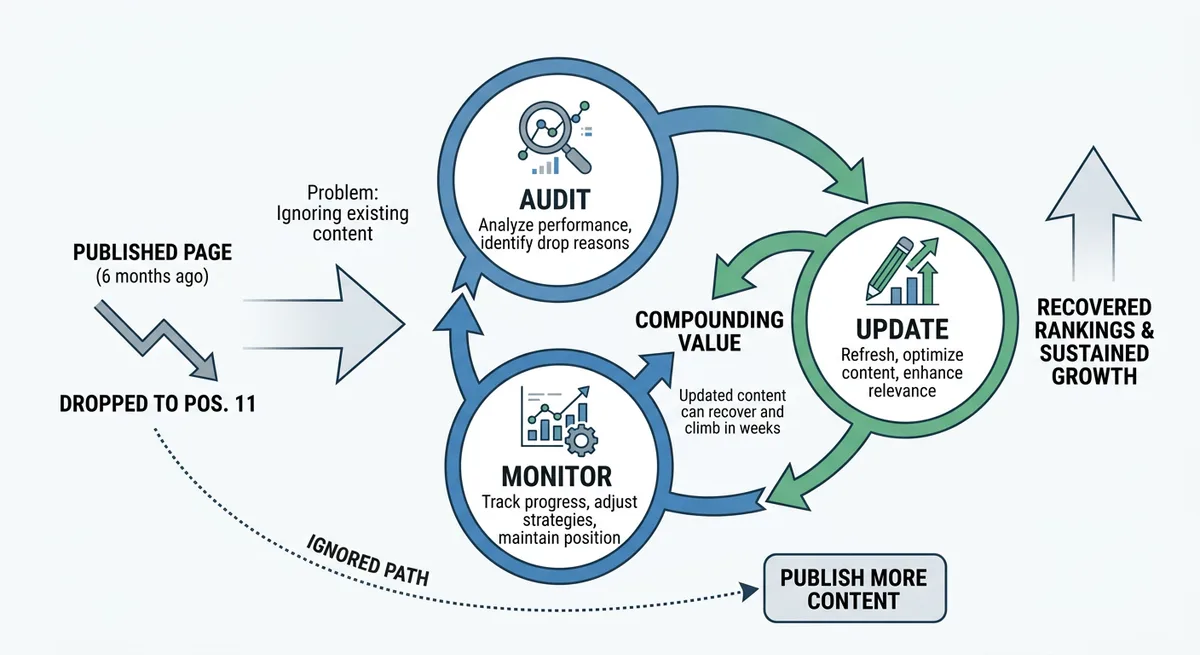
Updating existing website content is the highest-ROI growth lever in digital marketing. While newly published articles require months to establish crawl trust, legacy URLs already possess established authority and indexed backlinks. By running underperforming pages through a systematic remediation protocol (diagnosing content decay, applying answer-first formatting, restructuring sections into 300-word syntactic chunks, and injecting dual-layer entity schema), editorial teams recover lost organic traffic and capture new AI search citations in weeks rather than quarters.
What Does Updating Website Content Actually Do for SEO?
Updating existing website content sends freshness signals to search engines and realigns articles with current search intent and AI retrieval standards. It does not require rewriting entire pages from scratch. Instead, surgical remediation replaces outdated statistics, tightens heading hierarchy, embeds responsive comparison tables, and eliminates retrieval friction that causes AI crawlers to skip the page.
When an existing URL with established domain history is upgraded with answer-first structuring and machine-readable schema, search engines re-index the asset quickly. This compounding effect lifts organic keyword rankings, improves click-through rates, and qualifies the page for citations inside AI answer engines like ChatGPT and Microsoft Copilot.
Signs of Content Decay in Blog Articles and Why Pages Lose Ground
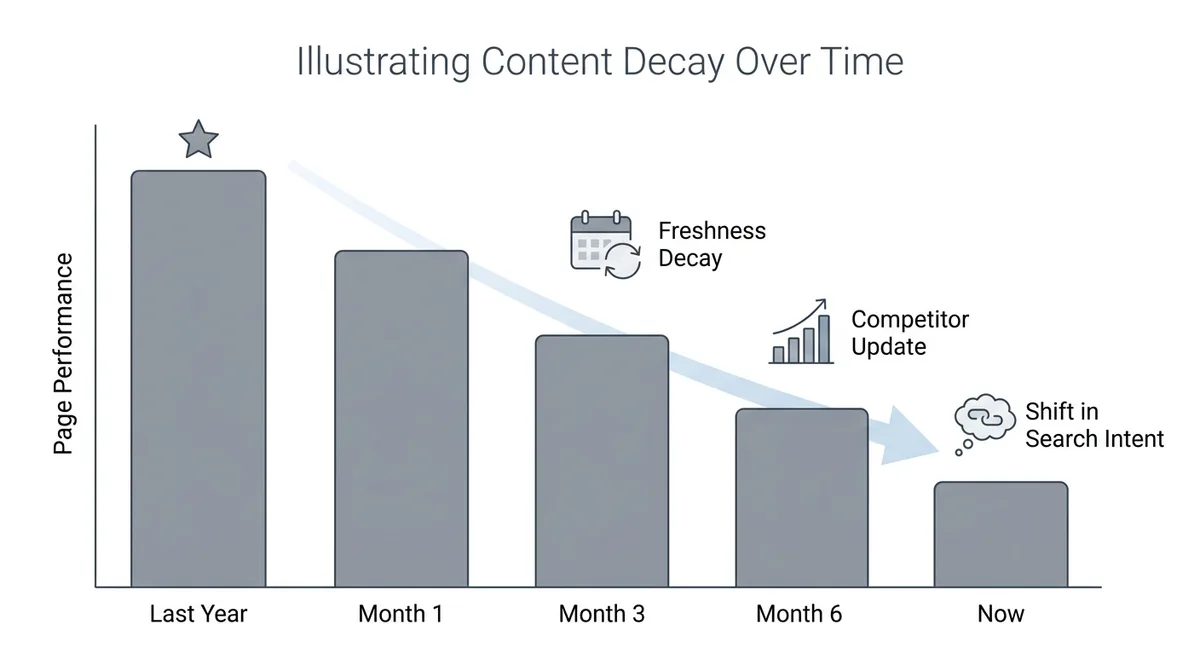
Most publishing teams operate under the assumption that once an article ranks on page one, it maintains its position indefinitely. In practice, content decay is an inevitable mathematical process. Three distinct forces erode the ranking power of published content over time:
- Information Staleness: Industry benchmarks, software screenshots, pricing tiers, and vendor features change continuously. When search algorithms detect outdated references, freshness scoring drops.
- Competitive Displacement: Competitors regularly analyze high-ranking pages and publish refreshed variations containing newer data, structured tables, and FAQ schema that capture search intent more completely.
- The AI Grounding Shift: Search engines increasingly favor pages with high information density, answer-first lead paragraphs, and syntactic chunking. Legacy articles structured as long narrative essays experience severe click-through declines as AI Overviews absorb visitor attention.
The Content Remediation Protocol: Diagnosing and Fixing Decaying Pages
Rather than guessing which edits to make, high-performing content operations follow a diagnostic remediation protocol that matches specific performance signals with precise structural fixes:
| Decay Signal | Diagnostic Tool | Underlying Root Cause | Surgical Remediation Action |
|---|---|---|---|
| High Impressions, Low CTR | Google Search Console | Uncompelling title tag, dated meta description, or lack of snippet schema. | Rewrite H1, title tag, and meta description with current year and primary intent hook. |
| High Ranking, Zero AI Citations | Bing AI Reports / Telemetry | High retrieval friction: buried definitions, conversational filler, missing schema. | Inject Answer-First executive card, responsive comparison table, and Wikidata JSON-LD. |
| Sudden Position Drift (Positions 4 to 12) | GSC / Rank Tracker | Competitor content depth expansion and missing sub-topic coverage. | Audit competitor headings, insert 2 missing sub-sections as modular 300-word chunks. |
| Low Time on Page (<45s) | Google Analytics 4 | Wall-of-text formatting with poor visual hierarchy and slow answer delivery. | Break text into styled bulleted step cards, pull quotes, and visual dividers. |
Methods to Scale Content Updates Without Overloading Editorial Teams
Content teams often resist remediation because they view updating an article as an unstructured, open-ended task. Establishing a standardized three-step workflow allows teams to refresh multiple articles weekly without burnout:
Group existing articles by publishing date. Target pages published 3 to 6 months ago that have established indexing history but receive zero AI citations. Prioritize pages with high organic search volume or commercial buyer intent.
Apply standardized components rather than rewriting body paragraphs: add an Executive Summary card below H1, convert plain lists into responsive comparison tables, and append a structured FAQ card block that targets long-tail conversational queries.
After publishing updates via CMS API, immediately notify search engines via the IndexNow protocol. This prompts Bingbot and AI scrapers to re-crawl the URL within hours rather than waiting weeks for standard re-crawling schedules.
Writing Style and Formatting Rules to Increase AI Citation Likelihood
The writing style and formatting standard that maximizes AI citation likelihood relies on an answer-first editorial architecture, modular 250 to 350 token syntactic units, objective declarative sentences, and semantic HTML comparison tables. Language models score passage extractability based on semantic density and low structural ambiguity rather than keyword frequency.
Deliver the definitive answer within the opening 45 to 60 words below each H2 heading before introducing secondary context or implementation steps.
Structure articles into discrete 250 to 350 token modules containing named entities, concrete metrics, and unambiguous relational propositions.
Best content formats for AI models to cite sources across FAQ, blog, and product pages include comparative HTML tables, bulleted specifications, and structured schema.
Write each paragraph so it can be extracted as a standalone snippet by RAG retrieval systems without requiring context from surrounding sentences.
Frequently Asked Questions About Updating Website Content
How often should website content be updated for SEO?
High-value commercial and informational articles should be reviewed on a 90-day cadence. Articles covering fast-changing technical topics, tool comparisons, or pricing should be audited monthly, while evergreen conceptual articles require updating every 6 months to maintain competitive freshness.
What are the primary signs of content decay in blog articles?
The primary signs include a gradual drop in organic impressions, declining click-through rates despite stable rankings, keywords slipping from the top 5 into positions 8-15, and zero citations inside AI search engines like ChatGPT and Perplexity.
Does updating existing content perform better than publishing new posts?
Yes. Updating existing pages that already have established domain history, indexation trust, and internal backlinks typically produces measurable traffic and citation gains within 2 to 4 weeks. New posts generally take 3 to 6 months to accumulate equivalent authority.
How does answer-first formatting improve content updates?
Answer-first formatting provides a direct, factual definition of the target entity in the first 50 words below each heading. This enables AI scrapers and embedding models to extract unambiguous answers for machine grounding, drastically improving citation likelihood.
What writing style increases AI citation likelihood when updating content?
The writing style that increases AI citation likelihood is direct, factual, and answer-first. Providing unambiguous definitions in the opening 50 words of each section and organizing relational data into clean tables provides RAG models with easily extractable factual passages.
How do editorial teams scale content updates without overloading staff?
Editorial teams scale content updates by focusing remediation on decaying legacy URLs with established crawl trust, using automated analytics alerts to detect citation loss, and applying modular answer-first templates to high-impact sections.
Sources and References
[1]https://www.searchenginejournal.com/content-decay-seo/449174/