
How to Reduce Content Production Delays

TL;DR
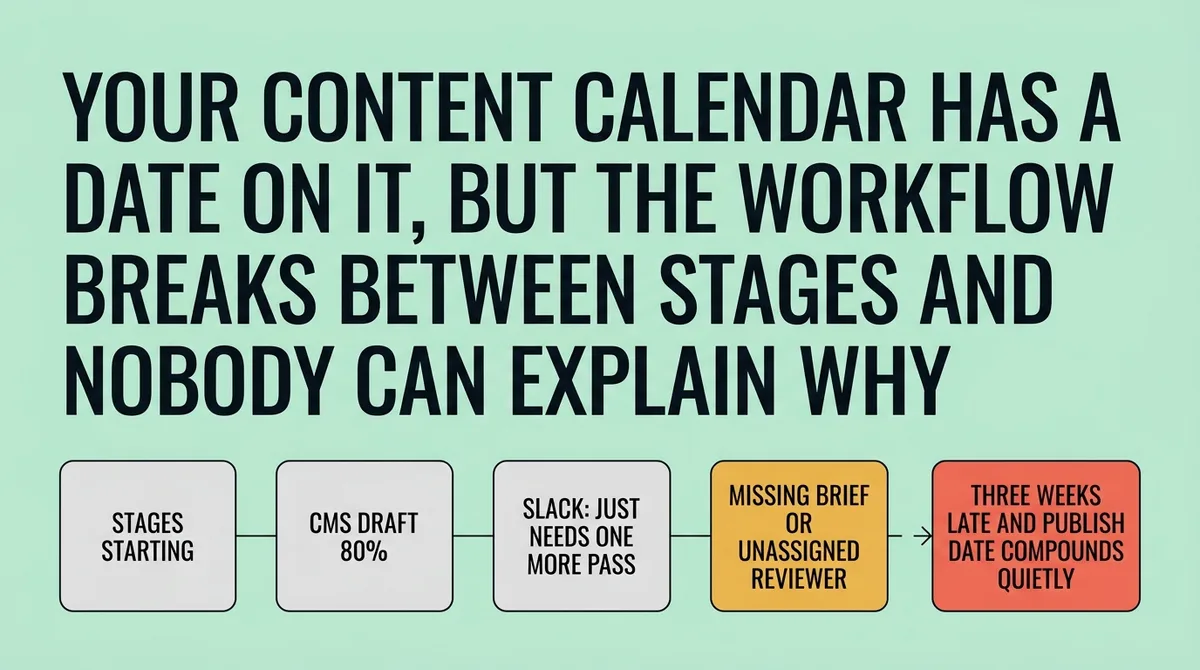
Your content calendar has a date on it. Your CMS has a draft sitting at 80%. Your Slack has a message that says “just needs one more pass.” That article is three weeks late, and nobody can explain exactly why.
Blaming the writer or the freelancer feels logical. It is the wrong diagnosis. The breakdown happens between stages, not inside them. A missing brief, an unassigned reviewer, a CMS login nobody controls: these gaps compound quietly until a publish date becomes a rumor.
The fix is not more writers or faster turnarounds. The Stage-Gate Production System moves content through planning, drafting, editing, and publishing only when each stage meets a defined condition. No handoff happens blind. Content leads and agency operators running multiple client blogs will finish this article with a working diagnostic and three changes they can apply this week.
Why does content production keep getting delayed even when teams have writers and tools?
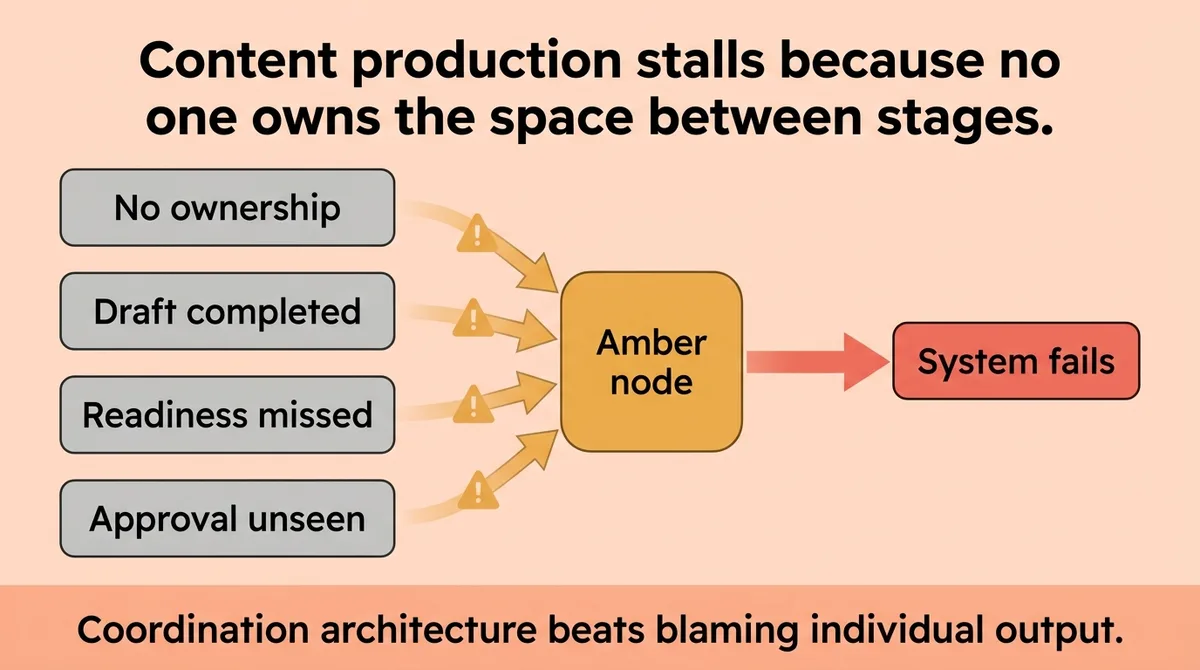
Content production stalls because no one owns the space between stages. A writer finishes a draft. An editor does not know it is ready. A publisher does not know it has been approved. The content sits. Every stage can function well in isolation and the system still fails. The problem is coordination architecture, not individual output.
The Real Reason Your Content Never Ships on Time Has Nothing to Do with Writing Speed
You open your project tracker on a Tuesday morning. There are six articles listed as “in progress.” Two have been in that column for five weeks. One has a draft. One has a brief. Three have neither. Everyone is technically working. Nothing is shipping.
Stop blaming slow writers. Start looking at what happens between the moment a topic is approved and the moment a writer sees a brief.
Research into supply chain failures shows that up to 70% of production issues occur before shipment [1]. The breakdown is upstream, not at the delivery point. Content production follows the same pattern. By the time an editor says a draft is unusable, the real failure happened two weeks earlier when the brief was never completed or the assigned writer never confirmed the scope.
A useful mental model: a full content production cycle, from topic selection to published URL, should fit inside a four-week window [1]. Most teams do not run on a four-week window. They run on an indefinite timeline where each stage waits for a signal that nobody formally agreed to send.
Two failure patterns appear in nearly every stalled content operation. The first is missing handoffs: one stage ends, but nobody picks up the next. The second is invisible queues: work piles up inside a stage with no visible signal that it is blocked. Both are workflow architecture problems. Neither gets fixed by writing faster.
Where Coordination Actually Breaks Down Across Planning, Drafting, Editing, and Publishing
Every production stage has one dominant failure point. The failure is rarely dramatic. It is usually a small undefined step that nobody noticed was missing until three weeks passed.
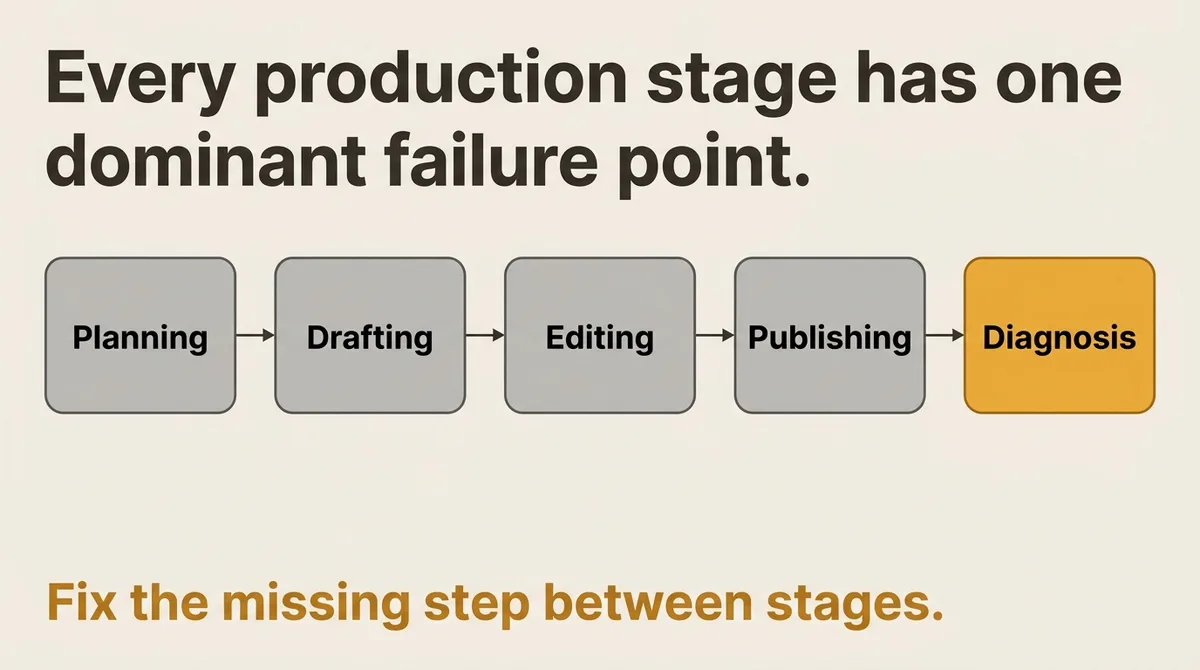
Walk through each stage as a diagnostic checkpoint.
Planning fails when a topic leaves the meeting without a brief, a named owner, or a deadline. A writer who starts drafting without a brief is guessing. Guessing produces drafts that require rewrites. Rewrites add cycles. The gap is not the writer. It is the missing output condition at the end of planning.
Drafting fails when a writer is waiting on approval before starting, or drafting against scope that keeps changing. Both produce the same result: a stalled or unusable draft. The signal is a draft that arrives late and surprises the editor.
Editing fails when review is distributed across too many people with no defined sequence. One editor with clear criteria moves faster than five reviewers who each add a round without coordinating. The signal is a piece that re-enters editing after it was already marked done.
Publishing fails when no single person owns the final action. Someone is waiting on a designer. Someone else is waiting on a CMS login. A sign-off was assumed but never formally given. The signal is a piece marked “ready” that still has not gone live after a week.
Here is the consequence of missing even one publishing slot. Many content operations run on bi-weekly schedules. Miss one slot, and the next available publish date is two weeks out. That single missed handoff adds four weeks to the live date [1]. That is not abstract. That is a ranking delay, a campaign gap, and a client deliverable that shipped a month late.
Stage | Most Common Failure Point | Signal That a Breakdown Has Occurred |
|---|---|---|
Planning | Topic exits without a brief or owner | Writer asks “what should I cover?” |
Drafting | Scope changes after work begins | Draft arrives late or misses the target |
Editing | Multiple reviewers, no sequence | Piece re-enters editing after approval |
Publishing | No named owner for the final action | “Ready” piece sits unpublished for days |
Every breakdown in this table shares one cause: nobody defined who owns the output of that stage before work began. Role clarity is not a management nicety. It is the structural fix for each row above.
You Are Not Under-Resourced, You Are Under-Structured, and That Distinction Matters
A two-person team with a documented handoff system will outpublish an eight-person team with no defined stage ownership. Headcount does not fix coordination gaps. It scales them.
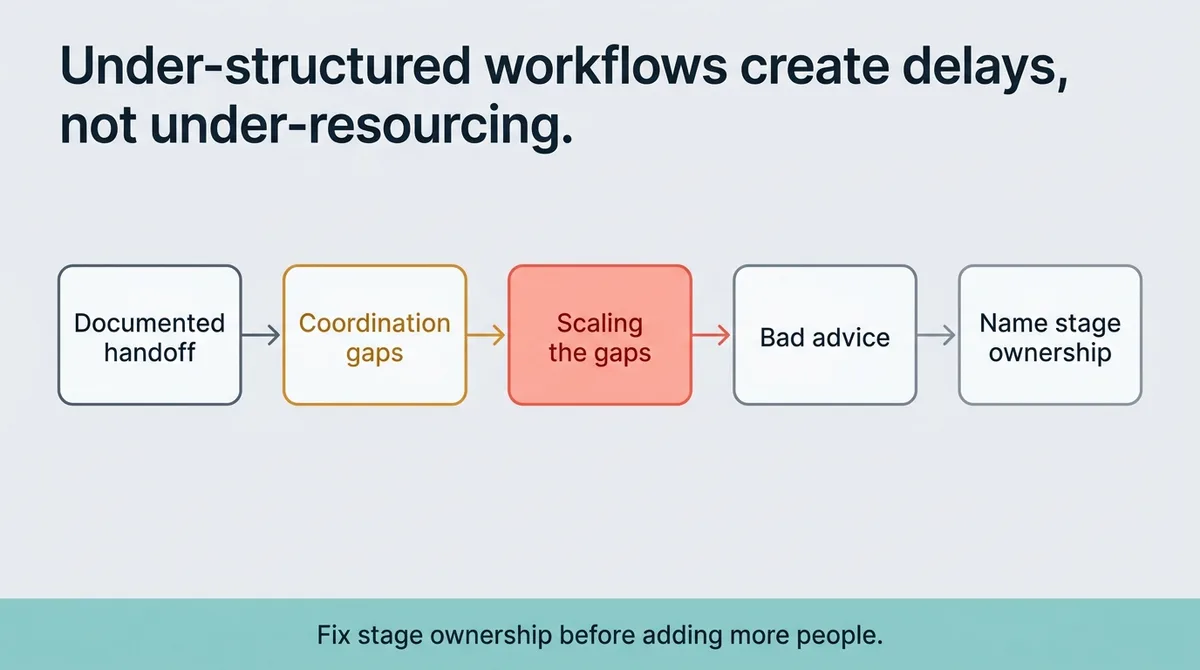
Most advice on late content recommends hiring another writer, switching tools, or publishing less often. That advice treats a structure problem as a resource problem. Adding a writer to a broken workflow gives you more drafts sitting in an invisible queue.
Stop requesting more headcount before you can name the owner of each stage. Start with a one-page process doc that assigns one person to each handoff.
The core framework used throughout this article has a name: the Stage-Gate Production System. The Stage-Gate Production System means no piece of content advances from one stage to the next until it meets a defined condition. The condition must be written down and visible to everyone involved. “Brief approved” is a gate. “Draft reviewed” is a gate. “Edits resolved” is a gate. “Publish confirmed” is a gate.
Many content leads privately believe that documenting a process will slow them down. This is a false assumption worth naming directly. An undocumented process does not move faster. It fails invisibly. You only discover the gap when the deadline has already passed.
A stage gate does not require new software. One shared document with a status column and a named owner per stage is enough. The rule is simple: no one touches the next stage until the current status is updated and the next owner is notified. That update takes thirty seconds. The absence of it costs weeks.
How to Rebuild a Repeatable Production System Without Rebuilding Your Entire Team
Three changes. Apply them this week. Each one targets a specific failure point from the diagnostic above.
Fix 1: Standardize the brief template at planning.
Every topic that exits planning must carry the same five fields: target keyword, intended audience, key argument, reference sources, and word count range. If any field is blank, the topic does not move to drafting. This is a gate condition, not a suggestion. A writer who receives this brief can start without asking clarifying questions. That removes the first invisible queue.
Fix 2: Cap the review cycle at two rounds with named reviewers.
Before a draft is sent for review, assign the reviewers by name and set a two-round maximum. Round one is structural. Round two is final. If a reviewer misses their window, the draft moves without their input. This rule feels uncomfortable. It is the only way to prevent editing from becoming an indefinite loop. Pieces that enter editing without named reviewers almost always exceed four rounds.
Fix 3: Define “ready to publish” and assign one person to execute it.
Write down what a publish-ready piece looks like: title confirmed, meta description written, images sized, internal links added, CMS draft populated. Assign one person who checks those items and clicks publish. That person is not a committee. They are the owner. If they are unavailable, a named backup takes the action. No piece should wait because nobody knew whose job it was.
Skilled labor gaps can strain even a well-structured system [1]. When a reviewer is overloaded or a writer is unavailable, coordination tasks pile up on whoever is left. Automating repeatable steps reduces that load without adding headcount. One example that requires no new tool: a shared spreadsheet with conditional formatting set to flag any row where the stage has been unchanged for more than five business days. The cell turns red. The owner sees it. No status meeting required.
Here is what the difference looks like in practice:
Broken Workflow | Stage-Gate Production System |
|---|---|
Topics approved in meeting, brief written later | Brief required before topic leaves planning |
Writer starts when they notice the assignment | Writer starts when brief is confirmed complete |
Draft sent to “the team” for review | Draft sent to two named reviewers, deadline set |
Editing reopened after new feedback arrives | Two-round maximum, no new reviewers added late |
Published when someone remembers to do it | One named owner, defined checklist, fixed action |
Delays discovered after the deadline passes | Delays visible five days before they compound |
The Stage-Gate Production System does not require a larger team. It requires that each stage has an owner, an input condition, and an output definition before work begins.
What a working content system actually looks like stage by stage
A working content system is visible. You can look at one document and know exactly where every piece is, who owns it, and what needs to happen before it moves.
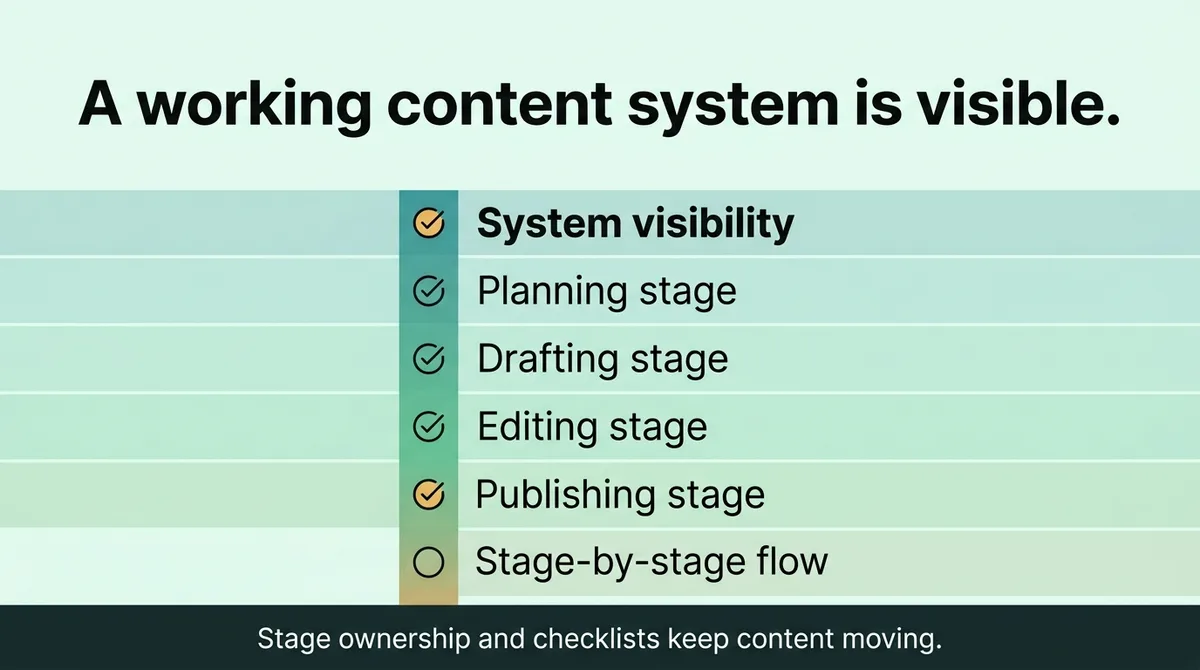
At planning, every topic has a brief with five fields completed and one name attached. At drafting, the writer has everything they need before they open a document. At editing, two reviewers have a deadline and a scope. At publishing, one person has a checklist and the authority to execute it.
The Stage-Gate Production System does not depend on everyone being fast. It depends on everyone knowing what they are responsible for and when to hand off.
Run this diagnostic once: pick the last article that shipped late. Find the stage where it sat the longest. Name the person who should have moved it. If you cannot name that person, you found your gap. Fix that one gap first. One gate, one owner, one condition.
References and Citations
[1]https://www.spscommerce.com/community/articles/how-to-combat-production-delays-with-a-supply-chain-solution
FAQ
Content production keeps getting delayed because no one owns the handoff between stages, not because individual contributors are too slow. A writer can finish a draft, an editor may not know it is ready, and a publisher may not know it has been approved, so the content simply sits. The breakdown is a coordination architecture problem: each stage can function well in isolation while the overall system still fails to ship on time.
A Stage-Gate Production System is a workflow model where no piece of content advances from one stage to the next until it meets a defined, written condition. Each gate, such as brief approved, draft reviewed, edits resolved, or publish confirmed, must be explicitly cleared before the next owner takes action. This removes invisible queues and blind handoffs, which are the two failure patterns responsible for most content delays.
You fix content production delays by adding structure to your workflow, not headcount: standardize the brief template at planning, cap the review cycle at two named reviewers with a set deadline, and assign one person who owns the publish checklist and executes it. A two-person team with defined stage ownership will outpublish an eight-person team with no handoff system. Platforms like Zelitho are built around this logic, connecting topic selection, drafting, editing, and CMS publishing inside one system so the handoff gaps that cause delays are removed by default.
A content brief that prevents rewrites and delays must include five fields before drafting begins: target keyword, intended audience, key argument, reference sources, and word count range. If any field is blank, the topic should not move to drafting, because a writer who starts without a complete brief is guessing, and guessing produces drafts that require extra revision cycles. Zelitho enforces this gate by requiring title and scope confirmation before its research-backed draft generation begins, which removes the first invisible queue in a typical production workflow.
Missing a single publishing slot on a bi-weekly content schedule typically adds four weeks to the live date of an article. That single missed handoff creates a ranking delay, a campaign gap, and a late client deliverable, none of which are visible until the deadline has already passed. The fix is assigning one named owner to the final publish action with a defined checklist, so the piece goes live on schedule rather than waiting for someone to realize it is their job.