
How to Manage an SEO Blog Backlog

TL;DR
You open the backlog spreadsheet on a Tuesday morning. There are 87 rows. Some have keywords, some have vague titles, some are just questions someone typed into a Slack thread. Nothing has a clear next step. The blog has not shipped in six weeks.
The common fix is to add more rows. A tool, a freelancer, a ChatGPT session. More ideas land. Publishing still stalls. The backlog grows denser and less useful at the same time.
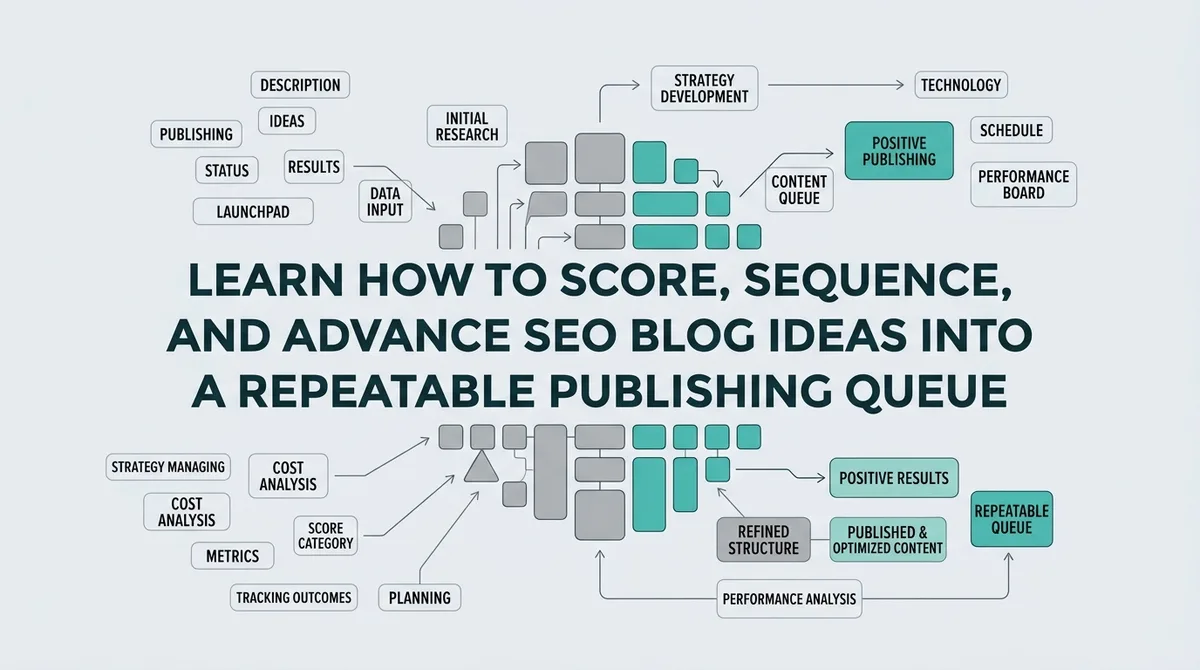
The actual fix separates three steps that most teams collapse into one: capture, score, and sequence. Capture accepts everything without judgment. Scoring assigns real rank based on search volume, difficulty, and business value. Sequencing matches topic priority to where the site sits in its authority growth cycle. This guide is written for content leads and agency operators who need publishing to run without weekly triage arguments.
Why Your Backlog Feels Endless but Your Publishing Queue Stays Empty
The false assumption most teams carry: more topics in the backlog means more publishing momentum.
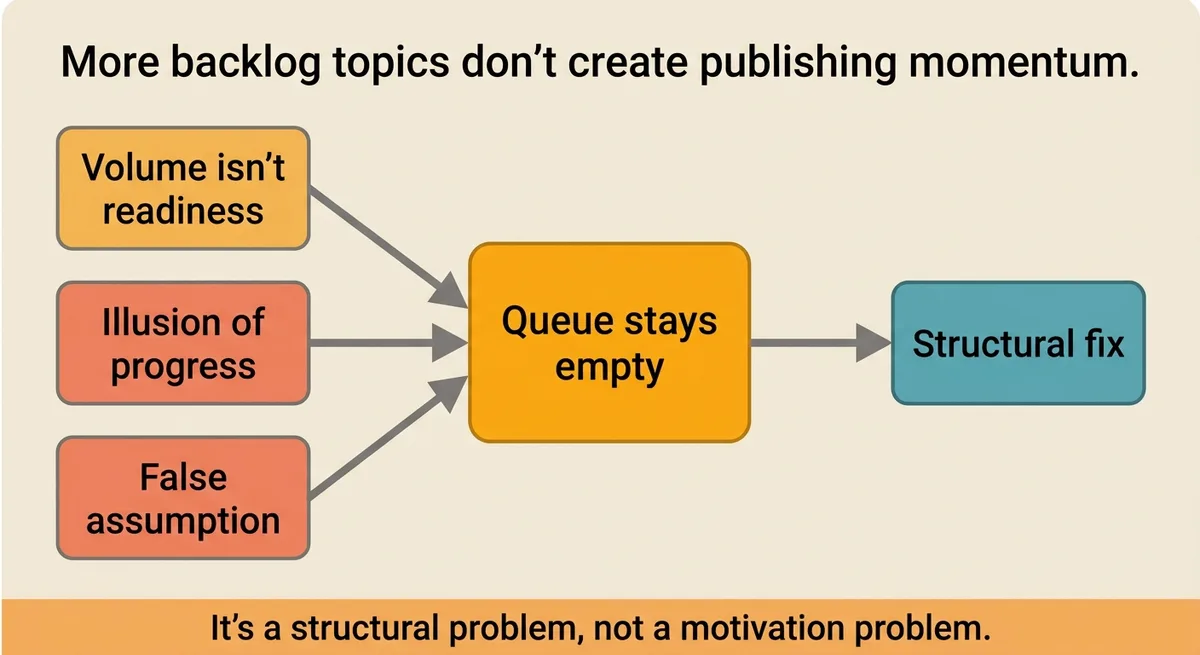
It does not. Volume is not readiness.
A backlog with 80 unscored ideas produces the same output as a backlog with eight: zero, until someone makes a hard call about what to write first. The pile creates the illusion of forward motion. The queue stays empty because no idea has been formally chosen, assigned, and moved.
This is a structural problem, not a motivation problem. Idea capture and topic selection are two different operations. Most teams run them simultaneously, which means every time someone opens the backlog, they face both tasks at once. They get stuck and close the tab.
One sign this is happening: your backlog has topics from four months ago that are still “under consideration.” Another sign is when the team debates the same three post ideas in every planning meeting without resolution. The conversation loops because no scoring criteria exist to break the tie.
Some teams try to solve this with publishing pace. Publishing three to four posts per week sounds like a forcing function, but a high posting pace without a scored queue just burns through budget on lower-priority topics [1]. You ship faster and still miss the posts that would have compounded.
Stop treating the backlog as a publishing plan. Start treating it as a holding area that requires a separate, scheduled scoring session before anything moves.
How to Organize and Score Every Topic So the Best One Always Rises
Scoring a topic is not a subjective process. It runs on four inputs: estimated monthly search volume, keyword difficulty, business value to your company, and execution readiness right now.
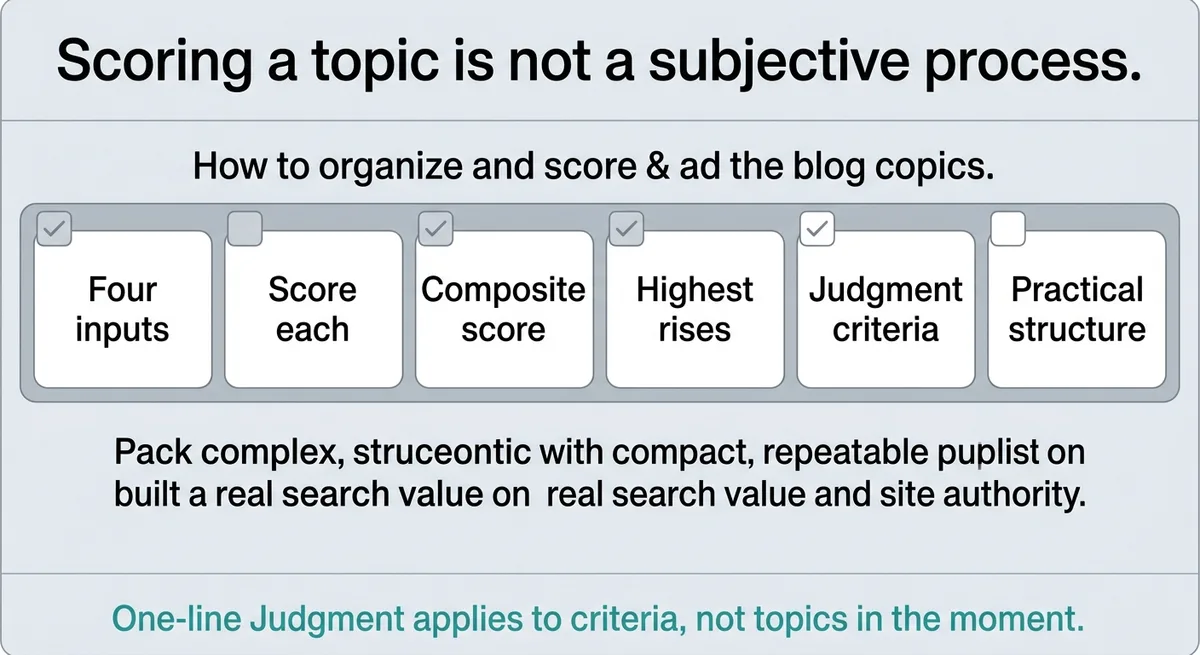
Each input gets a number. The topic with the highest composite score moves first. Judgment still applies, but it applies to the scoring criteria, not to individual topics in the moment.
Here is a practical scoring structure:
Input | What to Measure | Score Range |
|---|---|---|
Search Volume | Monthly searches for the primary keyword | 1 (under 100) to 5 (over 5,000) |
Keyword Difficulty | KD score from your SEO tool | 5 (under 20) to 1 (over 60) |
Business Value | Direct tie to a product, service, or conversion | 1 (informational only) to 5 (direct revenue path) |
Execution Readiness | Brief written, SME available, format decided | 1 (idea only) to 5 (ready to assign) |
Add the four scores. Topics with the highest totals go to the top of the production queue. Topics below a threshold go back to the holding area, not the queue.
Keyword difficulty deserves more weight than most teams give it. A 5,000-volume keyword at difficulty 70 will not rank for a site with a domain rating under 30 [1]. Scoring it high on volume alone puts it in the queue prematurely. The post gets written, published, and sits on page four for a year. Time spent, result: nothing.
Execution readiness matters just as much. A perfectly scored topic with no brief, no assigned writer, and no confirmed expert review will stall in production exactly the same way it stalled in the backlog. Score readiness honestly. If the topic needs three more prep steps before a writer can start, its readiness score is a one.
For example, imagine a content lead at a 40-person SaaS company with 60 backlog items scored only by keyword volume. She assigns the highest-volume topic to a freelancer. The brief takes two weeks to write. The SME review takes another two weeks. The post ships five weeks after assignment. If she had scored execution readiness, she would have seen that a topic with lower volume but a finished brief and a willing SME could have shipped in eight days.
Run the scoring session once a month. It takes 90 minutes for a backlog of 50 to 100 items. The output is a ranked list, not a debate.
The Stage of Your Site Determines What Gets Published First, Not Just Search Volume
A common mistake: treating all topics as equally available regardless of domain authority.
A new site with low authority and six months of publishing history cannot compete for the same keywords as a site with three years of consistent output and strong backlinks. Publishing a high-difficulty conversion topic early does not just fail to rank. It wastes a post slot that could have built the foundational trust that makes later posts rank faster.
Site authority moves through recognizable phases [1]. Early-stage sites need trust-building content first. That means low-difficulty topics, specific questions with clear answers, and content where thin competition means a modest domain can still appear on page one. These posts build crawl coverage and begin establishing topical relevance before pushing into competitive territory.
Around three to six months into a serious content effort, a second phase becomes available [1]. Traffic starts arriving from early posts. You now have data on which topics your audience actually reads. This is when you expand into adjacent keywords, build internal linking structure, and start targeting mid-difficulty terms. Publishing conversion-adjacent content here makes sense when difficulty scores are manageable.
The traffic-building work in this phase may run six to twelve months before the site generates consistent organic pull [1]. Teams that skip this phase and publish bottom-of-funnel content early often find that those posts stay invisible. The conversion content exists, but no one finds it because the site has not earned enough authority to surface it.
Conversion-focused posts, the ones tied directly to trials, demos, pricing comparisons, and product-specific use cases, should come after at least one year of consistent publishing [1]. This does not mean waiting forever. It means sequencing correctly so that the post has a realistic chance of ranking when it goes live, rather than sitting dormant.
This changes how you use the scoring table from the previous section. A topic might score high on business value and search volume. If the site is in month three of its content effort and the difficulty score is 55, that topic belongs in the backlog, not the queue. Hold it. Return to it in month twelve.
Stop building your queue based purely on what you want to rank for. Start building it based on what your site can actually compete for right now.
How to Move Prioritized Topics Into a Repeatable Production Workflow
Scoring gets topics ranked. A production pipeline gets them published.
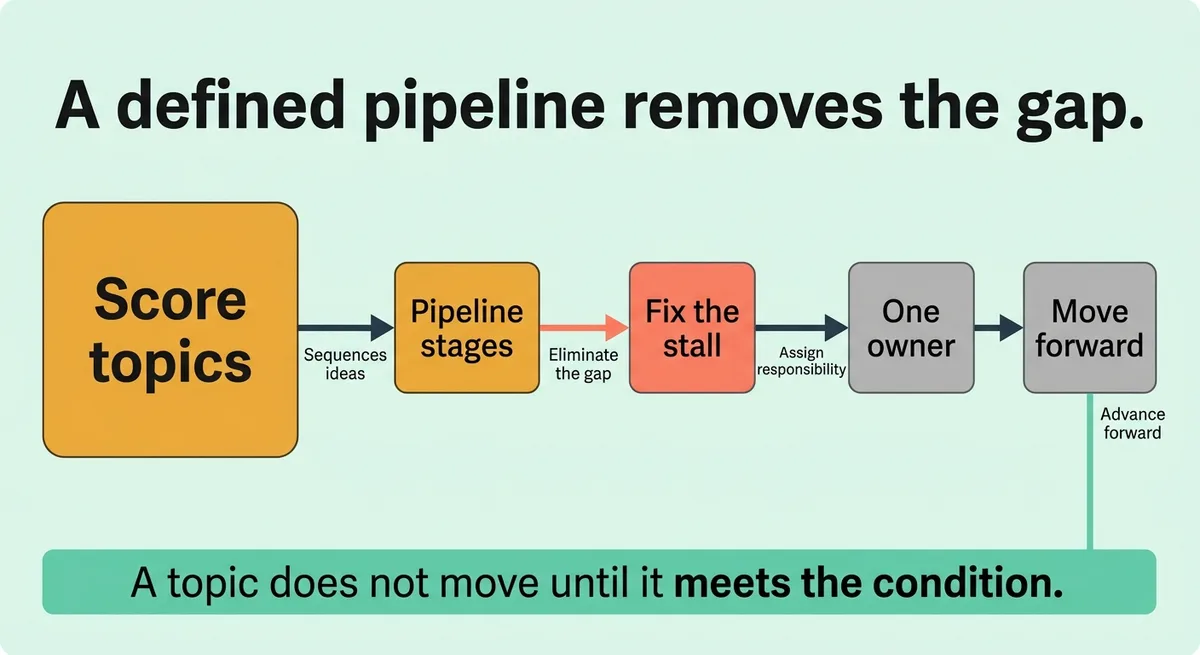
Most stalls happen between “topic selected” and “brief assigned.” Someone assumes someone else is handling the next step. No one is. The post sits in a “selected” column for three weeks and then gets re-discussed at the next planning meeting.
A defined pipeline eliminates that gap. Each stage has one owner and one exit condition. A topic does not move to the next stage until it meets the condition. There is no ambiguity.
A minimal pipeline looks like this:
Stage | Owner | Exit Condition |
|---|---|---|
Scored and selected | Content lead | Composite score meets threshold, stage of site confirmed |
Brief written | Content lead or strategist | Brief covers angle, target keyword, outline, and CTA |
Writer assigned | Project manager | Writer confirmed, deadline set in writing |
Draft received | Editor | Draft submitted by deadline |
Edited and approved | Editor | Final copy approved, no open comments |
Published and distributed | Content lead | Live URL confirmed, shared in at least one channel |
Six stages. Six owners. Six exit conditions. A topic that sits in any stage for more than five business days without movement gets flagged in weekly triage.
Weekly triage is not a creative meeting. It is a ten-minute status check. What advanced this week? What is stuck? What is the one next action to unstick it? That is the entire agenda.
The goal is throughput, not volume. One post that completes all six stages in twelve days is worth more than four posts that clear stage two and stall. A site that has published tens of thousands of readers’ worth of useful, well-executed content over more than ten years did not do it through bursts. It did it through consistent pipeline management [1].
Publishing consistency also compounds in a specific way. Each post that ships on cadence builds internal linking opportunities for the next one. Each post that ranks brings crawl signal that raises the probability of adjacent posts ranking. The pipeline is not administrative overhead. It is what makes earlier content investments pay off.
One implementation note: do not build the pipeline inside the same spreadsheet as the backlog. When idea capture, scoring, and production status live in the same document, every cell feels equally actionable. Separate the tools or at minimum separate the tabs with strict rules about what lives where. Ideas go into capture. Scored topics go into the priority list. Active posts go into the production tracker. Mixing them is how the blank-page paralysis returns.
What to do the week your backlog finally makes sense
Run the scoring session this week. Not next sprint. This week.
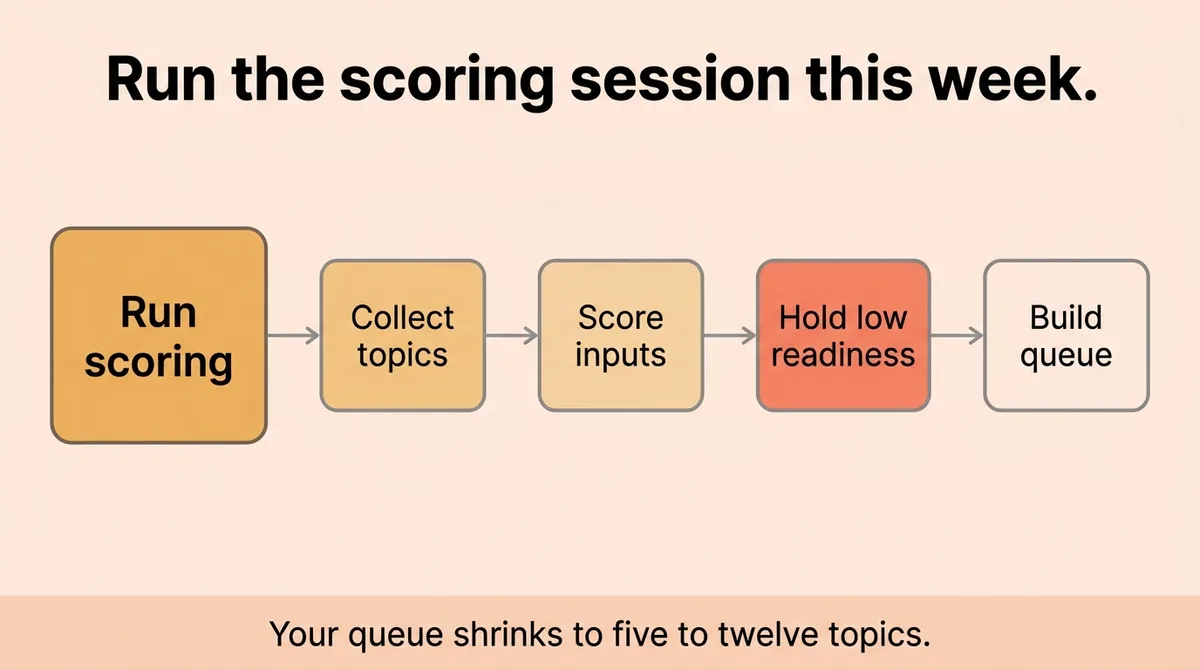
Pull every topic out of wherever they live: the spreadsheet, the Notion page, the Slack thread, the document titled “Content ideas v3 FINAL.” Paste them into one list. Score each one on the four inputs. Flag anything with an execution readiness score below three and move it to a separate holding list.
What remains is your actual queue. It will probably have five to twelve topics, not eighty. That is correct. Those are the posts your site can win, your team can execute, and your audience will find.
Assign the top-scored topic to a writer before the week ends. Write the brief yourself if one does not exist. Set a deadline.
Set a standing 30-minute scoring session for the first Monday of each month. New ideas accumulate in the capture list during the month. They get scored at that session. The queue replenishes automatically.
The backlog stops being a source of friction the moment it has a clear rule for what moves and what waits. Publish the next post. Update the tracker.
References and Citations
[1]https://www.heavybit.com/library/article/content-seo-founders-guide
FAQ
Score every topic on four inputs: estimated monthly search volume (1 to 5), keyword difficulty (5 to 1, inverted so harder keywords score lower), business value (1 to 5 based on proximity to revenue), and execution readiness (1 to 5 based on whether a brief, SME, and format are confirmed). Add the four numbers together and rank topics by composite score, moving only those above a set threshold into the active production queue. This removes the subjective debate that stalls most planning meetings and makes the highest-value, most executable topic obvious every time you run the session.
A large backlog does not produce publishing momentum because volume is not readiness: a backlog with 80 unscored ideas produces the same output as one with eight until someone makes a hard decision about what to write first. The real problem is structural: idea capture and topic selection are two different operations, and most teams run them simultaneously, so every time someone opens the backlog they face both tasks at once and end up closing the tab. Separating capture, scoring, and sequencing into distinct scheduled steps breaks the loop.
Your site’s domain authority should directly control which difficulty tier of topics enters your active queue: a site with a domain rating under 30 cannot realistically rank a keyword with a difficulty score above 60, regardless of how high that keyword scores on volume or business value. Early-stage sites should prioritize low-difficulty, specific-answer topics that build crawl coverage and topical relevance first. Conversion-focused content tied to demos, pricing, and product comparisons should be sequenced after at least one year of consistent publishing, when the site has enough authority to surface those posts competitively.
A repeatable blog production pipeline has six stages, each with a single owner and a defined exit condition: topic scored and selected, brief written, writer assigned, draft received, edited and approved, and published and distributed. No topic advances to the next stage until its exit condition is met, and any topic stuck for more than five business days gets flagged in a ten-minute weekly triage call focused only on what advanced and what is blocked. Platforms like Zelitho are built to compress several of these stages, connecting keyword selection, brief-level scoping, draft generation, and CMS publishing into one workflow so small teams do not manage the handoffs manually.
A backlog scoring session should run once a month and takes roughly 90 minutes for a list of 50 to 100 topics. The output is a ranked list of topics ready to enter production, not a debate: ideas accumulate in a capture list throughout the month and get evaluated in that single scheduled block. Teams using Zelitho can reduce this overhead further because keyword discovery, topic clustering, and title confirmation are already structured inside the platform, so the scoring session starts from organized, search-grounded inputs rather than a raw Slack thread.