
How to Create Effective Blog Posts, A Practical Guide to Planning and Writing Content

TL;DR
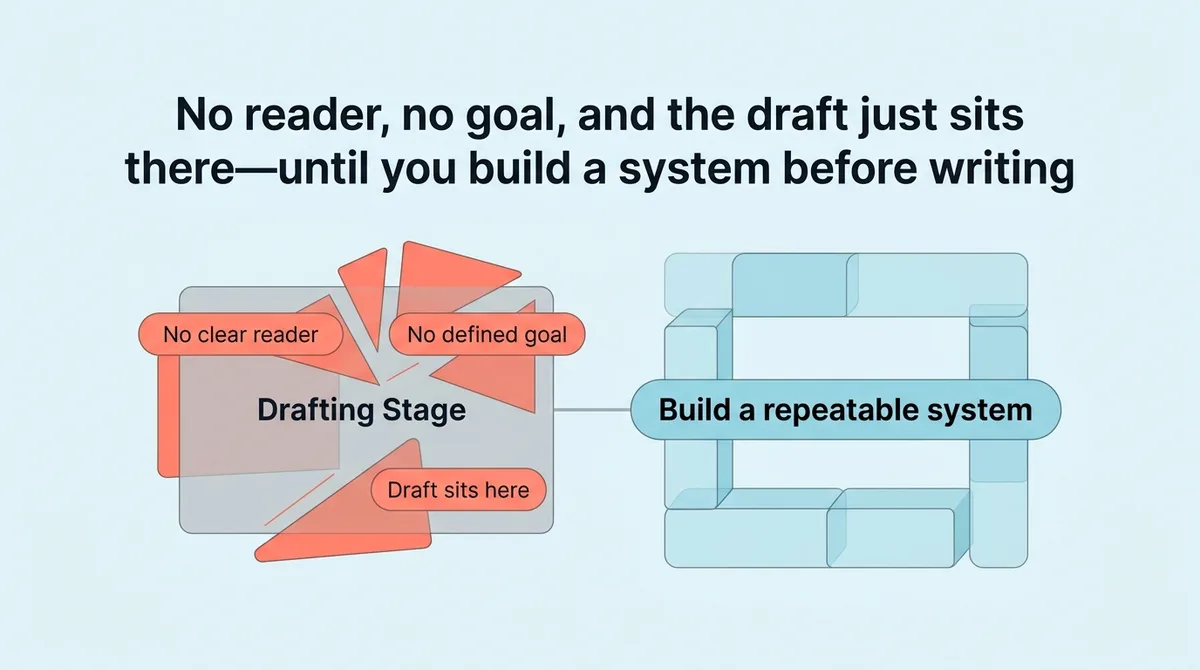
You open a Google Doc, paste a ChatGPT draft, and realize the post has no clear reader and no defined goal. The draft sits in a shared folder for three weeks. That is the real friction: not writing, but the absence of a system before writing starts.
Most content advice skips directly to headline formulas and word counts. That skips the decisions that determine whether a post reaches anyone or just fills a URL. Posts written without a defined reader and a tied goal produce traffic from the wrong audience, or no traffic at all.
This guide presents the Plan-Build-Ship Workflow, a three-phase process for setting goals, selecting topics through research signals, and producing posts through a repeatable structure. It is built for content leads and agency operators who need consistent output without restarting from scratch each time.
What does it actually take to write a blog post that works?
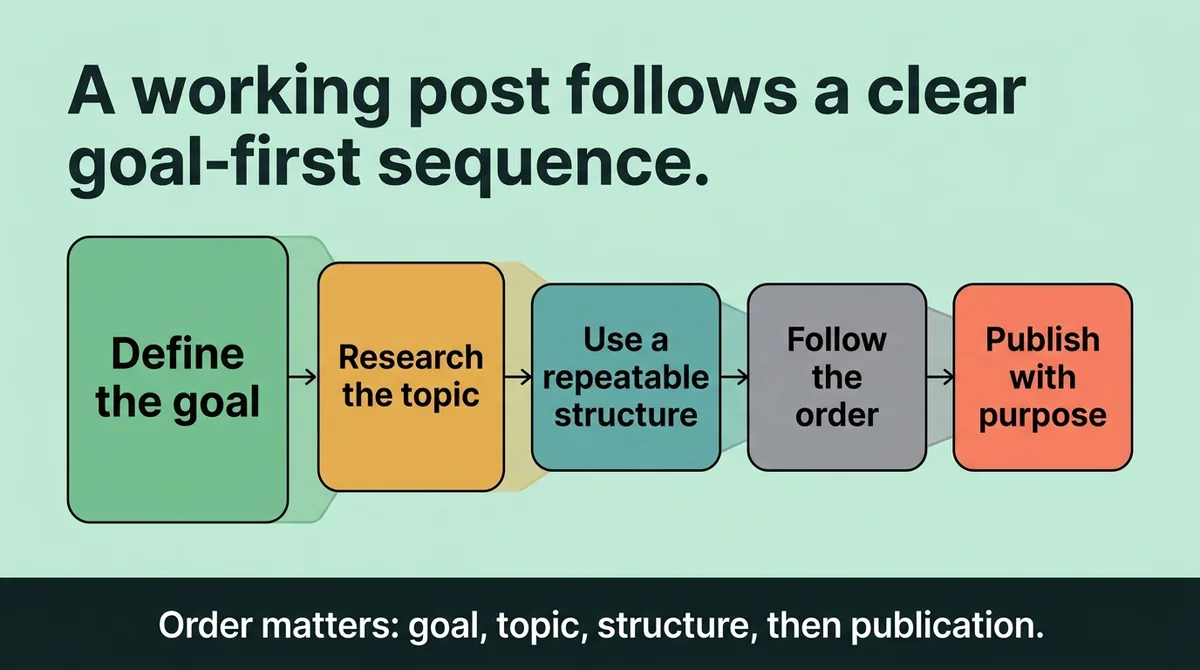
Writing a post that works requires three things done in a specific order: a defined goal, a researched topic matched to that goal, and a repeatable structure that moves the draft into publication. Skip the order and you produce content that is technically finished but functionally useless.
Start With a Goal and a Reader, Not a Topic
Here is the false assumption that breaks most content programs: a topic is a starting point.
A topic is not a starting point. A goal is.
When a content lead opens a blank document without a goal attached to that post, every decision from that point forward is a guess. The headline guesses at what the reader wants. The sections guess at what they need. The call to action guesses at what happens next. Guesses compound, and the post ends up serving no one clearly.
Before choosing any subject, write one sentence that names the goal and one sentence that names the reader. That is the entire pre-work requirement. Two sentences.
Content goals sort into five broad categories: awareness and visibility, engagement and lead generation, education, sales and conversions, and community [2]. Within those, the specifics differ by stage. Awareness goals might include reaching a new audience segment or getting picked up by a niche publication [2]. Sales goals might include reducing objection frequency or accelerating a trial conversion [2]. Pick one. One post cannot serve all five.
The reader description follows from the goal. If the goal is to reduce objection frequency during a sales call, the reader is someone already considering a purchase, not someone discovering the category for the first time. That distinction changes the post’s opening sentence, its assumed knowledge level, and the examples it uses.
Stop writing for “your audience.” Start writing for the person most likely to act on the goal you just named.
Every post should carry one defined reader and one defined goal before a single heading gets written. That constraint makes every later decision faster. Structural choices, tone, depth, and length all resolve from those two inputs.
You Are Probably Picking Topics the Wrong Way
Most topic selection happens through one of three methods: a team brainstorm, a competitor’s blog, or someone’s instinct about what feels relevant. All three share the same flaw. None of them verify that a real reader is actively looking for that content.
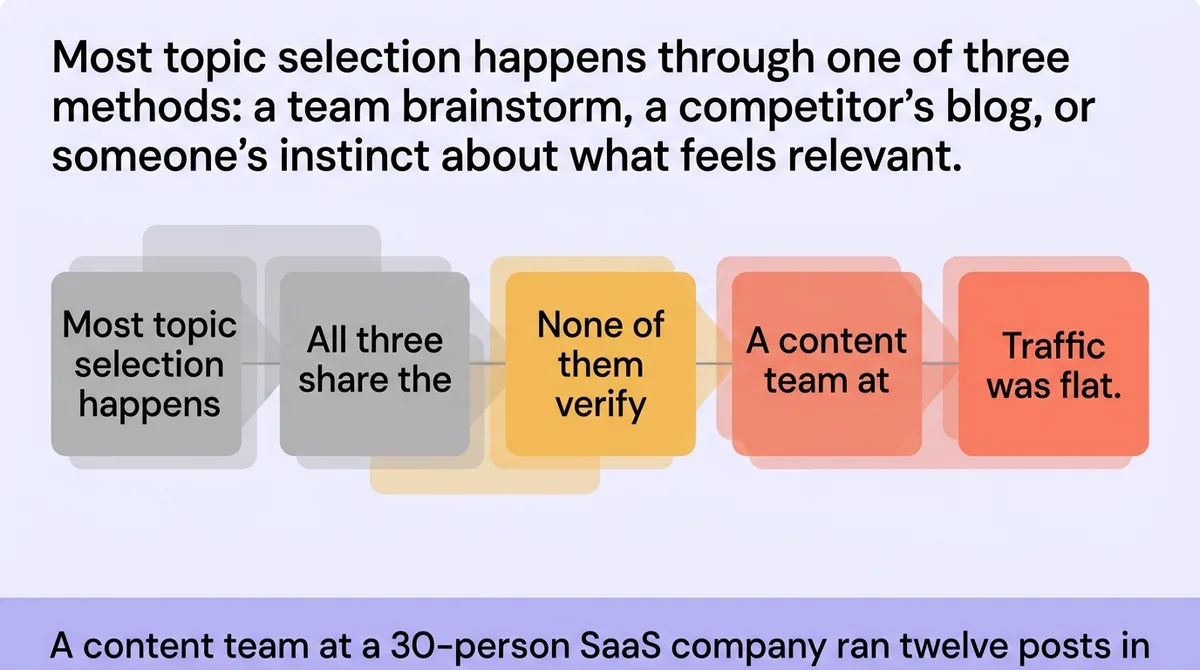
A content team at a 30-person SaaS company ran twelve posts in a quarter based on internal brainstorms. Traffic was flat. When they mapped the same topics against actual search queries and customer support tickets, nine of the twelve topics had no measurable search signal. Those nine topics also matched no question their customers had submitted in the prior six months. They replaced three posts with topic selections drawn from support tickets and sales call recordings. Those three posts drove more organic visits in the next quarter than the previous nine combined.
That pattern repeats because brainstorms produce what the team finds interesting, not what the reader is searching for.
A research-led selection method works differently. It starts with two pillar topics, the two subjects your business has the most legitimate authority to address [2]. From each pillar, you build out 20 or more specific cluster ideas, each tied to a real search query, a customer question, or a defined pain stage [2]. The strategy involves at least three planning areas before any implementation: goals and KPIs, audience research, and SEO analysis [4]. Each of those feeds topic selection rather than replacing it.
Eight steps form a complete content strategy, and topic selection sits in the middle, not at the start [4]. Goal-setting and audience mapping come first. Topics selected without those inputs tend to be generic.
Search intent adds one more filter. A post targeting someone who wants to compare two tools requires different content than a post targeting someone building a system from scratch. Both might share a keyword. The reader’s intent is different, and intent determines structure.
Selection Method | Signal Source | Risk |
|---|---|---|
Brainstorm | Team preference | No reader validation |
Competitor copy | Their audience, not yours | Lagging, not leading |
Research-led | Search queries, support tickets, sales calls | Requires 2–3 hours upfront |
The research-led method takes more time at the front. It saves two to four weeks of writing time later because it eliminates topics that were never going to serve the goal you defined in phase one.
Build a Post Structure That Can Repeat, Not Just Publish Once
A one-off post structure is a liability. Every new post becomes a new project. Each new project requires the same decisions: how many sections, what order, what depth, what format for the call to action. That decision load is where drafts stall.
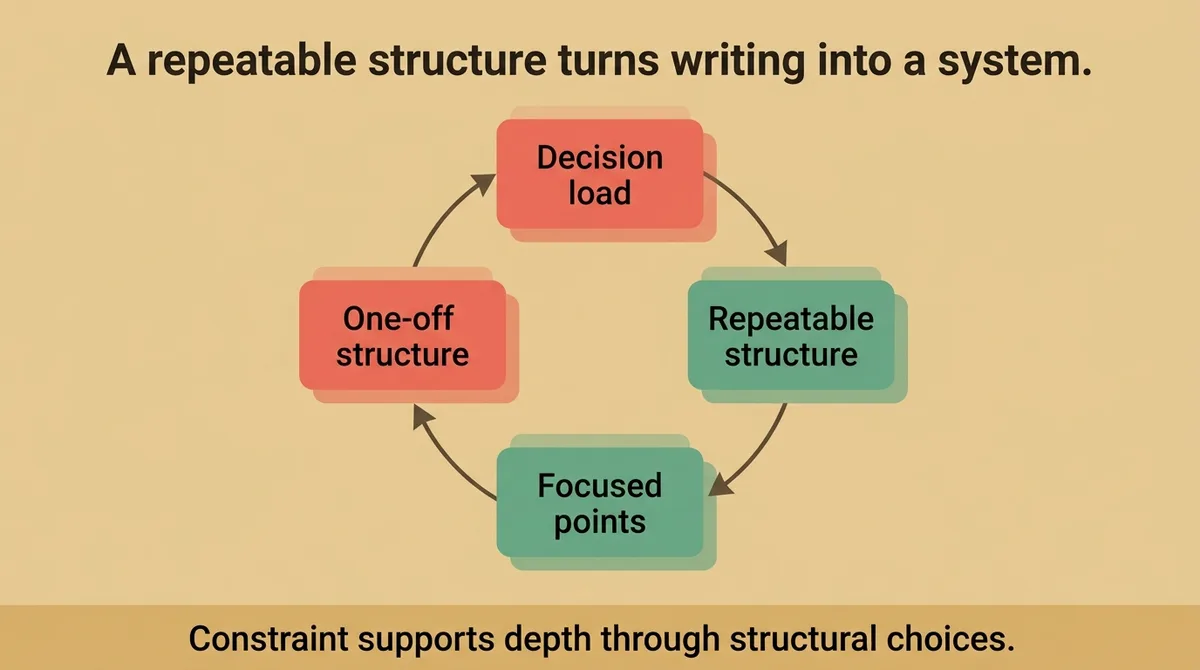
A repeatable post structure removes those decisions from the writing stage entirely.
Effective posts make two or three focused points, not seven [1]. That constraint is not a limitation on depth. It is a structural decision that forces the writer to identify what matters most rather than listing everything that could be said. Headlines that work run to ten words or fewer [1]. Shorter headlines force the same discipline: one idea, clearly named.
Build your standard post template around those two constraints. A standard post template has five parts: a goal statement, one reader description, a headline, two to three sections with defined purposes, and a single action. That template applies to every post in the queue. Writers fill in the parts. The structure stays constant.
The publishing cadence can be weekly, biweekly, or monthly depending on team capacity [4]. Cadence consistency matters more than cadence frequency. A team that publishes reliably twice per month outperforms a team that publishes six posts in January and one in March. Readers and search indexes both respond to regularity.
A production checklist connects the draft stage to the publication step. The checklist does not need to be complex. Six items cover the critical path: goal confirmed, reader confirmed, headline under ten words, focused on two to three points, internal links added, and CTA matches the goal. When the checklist is complete, the post is ready. When it is not complete, the post is not ready. That binary removes the subjective loop of “almost done.”
The publication channel affects format decisions. A post going to an email newsletter first has different structural requirements than one published directly to a blog [4]. Name the channel in the template so format decisions get made at the planning stage, not after the draft is written.
The Part Most Guides Skip: Connecting Your Outline to an Operational Workflow
An outline is not a workflow. An outline is a document. A workflow is the system that moves that document through drafting, review, and publication without losing days between each step.
Most content teams have the outline. They do not have the workflow. That gap is where posts go to stall.
The editorial calendar is the bridge. A functional editorial calendar tracks six elements for every post in the queue: topic and theme, title, author, format, publication channel, and estimated publish date [4]. When those six fields are filled, the post has an owner, a deadline, and a destination. When any of those fields are empty, the post has none of those things and will not ship on schedule.
Connecting the outline to the calendar happens at the moment the outline is approved, not after the draft is written. The moment an outline clears review, it gets assigned an author, a format, a channel, and a publish date. That assignment moves it from a planning artifact into a production commitment.
Content channels for a given program might include blog posts, email newsletters, webinars, and white papers [4]. Each channel has its own lead time. A white paper needs more review cycles than a blog post. A webinar needs promotional lead time that a blog post does not. The calendar accounts for those differences at the assignment stage.
One implementation caveat most guides omit: the editorial calendar is not the place to decide whether a topic is good. Topic quality is decided during research. The calendar is only a scheduling tool. When teams use the calendar to debate topics, scheduling collapses and posts stack up as drafts waiting for a decision that should have been made two phases earlier.
The Plan-Build-Ship Workflow resolves that confusion by keeping decisions in their correct phase. Planning decisions happen in phase one and two. Production decisions happen in phase three. Mixing them produces the exact stall that most teams are trying to escape.
Stop treating each post as an independent project. Start treating every post as one unit in a repeatable production system. The system carries the momentum, not the individual post.
From Blank Page to Published Post Without Starting Over
The Plan-Build-Ship Workflow is a three-phase system: set a goal tied to one reader, select a topic using research signals, then produce and publish through a repeatable structure with a functioning editorial calendar.
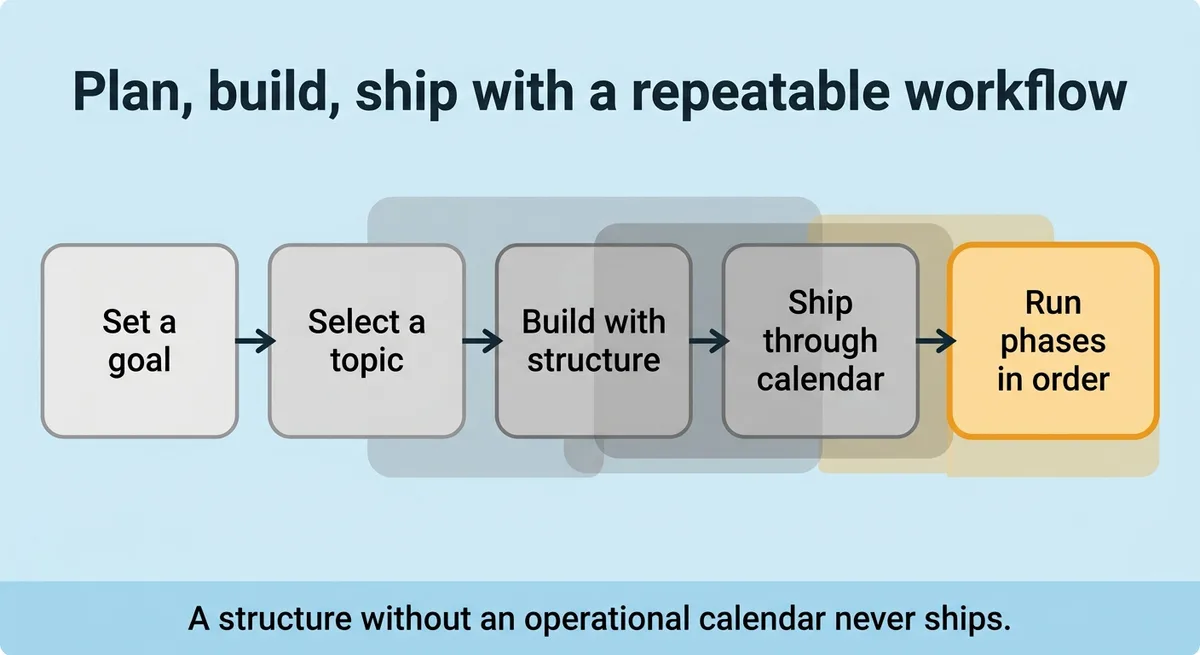
Each phase feeds the next. A goal without a researched topic stays abstract. A researched topic without a repeatable structure produces one-off posts that exhaust the team. A structure without an operational calendar produces finished outlines that never ship.
Run the phases in order. Use the production checklist before marking any post as ready. Fill all six calendar fields before assigning a draft. Keep topic quality decisions out of the scheduling stage.
The blank page is not the problem. The missing system before it is.
Build the system once. Every post after that runs through it.
References and Citations
[1]https://writing.wisc.edu/handbook/writingblogpost/
[2]https://susannagebauer.com/blog/content-creation/
[3]https://www.meltwater.com/en/blog/content-creation
[4]https://nytlicensing.com/latest/methods/how-create-successful-blog-content-strategy/
FAQ
Before writing a single heading, you need two things confirmed: a defined goal tied to a specific business outcome, and a one-sentence description of the exact reader most likely to act on that goal. Those two inputs determine the post’s assumed knowledge level, tone, depth, and call to action, so every structural decision that follows becomes faster and less arbitrary. Skipping this pre-work is why most drafts stall or produce traffic from the wrong audience.
Content teams get no traffic when they select topics through internal brainstorms or competitor copying rather than verified reader signals like search queries, support tickets, or sales call recordings. One documented case shows a SaaS team ran twelve posts in a quarter based on brainstorms and found nine of them had no measurable search signal and matched no customer question from the prior six months. The deeper cause is a missing system: goal-setting and audience research must come before topic selection, not after. Platforms like Zelitho address this directly by building clustered topic selection from keyword signals before any draft is generated, keeping the research phase in its correct position in the workflow.
A repeatable blog production workflow needs three phases run in order: goal and reader definition, research-led topic selection, and a structured production stage with a functioning editorial calendar. The editorial calendar must track six fields for every post, including topic, title, author, format, publication channel, and estimated publish date, so each post has an owner, a deadline, and a destination before drafting begins. A six-item production checklist, covering goal, reader, headline length, point focus, internal links, and CTA alignment, acts as the binary gate between draft and published. Zelitho is built around this kind of connected sequence, moving from keyword discovery through draft generation and on-page editing to direct CMS publishing inside one system rather than across separate tools and handoffs.
Research-led topic selection starts with two pillar topics your business has genuine authority to address, then builds out 20 or more cluster ideas tied to real search queries, customer questions, or defined pain stages. Brainstorms and competitor blog copying both fail the same test: neither confirms that a real reader is actively searching for that content. The correct sequence places goal-setting and audience mapping before topic selection, so topics emerge from reader signals rather than team preference.
An outline is a document; a workflow is the system that moves that document through drafting, review, and publication without losing days between each step. Most content teams have outlines but no workflow, which is exactly where posts stall as drafts waiting for decisions that should have been made earlier in the process. A functional workflow connects the approved outline to a calendar assignment at the moment of approval, giving the post an author, format, channel, and publish date immediately. Zelitho closes this gap by treating topic selection, draft generation, editing, and CMS publishing as one connected process rather than separate handoffs across tools.