
How to Create and Implement an Effective SEO Content Plan Step-by-Step

TL;DR
You just got a piece of content ranking. Now you need a system that does it repeatedly, not a second lucky swing.
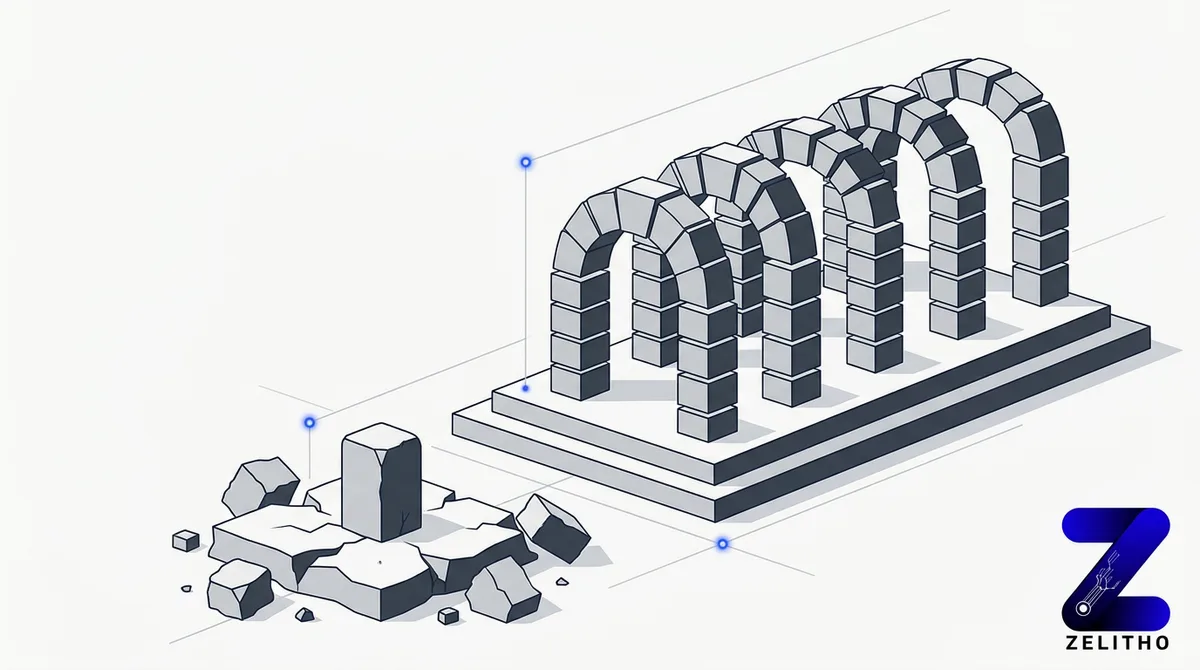
Most teams respond by producing more content faster. That move fails because volume without architecture creates competing pages, diluted authority, and writers guessing at scope. The content exists. The results do not compound.
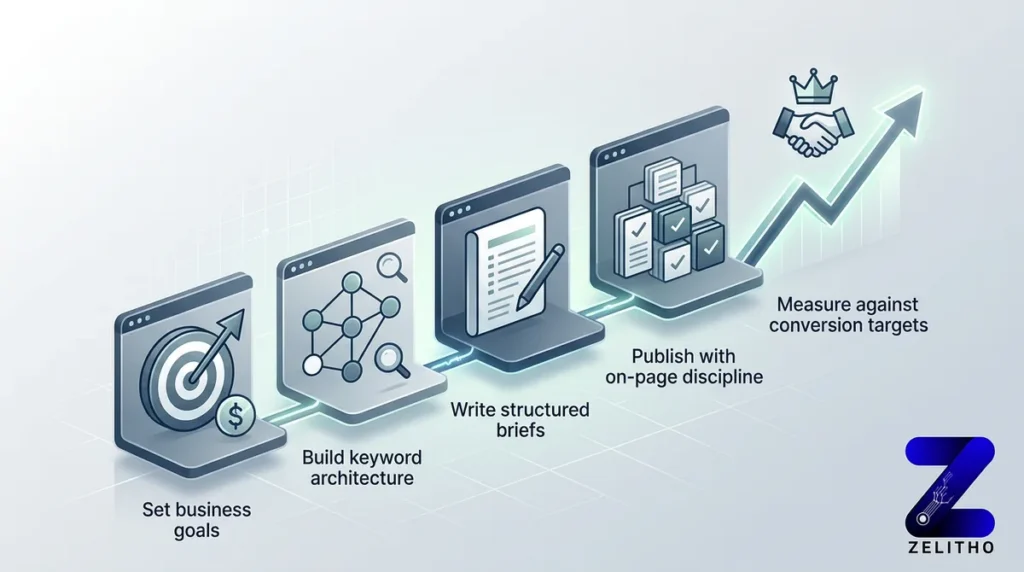
The ALIGN Framework is a five-phase system: set business goals, build keyword architecture, write structured briefs, publish with on-page discipline, and measure against conversion targets. Each phase feeds the next. Senior marketers at funded companies, founders scaling output, and agency owners managing multiple clients all benefit from running this as an operating rhythm, not a one-time sprint. Organic results take at least six months to surface. That timeline is fixed. The only variable is whether your process is ready when visibility arrives. [2]
What Does an Effective SEO Content Plan Actually Include?
An effective SEO content plan connects business goals to specific keyword targets, assigns ownership at each production stage, and sets a measurement cadence before the first piece is written. It is not a spreadsheet of keywords. It is a cross-functional system where strategy, production, and reporting share the same source of truth.
Why Most SEO Content Plans Break Before They Start (And What You’re Probably Getting Wrong)
You opened a keyword research tool, exported 200 terms, sorted by volume, and started assigning articles. That is not a plan. That is a queue.

The sting: most SEO programs stall not from bad keywords but from no defined owner, no connection to revenue, and no decision rule for when to stop waiting and when to pivot.
Here is the consequence in operational terms. A team that skips the planning phase and jumps to production typically rebuilds the strategy at month four. They lose the first four months to misaligned content. Then they lose another two to six months re-earning topical authority on the corrected path. That is six to ten months of compounding lost, not recovered.
Consider what that costs at scale. If your organic channel is targeting 500 qualified leads per month, every month of misalignment is 500 leads your paid channels have to cover at full cost. [2] That is not a performance issue. That is a planning tax.
68% of online experiences begin with a search engine. [3] That number means your buyers are actively looking. Your job is to be findable at the right moment with the right answer. A disconnected content queue does not accomplish that, even at high volume.
Stop assigning articles by volume rank. Start assigning by business outcome and buyer stage.
The real fracture point is ownership. Someone needs to own the keyword architecture. Someone else owns the brief. A third person owns the published result. When one person owns all three and also runs paid, social, and email, every phase gets partial attention. The plan breaks in the first sprint.
One more caveat that rarely gets named: if your site has technical issues (crawl blocks, slow page speed, duplicate title tags), no content plan survives them. Audit the technical baseline before you build the editorial calendar. Otherwise you are writing for pages that Google cannot process.
Phase 1–2 of the ALIGN Framework: Set Business Goals, Then Build Your Keyword Architecture Around Them
The ALIGN Framework starts with a question most teams skip: what does organic traffic need to do for the business?

Not “rank higher.” Not “get more traffic.” Specific outcomes: a 20% lift in organic traffic to the pricing page, or 500 qualified demo requests per month through inbound. [2][3] Those targets reverse-engineer the keyword strategy. Without them, you are selecting keywords with no filter for commercial relevance.
Phase 1: Goal Architecture
Write down two to three measurable organic goals before opening any research tool. Each goal needs a metric, a baseline, and a deadline. Example: increase organic-assisted pipeline from $0 to $80K per month within 12 months. That goal tells you which content categories matter, which buyer stages to prioritize, and which keywords to ignore even if they carry high volume.
Goal Type | Example Metric | Content Category It Drives |
|---|---|---|
Lead generation | 500 qualified leads per month | Bottom-funnel comparison, use-case pages |
Traffic growth | 20% lift in organic sessions | Top-funnel educational articles, glossary |
Conversion lift | 5% increase on demo page | Landing page optimization, intent-matched FAQs |
After the table: each row requires different keyword intent, different page structure, and different success signals. Mixing them without separation creates pages that rank but do not convert.
Phase 2: Keyword Architecture
Build a keyword map in three tiers. Tier one covers primary category terms with high commercial intent. Tier two covers supporting topics that qualify or educate the buyer. Tier three covers long-tail queries that answer specific objections or use cases.
Every tier maps back to a Phase 1 goal. If a keyword does not connect to a goal, it goes into a holding list, not the active plan. This filter alone removes 40% of the typical keyword export and saves dozens of production hours.
Assign a primary keyword and two to three secondary terms per page target. Avoid assigning the same primary keyword to two pages. That creates cannibalization where your own content competes against itself, splits authority, and leaves both pages ranking below their potential.
One case signal worth naming: a SaaS marketing team running on a 15-article-per-month cadence saw three of their core product terms cannibalized by blog posts written eight months earlier. They paused production for six weeks to consolidate and redirect. Traffic on those terms recovered within 90 days. The cost was 90 days of compounding growth delayed by a map that never existed.
Phase 3–4: Build Content Briefs That Actually Control Output Quality and Reduce Revision Cycles
A brief is not a title and a keyword. A brief is a document a writer can execute without asking a single clarifying question.
If your writers are emailing you to ask about tone, depth, or which competitor to reference, the brief failed. Every email is a revision cycle you paid for in advance.
Phase 3: Brief Construction
Each brief should run between 1,000 and 1,500 words. [1] That length covers: primary and secondary keyword targets, search intent classification, target word count for the finished article, required H2 structure, internal linking targets, competing pages to reference, and the specific business outcome the piece supports.
Keep title tags under 60 characters. [1] If your title exceeds that threshold, Google truncates it in search results. A truncated title loses the keyword signal you built the page around. Write the title tag inside the brief, not after publication.
Meta descriptions run 150 to 160 characters. [1] That window is enough to state the topic, name the outcome, and include a directional call to action. Write it inside the brief alongside the title tag. Leaving it to the writer or the CMS default means it gets skipped or auto-generated from the first sentence.
Phase 4: Quality Control Gates
Build a two-gate review process. Gate one is structural: does the piece follow the brief? Correct H2 order, primary keyword in the title and first 100 words, internal links in place, word count within 10% of target. Gate one takes 10 minutes. Any editor can run it with a checklist.
Gate two is editorial: does the piece answer the query better than the top three ranking pages? This gate requires a human judgment call. Someone must read the competing pages and identify what your piece adds. If it adds nothing, the piece is not ready to publish.
Teams that skip gate two publish content that technically follows the brief but adds no competitive advantage. Those pages rank below position 10 and stay there. The brief did its job. The editorial judgment did not.
One friend advice note: stop waiting for the perfect brief template. Start with a Google Doc, eight labeled sections, and a 30-minute kickoff with your first writer. Iterate from real production friction, not from a template you never finish building.
Phase 5: Implement, Measure, and Iterate Without Abandoning the Plan at Week Eight
Week eight is where most content plans die.
Traffic has not moved visibly. One article underperformed. A competitor published something similar. Someone in a leadership meeting asks why SEO is not working yet. And the team pivots.
SEO results typically take at least six months to become evident. [3] That is not a caveat. That is the operating window. Week eight is month two. You are measuring noise, not signal.
What to Measure and When
Set three measurement layers with separate review cadences.
Layer one is technical health, reviewed weekly: crawl errors, index coverage, page speed changes, broken internal links. These surface problems that prevent the plan from executing, not problems with the plan itself.
Layer two is content signal, reviewed monthly: keyword ranking movement on target terms, click-through rate from search results, time-on-page for new articles. Movement at month two means the page is being seen and processed. No movement at month two means a technical or quality issue, not a strategy failure.
Layer three is business outcome, reviewed quarterly: organic-assisted leads, demo requests, and pipeline influenced by organic entries. A 5% lift in conversion rate on an optimized landing page shows up here, not in weekly keyword reports. [2]
Avoiding the Premature Pivot
Build a decision rule before launch: the plan does not change direction until month six, unless a technical issue is confirmed. Ranking position, traffic volume, and click-through rate are not pivot triggers at month two. They are data points in a six-month model.
If leadership pressure forces an earlier review, present layer-one and layer-two data as leading indicators. Show keyword movement even without traffic payoff. Show index coverage improvements. Show brief completion rate and publishing velocity. Those numbers demonstrate execution quality before outcomes arrive.
One operational caveat: if you publish 20 pieces in month one and then nothing in months two and three, the algorithm does not wait for you. Publishing cadence is a signal. Inconsistent cadence produces inconsistent ranking behavior. Set a volume you can sustain every month, not a sprint you cannot repeat.
Link building belongs in this phase, not in a separate silo. Each published piece needs at least one internal link from a high-authority page already on your site. External links develop over time through outreach, digital PR, and cited content. Do not wait for external links before measuring. Internal linking structure is within your control from day one.
The ALIGN Framework Is Your Operating Rhythm
The ALIGN Framework is not a template you fill in once. It is the operating rhythm your team runs on every quarter. Businesses that connect each phase, from goal-setting through measurement, stop producing content that sits unread and start building an asset that compounds. Come back to the framework when priorities shift, when traffic plateaus, or when a new product line demands a fresh content push. The plan is only as durable as the process behind it.
Run phase reviews at the start of each quarter. Update the keyword map when product positioning changes. Retire briefs that no longer match buyer intent. The framework adapts. The structure holds.
Your next piece of rankable content starts with a goal written before a keyword is selected.
📌What Is Keyword Research? A Simple Definition and Why It Matters
Sources
[1]https://www.pageoptimizer.pro/blog/how-to-create-an-seo-content-brief-a-step-by-step-guide-for-high-impact-content
[2]https://monday.com/blog/marketing/seo-planning/
[3]https://www.score.org/resource/blog-post/how-build-seo-strategy-and-how-make-seo-plan