
What Is Keyword Research? A Simple Definition and Why It Matters


TL;DR
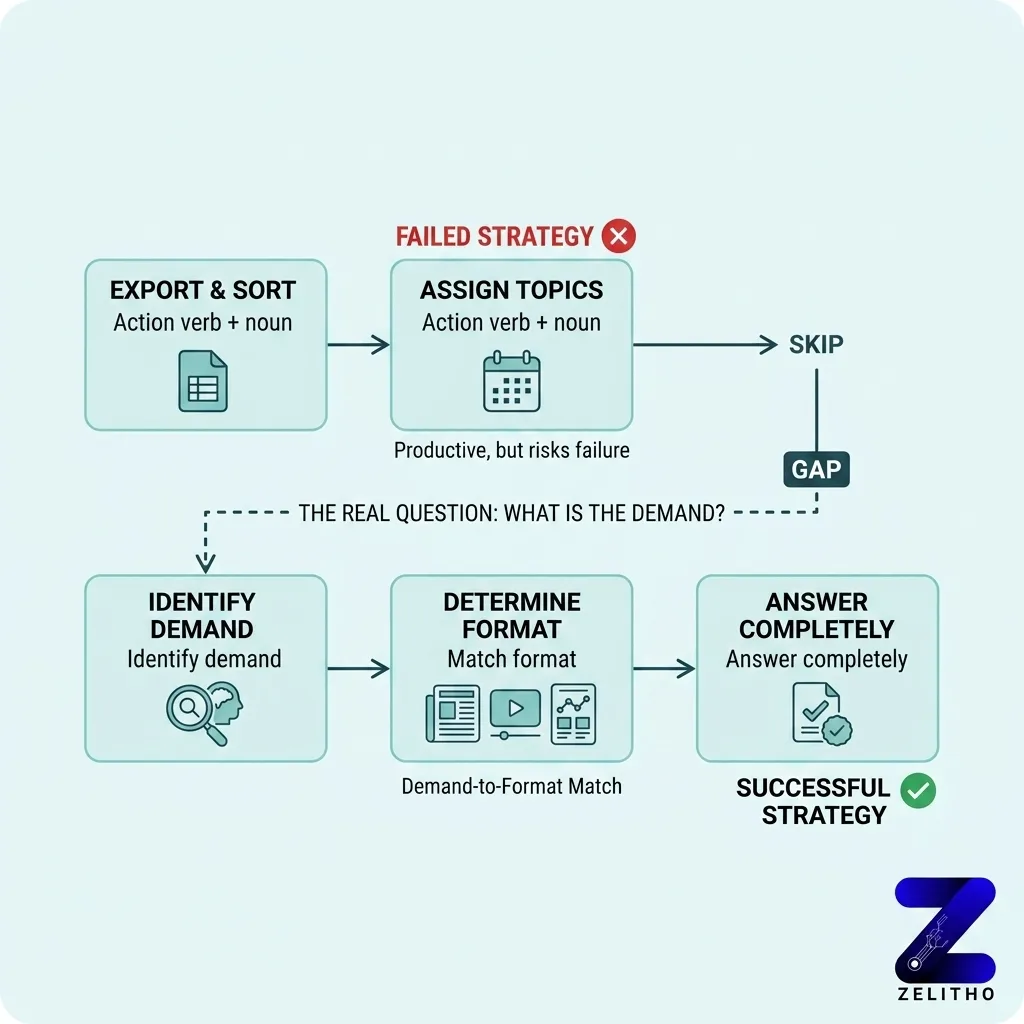
You exported a keyword list, sorted by volume, and started assigning topics to your content calendar. That process feels productive. It is also where most content strategies quietly fail.
Sorting by volume skips the actual question: what does this person need right now, and what type of answer will satisfy it? A keyword is a signal, not a brief. The word tells you what someone typed. It does not tell you what they came to find.
The Demand-to-Format Match is a three-step process that reads what Google has already confirmed about a term, identifies the pattern across top results, and maps the search to the correct page type before a single word gets written. Senior marketers, founders scaling content, and agency owners running content programs for clients all stop wasting build cycles when they apply this system to every keyword before acting on it.
What does keyword demand actually mean in SEO?
Keyword demand is the underlying need a search represents. It is not the word someone typed. A search term is the surface. Demand is the reason the search happened at all. When you identify demand correctly, you know what page to build, what format to use, and what question to answer completely.
The Keyword Is a Clue, Not the Answer
You are staring at a spreadsheet. Column A has the keyword. Column B has the volume. Column C has difficulty. Nothing in that sheet tells you what the person actually wants.
That is the gap most keyword guides skip entirely.
Take the term “running shoes.” One person typing that phrase wants to buy a pair today. Another is comparing cushioning types after a stress fracture. A third just started running and wants to know how shoes affect gait. Same two words. Completely different needs. Completely different pages required to satisfy each one.
Stop treating the keyword list as the deliverable.
The keyword is a clue. Your job is to decode what it signals. Demand is the underlying need a search represents. Not the vocabulary a searcher chose. Not the volume attached to that vocabulary. The specific situation, question, or decision that caused someone to open a search bar.
This article does not teach you how to pull data from a keyword tool. Those tools are fine for what they do. What they do not do is tell you what a person needs when they search. That interpretation is yours. Getting it right is what separates a page that converts from a page that collects impressions and produces nothing.
Every search has a person behind it. That person is in a specific moment. They have a specific expectation about what they will find. When the page you built matches that expectation, demand gets satisfied. When it does not match, the person leaves, and Google notices.
You Are Probably Targeting Keywords That No One Actually Needs Answered
Here is the uncomfortable part: a large portion of your current keyword targets may be structurally mismatched to what your content actually delivers.
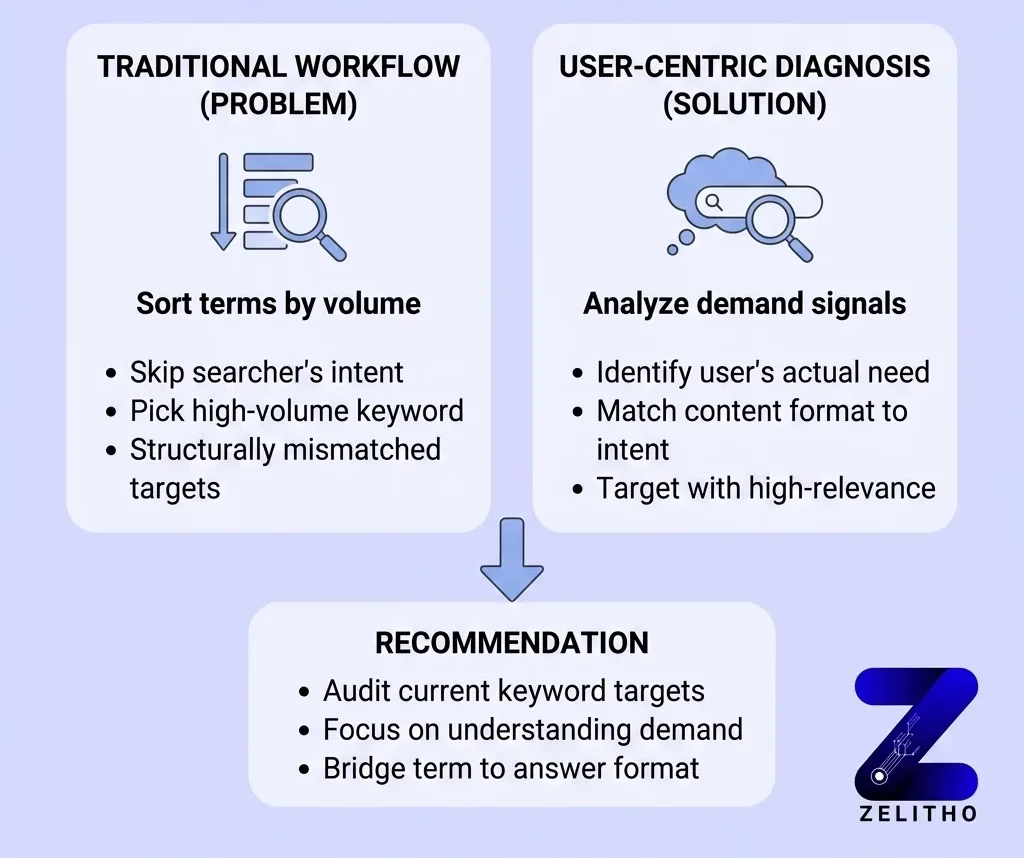
This is not a workflow problem. It is a diagnosis problem.
The specific mistake is choosing terms based on volume without checking what the searcher actually wants from that term. High volume does not mean high relevance to your content. It means a lot of people typed that phrase. What they wanted when they typed it is a separate question entirely.
Consider this scenario. A team spends six weeks producing a detailed, well-researched article targeting a broad, high-volume term. The content is genuinely good. It gets indexed, earns a few links, and briefly ranks on page two. Then it stalls. Traffic trickles in. No one converts. The team assumes the topic was too competitive.
The actual problem: the intent behind that term was navigational. Most people searching it already had a brand in mind. They were looking for a specific company, not an explanation. The article had no chance of satisfying that need, regardless of its quality.
Six weeks. No return.
That is the cost of skipping demand analysis. It is not abstract. It is measured in sprints, salaries, and publishing slots that produced no result.
Intent categories give you a practical filter before you commit to any term:
Informational: The searcher wants to learn. They have a question. They are not close to a purchase.
Navigational: The searcher has a destination. They are looking for a specific brand, tool, or page. Your content cannot intercept this demand unless you are that brand.
Commercial: The searcher is comparing options. They are close to a decision but not ready to act. They want a ranking, a review, or a side-by-side.
Transactional: The searcher is ready to act. They want to buy, sign up, or download now.
The same keyword root behaves differently across these types. “Email marketing” is informational. Someone wants to understand what it is. “Email marketing software for small business” is commercial. Someone is shortlisting tools. “Buy email marketing plan” is transactional. Someone has their credit card nearby.
Three phrases. Three completely different pages required. Build the wrong one and you satisfy no one.
Matching intent is not optional. It is the mechanism by which demand gets satisfied. A technically excellent page built for the wrong intent type will not convert, because it answers a question the searcher was not asking.
Understanding Demand Tells You What Page to Build, Not Just What to Write About
Once you know what someone actually needs, the content format stops being a guess.
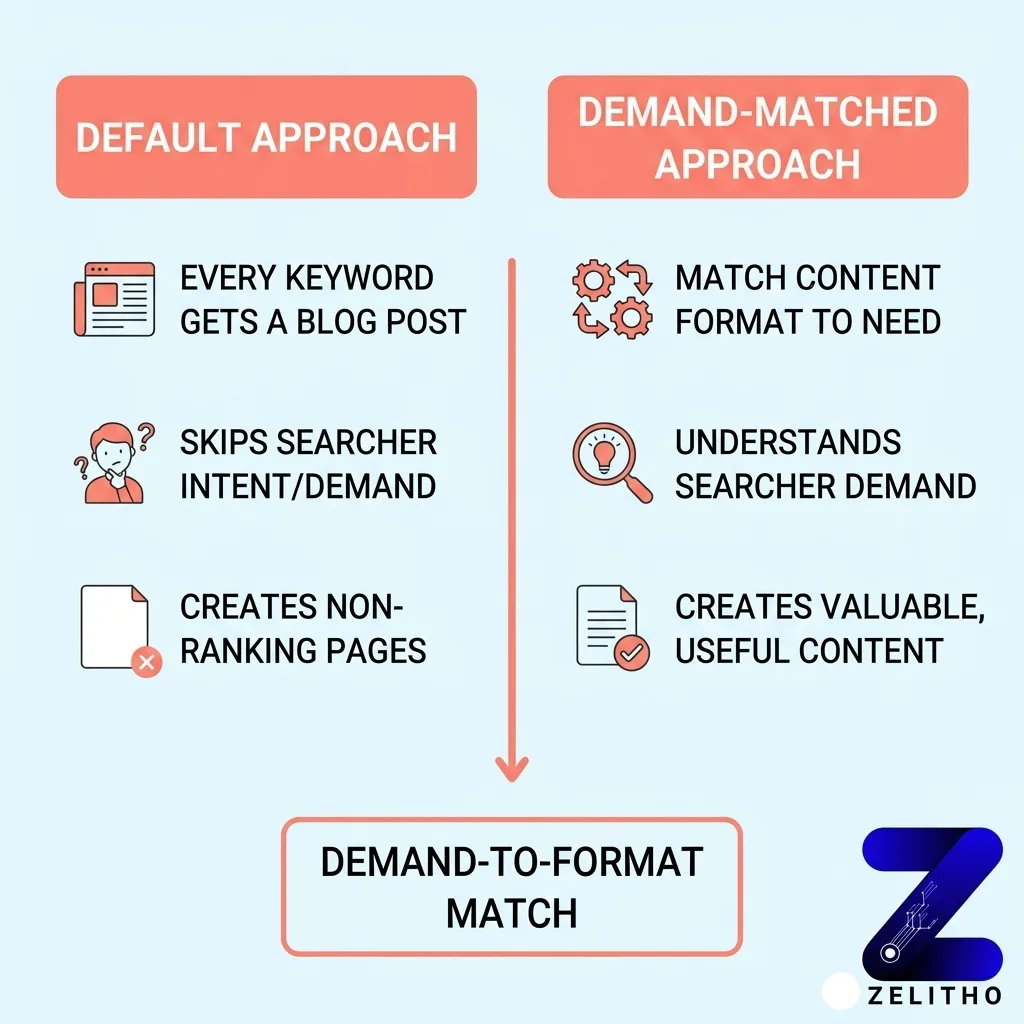
Most content teams default to a blog post. Every keyword becomes an article. That default costs time and creates pages that rank for nothing, because a blog post is the right answer for one specific type of demand: informational. It is not the right answer for someone comparing tools. It is not the right answer for someone ready to buy. It is not the right answer for someone looking for a file to download.
Stop writing blog posts for every keyword. Start building pages that match what the search demands.
This is the Demand-to-Format Match. It is a direct translation from demand type to page decision. Once you identify the demand, the format becomes obvious. The system removes the guesswork.
Demand Type | Content Format | Page Type |
|---|---|---|
Learn how to do something | Step-by-step tutorial | Blog post or guide |
Compare options before deciding | Structured comparison | Landing page or hub |
Ready to act | Product or service details | Category or product page |
Find a specific brand | Direct navigation | Homepage or branded page |
Someone searching “how to set up Google Analytics” needs a numbered walkthrough. A 2,000-word editorial explaining why analytics matter does not satisfy that need. It answers a question they were not asking.
Someone searching “best project management tools” needs a comparison page with clear criteria, specific tools named, and honest tradeoffs. A post defining what project management is will rank nowhere near that term, because it does not match the demand.
The format is not a creative choice. It is a functional one. The demand type tells you which row of that table applies. The row tells you what to build.
One implementation caveat: some keywords carry mixed intent signals. “Content marketing” pulls both informational and commercial results. When intent is mixed, look at what Google surfaces most prominently. That is the demand Google has confirmed. Weight your page toward that format, with a secondary nod to the secondary intent.
How to Read Demand Before You Write a Single Word
Apply the Demand-to-Format Match as a repeatable process. Run it on every term before assigning it to your content calendar.
Step one: search the term yourself.
Open an incognito window. Type the keyword. Look at what Google returns. Not just the blue links. Look at the page types. Are the results product pages? Forum threads? How-to guides? Downloadable files? News articles? The result types tell you what demand Google has already confirmed through billions of user signals. Google does not guess. It has observed what searchers clicked and stayed on. The results are the answer.
Step two: identify what the top results share.
Look across the first five organic results. What format do they use? What length? What angle? Are they written for someone just starting to research, or for someone ready to act? If four out of five results are comparison pages with a clear winner declared, that is the format Google rewards for this term. Your page needs to match that pattern or outperform it on the same terms.
Step three: ask what the searcher is trying to accomplish.
Not what they typed. What they came to do. There is a difference. Someone who types “project proposal template” is not trying to learn about project proposals. They are trying to get a file they can fill out and send. The demand is tool-based. Building a 3,000-word educational blog post on how to write a project proposal ignores the actual need. The searcher wanted a document. You gave them a lecture. They left.
The Demand-to-Format Match is not about being clever with content. It is about not building pages that cannot satisfy what the searcher came to find. Run these three steps before writing anything, and you stop wasting build cycles on content that was structurally misaligned before the first paragraph was drafted.
Run this as a rule: no keyword gets assigned to a content brief until it clears all three steps.
That is the process. The keyword points you toward demand. Demand tells you the format. The format determines the page. The page either satisfies the need or it does not. Everything before the page build is just analysis. The Demand-to-Format Match turns analysis into a clear decision.
What Search Terms Reveal When You Stop Counting Them
A keyword list is not a content strategy. It is raw material.
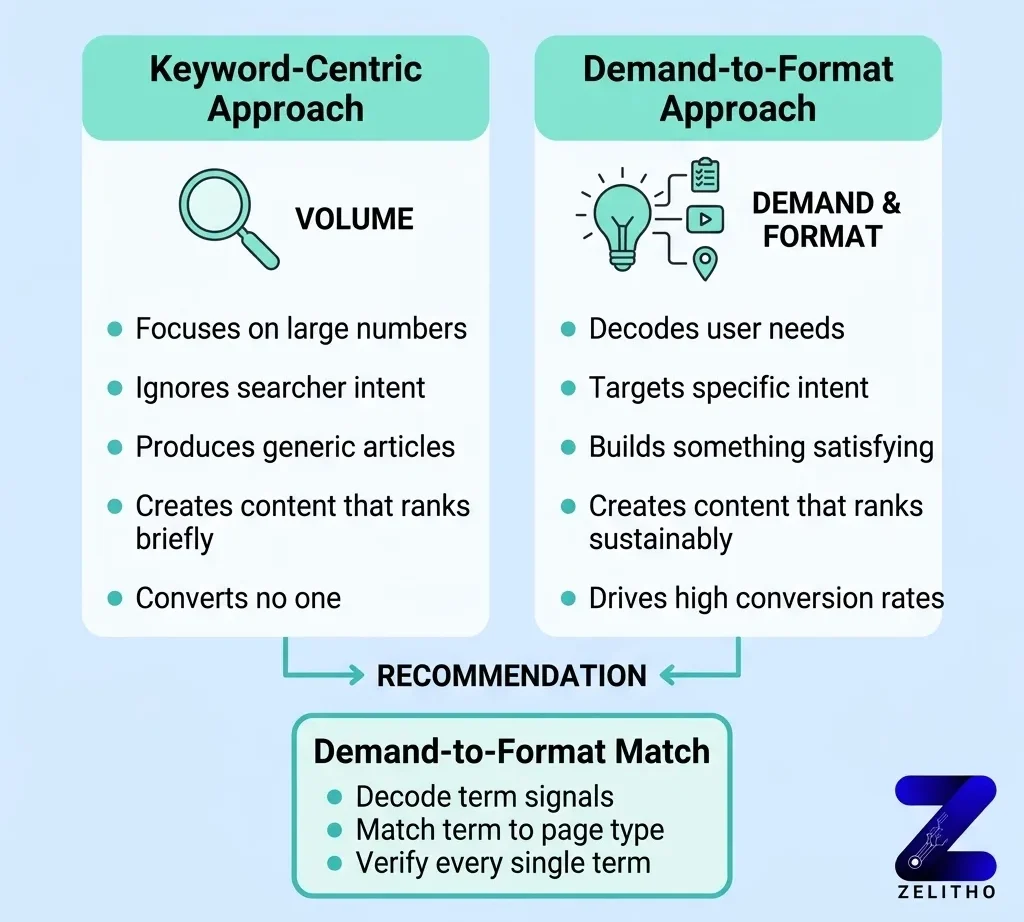
The work is decoding what each term signals, matching that signal to the correct page type, and building something that actually satisfies the need behind the search. Run the Demand-to-Format Match on every term before acting, and you stop producing content that ranks briefly and converts no one.
Senior marketers lose months building content that targets volume without checking intent. Founders scale output without scaling judgment. Agency owners produce deliverables that miss what the client’s audience actually came to find.
The fix is not more research tools. The fix is a cleaner question asked earlier: what does this person need, and what page satisfies that need completely?
Search terms tell you where demand exists. Reading that demand correctly tells you what to build. Build the right page for the right demand, and the content works.
People Also Read: What Is Keyword Density? A Simple SEO Definition and How It Is Measured
FAQ
The four intent types are informational, navigational, commercial, and transactional. Informational keywords signal someone learning. Navigational keywords signal someone looking for a specific brand or page. Commercial keywords signal someone comparing options. Transactional keywords signal someone ready to act. Each type requires a different page format to satisfy the demand behind the search.
Keyword research remains a core input for content decisions, but its value depends entirely on how you use it. Collecting terms and sorting by volume produces an incomplete picture. Reading the demand behind each term, and matching that demand to the correct page format, is what turns keyword data into content that ranks and converts.
No single tool gives you the full picture. Tools like Ahrefs, Zelitho, Semrush, and Google Search Console each surface different data points around volume, competition, and existing performance. The more important question is not which tool is most accurate, but whether you are reading intent after pulling the data. Tool accuracy does not compensate for misreading what a search term actually demands.
Keyword demand is the underlying need a search represents. It is not the word someone typed. It is the specific situation, question, or decision that caused someone to search in the first place. Identifying demand correctly tells you what page to build, what format to use, and what the content must accomplish to satisfy the person who searched.
SEO is not dead. The mechanism is shifting. AI-generated answers and zero-click results are changing how some informational queries get satisfied. Pages that match demand precisely, and build genuine authority on a topic, continue to receive traffic and conversions. Pages built purely to capture volume without satisfying a specific need are losing ground faster than before.
In content strategy, the 80/20 principle suggests that a small portion of your pages will drive the majority of your organic traffic and conversions. Applying it means identifying the page types and demand categories that already produce results, and concentrating effort there rather than spreading output across every keyword opportunity. Demand analysis helps you identify which terms belong in that productive minority.
SEO as a practice is not being phased out, but search behavior is changing. More queries now surface AI-generated summaries, maps, or shopping results before organic links. Content that satisfies a specific, well-defined demand clearly and efficiently holds more value in this environment than broadly written articles targeting high volume with weak intent alignment. The fundamentals of matching content to need remain intact.