
How Time to Publish Is Measured for Blog Content

TL;DR
Time to publish is calendar time from brief handoff to the CMS publish timestamp. Measuring stage wait times shows whether the constraint is writing, review, or handoffs.
Your blog has stalled. The Notion board shows eight drafts in progress. Three are marked “needs review.” One has been sitting in “ready to publish” for eleven days. You know content should be moving faster, but you can’t say where it slows down.
Most teams respond by adding a deadline column or pressuring the writer. That doesn’t work because the deadline doesn’t tell you which stage of the workflow is eating the time.
Time to publish measures elapsed time from a defined starting point to the moment a post goes live. The number shifts based on which stages you include. A post taking 4 to 6 weeks to publish [1] is not automatically slow. The metric becomes useful only when you break it down by stage. This article is for content leads and agency operators who want to read the number correctly and act on what it shows. This guide explains how blog teams measure time to publish and what the result means.
What does time to publish mean for blog content?
Time to publish is the elapsed time between a defined starting point and the date a blog post goes live. That sentence sounds simple. The measurement problem is in the phrase “defined starting point.”
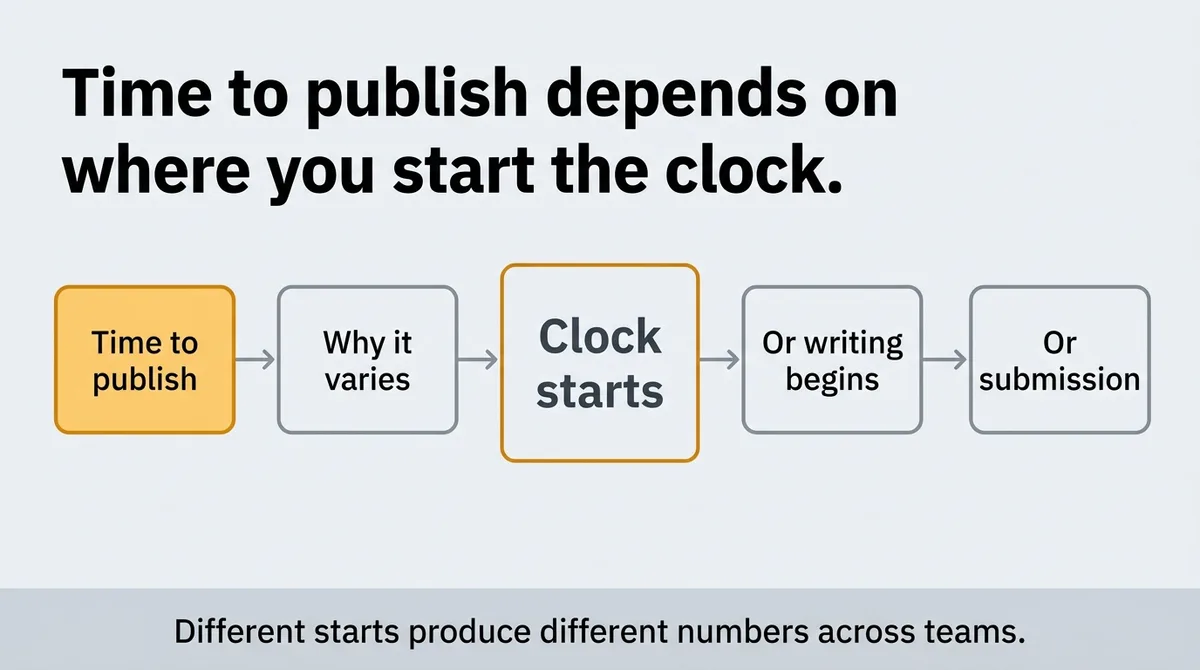
Different teams start the clock at different moments. Some start at brief creation. Some start when writing begins. Some count from the moment a freelancer submits a draft. Each approach produces a different number, and comparing those numbers across teams tells you nothing useful.
What the Metric Actually Measures and Where the Clock Starts
The metric measures elapsed calendar time, not active working time. A post that takes three weeks to publish may have involved four hours of actual work. The rest of the time sat in a queue.
That distinction matters. If you measure working hours, you assess writer productivity. If you measure elapsed calendar time, you assess process coordination. Both are worth knowing, but they answer different questions. Conflate them and you draw wrong conclusions.
The clock starts at the moment you can first assign work.
That is the most operationally useful starting point. It means the clock starts when a brief is approved and handed off, not when the idea was floated in a Slack thread. If you start earlier than that, you include pre-production ambiguity that obscures downstream problems. If you start later, say at draft submission, you skip the assignment and briefing stages entirely and miss delays that happen before a writer types a word.
Stop measuring from “when we came up with the idea.” Start measuring from “when a brief was assigned to a specific person.”
The end point is equally specific. Publication timestamp is the clearest end point. Some teams use “ready to schedule,” which introduces a gap between approval and actual going live. If your CMS holds posts in a scheduled queue for days, those days still count as publish lag.
A common false assumption: many teams believe their process is faster than it is because they measure from draft submission to publish, skipping the briefing and research phases. That shortened window hides the real cost.
The full window should cover: brief creation and approval, assignment, research or outline, writing, internal review, revision, final approval, CMS upload, and publication. Any stage you exclude from the window becomes invisible to diagnosis. [1]
The Workflow Stages That Determine Why the Number Changes
Two teams can both report a four-week publish time and have completely different problems. One loses two weeks in the review stage. The other loses two weeks waiting for a freelancer to start. The aggregate number looks identical. The fix is entirely different.
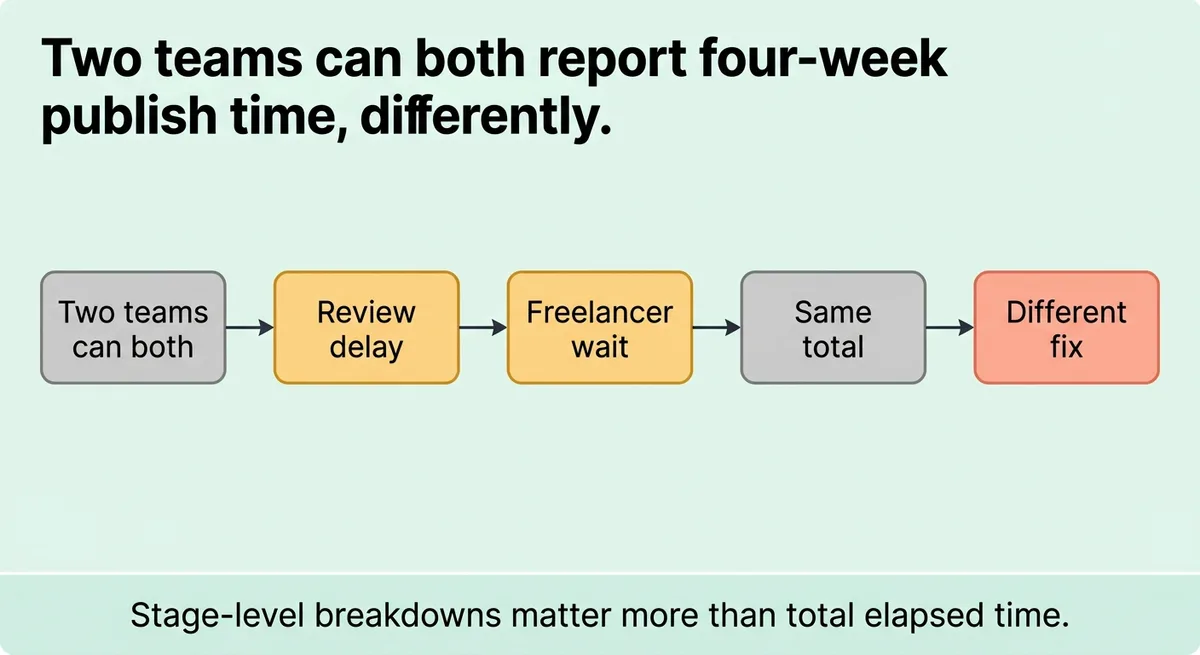
This is why stage-level breakdowns matter more than the total elapsed time.
Workflow Stage | What Gets Measured | Common Delay Source |
|---|---|---|
Brief creation and approval | Days from idea to approved brief | Stakeholder alignment, unclear scope |
Assignment and kickoff | Days from brief approval to writer start | Freelancer availability, unclear handoff |
Draft submission | Days from kickoff to first draft received | Writer workload, brief quality |
Review and revision | Days from draft received to approved | Reviewer availability, revision cycles |
CMS upload and publish | Days from approval to live | Production backlog, scheduling gaps |
Each row represents a distinct zone of potential delay. A team that publishes every couple of weeks [1] has usually compressed at least two of these stages, often by batching briefs in advance or removing a review layer.
A team publishing on a slower cadence almost always has one stage that runs long relative to the others. Brief creation stretches when strategy decisions are unresolved. Review stretches when an approver handles multiple responsibilities. CMS upload stretches when no one owns the production step.
The number 4 to 6 weeks [1] for a full-cycle blog post is common for teams running all stages sequentially with a single reviewer. That is not a broken process. It becomes a problem when the goal is weekly publication and no stage has been shortened or parallelized.
For example, imagine a content lead at a B2B SaaS company with twelve posts in the pipeline. Every post routes to the same VP for final approval. The VP is traveling two weeks out of four each month. The review stage alone adds ten to fourteen days per post. The writing stage takes five days. The total publish time looks like three weeks of writer delay when it is actually one week of writer work plus two weeks of approval wait. Separating the stages makes the true constraint visible immediately.
Why Tracking Elapsed Time Without Stage Breakdowns Misleads Your Team
An aggregate publish time number hides more than it reveals. Your team sees “six weeks per post” and starts guessing: is the writer slow? Is the brief unclear? Is the topic too complex? Everyone defends their own stage without data.
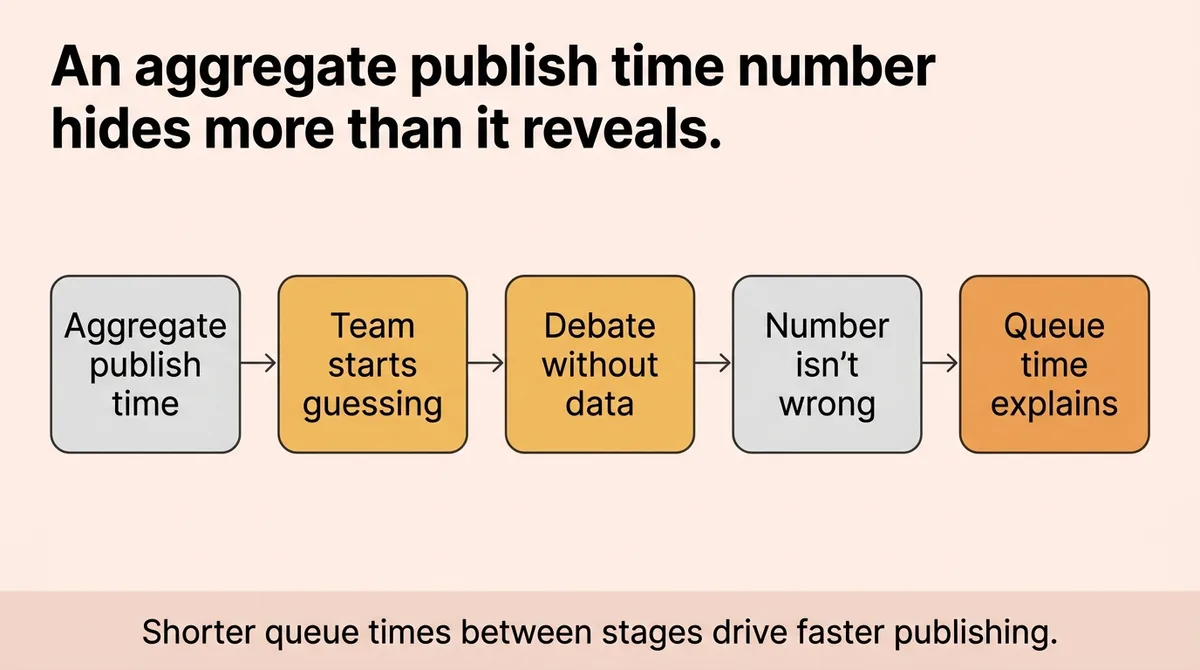
The problem is not that the number is wrong. A single number cannot tell you where time disappears.
Teams that publish several times per week [1] do not have faster writers. They have shorter queue times between stages. The writing takes similar hours. The handoffs happen faster. That difference only becomes visible when you track each stage separately.
There is also a misattribution risk. A content lead sees a long elapsed time and concludes the freelancer is underperforming. The freelancer submitted the draft in four days. The draft sat in a shared folder for nine days before anyone read it. Tracking only the total elapsed time assigns blame to the wrong stage.
Practical consequence: say your team publishes one or two posts per month [1]. You have eight posts in progress at any given time. If review consistently takes twelve days per post, you are carrying roughly ninety-six days of review lag across your pipeline. That is three months of capacity tied up in a single stage. That backlog does not show up in a total-elapsed-time metric. It only shows up when you break the window by stage.
Tracking stage durations also reveals a second problem: rework loops. A post that goes through three revision cycles does not just take longer. It occupies a reviewer’s attention across multiple separate sessions, compressing the time available for other posts. Every rework loop delays the current post and the next one simultaneously.
The fix is not complicated. Add a date field for each stage transition in your project management tool. Record when each stage starts and when it ends. Review the stage durations weekly, not the total elapsed time. Patterns surface within two or three publishing cycles.
How to Interpret the Metric and Connect It to Editorial Throughput
Knowing your publish time is only useful if you connect it to a decision. The decision is almost always one of two things: whether to change the workflow or whether to change the publishing goal.
If your goal is to publish every other day [1] and your current process takes four weeks per post, you have a structural mismatch. You cannot close that gap by asking everyone to work faster. You need to either add parallel capacity, remove stages, or lower the publishing frequency.
If your goal is one or two posts per month [1], a four-week elapsed time is not a problem. The metric is healthy for that target. Treating it as a problem and trying to accelerate it wastes coordination effort.
Throughput is the operative word. Time to publish tells you the speed of one post through the system. Throughput tells you how many posts the system produces per period. A team with a three-week average publish time and four parallel posts in progress can have higher throughput than a team with a two-week average and one post moving at a time.
Connect the two numbers. Multiply your monthly publishing goal by your average publish time expressed in months (WIP ≈ monthly publishing goal × cycle time in months). If you want eight posts per month and each post takes four weeks, you need approximately eight posts in active progress at any given time to maintain that rate. If you have three in progress, the math tells you the cadence will slip before you even look at individual stage delays. [1]
This is where the metric becomes actionable for team coordination. If the math shows you need eight active posts and you have three, the problem is not execution. The problem is pipeline volume. You need more briefs approved and assigned, not a faster review process.
Approval layers affect throughput directly. Each approval layer adds a minimum queue time equal to the reviewer’s response lag. A post requiring two sequential approvals from people with forty-eight-hour response times adds at least four days per post, structurally. That is not a people problem. That is a process design problem. Removing one approval layer or running approvals in parallel cuts that delay without changing anyone’s working hours. [1]
A useful internal benchmark: calculate the ratio of active working time to total elapsed time for a recent post. If a post takes twenty-one days to publish and involved nine hours of actual work, the ratio is about twenty-six minutes of work per calendar day. The rest is queue, wait, and handoff time. A ratio that low suggests process coordination is the constraint, not output capacity.
Use that ratio to make a specific argument internally. It is harder to dismiss than “the process feels slow.”
What Your Publish Lag Reveals About Editorial Coordination Gaps
Publish lag is not a writing problem. It is a coordination problem.
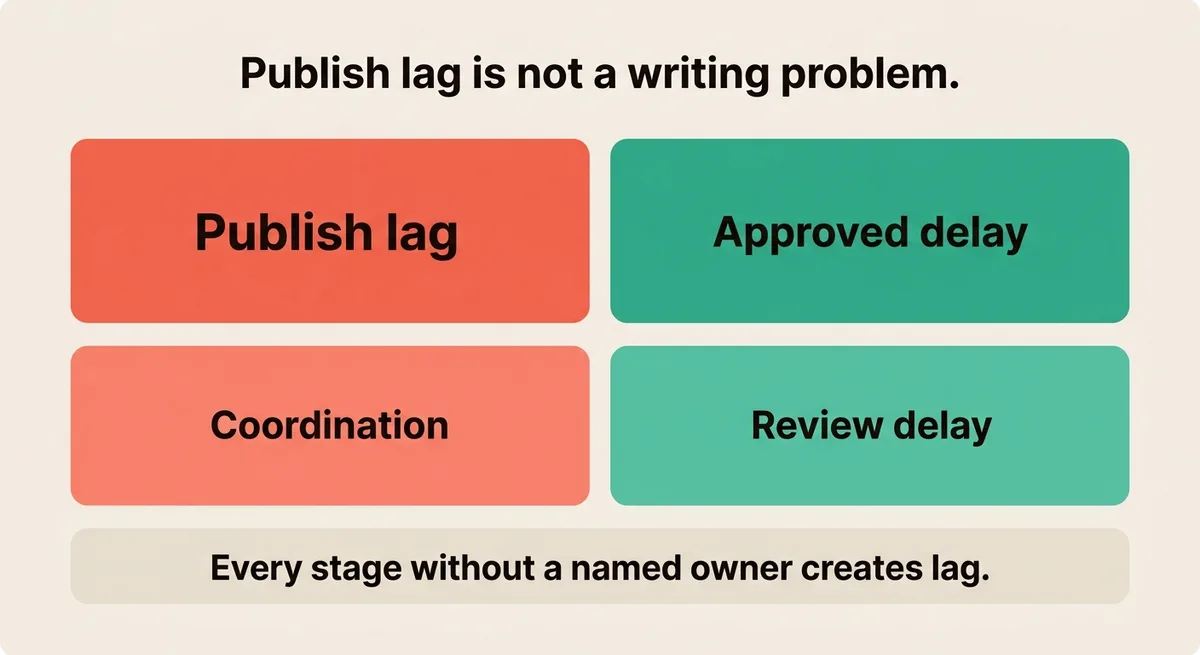
The gap between when a post is ready and when it goes live tells you whether your team has clear ownership of each transition. A post sitting in “approved” for six days before someone uploads it to the CMS points to an undefined production owner. A post in review for twelve days points to either reviewer overload or an unclear revision standard.
Every stage without a named owner accumulates idle time. That idle time is invisible in an aggregate metric and obvious in a stage-by-stage breakdown.
The practical starting point: pull your last ten published posts. Record the date each major stage started and ended. Calculate the average duration per stage. Rank the stages by average duration. The longest stage is where your coordination gap lives.
That one exercise takes less than an hour. It tells you more than six months of tracking total elapsed time.
Your publish cadence is a direct output of how well your team hands work from one stage to the next.
References and Citations
[1]https://susannagebauer.com/blog/blogging-schedule/
FAQ
The clock should start the moment a brief is approved and handed off to a specific person, not when the idea was first floated in a meeting or chat thread. Starting earlier adds pre-production ambiguity that obscures where downstream delays actually occur, while starting later, such as at draft submission, hides the full cost of briefing and assignment stages. The end point should be the publication timestamp in the CMS, not an internal ‘ready to schedule’ status, because any days spent in a scheduled queue still count as publish lag.
Review and approval is the most common bottleneck in blog publishing workflows, especially when a single person handles final sign-off across many posts. A reviewer traveling or managing multiple responsibilities can add ten to fourteen days per post to the pipeline, even when the writing itself takes only five days. Brief creation also stretches when strategic decisions are unresolved, and CMS upload accumulates lag when no one has clear ownership of the production step.
Multiply your monthly publishing goal by your average time to publish per post, expressed in months, to find how many posts must be in active progress simultaneously to sustain that cadence. For example, if you want eight posts per month and each takes four weeks end to end, you need roughly eight posts moving through the pipeline at any given time. If you have only three in progress, the math tells you the cadence will slip before you even review individual stage delays. Platforms like Zelitho can help by connecting topic selection, drafting, and CMS publishing in one system, which can make pipeline volume and handoff timing easier to see and manage with fewer separate tools.
Tracking only total elapsed time hides which stage is responsible for the delay, which causes teams to misattribute slow publishing to the wrong person or step. A freelancer who submitted a draft in four days looks like a bottleneck when the draft actually sat unread in a shared folder for nine days before anyone reviewed it. Breaking the window into per-stage durations, from brief approval through CMS upload, makes the true constraint visible within two or three publishing cycles.
A fragmented blog workflow, where research, keyword selection, drafting, editing, and CMS publishing each happen in separate tools with manual handoffs, can be replaced by consolidating every stage into one connected system. Each handoff between tools adds queue time and misattribution risk, which inflates total publish time without adding working hours. Zelitho is designed to help with this problem: it supports keyword discovery, title planning, research-backed draft generation, on-page editing, and direct publishing to WordPress or Webflow in a single workflow, which can help reduce the coordination gaps that accumulate across disconnected tools.