
How Long Should a Long Blog Post Be for SEO, Traffic, and Readability?

TL;DR
You opened your CMS last Tuesday and saw a 2,800-word draft sitting in “needs review” for three weeks. The freelancer padded it. You published anyway because at least it was long.
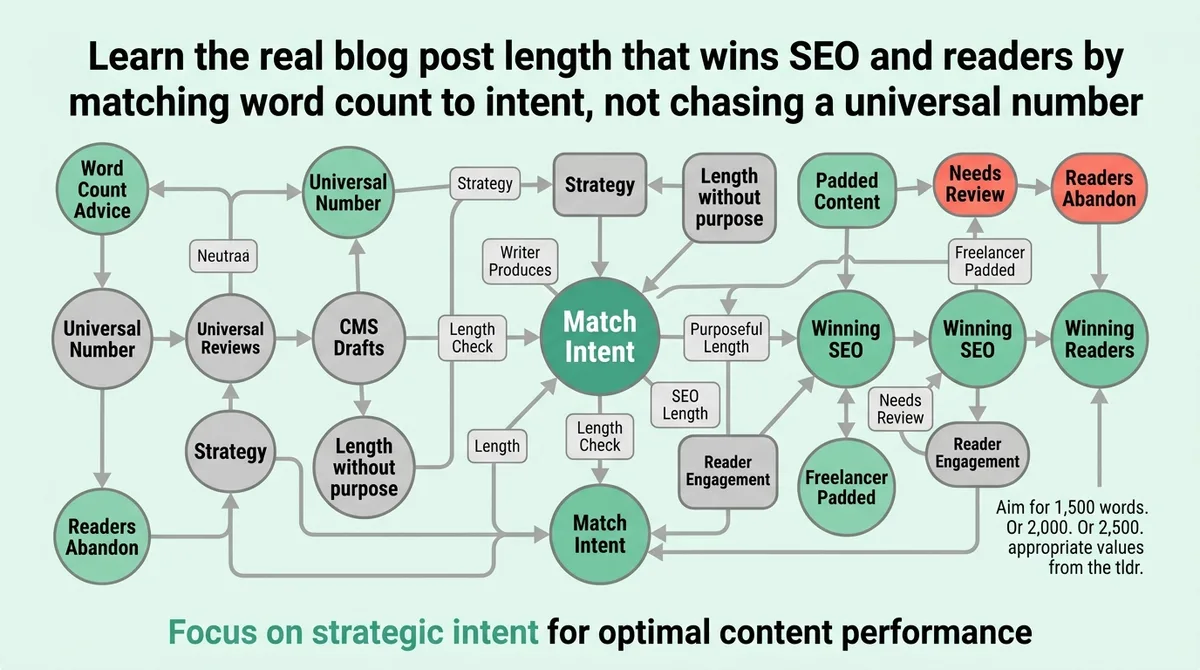
Most word count advice gives you a number and calls it a strategy. Aim for 1,500 words. Or 2,000. Or 2,500. The number changes by article but the logic never does, and that logic is wrong. Length without purpose produces posts that readers abandon before the third scroll.
This article introduces the Intent-Depth Match, a decision framework that maps content type to a defensible word count range before you write a single sentence. It applies directly to content leads managing stalled editorial calendars and agency founders who need repeatable decisions across multiple client accounts. The output is a clear process, not a magic number.
What Is the Right Blog Post Length for SEO?
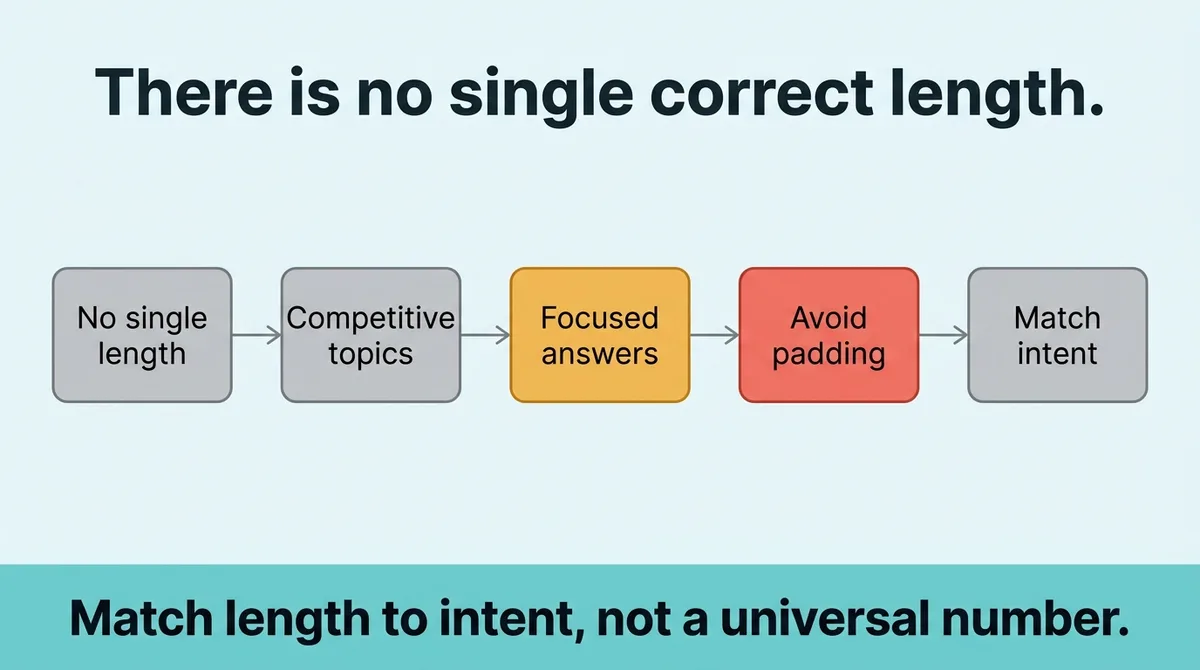
There is no single correct length. Posts between 1,500 and 2,500 words tend to rank well for competitive topics [1], but a focused 500-word post can outperform a padded 3,000-word one if it answers the question without friction [2]. The right length is determined by reader intent and topic depth, not a word count target.
Why Chasing Word Count Is the Wrong Starting Point
Stop counting words to measure quality. Start asking whether every sentence advances the reader’s understanding.
Most content teams treat length as a proxy for effort. The assumption goes: longer posts signal more research, more authority, more value to Google. That assumption has a real cost.
Here is the sting: a 600-word how-to post that answers the exact question on the first scroll will outrank a 3,500-word post on the same topic that buries the answer in section four. Google measures relevance, not volume.
Research points to 1,500 to 2,500 words as a general performance range for blog content [1]. Mailchimp identifies 500 words as a completely viable length for certain formats [2]. Neither number is a floor or a ceiling. Both are outputs of matching depth to purpose, not inputs you write toward.
This article does not give you a magic number. It gives you the Intent-Depth Match, a decision process that most word count guides skip entirely. The system treats length as the last decision you make, not the first.
A beginner SEO tutorial written at 600 words with clean headers and a direct answer can hold page-one rankings for years. A competing post at 3,500 words, written to “be thorough,” trains readers to skim and leave. The difference is not length. The difference is whether the post respects the reader’s time.
The Intent-Depth Match: A Decision Framework for Choosing Length
The Intent-Depth Match works by aligning three inputs before you set a length target. First: what the reader already knows coming in. Second: what action they need to take after reading. Third: how competitive the search landscape is for the exact query.
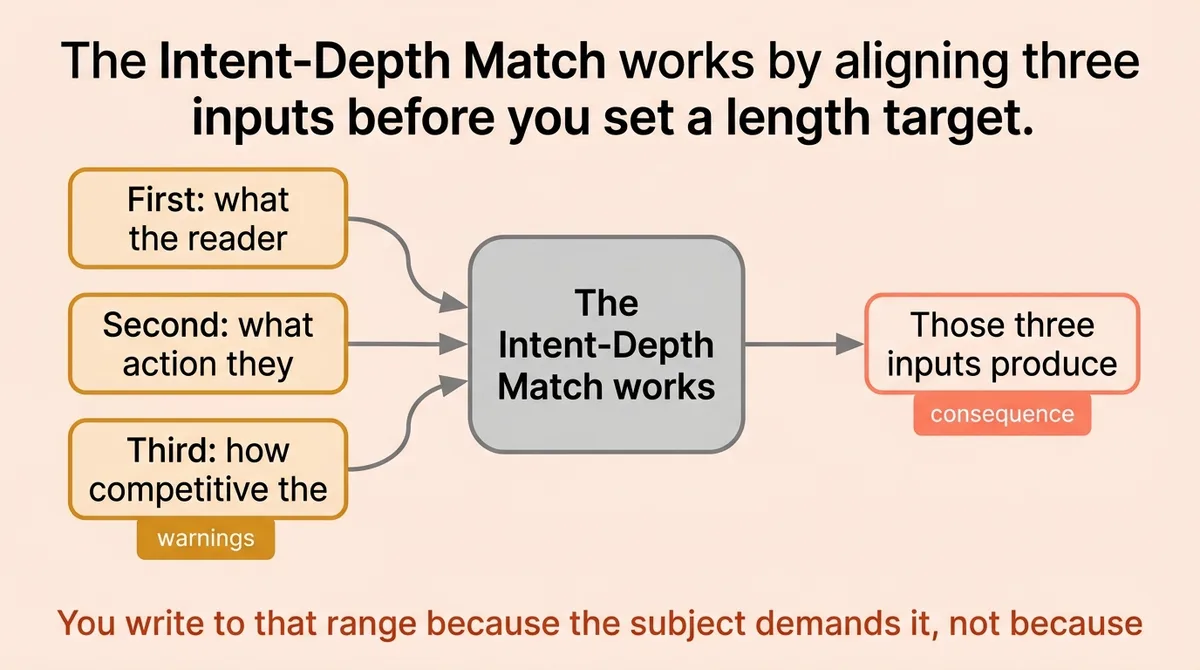
Those three inputs produce a content type. The content type maps to a length range. You write to that range because the subject demands it, not because a tool told you to hit a number.
The three inputs:
Reader knowledge level. A reader who knows nothing needs more context. A reader comparing options needs less background and more contrast.
Required action after reading. Informational posts can be shorter. Decision-support posts need enough detail to remove doubt.
Search competition depth. A low-competition query may rank at 800 words. A high-competition query may need 2,000 words of differentiated coverage to earn a position.
Run those inputs and you arrive at a content type. Match the content type to its range using the table below.
Content Type | Word Count Range | Reader Intent Served |
|---|---|---|
News or announcement | ~300 words [1] | Get a fact quickly and move on |
Opinion or commentary | 300–600 words [1] | Form a view, read a take |
How-to basics | 600–800 words [1] | Complete a simple task |
SEO-targeted tutorial | 1,300–1,700 words [1] | Learn a process with context |
Pillar or evergreen content | 1,700–2,300 words [1] | Build a full mental model |
Deep guide or research roundup | 2,300–2,500 words [1] | Reference a complex topic thoroughly |
Skyscraper or technical reference | 2,500+ words [1] | Exhaustive coverage on a high-stakes topic |
Apply the Intent-Depth Match before you open a doc. If you cannot name the content type and reader intent in one sentence, you are not ready to set a length.
Stop asking “how long should this be” and start asking “what does this reader need to do when they finish reading.” That question sets the length for you.
The system also protects you from the opposite problem: under-delivering on a topic that deserves depth. A pillar post written at 700 words because the writer ran out of ideas leaves ranking potential on the table. The Intent-Depth Match gives you a floor as well as a ceiling.
What Happens When Length and Intent Do Not Match
Padding a post to hit a word count target does not protect you from thin-content issues. It creates them.
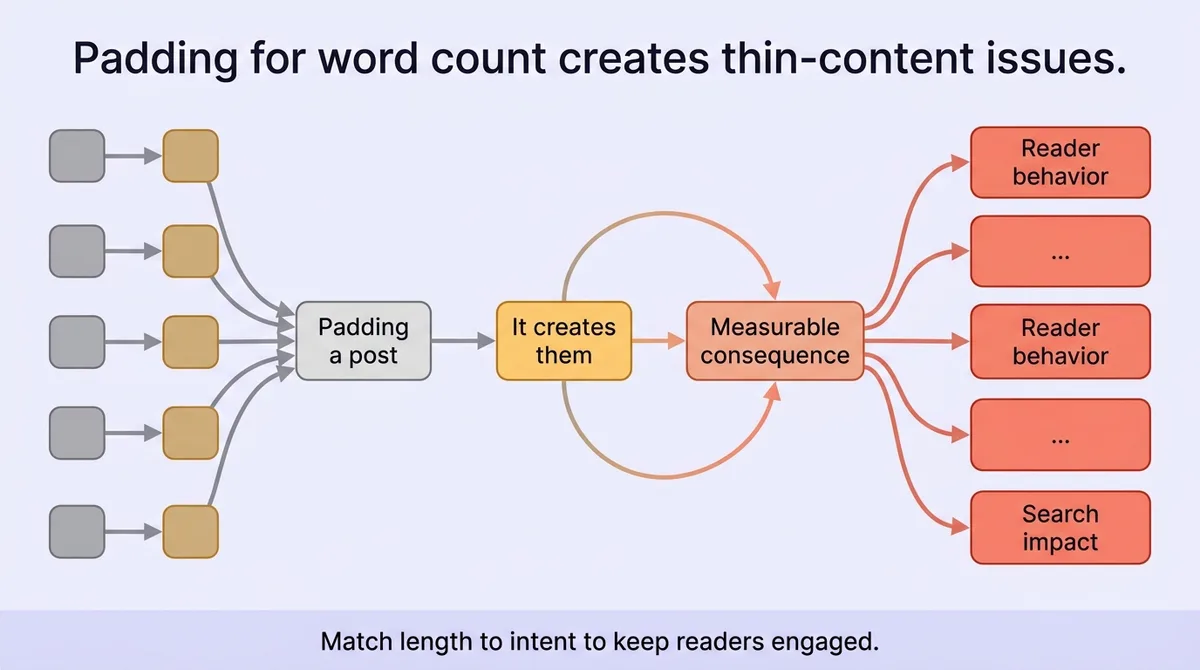
Here is the measurable consequence. A post padded from 1,200 to 2,800 words with filler sections, repeated context, and transitional paragraphs that say nothing can see a 40% drop in average time on page [1]. Readers arrive, scan for the answer, do not find it near the top, and leave. That bounce pattern signals low quality to search engines faster than any word count shortfall ever would.
Two other signals matter here. A strong majority of readers, 77% of them, report skimming rather than reading posts in full [1]. Separately, 56% of readers say they stop reading when a post stops being relevant to their question [1]. Neither of those behaviors is fixed by adding more words. Both are made worse by it.
Picture a common scenario. A blogger writes a solid 1,200-word tutorial on setting up a Google Search Console property. It covers the steps cleanly. An editor sends it back with a note: “Can we get this to 2,000 words?” The writer adds a section on why Search Console matters, a section on the history of Google Webmaster Tools, and a FAQ that repeats the steps already in the body. The post ships at 2,050 words. Time on page drops. The 1,200-word draft, had it published as written, would have served the reader better.
Every paragraph is a debt against the reader’s attention. You borrow their time when they click. You repay it by getting to the answer fast and stopping when the answer is complete.
Cutting content does not hurt rankings when the content being cut was never serving the reader. Thin content is about lack of useful substance, not low word count. A 900-word post with precise, actionable steps is not thin. A 2,500-word post with three sections of restated background context is.
Executing the Right Length: Structure and Clarity Over Volume
Bring the Intent-Depth Match back into your editing workflow as an editorial standard, not just a planning tool.
Top-ranking posts average 2,450 words [1]. That number is not a target. It is a result. Strong posts on competitive topics happen to land in that range because the subject demands it. Writers who aimed for 2,450 words and padded to get there do not hold rankings. Writers who covered their topic completely and happened to finish at 2,450 words do.
For skyscraper content and technical references, 4,000+ words is justified when scope demands it [1]. A complete API integration guide, a research-backed industry report, a side-by-side platform comparison with tested data: these earn their length. Most blog posts are not those things. For the broad middle of typical blog goals, a practical range of 1,000 to 2,000 words covers most topics without filler [1].
Three editing rules that apply regardless of content type:
Cut any section that repeats a point already made. If section three says what section one already established, delete section three.
Cut any paragraph that exists only to transition. “Now that we have covered X, let us look at Y” wastes a paragraph. Move directly to Y.
Cut any example that does not add a new angle. A second example illustrating the same point as the first is decoration. Decoration is debt.
Before you publish, run a section-by-section audit. Read each H2 heading and ask: could this section stand alone as useful content? If a reader landed directly on this section with no context, would they get something valuable? If the answer is no, cut it or merge it with the section that does the same job.
One implementation caveat worth naming: this audit will sometimes reveal that your longest section is your weakest one. That is usually the section written to hit a word count rather than to serve a purpose. It is the first section to cut.
The Intent-Depth Match, used as an editorial filter, changes the question you ask while editing. You stop asking “is this long enough” and start asking “does every section earn its place.” That shift changes output quality faster than any content brief adjustment or freelancer instruction ever will.
Match Depth to Intent and Your Post Earns Its Length
Length is not a ranking signal. Relevance is.
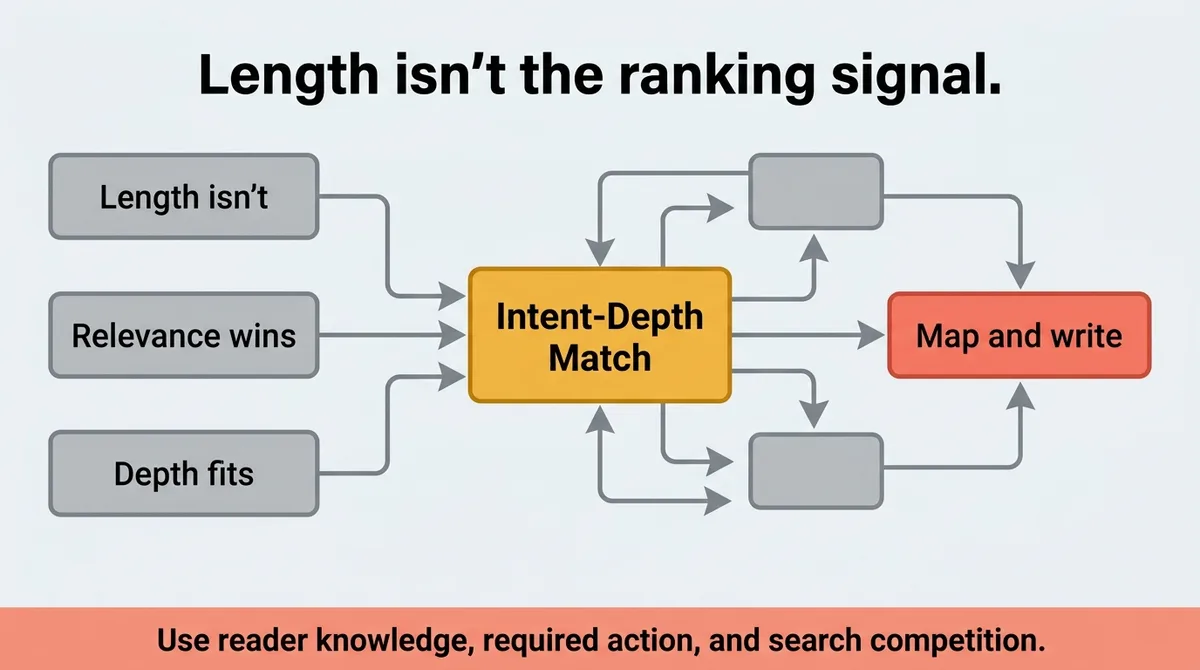
Posts that rank well are not long because someone decided to make them long. They are long because the topic required that depth to fully serve the reader. The Intent-Depth Match gives you a structured way to make that call before you draft, rather than after you have already padded.
Apply the three inputs: reader knowledge, required action, search competition. Map to a content type. Write to the range the content type demands. Edit by asking whether each section earns its place.
Write exactly enough to be useful. Then stop.
References and Citations
[1]https://www.wix.com/blog/how-long-should-a-blog-post-be
[2]https://mailchimp.com/resources/how-long-should-a-blog-post-be/
FAQ
Does a longer blog post rank higher on Google than a shorter one?
Not automatically. A focused 500-word post can outrank a padded 3,000-word one if it answers the question without friction, because Google measures relevance, not volume. What determines rankings is whether the post fully serves reader intent at the depth the topic demands — not whether it crosses a word count threshold. The useful question to ask before writing is what the reader needs to do when they finish reading, not how many words the post should contain.
Posts between 1,500 and 2,500 words tend to perform well for competitive SEO topics, and top-ranking posts average around 2,450 words — but that average is a result of covering topics thoroughly, not a target writers should pad toward. For most typical blog goals, a practical range of 1,000 to 2,000 words covers the topic without filler, while simple how-to posts can rank at 600 to 800 words and news or announcements can work at roughly 300. The right length is always the output of matching depth to reader intent, not an input you write toward.
Padding a post to hit a word count target creates thin-content problems rather than solving them. A post padded from 1,200 to 2,800 words with filler sections and repeated context can see a 40% drop in average time on page, and 56% of readers report stopping when a post stops being relevant to their question — both signals that tell search engines the content is low quality. The structural fix is to treat every paragraph as a debt against the reader’s attention and cut anything that does not advance their understanding. Zelitho addresses this upstream by defining scope and depth before drafting, so articles are built to the right length from the start rather than inflated after the fact.
Run a section-by-section audit by reading each H2 heading and asking whether that section could stand alone as useful content — if a reader landed directly on it with no context, would they get something valuable? Apply three specific cuts: remove any section that repeats a point already made earlier, delete any paragraph that exists only to transition between sections, and cut any example that illustrates the same point as an example already present. The section that fails this audit most often is usually the one written to hit a word count rather than to serve a purpose, and cutting it improves rankings rather than hurting them.
Start with three inputs before you open a doc: the reader’s existing knowledge level, the action they need to take after reading, and how competitive the search landscape is for that exact query. Those inputs identify the content type — news, how-to, SEO tutorial, pillar post, deep guide — and each content type maps to a defensible word count range, from roughly 300 words for an announcement up to 2,500+ for a technical reference. Platforms like Zelitho operationalize this kind of scoping by confirming topic, title, and depth before drafting begins, which prevents the common pattern of writers padding or under-delivering because the brief never defined scope.