
How a Blog Production Workflow Works From Topic Selection to Publication

TL;DR
You have a Notion board with twelve topic ideas. You have a ChatGPT draft sitting in a Google Doc. You have a freelancer who submitted something three weeks ago that still needs edits. Nothing has published in six weeks.
The common fix is to hire another writer or push harder on deadlines. That does not address the real problem. Topics get picked by gut feel. Drafts start without a confirmed angle. Editing lives in someone’s inbox. Each handoff is informal, so posts stall between stages.
A blog production workflow is a repeatable sequence that moves a topic from raw idea through planning, drafting, editing, and publishing without losing momentum at each transfer point. This guide is for marketing leads and agency operators who need consistent output, not another creative sprint that fades after two weeks.
What is a blog production workflow and how does it work from topic to publication?
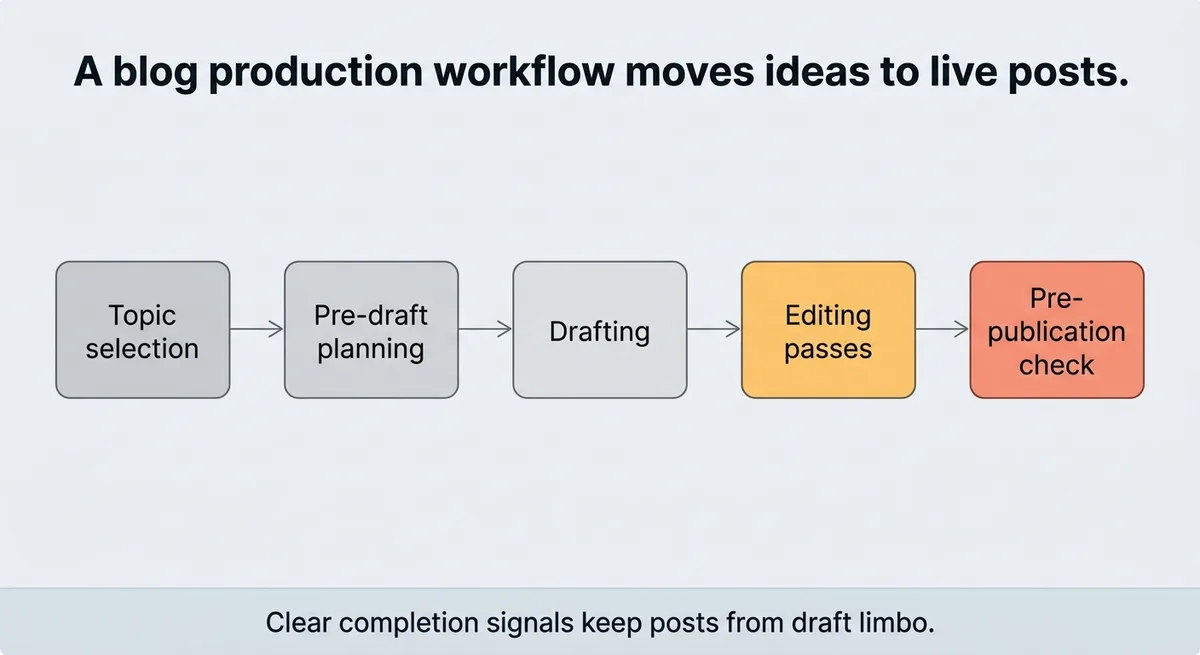
A blog production workflow is a defined sequence of stages, each with a clear input and output, that moves content from idea to live post. It covers topic selection, pre-draft planning, drafting, editing passes, and a final pre-publication check. The sequence only holds when every stage has a clear completion signal before the next one begins. Skip the handoff logic and posts pile up in draft limbo.
How to Pick a Topic That Actually Fits Your Audience Before You Write a Word
Most topic lists are wish lists. They reflect what the writer finds interesting or what felt timely during a team meeting. That is the wrong starting point.
The right starting point is a short confirmation check before any writing begins. Run each idea through three questions. First: does this match something my audience is already looking for, not just something I want to say? Second: does the search intent behind this topic align with where my reader is in their decision process? Third: can this topic be covered completely within one focused post, or does it need to be narrowed?
That third question matters more than most writers expect. A broad topic produces a surface-level post. A narrow topic produces a post that actually answers a specific question and earns the reader’s time.
Stop writing about what excites you. Start writing about what your reader typed into a search bar yesterday.
The contrast below shows how the same general subject area produces two very different topic choices depending on whose perspective drives the decision.
Dimension | Topic that fits the audience | Topic that feels right to the writer |
|---|---|---|
Starting point | Reader’s question or search behavior | Writer’s interest or recent idea |
Scope | Narrow, answerable in one post | Broad, could be three posts |
Intent match | Matches where reader is in their process | Matches what writer wants to explain |
A topic that passes this check is ready to move to the next stage. A topic that fails any row needs to be revised or dropped. The goal is a short decision gate, not a lengthy approval process.
One hidden belief causes teams to skip this check entirely. They assume a good idea is enough justification to start writing. A good idea and a well-matched topic are not the same thing. One satisfies the writer. The other serves the reader.
The Stage Most Writers Skip That Causes Drafts to Stall or Miss the Point
A blank document is not the right place to figure out what a post is about.
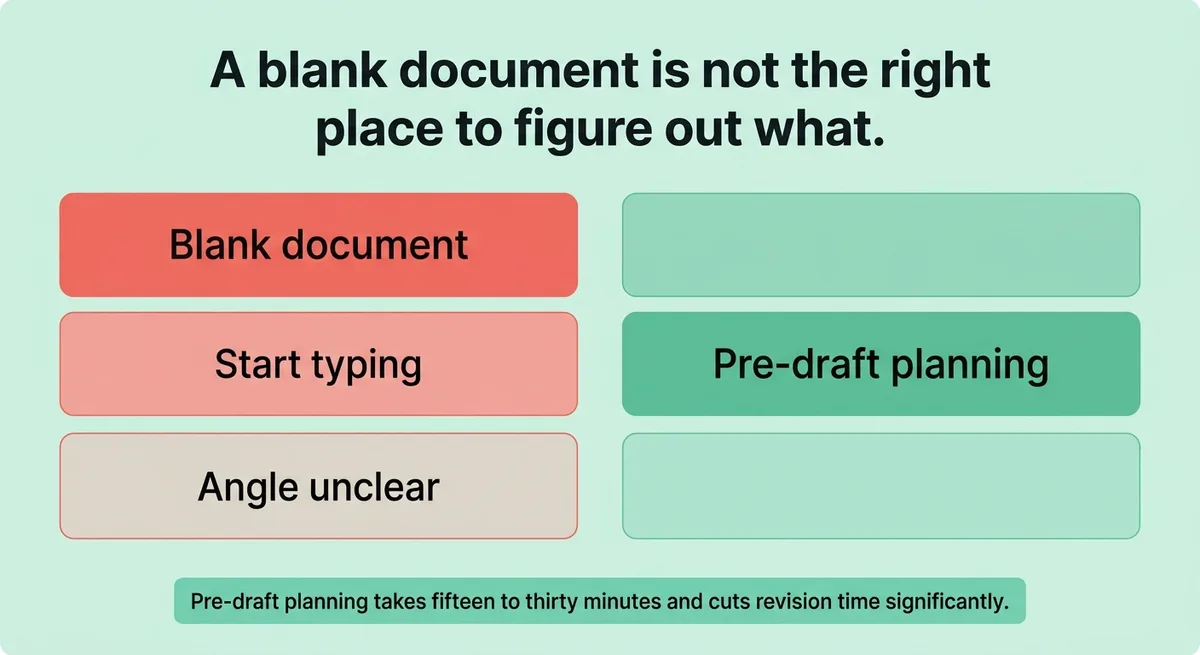
Opening a blank document and starting to type is how drafts run out of direction halfway through. The writer hits paragraph six, realizes the angle is unclear, and either pushes through with unfocused prose or abandons the draft. Both outcomes waste time that pre-draft planning would have protected.
Pre-draft planning takes fifteen to thirty minutes and cuts revision time significantly. It is not optional for teams running on tight schedules.
Here is what to confirm before opening a blank document:
- The core question the post answers. One sentence. If you cannot write it, the topic is not ready.
- The angle. What perspective makes this post distinct from the three other posts already ranking on this topic?
- The intended reader stage. Are they problem-aware, solution-aware, or comparing options? This controls tone and depth.
- The sources and data. Gather them before drafting, not during. Stopping to search mid-draft breaks momentum.
- The word count range. Decide whether this is a 900-word focused answer or a 1,800-word detailed walkthrough. Commit before writing.
This planning step addresses a practical reality about blog readership. Only about 10% of readers, or fewer, engage visibly with a post through comments or shares [1]. The other 90% read silently and move on. A post planned to serve that silent majority, with clear structure and a direct answer, performs better than a post built around generating visible reactions.
For example, imagine a content agency where writers receive a topic name and a deadline and nothing else. The writer spends the first hour of drafting figuring out the angle. The draft comes back unfocused. The editor rewrites forty percent of it. The post ships two weeks late. A fifteen-minute planning document given to the writer before drafting would have eliminated most of that revision cycle.
The working outline produced in this stage becomes the draft’s spine. Each section heading in the outline is a confirmed question the post will answer. The draft then fills in the answers, not the other way around.
How the Drafting, Editing, and Handoff Sequence Connects Into One Production Path
A draft written and edited in the same pass takes longer and produces worse results. The brain cannot generate and evaluate simultaneously. These are two separate cognitive modes, and mixing them creates friction at both tasks.
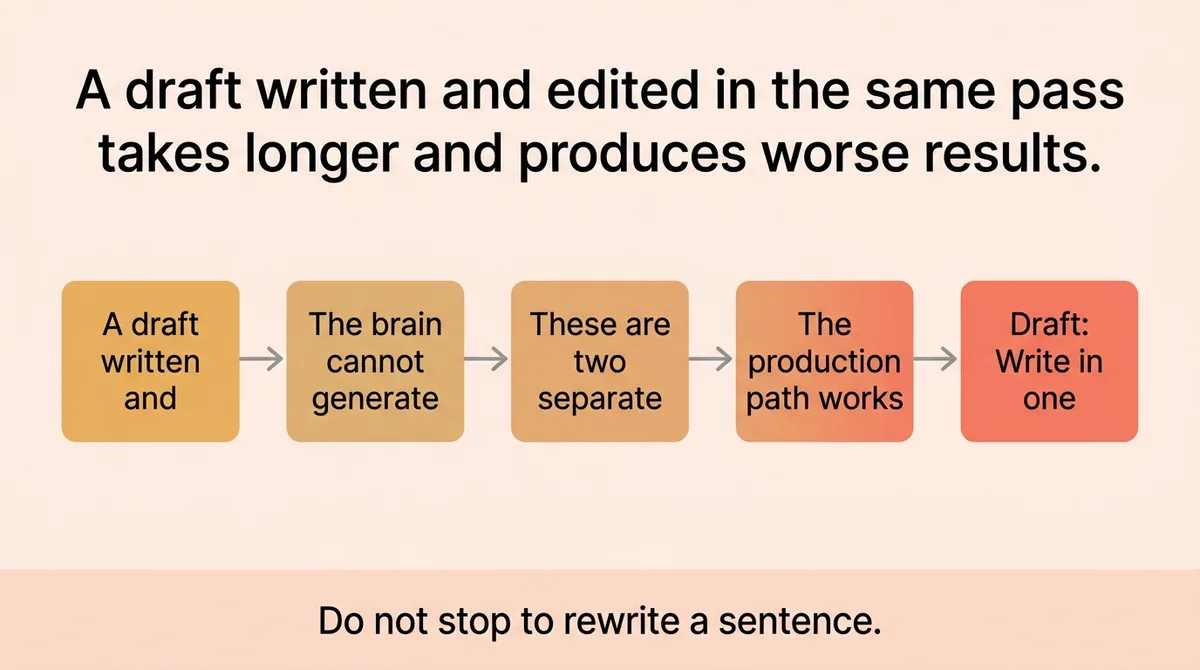
The production path works in a defined sequence:
Draft → Structural Edit → Line Edit → Pre-Pub Check → Publish
Each stage has a specific job.
Draft: Write in one pass. Do not self-edit. Do not stop to rewrite a sentence. Get the argument on the page. Gaps and rough phrasing are expected and will be fixed in editing.
Structural edit: Read for logic, not language. Does the post answer the question stated in the plan? Is the argument in the right order? Are any sections missing or redundant? This pass moves and removes sections. It does not fix sentences.
Line edit: Fix language after the structure is confirmed. Sentence clarity, word choice, length variation, and paragraph breaks all belong here. Editing language before structure is confirmed wastes the line editor’s time.
Pre-publication checklist: Before the post goes live, confirm the following. Title tag and meta description are written. At least two internal links are placed. All images have descriptive alt text. The call to action is present and specific. The URL slug is clean.
This sequence is not about SEO optimization or keyword density. It is a production process. Its value is that each person in the chain knows exactly what they are receiving, what they are responsible for, and what they are handing off. Ambiguity at any handoff point creates delay.
A team that runs this sequence with a shared checklist moves a post from draft submission to publish-ready in a predictable time window. A team without the sequence negotiates every post individually, which compounds into missed schedules.
What Publishing Cadence Does to Your Output When the Workflow Behind It Is Broken
Publishing frequency is a result of workflow quality. It is not a target you set independently and then meet through willpower.
Teams that commit to a weekly publishing schedule before confirming their production process can support it will miss that schedule within four to six weeks. The commitment does not change the underlying production capacity. It only creates pressure that leads to shortcuts: posts that skip the planning stage, editing that gets compressed into one pass, or publication with missing metadata.
Research recommends publishing two to four posts per week to build meaningful momentum [1]. One post per week is described as difficult for gaining real traction [1]. Those benchmarks are relevant, but they only apply when the production process behind the schedule is structured. Without that structure, the cadence target is just an aspiration.
For example, imagine a ten-person B2B SaaS company that commits to one post per week. They have no defined handoff between the writer and the editor. The editor receives drafts informally, via Slack or email, with no standard format and no completion signal. The editor also handles three other responsibilities. Posts that should publish on Tuesday get reviewed the following Monday, if that week has no higher-priority interruption. The company publishes every three to four weeks instead of weekly, despite the original commitment.
Inconsistent publishing compounds over time in two directions. Readers who find the blog and return for a second post encounter nothing new and do not return again. Search engines treat low update frequency as a signal of low activity, which affects how often the blog is crawled.
A blog that published eight posts in January and two posts in February sends a different signal than one that published five posts each month. The consistent blog is easier for both readers and crawlers to trust.
The correct sequence is: define your production stages, time each stage honestly, calculate how many posts your team can move through the full sequence per week, and set the cadence from that number. A team that can realistically move two posts per week through all stages should publish two posts. A team that can support one should start there and build.
Committing to a cadence your process cannot support does not demonstrate ambition. It produces a stale blog with a gap that readers notice.
Build the Workflow First and the Publishing Schedule Will Hold Itself
A publishing cadence is a downstream measure. It reflects how well the stages upstream are running.
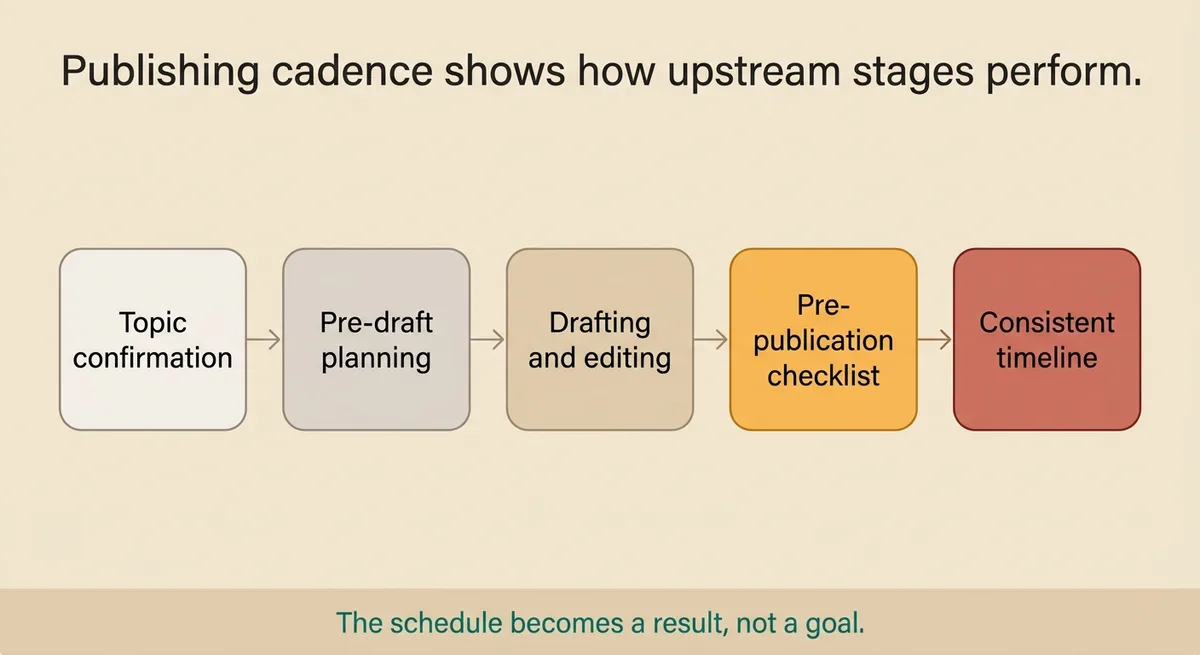
Get the stages right: topic confirmation, pre-draft planning, a separated drafting and editing sequence, and a pre-publication checklist with clear completion signals. Each stage should have a defined output that the next stage can receive without a conversation.
When every stage works, posts move through the sequence on a consistent timeline. The schedule stops being a goal you push toward and becomes a result the workflow produces automatically.
Start with one post. Run it through all five stages. Time each stage. Identify where it slowed down. Fix that stage before adding volume.
The workflow runs the cadence. Build it first.
References and Citations
[1]https://janefriedman.com/blogging-for-writers/
FAQ
A blog production workflow needs five stages: topic confirmation, pre-draft planning, drafting, editing (split into a structural pass and a line-edit pass), and a pre-publication checklist before the post goes live. Each stage must produce a clear output that the next stage can receive without a side conversation, otherwise posts stall between handoffs.
Teams miss their publishing schedule because the cadence target is set before the production process can actually support it. Without defined handoffs between topic selection, drafting, and editing, posts sit in informal queues, and a weekly commitment collapses into publishing every three or four weeks within a month or two.
Before a writer opens a blank document, confirm five things: the single core question the post answers, the angle that distinguishes it from posts already ranking on that topic, the reader’s decision stage, the sources and data to be cited, and the target word count range.
Run every topic idea through three questions before writing begins: does it match something your audience is already searching for, does the search intent align with your reader’s decision process, and can it be covered completely in one focused post.
Platforms that connect the full path from keyword discovery to CMS publishing in one system eliminate handoff delays. Zelitho combines clustered topic selection, title confirmation, research-backed generation, custom images per section, and direct publishing to WordPress or Webflow.