
Can AI Actually Do SEO? Keyword Optimization, Accuracy & Speed

TL;DR
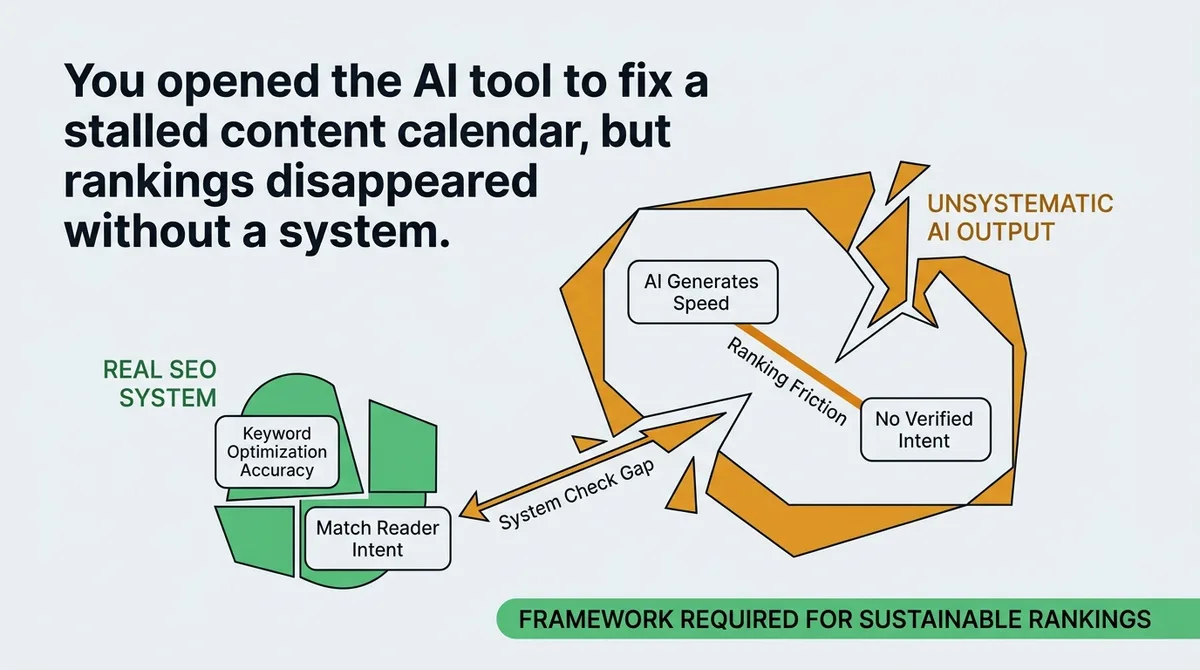
You opened the AI tool to fix a stalled content calendar. Weeks later, drafts exist but nothing ranks. The friction is not the tool. It is the absence of a system for deciding what AI should touch and what it should not.
Most teams treat AI as a content replacement. It is not. AI generates at speed but cannot verify intent, confirm accuracy, or match a specific reader’s decision stage. That gap is where rankings disappear quietly, without a clear error to diagnose.
The SEO Task Risk Matrix introduced here gives content leads and agency operators a repeatable decision layer. Before opening any AI tool, assign the task a tier. That single step separates teams shipping ranked content from teams shipping volume that converts nothing.
Does AI actually work for SEO keyword research and content?
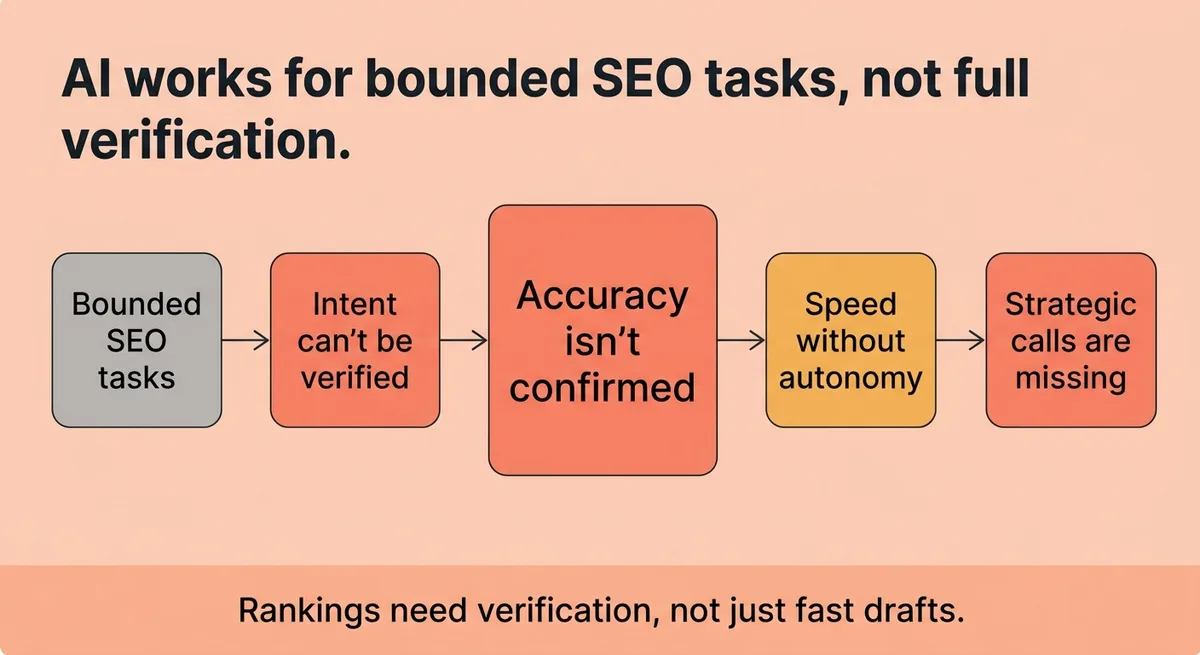
AI works for bounded SEO tasks: keyword clustering, semantic gap analysis, meta draft generation, and first-pass content outlines. It does not verify live search intent, confirm source accuracy, or make strategic calls about brand positioning. Speed is real. Autonomy is not.
What AI Can Actually Do in an SEO Workflow Right Now
Your Notion board has fourteen “ready to publish” articles from last quarter. Three shipped. The others stalled somewhere between the ChatGPT draft, the freelancer edit, and whoever owns CMS access this week.
AI does not solve that pipeline problem. A workflow structure does. The first step is knowing exactly which tasks AI performs well so you can assign them deliberately instead of experimentally.
AI-assisted SEO breaks into five process stages [4]: identifying seed keywords, expanding keyword lists through related term generation, clustering keywords by topic and intent, mapping clusters to content types, and surfacing semantic gaps between existing content and target queries. Each stage produces usable output. None of them replaces the strategic layer sitting above the data.
Five tools operate across these stages as concrete examples [4]: Semrush’s AI features, Ahrefs, Surfer SEO, Clearscope, and ChatGPT with search-enabled plugins. Each has a different scope. None runs autonomously from brief to ranked page without human input.
The 10-minute drafting benchmark is real under specific conditions [3]. A focused prompt with a tight brief, a defined audience, and a confirmed keyword target can produce a first draft in that window. That is a speed input to your process, not a signal that the draft is ready to publish.
Task | AI Role | Human Role | Risk Level |
|---|---|---|---|
Keyword clustering | Groups by co-occurrence pattern | Validates against actual intent | Low |
Content brief | Drafts structure from seed topic | Confirms angle, depth, source needs | Medium |
Meta description | Generates from page summary | Reviews for accuracy and brand fit | Low |
First draft | Produces raw copy fast | Rewrites for accuracy and specificity | Medium |
YMYL claims | Not appropriate | Writes and cites from verified sources | High |
AI earns its place on the left side of that table. It does not operate unsupervised on the right.
You Think AI Optimizes for Keywords , It Actually Optimizes for Patterns
Stop expecting AI to know what your buyer means by a query. Start treating its keyword output as a pattern list that still needs intent validation.
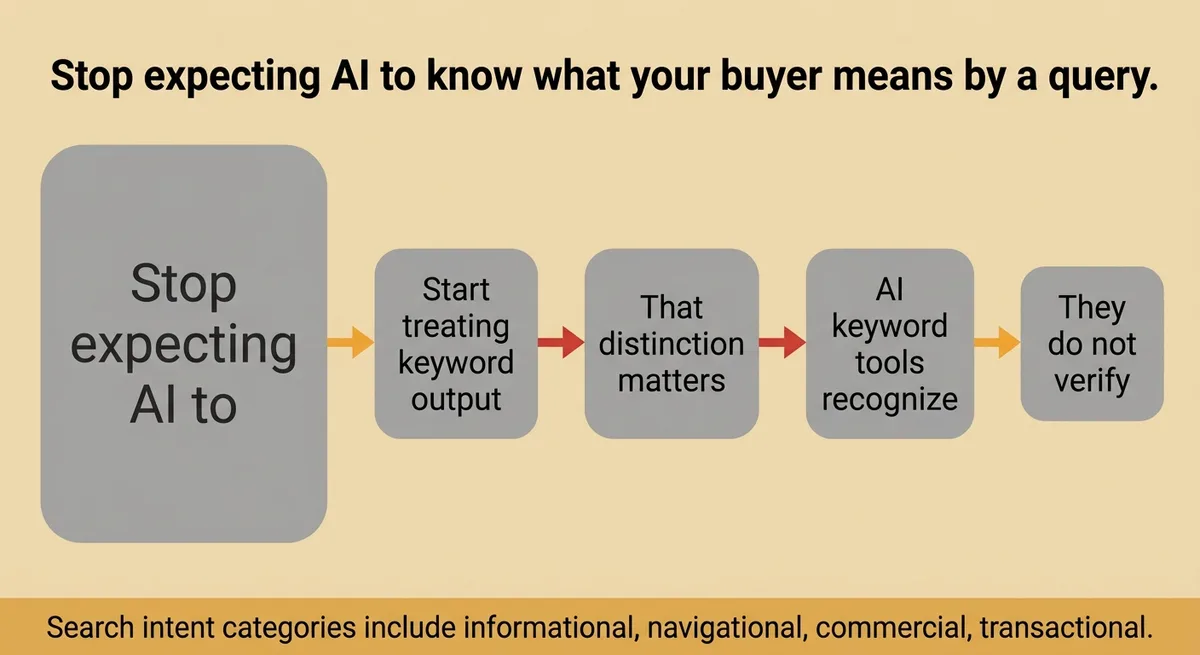
That distinction matters more than most content teams realize. AI keyword tools recognize which terms appear near each other in training data. They do not query Google, analyze SERP layouts, or verify whether a keyword currently attracts the buyer type you need.
The four search intent categories are informational, navigational, commercial, and transactional [4]. AI can label keywords with those categories. It cannot confirm which label applies to a specific query in your market, at this moment, for this audience. That label comes from reading live SERPs, studying the pages that currently rank, and understanding what a real buyer is trying to do before they click.
The six benefit areas of AI keyword research are speed, volume handling, semantic coverage, gap identification, clustering efficiency, and content ideation [4]. Those benefits are real. They live at the data layer. The strategic layer sits above them and requires judgment AI does not carry.
Here is the consequence when that distinction breaks down. A content team used AI to cluster 200 keywords by topic in under an hour. The cluster labeled “project management software comparison” got mapped to a landing page with transactional copy pushing a free trial. The queries in that cluster were navigational. People searching those terms were looking for a specific tool they already knew. The page attracted traffic and converted nothing. Six weeks of production time produced a page that ranks but does not contribute to pipeline.
AI gave speed on volume. The team needed judgment on match. Those are not interchangeable, and the gap between them does not surface in a keyword report.
Where AI-Generated SEO Content Fails the Accuracy Test
The hidden problem with AI content at scale is not obvious bad writing. It is plausible bad information. Drafts that pass a surface read but contain outdated statistics, hallucinated study citations, or entity names that have changed since the model’s training cutoff.
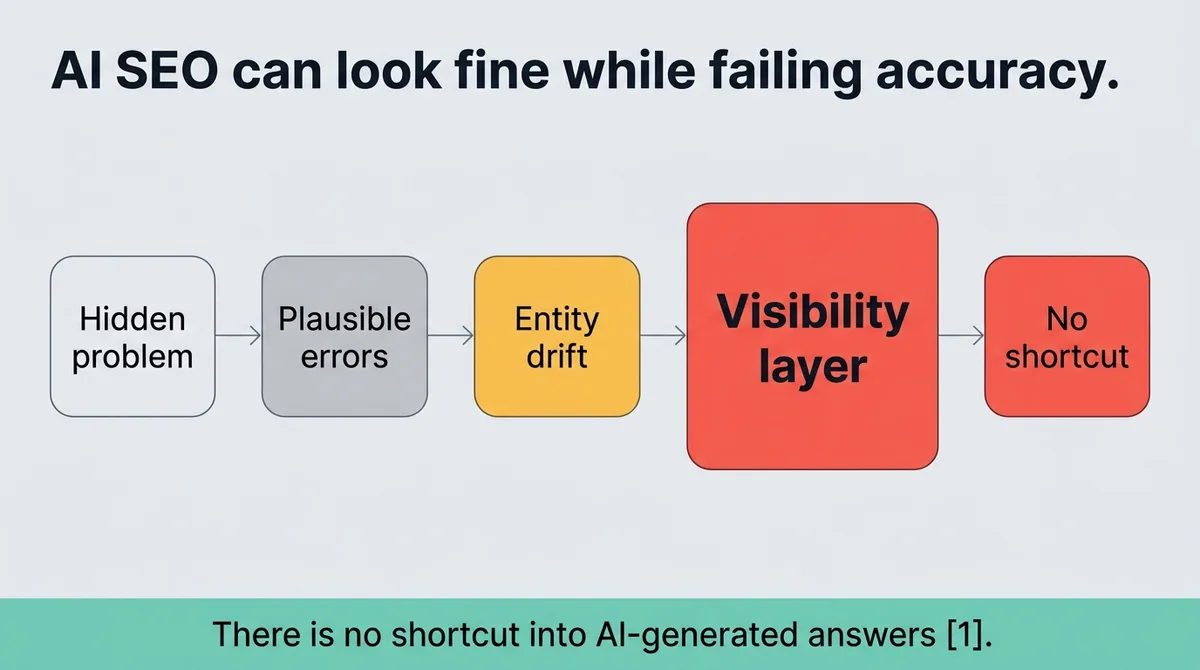
Two generative search features represent the current AI visibility layer in Google Search [1]. Pages appearing in these features must already be indexed and eligible for a featured snippet. There is no shortcut into AI-generated answers [1]. The page earns that position through existing signals, not through new formatting.
Three approaches teams frequently attempt do not work and are explicitly dismissed by Google’s own guidance [1]: adding special files or markup aimed at AI systems, restructuring content into chunks for AI parsing, and rewriting content specifically for AI-search formats. None of these substitutes for foundational accuracy. Publishing a technically formatted page with a hallucinated statistic does not perform better because the markup is tidy.
Build the Verify-Before-Ship rule into your pipeline as a named checkpoint. Before any AI-drafted content moves to publish or client approval, it passes three checks:
- Source traceability. Every factual claim links to a verifiable, current source. If no source exists, the claim gets rewritten or removed.
- Flagged factual claims. Numbers, dates, named studies, and attributed quotes get marked for manual confirmation before the draft clears review.
- Entity consistency. Brand names, product names, and people mentioned in the draft match current, confirmed usage. AI training data goes stale. Brand entities change.
The Verify-Before-Ship rule does not slow publishing. It stops the cycle of publishing, discovering an error, correcting, and re-submitting for indexing. That cycle costs more time than one structured review pass before the first publish.
A Decision Framework for Matching AI Assistance to SEO Task Risk
The SEO Task Risk Matrix is a pre-task decision step, not a retrospective audit. Before opening any AI tool for an SEO task, the team assigns a tier. That assignment determines how much human review the output requires before it moves forward.
SEO gains take time regardless of how content is produced. Measurable movement typically appears over a one-to-two month window after publishing [3]. That timeline makes publishing errors expensive. A page with a hallucinated citation or misaligned intent does not fail visibly on day one. It fails quietly over weeks while the team moves on to the next piece.
Two Google product areas where AI assistance carries lower risk are Merchant Center and Google Business Profiles [1]. Structured data feeds, product descriptions, and profile attributes follow defined formats. AI generates within those formats accurately and at volume. The human review layer checks for brand accuracy, not structural creativity.
The SEO Task Risk Matrix:
Tier 1 , Low risk, high AI autonomy Keyword clustering, meta description drafts, internal link mapping, topic ideation from a seed keyword list. AI operates with minimal review. A human spot-checks output before it enters the brief or CMS.
Tier 2 , Medium risk, AI plus structured human review Content briefs, topical gap analysis, entity optimization, FAQ drafts. AI generates. A human with subject knowledge reviews for intent match, accuracy, and brand alignment before the output moves downstream.
Tier 3 , High risk, human primary YMYL content, any claim requiring a citation, brand voice decisions, strategic positioning pages. AI may assist with structure or phrasing options. A qualified human writes and verifies the substance.
The operational rule is simple. No one opens an AI tool for an SEO task without knowing its tier first. That single constraint eliminates the most common failure mode: applying Tier 1 speed to Tier 3 content.
The SEO Task Risk Matrix does not require new software. It requires a shared decision before the work starts.
Where the SEO Task Risk Matrix pays off every sprint
Teams that tier their tasks before touching an AI tool stop losing weeks to content that looked done but was not ready. The speed gains are real. The accuracy failures are also real. The matrix keeps both in view at the same time.
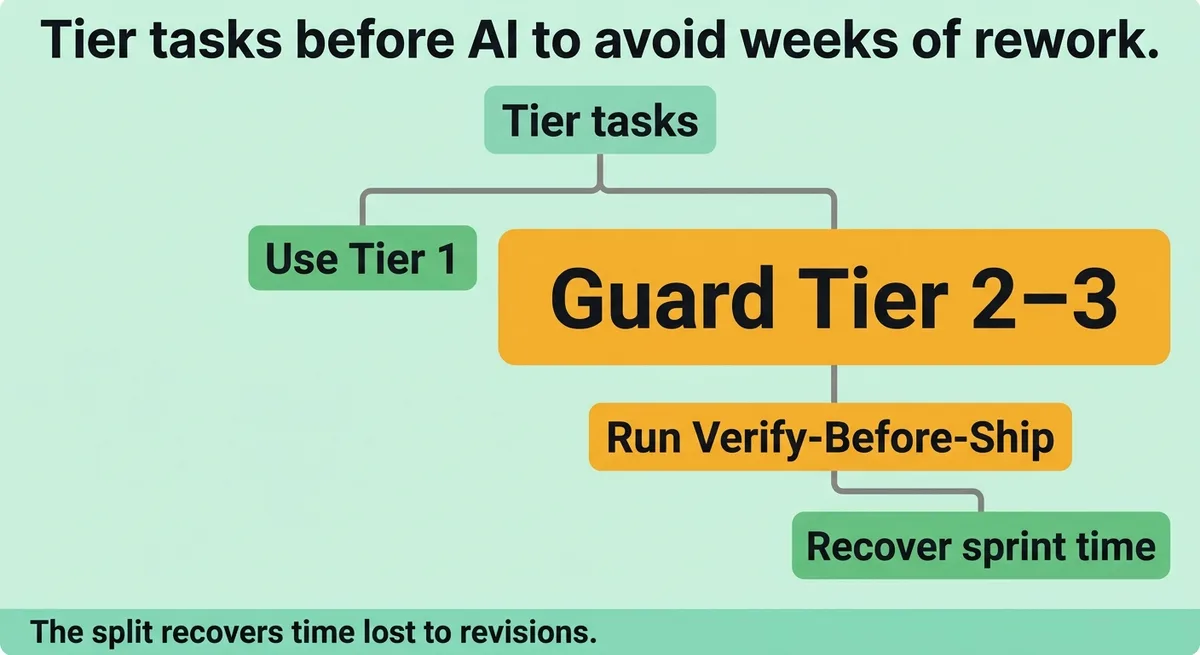
Run the Verify-Before-Ship check on every Tier 2 and Tier 3 output. Apply AI freely at Tier 1. That split alone recovers the time most teams lose to revision cycles and client correction requests.
Assign every task a tier. Ship what clears the check.
References and Citations
[1]https://developers.google.com/search/docs/fundamentals/ai-optimization-guide
[4]https://www.pageoptimizer.pro/blog/ai-keyword-research-the-future-of-seo-strategy
FAQ
AI should handle Tier 1 tasks such as keyword clustering, meta description drafts, internal link mapping, and topic ideation, while a human must review Tier 2 tasks like content briefs and FAQ drafts, and own Tier 3 tasks such as YMYL claims and brand positioning pages entirely. The SEO Task Risk Matrix gives teams a pre-task decision layer: assign a tier before opening any AI tool, and the review requirement follows automatically. That single constraint stops teams from applying Tier 1 speed to Tier 3 content, which is where most AI-assisted SEO failures originate.
AI-generated content ranks but does not convert when the keyword cluster is mapped to the wrong intent type, for example, when navigational queries are matched to a transactional landing page pushing a free trial. AI groups keywords by co-occurrence patterns in training data, but it cannot confirm which search intent category applies to a specific query in your market right now. That label requires reading live SERPs and understanding what a real buyer is trying to do before they click, which is a judgment call AI does not make.
AI keyword research is accurate at pattern recognition, clustering related terms by semantic co-occurrence, and surfacing gaps at volume, but it does not query live search results or verify current intent signals the way manual SERP analysis does. The six real benefits of AI keyword research are speed, volume handling, semantic coverage, gap identification, clustering efficiency, and content ideation, and all six operate at the data layer. The strategic layer, confirming which intent label actually applies to a query in your market today, still requires a human reading live SERPs.
A publishing workflow that ranks requires three connected layers: a tiered task assignment that decides what AI touches before the tool opens, a Verify-Before-Ship checkpoint that confirms source traceability, flagged factual claims, and entity consistency before any draft moves to the CMS, and a direct handoff to publishing so drafts do not stall between tools. Fragmented pipelines where keyword research, drafting, editing, and CMS publishing happen in separate tools with manual handoffs are where cadence breaks and articles stay perpetually in draft. Zelitho addresses this by connecting topic selection, research-backed draft generation, on-page optimization, and direct WordPress or Webflow publishing inside one workflow so the gap between a draft existing and an article being live is a process step, not a coordination problem.
No, reformatting content specifically for AI search features does not improve rankings, and Google’s own guidance explicitly dismisses adding special markup, restructuring content into AI-readable chunks, or rewriting for AI-search formats as substitutes for foundational accuracy. Pages that appear in AI-generated answer features must already be indexed and eligible for a featured snippet through existing signals, not through new formatting choices. Building content with verified sources, accurate entity names, and confirmed intent match is what earns that visibility, which is the approach Zelitho‘s research-backed draft generation with citations is designed to support from the start of production.