
Google ignored it. AI quoted it 3,258 times.
We had a 30-minute GEO readiness checklist built using Zelitho that barely registered in Search Console: 444 impressions, 2 clicks. No viral launch. No paid push. A practical page we almost overlooked. Then Bing AI Performance showed the other side: 3,258 visible citations in five months, roughly half of every AI citation on our site. Eat your own cooking: the post we built on our own platform became our strongest AI citation asset.
from one post
citation activity
citations
query cluster
Source: Bing Webmaster Tools AI Performance[1] (Pages + Grounding Queries exports, Jun 2026). A citation means your URL was visibly shown as a source in an AI-generated answer.[3]
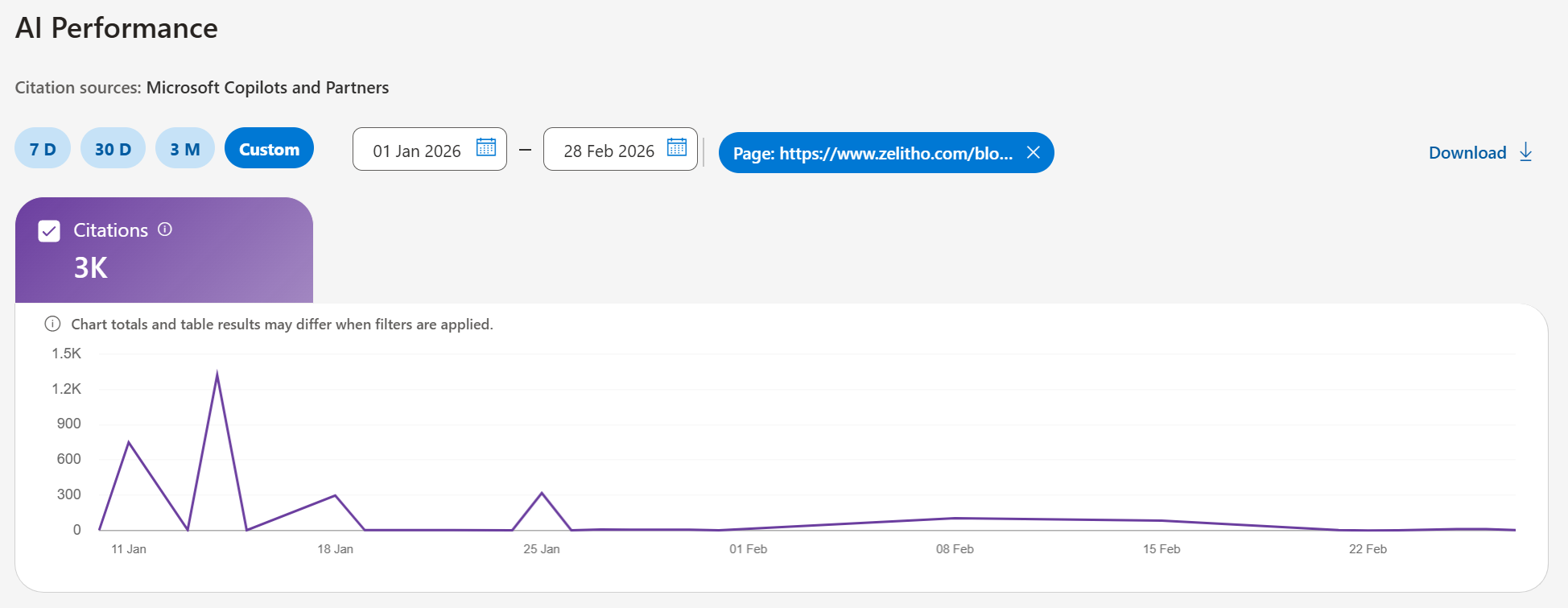
The scoreboard you check every morning may not be the one that matters
We felt this personally. The checklist we built using Zelitho had 444 Google impressions and 2 clicks in the same window. Two clicks. Meanwhile it was being surfaced as a source thousands of times in Copilot and Bing AI answers.[1] Official guidance puts it plainly: citations measure how AI systems use your content to generate answers, not rankings, clicks, or traffic.[4] Our numbers are not a flex. They are a wake-up call.
One checklist. Half the citations.
Between January 1 and June 2, 2026, a GEO audit checklist built using Zelitho became the most-cited page on zelitho.com. What follows is that page, how Bing defines what we measured, and the exports behind every number here.
What Zelitho published
The post was built using Zelitho: a practitioner-focused checklist with step-by-step GEO readiness tests a marketer or SEO can run in about 30 minutes. Clear H2/H3 structure, scannable sections, discrete audit steps. Each step answers a sub-question AI can pull out on its own. Not a product page. Not a landing page. A task-complete reference asset we produced on our own platform, then published to the blog.
What “3,258 citations” means
A citation is the number of times your content was visibly referenced or shown as a source in AI-generated answers.[1] Scope: Microsoft Copilot, AI-generated summaries in Bing, and select partner AI integrations. AI Performance does not measure rankings, authority, or importance. It only shows which content was cited and how often.
Data is aggregated and sampled.[6] Totals can differ across the Pages view, Grounding Queries view, and timeline. We label each denominator below so you know exactly what you are reading.
| Bing term | This case |
|---|---|
| Page citations | 3,258 |
| Share of page-level total (5,969) | 55% |
| Share of timeline total (6,671) | 49% |
| Top grounding phrase | 1,259 |
| Days tracked | 153 |
Page-level distribution
Of 44 cited pages and 5,969 page-level citations across the site, this one URL absorbed more than half. The next closest asset, our Complete GEO guide, earned 592 citations. Read that again: one checklist built in Zelitho outperformed a long-form pillar by more than 5x on citation frequency alone. That is the part that changed how we think about what the platform can produce.
Grounding query alignment
Grounding queries are grouped phrases the AI used when retrieving content.[2] They are not full user prompts. One query can map to multiple pages; one page can appear under multiple queries. Do not sum grounding-query rows to equal page totals.
Our top phrase, “GEO site audit AI search optimization,” aligns with the page title, H1, and practitioner intent. That is retrieval match, not keyword stuffing. Someone was asking how to audit their site. We gave them exactly that.
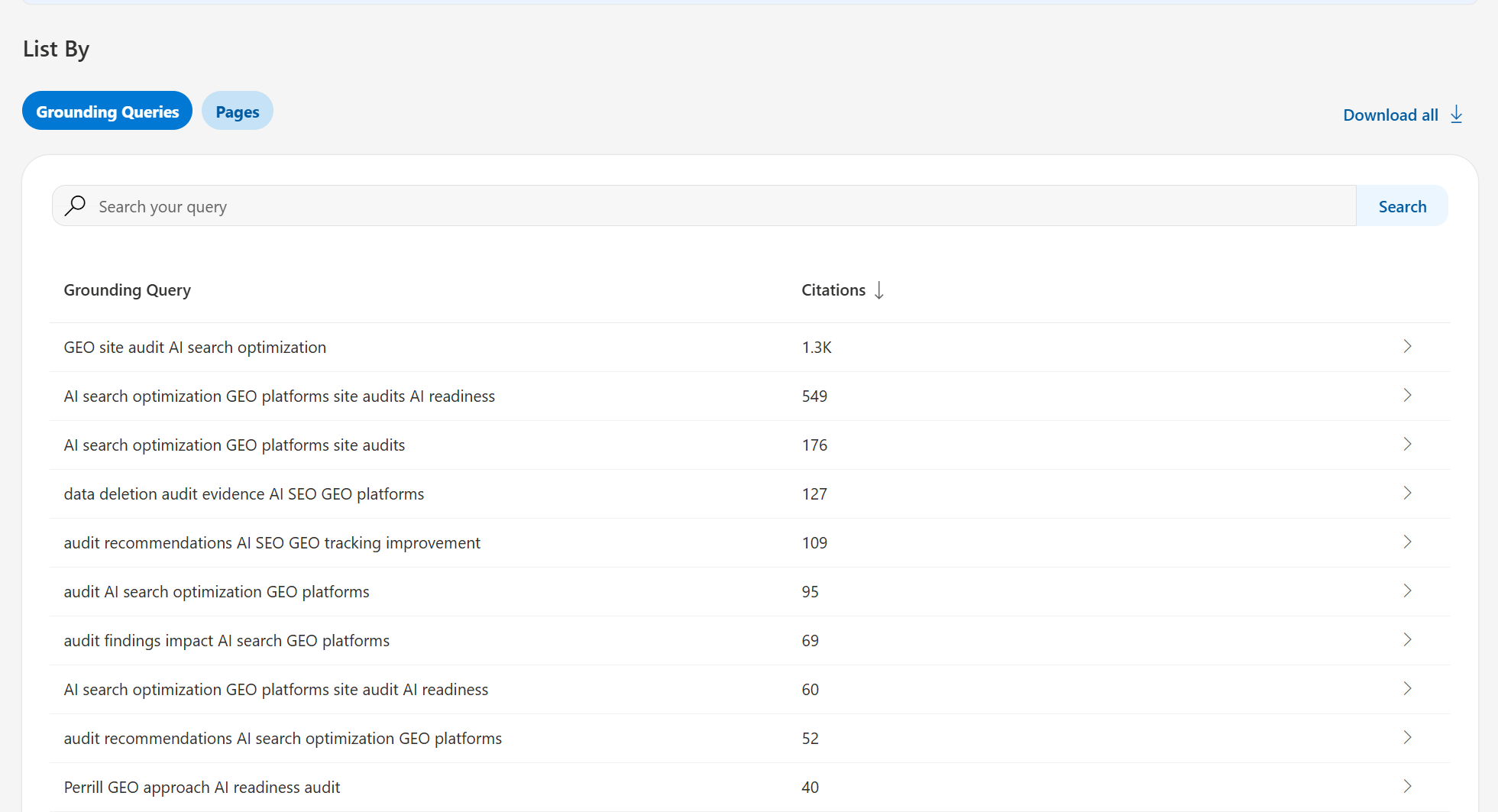
| Grounding phrase (grouped) | Citations |
|---|---|
| GEO site audit AI search optimization | 1,259 |
| AI search optimization GEO platforms site audits AI readiness | 567 |
| AEO GEO strategies impact on traditional SEO | 183 |
We did not chase virality. We made the page easy to quote.
There was no viral moment. No influencer push. We built a checklist the way you would explain the audit to a colleague: clear steps, plain language, nothing buried in prose. Those choices line up with published guidance for getting cited in AI-generated answers.[5] The format worked because Zelitho defaults to structured, retrieval-ready output.
Clarity and structure
Stepped audit flow with descriptive headings, concise sections, tables, and bullets. Information that is easier to understand and reference in AI answers.
Intent alignment
Title and H1 match the top grounding cluster (“GEO site audit”). The page answers the question practitioners ask in AI chat: how do I audit my site for AI search visibility?
Topic cluster depth
Internal links to related GEO/AEO guides reinforce subject focus. Those sibling posts are also cited (592, 463, 340). Cluster depth, not orphan content.
Evidence and freshness
Actionable steps with examples, author/byline, consistent entity naming, and dated updates when methodology changes. Signals Bing recommends for trustworthy reuse.
“We stopped asking which post would rank. We started asking what Zelitho could publish that AI would actually quote.”
Zelitho content teamYou do not need a bigger blog. You need one page AI can trust.
That is the takeaway we wish someone had handed us six months earlier. You do not need a hundred posts. You need one definitive, structured asset on a clear intent, built with a workflow that defaults to retrieval-ready format. That is what Zelitho is for.
Run the 30-minute GEO readiness checklist on your own site first. Then watch what moves in the AI Visibility Action Dashboard. Or build your next asset in Zelitho and measure whether AI picks it up the same way.
“The checklist did not feel like our biggest bet. The data said otherwise.”
Proof from content we built using ZelithoSix steps to build a citation asset
Repeatable workflow for teams that want one URL to earn outsized AI visibility.
- 1Pick one high-intent question your buyers ask in AI chat. Example: “How do I audit my site for AI search?”
- 2Publish a checklist, not a thought piece. Aim for 8 to 15 steps, each testable in minutes.
- 3Match title and H1 to the grounding cluster you want to own. Natural language, not keyword stuffing.
- 4Link to 2 or 3 supporting articles in the same topic cluster for depth.
- 5Export Bing AI Performance monthly. Pages, Grounding Queries, and timeline CSVs.
- 6Refresh when steps or tools change. Date-stamp updates so AI systems reference current information.
Source data
All AI citation metrics below come from Bing Webmaster Tools AI Performance[1] exports dated June 5, 2026. Google Search Console figures cover the same audit window.
| Metric | Value | Source |
|---|---|---|
| Page AI citations (checklist URL) | 3,258 | Bing AI Performance Pages export |
| Site page-level citation total | 5,969 | Same export (44 URLs) |
| Site timeline citation total | 6,671 | Bing AI Performance Overview export |
| Share of page-level citations | 54.6% (~55%) | 3,258 ÷ 5,969 |
| Share of timeline citations | 48.8% (~49%) | 3,258 ÷ 6,671 |
| Top grounding query citations | 1,259 | Grounding Queries export |
| Next closest cited page | 592 | Complete GEO guide |
| GSC impressions (same URL) | 444 | Google Search Console |
| GSC clicks (same URL) | 2 | Google Search Console |
| Date range | Jan 1 to Jun 2, 2026 | 153 days tracked |
What this case study does not prove
- Citations are not clicks, traffic, or engagement.[3]
- AI Performance is sampled and aggregated.[6] Not every real-world citation appears in the dashboard.
- Page counts show citation frequency, not ranking or importance within an answer.
- Scope is Microsoft Copilot, Bing AI summaries, and select partners. Not ChatGPT, Perplexity, Gemini, or Google AI Overviews.
- Site-wide spike days (e.g. Jan 14: 1,354 timeline citations) are observational; Bing does not attribute them to a single cause or page.
Frequently asked questions
What is an AI citation in this case study?
The number of times your content was visibly referenced or shown as a source in AI-generated answers across Microsoft Copilot, Bing AI summaries, and select partner experiences.[1] It is not traffic, clicks, or engagement.[3]
What is a grounding query?
A grouped phrase summarizing key terms the AI used when retrieving cited content.[2] It is not a full user question. Our top phrase (“GEO site audit AI search optimization”) registered 1,259 references in that grouped form during the export period.
Why did one post get 3,258 citations?
Strong alignment with top grounding queries plus checklist structure matching published guidance: clear headings, scannable steps, and intent-aligned copy.[5] Citation count reflects frequency of visible references, not a “#1 ranking” in AI.
Does 49% mean half of all traffic?
No. It means roughly half of tracked citation activity in the timeline export (6,671 total). Page-level share is 55% of the Pages export (5,969). Different views can show different totals because data is sampled and aggregated.[6]
Do AI citations match Google Search performance?
No. AI Performance metrics differ from traditional search metrics.[4] Our GSC data for the same URL (444 impressions and 2 clicks) versus 3,258 AI citations demonstrates that split directly.
How do I measure this on my own site?
In Bing Webmaster Tools, open the AI Performance report for your site.[7] Select your date range, then export Pages, Grounding Queries, and timeline data as CSV or Excel. Re-export monthly for trend analysis.
Can I replicate this without a large blog?
Yes. One definitive, structured asset on a clear intent can outperform dozens of generic posts, provided the page is index-eligible and aligned with how users ask questions in AI surfaces.
References
Methodology definitions summarized from Microsoft Bing Webmaster Tools AI Performance documentation. Anchor IDs match in-page citations.
- AI citation and scope. A citation is the total number of times your content was visibly referenced or shown as a source in AI-generated answers during the selected date range. AI Performance reflects activity across Microsoft Copilot, AI-generated summaries in Bing, and select partner AI integrations. It does not measure rankings, authority, performance, or importance.
- Grounding queries. Short grouped phrases representing key terms the AI used when retrieving content that was cited. They are not full user questions or prompts. One grounding query can map to multiple pages; one page can appear under multiple grounding queries.
- Citations vs engagement. A citation indicates that content was visibly referenced in an AI-generated answer. It does not represent traffic, clicks, or user engagement.
- AI vs traditional search metrics. Grounding and citations show how AI systems use your content to generate answers. This differs from traditional search metrics, which measure rankings, clicks, and traffic.
- Content practices for AI inclusion. Align content with user intent; use descriptive headings, concise sections, tables, and FAQ-style structure; strengthen depth across related topics; support claims with evidence; keep content fresh and accurate; maintain consistency across formats.
- Data sampling and views. AI Performance data is aggregated and summarized, not a complete log of every citation. Totals may differ across Pages, Grounding Queries, and timeline views. Timeline trends are observational and cannot be attributed to a single cause or event.
- Measuring on your site. In Bing Webmaster Tools, open AI Performance for your verified site. Export page-level citations, grounding queries, and timeline metrics as CSV or Excel. Use Grounding Query to Pages mapping to connect phrases to URLs. Data refreshes daily with a short processing delay.
Definitions [1]–[7] on this page are paraphrased for readability. Export filenames dated June 5, 2026.
Source: Microsoft Bing Webmaster Tools. AI Performance in Bing Webmaster Tools
Find out what AI is already saying about your site.
You might have a checklist hiding in plain sight. Run Zelitho’s 30-minute GEO audit on your own URLs, or build your next one using Zelitho, then see what Bing AI Performance reports back.