
What Is Generative Engine Optimization, and How Does It Improve AI Visibility?

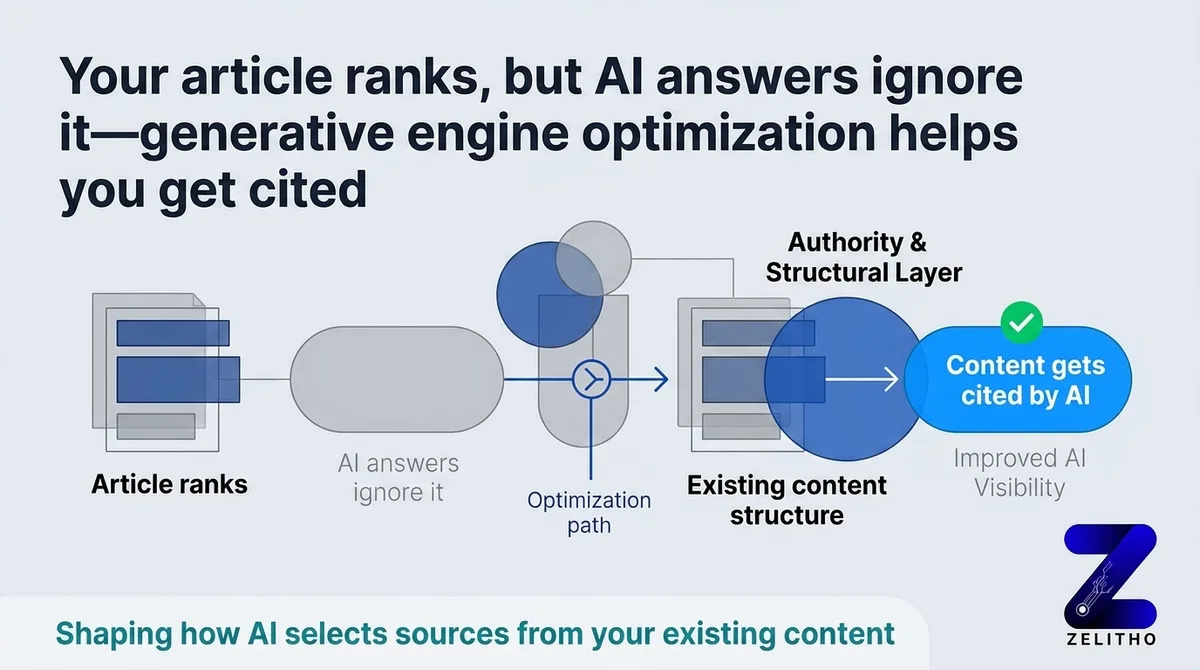
Generative Engine Optimization (GEO) is the practice of organizing website content, technical metadata, and verifiable claims so that artificial intelligence search systems select and cite your pages in conversational answers. Traditional search engine optimization focuses on securing ranked blue links on a results page, measuring success through organic impressions and clicks. GEO focuses on source selection during multi-model synthesis, optimizing for context-window extraction, entity verification, and citation inclusion across platforms like Microsoft Copilot, Perplexity, and ChatGPT Search.
What Is Generative Engine Optimization?
Generative Engine Optimization refers to the technical and editorial discipline of preparing web content for retrieval-augmented generation (RAG) engines. Unlike traditional search crawlers that rank entire documents based on link equity and page-level keyword relevance, AI search engines evaluate content at the passage and entity level.
When an AI engine processes a query, it breaks the prompt into sub-questions, retrieves relevant text passages from indexed sources, ranks those passages using dense semantic embeddings, and synthesizes a direct response. If your content lacks concise definitions, verifiable statistics, or structured formatting, the retrieval algorithm skips your page in favor of sources that present clear, extractable facts.
GEO Defined: What It Actually Means to Optimize for AI Answers
Consider what happens when a generative engine builds an answer in real time. It retrieves dozens of candidate passages across the web, evaluates their credibility, and selects three or four sources to display as citations. A mid-sized company blog with an authoritative explanation often beats an enterprise home page that ranks higher in traditional search.
That outcome illustrates how GEO changes the economics of search visibility. AI systems do not read web pages like human visitors. They extract structured components:
Clear, unambiguous definitions positioned in the opening sentences beneath each major heading.
Concrete figures, benchmarks, and publication dates anchored directly to named entities.
Structured comparative analysis resolving “X vs Y” questions that generative engines routinely synthesize.
Relational tables that translate cleanly into markdown representations inside language model context windows.
Recent benchmarking on generative answer inclusion confirms this mechanism [2]. Across datasets tracking thousands of conversational queries, structured, clearly attributed passages appeared in AI-generated answers 34.5% more often than unstructured narrative pages covering the same subject. The difference is not an algorithmic mystery: models choose the sources that provide the highest factual density with the lowest parsing friction.
How to Optimize a Website for AI Search Engines (GEO Implementation Framework)
Optimizing a website for AI search engines requires aligning your site architecture with the four stages of AI retrieval: crawl permission, static document extraction, semantic chunking, and entity validation.
Step 1: Configure Crawler Permissions for AI User-Agents
AI search engines rely on dedicated crawling bots that differ from standard search indexers. Verify that your server returns clean HTTP 200 responses and that your robots.txt file does not inadvertently block essential user-agents:
- Bingbot: Ingests pages for Microsoft Copilot and Bing Generative Search.
- GPTBot & ChatGPT-User: Powers OpenAI search grounding and live web retrieval.
- ClaudeBot: Anthropic retrieval and evaluation systems.
- PerplexityBot: Perplexity search indexer.
- Bytespider: ByteDance AI search and recommendation crawler.
Performance Note: Keep server response times (TTFB) under 500 milliseconds for these bots. Scrapers operating on tight latency budgets frequently terminate requests that defer content behind heavy client-side JavaScript hydration.
Step 2: Write Answer-First Passages (The 60-Word Rule)
Place the direct answer to the primary question in the first 45 to 65 words immediately beneath each major heading. Follow with supporting data, operational nuances, and implementation details. When an embedding model scores text passages against user queries, leading with the core definition maximizes semantic cosine similarity.
Step 3: Organize Relational Data into Semantic HTML Tables
Tabular data is one of the most reliable formats for earning AI citations. Models easily convert clean HTML tables into markdown representations within their internal context windows. Use explicit <th> headers and descriptive row labels so relational facts remain unambiguous.
Step 4: Anchor Content to Verifiable Entities
Avoid vague assertions like “most companies find efficiency improves.” State concrete figures and name the relevant tools, standards, or protocols. Linking key concepts to established Wikidata or Wikipedia entities helps language models disambiguate your content from generic marketing text.
Traditional SEO vs Generative Engine Optimization (GEO)
Understanding how GEO contrasts with traditional search helps marketing and engineering teams prioritize work without duplicating effort:
| Dimension | Traditional Search Engine Optimization (SEO) | Generative Engine Optimization (GEO) |
|---|---|---|
| Primary Objective | Rank URLs on page one of search engine results pages (SERPs). | Secure citations and source attribution inside AI-generated answers. |
| Discovery Surface | Google and Bing traditional 10-blue-link results. | Microsoft Copilot, ChatGPT Search, Perplexity, Google AI Overviews. |
| Core Mechanism | Page-level keyword indexing and backlink authority algorithms. | Passage-level dense vector retrieval (RAG) and entity grounding. |
| Content Architecture | Long-form comprehensive articles targeting keyword clusters. | Syntactically chunked answer blocks, semantic tables, and schema. |
| Key Success Metrics | Keyword rank, organic impressions, organic click-through rate (CTR). | Citation frequency, prompt share of voice, AI referral conversions. |
GEO Visibility Optimization for U.S. and Enterprise Companies
For enterprise organizations and U.S. businesses managing content at scale, generative search creates both risk and opportunity. When buyers research B2B software, service providers, or regulatory guidance inside conversational interfaces, they rarely scroll past the synthesized answer.
Capturing visibility in this environment requires three enterprise capabilities:
LLMs verify internal claims against external datasets. If your corporate Wikipedia entry, Wikidata record, and Crunchbase profile present conflicting information regarding products or pricing, model confidence drops and citations default to industry analysts.
Enterprise security teams frequently configure web application firewalls (WAFs) like Cloudflare or AWS CloudFront with over-aggressive bot mitigation rules. Inadvertently blocking ChatGPT-User or Bingbot eliminates your domain from real-time grounding retrieval.
Platforms like Bing Webmaster Tools now provide dedicated AI Performance dashboards. Regularly reviewing top opportunity queries allows enterprise content teams to identify high-volume conversational prompts where competitor brands earn citations but their own domain is absent.
The Three-Layer Visibility System: Structure, Authority, and Metadata
The Three-Layer Visibility System describes the three conditions AI systems evaluate when selecting sources. If one layer fails, the remaining layers cannot compensate.
Layer 1: Structure
Structure means a page answers a question before providing historical context or narrative background. A direct definition belongs in the opening paragraph. A clear assertion should precede its supporting evidence. Google’s technical documentation for AI optimization emphasizes that structured, factual inputs in merchant and business profiles consistently achieve higher visibility because structured data reduces machine ambiguity [1].
Layer 2: Authority
Authority in the GEO context reflects content-level verifiability rather than domain-wide backlink counts. A named author with documented industry expertise, cited statistics with direct source links, and clear publication timestamps give language models confidence to reference the material without risking hallucination.
Layer 3: Metadata
Metadata extends beyond standard title tags. Comprehensive JSON-LD schema (including TechArticle, FAQPage, and Organization markup) provides explicit semantic declarations that crawlers ingest directly. When paired with current last-modified dates, schema helps retrieval systems recognize that a page offers fresh, accurately scoped insights.
How to Measure Whether Your Content Is Actually Being Selected
Tracking GEO performance requires shifting focus from position rankings to citation inclusion:
- Track Citation Frequency: Record how often your URLs appear as cited sources across target queries in Copilot, ChatGPT, and Perplexity.
- Examine Answer Proximity: When an engine cites your article, evaluate whether it quotes your specific definitions and data or merely lists your link in an extended footnote. High proximity indicates strong passage extractability.
- Identify Coverage Gaps: Monitor high-demand industry queries where generative answers cite competing brands. These gaps represent high-priority optimization opportunities where your core content already exists but requires structural remediation.
What Factors Influence Company Mentions in ChatGPT and AI Answers?
Company mentions in ChatGPT, Microsoft Copilot, and Perplexity depend on four primary factors: entity disambiguation in structured knowledge graphs, factual consensus across multi-source reviews, syntactic passage extractability, and retrieval freshness. Generative models prioritize sources whose claims can be validated against independent third-party records.
Clear alignment of your organization name with established Wikidata entities, official registries, and schema metadata prevents model confusion and hallucinated attributions.
AI engines corroborate factual claims across external publications, verified case studies, and industry comparisons before recommending a provider.
Passages that present concrete figures, operational timelines, and technical capabilities within self-contained 250 to 350 token chunks rank higher during passage retrieval.
Grounding systems favor recently modified documents containing current-year benchmarks and validated protocol updates over static archival pages.
How Brands Track Citation Share of Voice Across LLMs
Tracking citation share of voice across large language models requires auditing how frequently your domain appears as a source compared to competitors for target buyer queries. Enterprise marketing teams monitor three essential metrics:
- Citation Share of Voice (SoV): The percentage of generative responses in your category that cite your content.
- Passage Extractability Score: The frequency with which an AI engine quotes your exact sentences or data points directly in the generated summary.
- Brand Sentiment Rating: The qualitative evaluation (positive, neutral, or critical) assigned to your organization during comparative model syntheses.
Frequently Asked Questions About Generative Engine Optimization
What is Generative Engine Optimization?
Generative Engine Optimization (GEO) is the process of formatting website content and technical signals so artificial intelligence search engines (such as Microsoft Copilot, Perplexity, and ChatGPT Search) extract, summarize, and cite your pages in conversational answers.
How do you optimize a website for AI search engines?
To optimize a website for AI search engines, ensure your robots.txt allows crawlers like GPTBot and Bingbot, structure articles with answer-first paragraphs beneath each heading, include clean HTML comparison tables, link key claims to verifiable entities, and implement structured JSON-LD schema markup.
Why are U.S. companies investing in GEO visibility optimization?
U.S. businesses and enterprise brands are investing in GEO because a growing share of product research and high-intent buyer queries now occur inside conversational AI interfaces, where only cited sources receive brand visibility and qualified referral traffic.
What is the difference between SEO and GEO?
Traditional SEO optimizes for keyword rankings and organic click-throughs on search results pages, whereas GEO optimizes for passage extraction, factual attribution, and citation inclusion inside AI-synthesized responses.
What factors influence company mentions in ChatGPT answers?
Company mentions in ChatGPT answers are governed by entity disambiguation in structured knowledge graphs, verified multi-source consensus across third-party websites, high factual density in modular passages, and regular updates reflected in schema markup.
How do brands track citation share of voice across LLMs?
Brands track citation share of voice by running automated prompt audits across models like ChatGPT, Perplexity, and Copilot, measuring the percentage of target queries where their URLs are cited, and quantifying direct passage extraction rates.
References and Citations
[1]https://developers.google.com/search/docs/fundamentals/ai-optimization-guide
[2]https://www.coursera.org/articles/what-is-generative-engine-optimization