
What Is Content For? Understanding Its Purpose and Functions

Content is structured information engineered to perform a specific job for a specific recipient at a defined moment in their decision journey. In modern search environments, content must simultaneously serve two audiences: human buyers seeking clarity to solve a problem, and AI retrieval models (like ChatGPT, Perplexity, and Copilot) seeking grounded, verifiable facts to cite. Understanding content by function rather than format enables editorial teams to implement answer-first formatting, syntactic chunking, and semantic schemas that win AI citations while driving commercial conversions.
What does content actually do for a business?
Content is not a format, a publishing schedule, or an arbitrary word count. Content is meaning delivered to do a job. That job might be answering a buyer’s immediate question, resolving a technical objection during vendor evaluation, or providing structured data that an AI answer engine can retrieve and cite as an authoritative source.
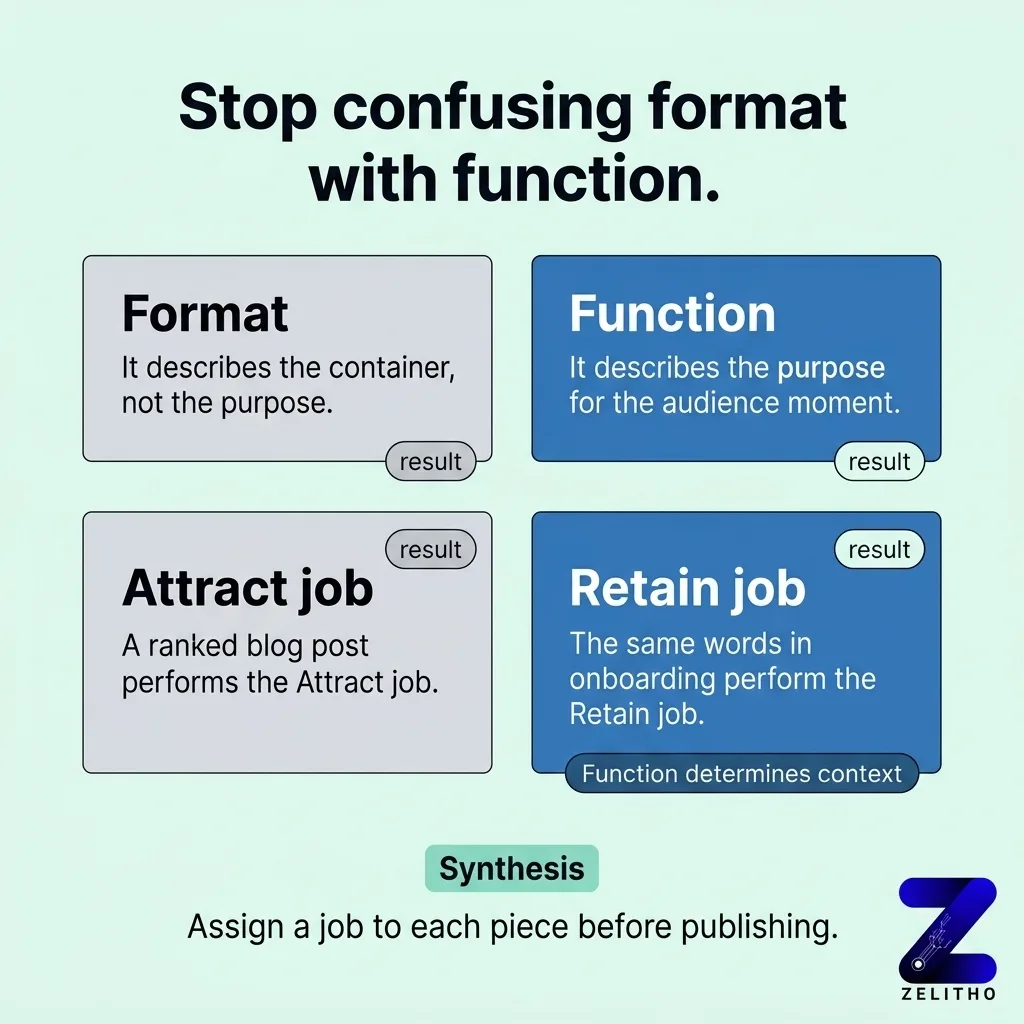
Most publishing failures occur when editorial teams organize their work around containers (writing “a weekly blog post” or producing “an infographic”) rather than functional outcomes. When you define content by its operational job, format becomes a tactical choice rather than the goal itself.
The Four Traditional Jobs of Content and the Emerging Fifth Job
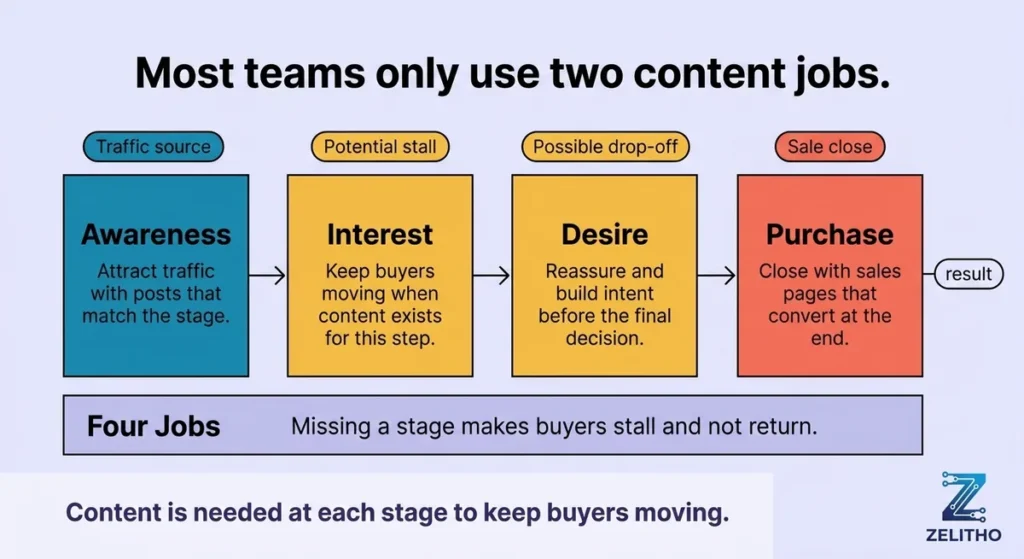
In standard marketing frameworks, content performs four sequential jobs across the customer journey:
- Job 1: Attract. Content that captures cold interest by answering high-volume informational questions. It earns the initial visit.
- Job 2: Inform. Content that develops interest into comprehension. It explains architectural mechanics, operational frameworks, and strategic alternatives.
- Job 3: Convince. Content that moves an educated buyer toward commercial intent. Comparison grids, case studies, and transparent ROI benchmarks operate here.
- Job 4: Retain. Content that reinforces existing customer confidence, accelerates onboarding, and reduces post-purchase churn.
In the era of generative search engines, high-performing editorial operations add a critical fifth job: Machine Grounding & AI Retrieval. This is content structured so that autonomous web scrapers, embedding models, and RAG vector stores can ingest, verify, and cite your brand inside synthesized answers.
| Content Job | Target Stage | Primary Human Outcome | AI Retrieval Function | Failure Mode Without It |
|---|---|---|---|---|
| Attract | Awareness | Discovery of category and problem space. | Matches top-of-funnel informational prompts. | Zero inbound pipeline. |
| Inform | Interest & Research | Deep comprehension of mechanisms and trade-offs. | Provides clear entity definitions and syntactic blocks. | High bounce rates; no trust. |
| Convince | Evaluation & Intent | Confidence that this vendor solves the specific need. | Populates comparative prompts and vendor bake-offs. | Deals stall during evaluation. |
| Retain | Post-Sale & Loyalty | Faster time-to-value and lower implementation friction. | Powers technical support bots and documentation search. | Elevated customer churn. |
| Machine Grounding | Generative Citations | Brand authority cited directly inside ChatGPT and Perplexity. | Extracts clean facts, comparison matrices, and JSON-LD data. | Total invisibility in AI answers. |
Research across B2B purchasing demonstrates that 45% of buyers consume three to five content pieces before initiating vendor contact [3]. When teams produce solely top-of-funnel articles, they leave middle-of-funnel research to competitors. In AI search, the penalty is immediate: if your library lacks answer-first structuring and comparison grids, AI models cite third-party reviews and competitor pages instead.
Content Formatting Best Practices for AI Retrieval and Chunking
To ensure content performs its functional job in generative search, editorial workflows must implement proven AI retrieval formatting standards. Large language models retrieve and process content in discrete token chunks (typically 250 to 400 words). If a critical definition or comparative table is buried inside conversational fluff, the retrieval model truncates the passage and skips citation.
Implement these four content formatting standards across every published asset:
Deliver a direct, entity-rich definition of the core topic within the first 45 to 65 words immediately following an H2. State the entity, its primary operational mechanism, and its business impact. Eliminate introductory filler such as “In today’s fast-paced digital world.”
Structure every sub-heading as a self-contained module of 250 to 350 tokens. Ensure each chunk includes at least two named entities and one verifiable metric. When an LLM retrieves a single chunk for grounding, that chunk must deliver complete, unambiguous meaning independently.
Use clean HTML tables with semantic table headers rather than nested card components. Embedding models retain relational entity context across structured rows and columns far more effectively than unstructured prose, drastically increasing citation probability for vendor comparisons.
Conclude technical articles with 3 to 5 targeted question cards addressing exact conversational queries. Mirror these questions in JSON-LD FAQPage and TechArticle schema, linking core concepts directly to Wikidata entity URIs.
The Future of Blogging: Adapting Workflows for Conversational AI Search
Blogging is not dying; the low-effort aggregation model of blogging is dying. When an AI assistant can summarize twenty listicles in three seconds, publishing generic regurgitated tips provides zero value to humans and zero citation incentive to search engines.
To thrive in conversational search environments, editorial workflows must adapt along three operational lines:
Stop stuffing exact-match keywords. Focus on entity relationships, domain ontology, and linking proprietary data to authoritative knowledge bases. LLMs cite sources that demonstrate deep, structured subject mastery.
Replace 3,000-word repetitive guides with concise, dense explanations. Provide clear answers upfront, followed by original empirical data, step-by-step methodologies, and technical decision criteria.
Rather than waiting months for ranking shifts, track AI crawler telemetry and citation rates continuously. Use platforms like Zelitho to patch retrieval friction in existing articles and maintain AI grounding.
Content Formatting for Generative Engines: Answer-First Structure and Chunking
Structuring content for generative engines requires formatting articles with answer-first inverted pyramid hierarchies, clear question headings, and modular 250 to 350 token syntactic units. When informational articles provide direct definitions immediately beneath each heading, retrieval algorithms extract answers with minimal computational overhead.
Place the complete answer in the opening 50 words below each H2 before presenting technical elaboration or operational nuances.
Design sections as standalone topical chunks so embedding models can extract self-contained meaning without losing sentence context.
Monitor articles for citation drop-offs, outdated statistics, and missing entities to refresh passages before competitive sources replace them.
Frequently Asked Questions About Content Purpose & AI Formatting
What are content formatting best practices for AI retrieval and chunking?
Best practices for AI retrieval chunking include formatting content into modular 250 to 350-token sections beneath clear semantic H2 headers, delivering answer-first definitions in the opening 50 words, utilizing structured comparison tables for relational data, and applying JSON-LD schema with Wikidata entity linkages.
How does answer-first formatting increase AI citation likelihood?
AI answer engines rely on similarity scoring between user prompts and web content chunks. Placing a direct, factual answer immediately below the heading provides the embedding model with an unambiguous match, dramatically increasing the probability that the search scraper extracts that chunk as a cited source.
Which content formats do AI models prefer to cite?
AI models demonstrate a strong preference for citing structured technical articles, comparative evaluation tables, transparent benchmark case studies, and well-organized FAQ sections. Dense, verified tabular data and unambiguous step-by-step methodologies receive substantially higher citation rates than generic opinion essays.
What is AEO content writing?
AEO (Answer Engine Optimization) content writing is the practice of structuring text, data tables, and technical metadata specifically to be indexed, understood, and cited by AI answer engines such as ChatGPT Search, Perplexity, and Google AI Overviews. It emphasizes factual conciseness, entity clarity, and syntactically chunked answers over traditional keyword repetition.
What is answer-first content formatting and why is it essential for AI search?
Answer-first content formatting delivers the primary answer in the first 45 to 60 words beneath each section heading. It is essential for AI search because semantic embedding models prioritize passages that immediately answer user queries without preliminary fluff.
What are the key signs of content decay in blog articles?
Key signs of content decay include loss of citations in AI answer engines, declining organic impressions for high-intent queries, outdated third-party statistics, and broken outbound reference links.
References and Citations
[1]https://www.toprankmarketing.com/blog/what-is-content/
[2]https://www.justwords.in/blog/what-is-content/
[3]https://www.digitalnrg.co.uk/the-essential-guide-to-understanding-the-meaning-of-content/
[4]https://wwwext.arlut.utexas.edu/ccu/what_is_cu.shtml
[5]https://www.braintraffic.com/blog/defining-content-terminology-to-build-community