
What Is AI in Digital Marketing? Use Cases, Benefits, Challenges, and Tools

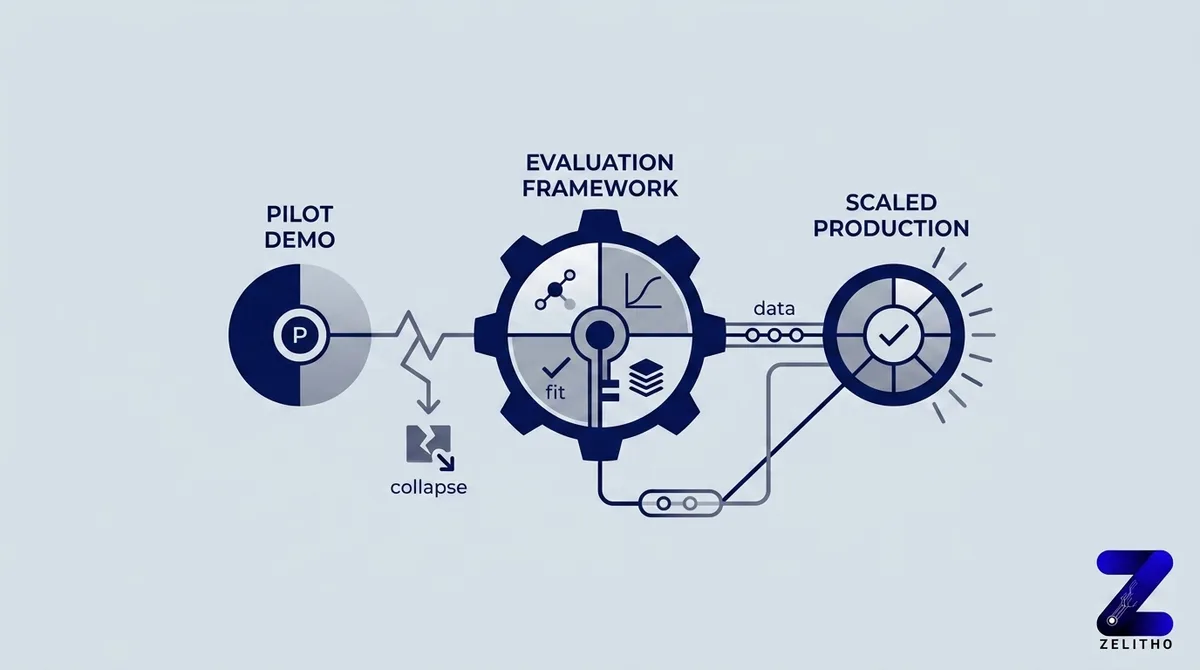
AI in digital marketing refers to the use of machine learning, natural language processing, and automated reasoning to anticipate buyer needs, personalize messaging, and maintain brand authority across digital search surfaces. As buyers migrate from traditional Google search to generative answer engines like ChatGPT, Perplexity, and Copilot, digital marketing strategy must expand beyond legacy SEO. Marketers who implement an Answer Engine Optimization (AEO) experimentation roadmap capture market share by securing direct citations inside AI synthesized answers while competitors remain invisible.
What percentage of AI marketing initiatives actually succeed?
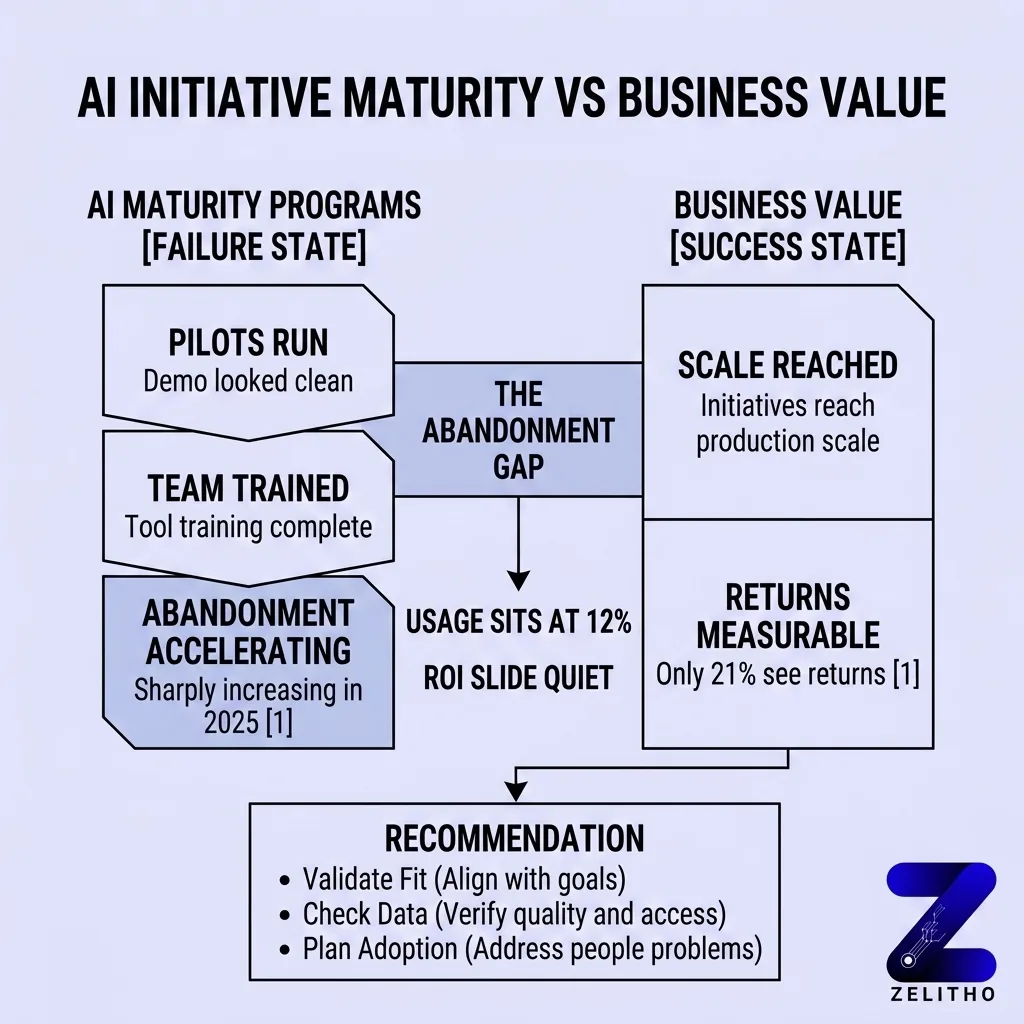
Only 21% of AI initiatives in marketing reach production scale with measurable returns on investment [1]. Despite widespread experimentation (with 88% of organizations regularly testing generative tools), the majority of companies struggle to turn pilots into permanent revenue drivers.
The gap between initial experimentation and production value accelerated sharply in 2025, with 42% of companies abandoning projects due to poor integration, unready data, and an inability to track commercial attribution [1]. In search marketing specifically, the shift from traditional keyword targeting to Answer Engine Optimization requires an entirely new framework: prioritizing semantic chunking, structured entities, and grounding signals over generic content volume.
The Shift in Buyer Behavior: When Buyers Use ChatGPT Instead of Google
The primary catalyst transforming digital marketing is buyer research behavior. When enterprise decision-makers and consumers evaluate products, a growing percentage query AI answer engines rather than scanning pages of blue links. In response, AI engines do not present a list of websites; they synthesize an authoritative summary, citing only two or three preferred sources.
This dynamic introduces a severe market asymmetry: brands with top-ranked Google positions frequently have zero visibility inside AI answers. A study of AI search grounding revealed that 88% of citations in AI assistant outputs come from sources outside Google top 10 rankings. If your digital marketing strategy only optimizes for traditional search results, your brand becomes invisible at the exact moment purchase decisions are synthesized.
| Dimension | Traditional Digital Marketing (SEO) | Generative AI & AEO Marketing |
|---|---|---|
| Primary Target | SERP keyword rankings, page impressions, and organic clicks. | Machine citation grounding, AI share of voice, direct answer inclusion. |
| Buyer Discovery | User types keywords, scans 10 blue links, clicks multiple tabs. | User asks natural language question, reads synthesized comparison with 2-3 cited brands. |
| Content Architecture | Long-form comprehensive guides, keyword density, internal backlink trees. | Syntactically chunked 300-word blocks, answer-first summaries, structured comparison tables. |
| Conversion Path | Landing page lead magnets, popups, and gated whitepapers. | High-intent AI referral traffic arriving pre-educated with explicit intent. |
The AEO Experimentation Roadmap: Marketers’ Path to AI Visibility and Conversions
Senior marketers managing client acquisition cannot solve AI invisibility by publishing more generic blog articles. Capturing AI share of voice requires a structured, four-phase experimentation roadmap designed to identify citation gaps, test grounding hypotheses, and deploy machine-readable content patches:
Run synthetic prompt batteries across ChatGPT, Perplexity, Claude, and Microsoft Copilot across your top 50 commercial evaluation queries (for example: “best marketing automation tools for mid-market b2b”). Document your baseline AI citation rate, sentiment score, and which competitors are cited in your place.
Audit high-ranking legacy URLs that lack AI citations. Measure four retrieval friction factors: Answer-First placement (is the core definition delivered within 60 words?), Token Chunkability (are headings structured as clean 250-350 token modules?), Entity Disambiguation (are Wikidata URIs declared?), and semantic table formatting.
Instead of writing new pages from scratch, update underperforming legacy URLs with citation-engineered patches. Inject an answer-first executive card, a responsive comparison grid, targeted FAQ cards, and dual-layer schema markup. Push updates directly via CMS API and ping IndexNow to trigger instant crawler re-indexing.
Monitor crawler logs for immediate re-scraping by GPTBot, ClaudeBot, and Bingbot. Track weekly citation deltas in Bing Webmaster Tools AI Performance reports, and measure downstream assisted conversions from AI referral visitors in Google Analytics 4.
The Four Failure Modes: Where AI Marketing Breaks Down Before It Scales
Beyond search visibility, broader marketing AI implementations fail because organizations confuse technology capabilities with operational readiness. Four documented failure modes explain where budget disappears:
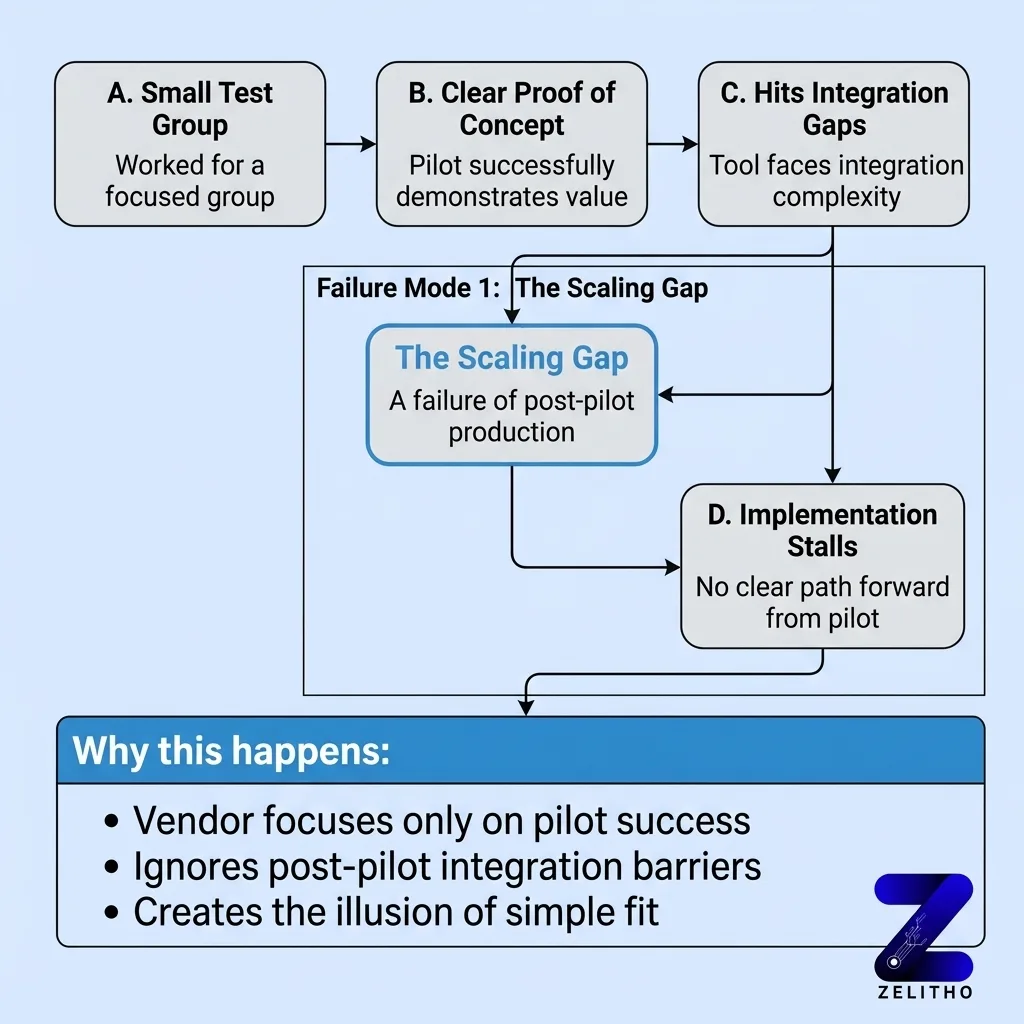
95% of enterprise AI pilots fail due to integration bottlenecks [1]. A small pilot works in isolation, but stalls when trying to coordinate across departmental approval chains, enterprise security audits, and legacy databases.
65% of organizations lack AI-ready data [1]. Generative models cannot produce differentiated value if brand briefs, tone guides, and customer personas are fragmented across unmaintained documents.
48% of mature organizations encounter security roadblocks [1]. SaaS tools handling proprietary customer data often spend 6 to 12 months navigating IT reviews, closing budget windows before implementation starts.
54% of executives cite team resistance as a core barrier [1]. Teams complete training seminars, but usage falls to 12% within three months if tools are not integrated into daily performance reviews.
| Failure Mode | Primary Diagnostic Signal | Documented Commercial Cost |
|---|---|---|
| Scaling Gap | Pilot clears small test group, production rollout stalls. | 95% enterprise pilot abandonment rate. |
| Data Unreadiness | Model outputs require extensive manual re-writing. | Over 60% of initiatives abandoned before positive ROI. |
| Security Friction | Vendor tool remains trapped in IT and legal review queues. | 6 to 12-month deployment delays. |
| Cultural Resistance | High training completion, active daily usage under 15%. | 6x lower realization rate without active change management. |
The Fit-First Framework: Sorting High-Value AI Uses from Weak Ones Before You Spend
The Fit-First Framework serves as a pre-purchase evaluation filter. Rather than asking “What can this tool do?”, ask “Does our organization possess the operational conditions this tool requires to function?”:
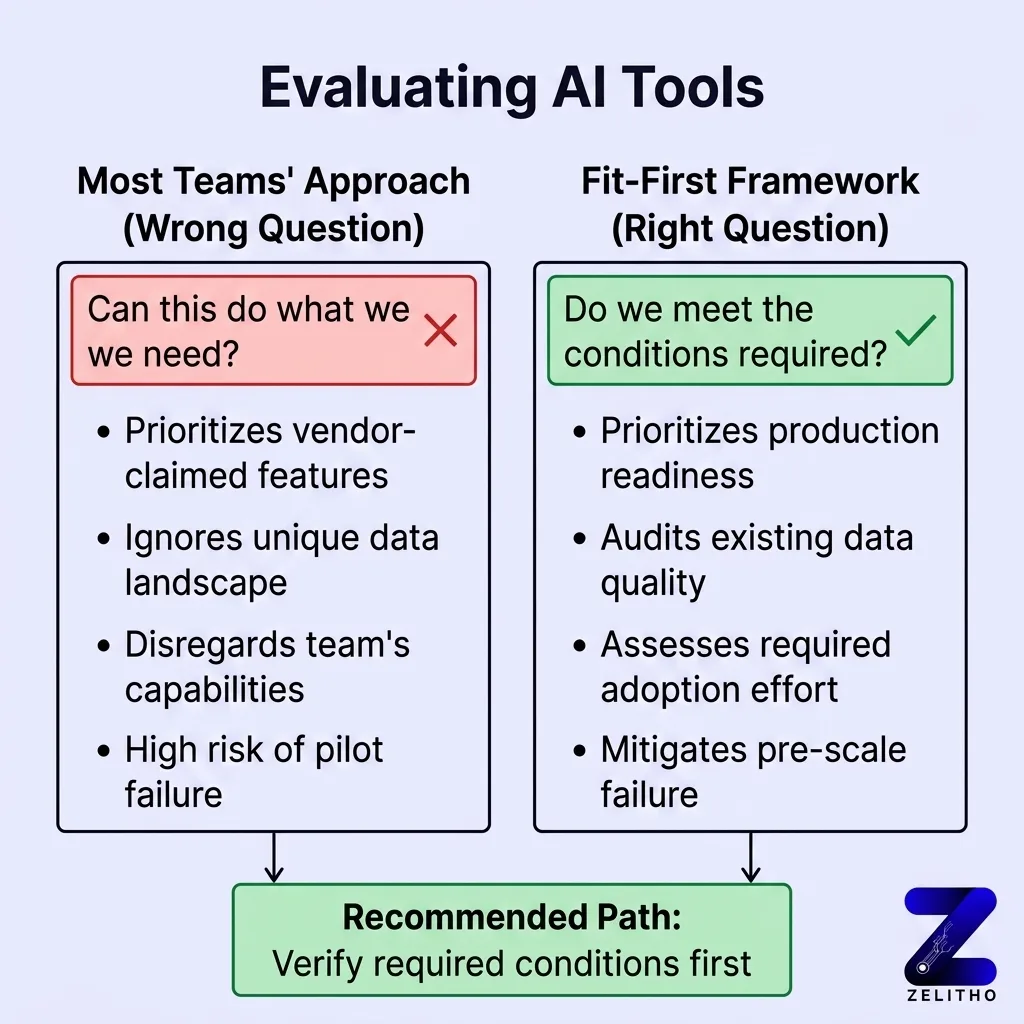
Sort potential applications across three gating criteria:
- Task Repeatability: Focus AI tools strictly on high-frequency, structured tasks with defined success criteria (such as drafting answer-first summaries, generating schema, or monitoring brand mentions across prompts). Avoid unstructured creative strategy tasks where human judgment is the primary quality signal.
- Source Data Accessibility: Confirm that reference documentation exists in centralized, machine-readable formats. If tone guidelines, product specs, or customer case studies are scattered across Slack or email, pause tool procurement until knowledge bases are consolidated.
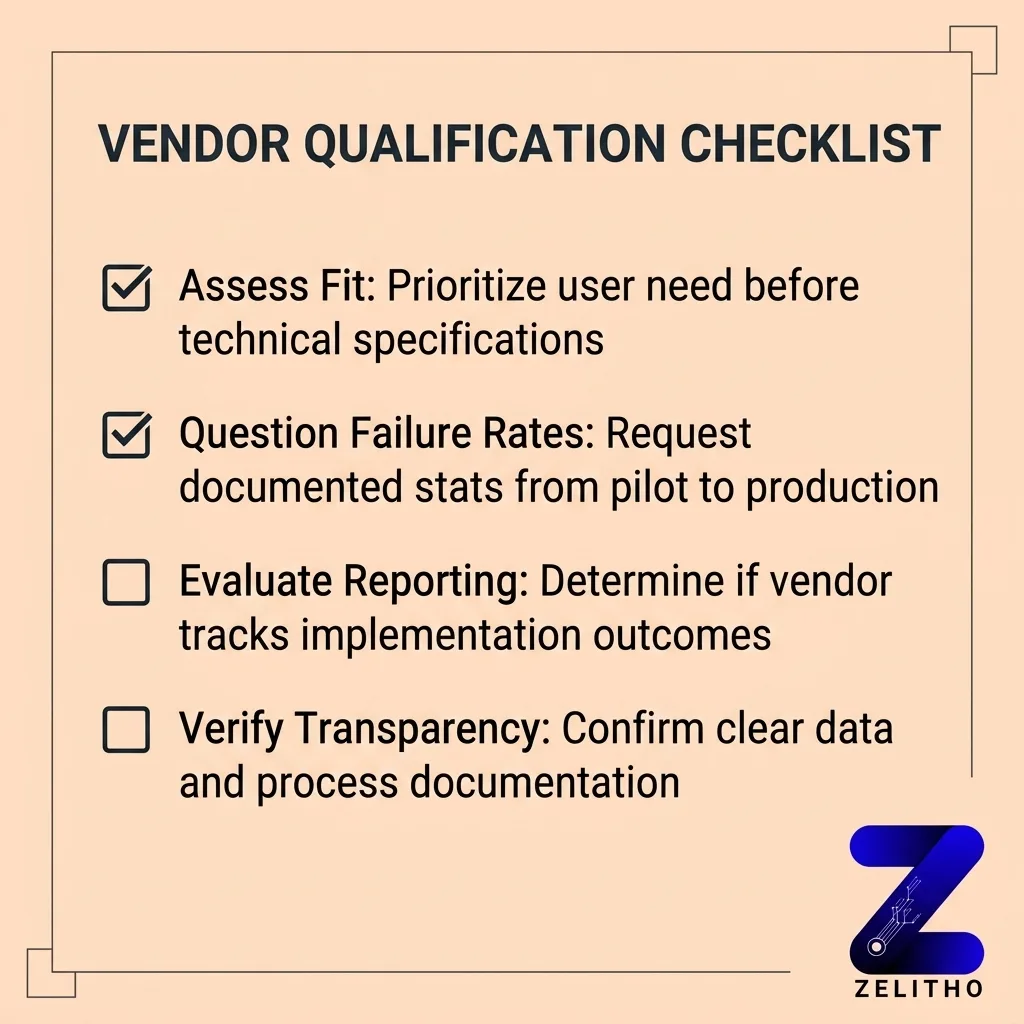
- Closed-Loop Integration: Choose solutions that connect directly to your publishing and analytics infrastructure. Tools like Zelitho close the loop between detecting citation gaps and deploying content patches directly into the CMS.
Commercial Impact: How ChatGPT Recommendations Influence Sales and Brand Sentiment
Proving how ChatGPT recommendations influence sales pipeline requires connecting AI search visibility with closed revenue attribution. When enterprise buyers query conversational engines for vendor recommendations, cited companies experience higher conversion velocity and qualified lead engagement than traditional web channels.
Buyers using ChatGPT often enter sales cycles with pre-validated requirements, having already compared architectures, integrations, and compliance benchmarks.
Reporting brand sentiment metrics to leadership ensures marketing executives understand whether models portray the company as an innovative category leader or a legacy provider.
More than 60% of modern B2B procurement teams now consult conversational AI tools during preliminary vendor research before submitting formal requests for proposals.
Frequently Asked Questions About AI in Digital Marketing
What is an AEO experimentation roadmap for marketers?
An AEO (Answer Engine Optimization) experimentation roadmap is a phased methodology for testing and improving brand citation rates across conversational AI engines. It involves auditing baseline AI share of voice, diagnosing retrieval friction across existing content, deploying structured content patches, and tracking assisted conversions from AI search referral traffic.
How does buyers using ChatGPT instead of Google impact brand visibility?
When buyers use ChatGPT, Perplexity, or Copilot instead of Google, they receive a synthesized answer that cites only two or three authoritative domains instead of ten blue links. Brands that rank well on Google but lack answer-first structuring, schema, or entity clarity are dropped by the LLM retrieval engine, resulting in zero brand visibility during high-intent evaluation queries.
How do marketers improve brand AI share of voice against competitors?
Marketers improve AI share of voice by identifying the specific prompts where competitors are recommended, restructuring target articles with concise answer-first lead blocks, embedding responsive comparison grids, linking Wikidata entity schemas, and updating legacy URLs to eliminate retrieval friction.
Why do 95% of enterprise AI pilots fail to reach scale?
Enterprise AI pilots fail primarily due to integration and operational friction rather than model limitations. Flawed data inputs, lengthy security reviews, lack of change management, and an absence of automated publishing workflows prevent isolated test projects from integrating into production operations.
How can marketing teams prove ChatGPT recommendations influence sales?
Marketing teams can prove sales influence by capturing conversational referral parameters, deploying post-conversion attribution surveys, and correlating citation share of voice spikes with inbound demo requests.
What brand sentiment metrics should be reported to leadership for AI search?
Key brand sentiment metrics include prompt recommendation bias, qualitative vendor classification scores, competitive perception index, and factual attribution accuracy across major LLMs.