
What Is a CMS Workflow? A Simple Guide to Drafts, Approvals, and Publishing

TL;DR
You opened the CMS tab, saw fourteen posts sitting in “Draft,” and couldn’t remember which ones had been reviewed. That tab has been open for three weeks.
The common fix is to add more tools: a Trello board, a Slack reminder, a shared Google Doc with color-coded status columns. None of it works because the problem isn’t tracking. It’s that no one owns each stage inside the system itself.
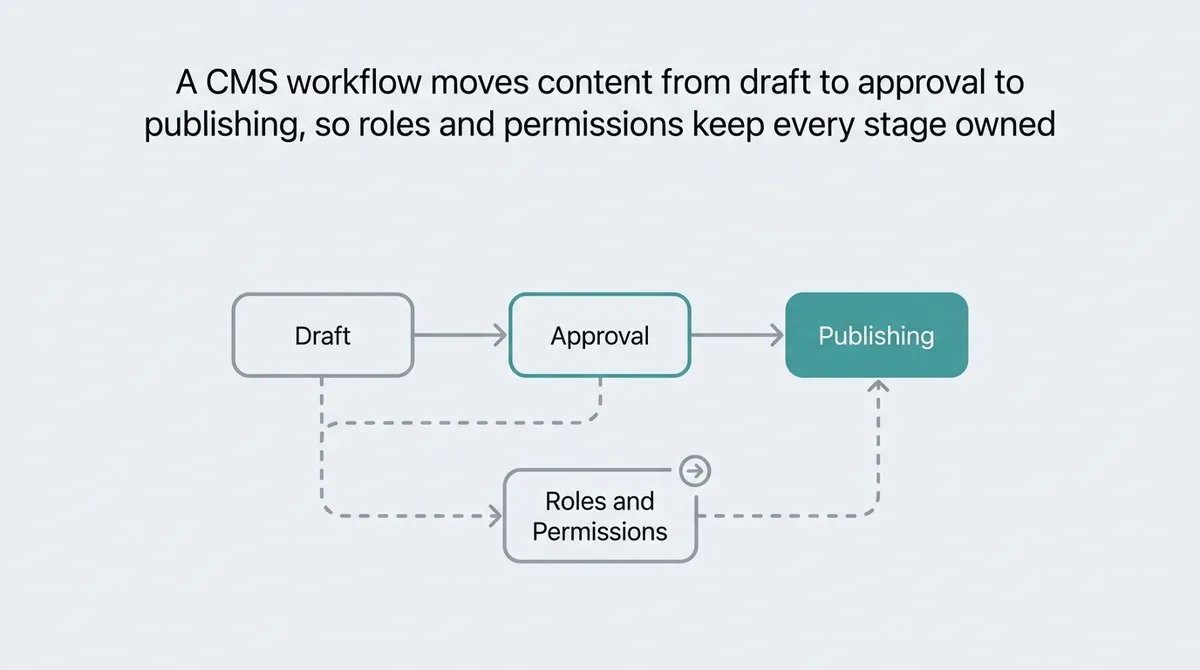
A CMS workflow is the ordered path content follows from creation to publication. The Draft-Review-Release Loop names the three stages every piece must pass through. Each stage has one owner, one required action, and one gate before content can advance. Content leads and agency operators running multiple blogs by hand will get the most out of this guide. It gives you a system to implement before your next publishing date.
What does a CMS workflow mean for content teams?
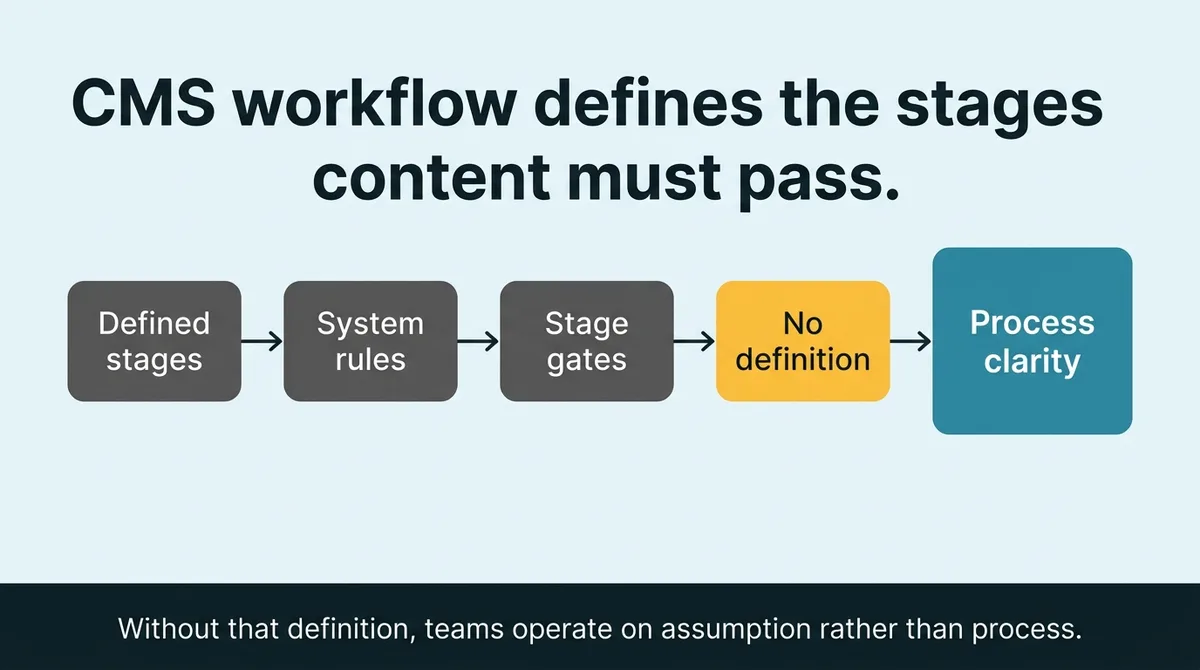
A CMS workflow is the defined sequence of stages a piece of content must pass through before it reaches a live audience. The system specifies who acts, what action they take, and what must happen before the next stage begins. Without that definition, content teams operate on assumption rather than process.
What a CMS Workflow Actually Is , and What It Is Not
Your CMS did not design your workflow. You have to do that yourself.
This is the false assumption that causes the most damage: teams install a content management system and believe the system will manage the content process. It will not. The CMS gives you states: draft, pending, published. Your team must define who owns each state and what qualifies as completion.
A CMS workflow is the ordered set of stages content must pass through before it reaches a live audience. That sequence has clear owners, clear actions, and clear advancement conditions. It is not an editorial calendar. An editorial calendar tells you what to publish and when. A workflow tells you how content gets from blank page to live URL. Those are different problems.
A workflow is also not a project management tool. Asana and Notion can reflect your workflow. They are not the workflow. The workflow lives in the rules your team agrees to follow, enforced by the permissions your CMS applies to each role.
A blog post passes through at minimum three distinct states before publication. Something exists in draft, something gets reviewed, something gets released. The gap between teams that ship consistently and teams that stall is not talent or tools. It is whether those three states are assigned to specific people with specific authority over each one.
The Three Stages Every Piece of Content Moves Through
Stop treating review as optional. Start treating it as a hard gate with an assigned owner.
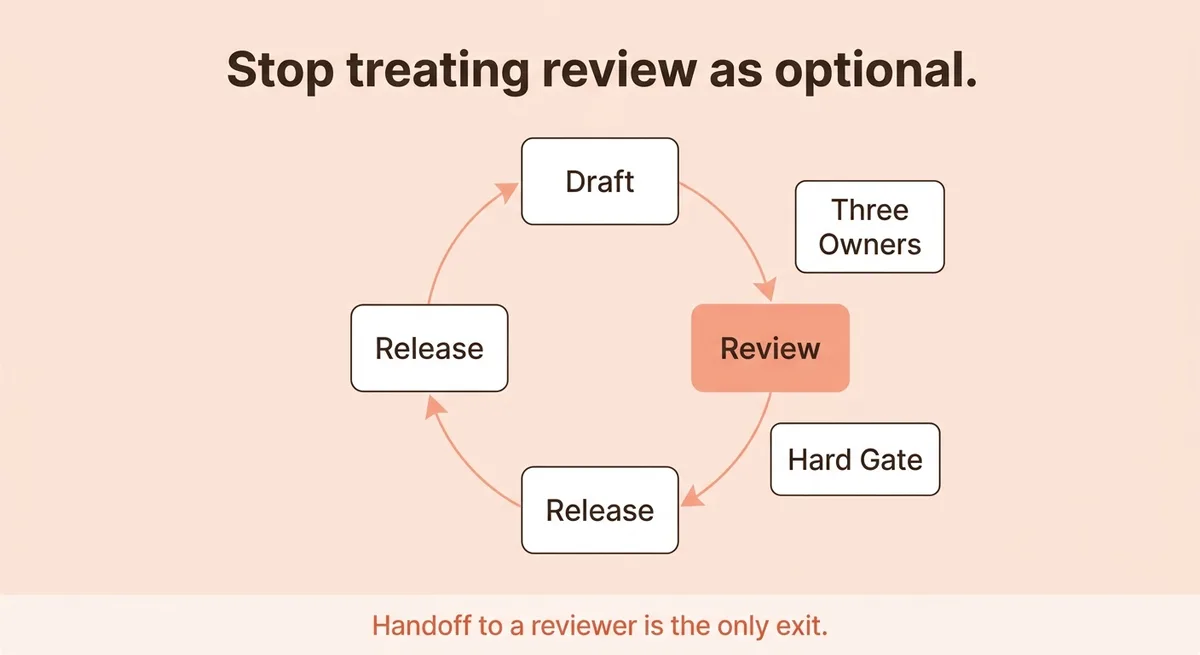
The Draft-Review-Release Loop is the minimum viable structure for any content operation. Three stages. Three owners. Three required actions before content advances.
Stage one: Draft. The writer creates and saves the content. No one else sees it in a live environment. The writer owns this stage completely. The only exit condition is a deliberate handoff to a reviewer, not a publish button.
Stage two: Review. A designated reviewer reads the content, checks it against standards, and either approves it or returns it with specific notes. This person does not publish. They approve or reject. Separating that authority from the publish action is what gives this stage its value.
Stage three: Release. An authorized publisher pushes the content live. This person confirms the piece has passed review and meets any final technical requirements. They are the last check, not an additional editor.
Stage | Owner | Required Action | Outcome |
|---|---|---|---|
Draft | Writer | Create and save content | Content ready for review |
Review | Reviewer | Approve or return with notes | Content cleared or revised |
Release | Publisher | Push content live | Content reaches the audience |
The most common mistake is collapsing stages two and three into one person. When the reviewer also publishes, the review stage becomes a formality. The person reviewing their own work before publishing has no external check. A product update published without a legal review pass, because the writer had publish permissions, is a realistic consequence of this collapse. A single approval gate would have flagged the issue before it became a retraction.
One missed review stage can cost a week of damage control. That is not an exaggeration. It is the realistic outcome when a compliance-sensitive piece goes live without a sign-off checkpoint.
Why Roles and Permissions Are the Real Engine of the Workflow
Permissions are not a developer’s job. They are an editorial decision with operational consequences.
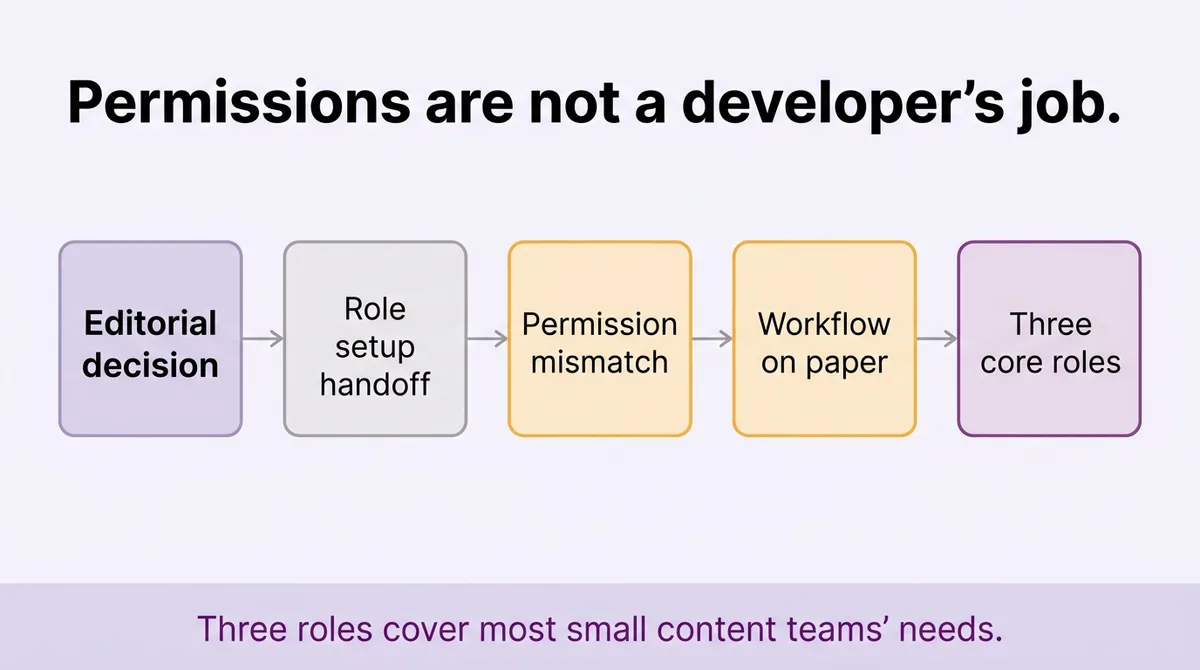
Most teams hand off role setup to whoever manages the CMS technically. That person configures permissions based on what they know about the system, not what the editorial team has decided about process. The result is a mismatch: the workflow exists on paper, and the permissions allow anyone to skip it.
Three roles cover the needs of most small content teams:
Contributor. Can draft and save content. Cannot publish. Cannot approve. This person’s authority ends at the handoff.
Editor. Can review, comment, and approve. Cannot publish without a second sign-off in place. This role owns the review gate.
Publisher. Has final release authority. Can push content live only after the review gate clears. This role does not edit; it releases.
A review gate is a hard stop in the system. It requires a specific role to act before content can advance to the next stage. Without a gate, the stages are descriptive labels rather than enforced checkpoints.
The clearest sign that permissions are misconfigured: every team member has publish rights. When that happens, the draft stage becomes decorative. A writer can move content from blank page to live URL in one action. The Draft-Review-Release Loop exists on the team’s process document and nowhere in the actual system.
Audit your current CMS role assignments before you build a workflow. Mismatched permissions override your process every time. You can document the perfect three-stage sequence, and one user with incorrect publish rights can bypass the entire thing in thirty seconds.
The permissions are not the supporting layer for the workflow. They are what gives the workflow its teeth.
What Breaks When You Skip the Workflow , and How to Keep It Simple
A missing workflow does not create a visible problem immediately. It creates a slow accumulation of small failures that compound across weeks.
Teams without a defined content path publish drafts. They lose review history. They duplicate work on pieces sitting in undefined states. Six weeks into a product launch, three writers are editing the same article in different saved versions because no one assigned draft ownership at the start. No one is wrong. The system just has no rules.
The fix does not require a complex process. Reject the idea that a workflow must be elaborate to work. A three-stage sequence with two roles is sufficient for most teams under fifty people. More stages mean more handoffs. More handoffs mean more places for content to stall.
The practical starting point is four steps:
- Name your stages using the Draft-Review-Release Loop.
- Assign one person as the owner of each stage.
- Set permissions in the CMS to match those assignments before anyone publishes.
- Agree on the exit condition for each stage: what must be true before content advances.
That is a functioning workflow. It is not a lightweight version of a real workflow. It is a real workflow calibrated to the size of the team.
One implementation caveat: if your CMS does not support role-based permissions natively, a documented handoff process in a shared Slack channel or project thread can serve as a temporary gate. Someone posts the piece for review. The reviewer replies with explicit approval. The publisher acts only after that reply exists. It is lower-tech but it preserves the logic of the Loop.
The operational cost of skipping this is not abstract. Content sitting in undefined states means someone is doing rework. Rework on a piece that should have shipped two weeks ago is time pulled from the next piece. That is the compounding effect. It does not show up on a dashboard. It shows up when the blog has been stale for ninety days and no one can explain why.
The Simplest Workflow Your Team Will Actually Follow
The Draft-Review-Release Loop works because it matches the actual path content already travels. It does not add steps. It names and assigns the steps already happening informally.
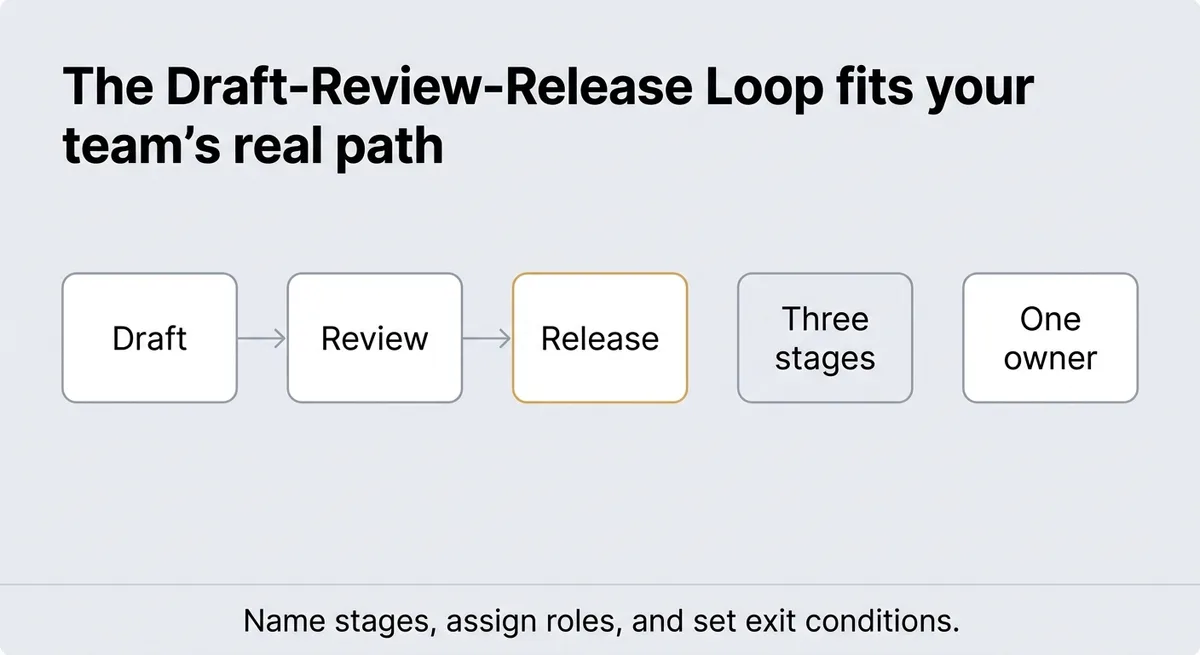
Three stages. One owner per stage. Permissions set before the first publish. That is the whole system.
Your team has likely been running on informal process. The shift feels administrative at first. Name your stages in the CMS. Update your role assignments. Write down the exit condition for each stage in a shared document. Run one piece of content through the Loop intentionally and watch where it stalls. That stall point is where your process needs one specific decision, not more tooling.
The workflow is not a constraint on creative work. It is what makes creative work shippable on schedule.
Name your stages, assign the owners, and set the permissions today.
FAQ
Every piece of content should pass through Draft, Review, and Release, each owned by a different person with a defined exit condition before the next stage begins. The Draft stage belongs to the writer, the Review stage belongs to a designated reviewer who can approve or return content but cannot publish, and the Release stage belongs an authorized publisher who acts only after review clears. Separating these roles in the CMS with matching permissions is what transforms descriptive labels into enforced checkpoints.
Skipping a CMS approval workflow causes drafts to go live unreviewed, review history to disappear, and multiple writers to duplicate work on pieces sitting in undefined states, compounding into a stalled publishing cadence. The damage is not always immediate: it accumulates over weeks until the blog goes stale and no one can trace why. One missed review gate on a compliance-sensitive piece, for example, can trigger a retraction and a week of damage control that pulls time from future content.
Assign three roles in your CMS: Contributor (can draft and save, cannot publish), Editor (can review and approve, cannot publish unilaterally), and Publisher (has final release authority only after the review gate clears). Audit your current role assignments first, because one user with incorrect publish rights can bypass the entire workflow in thirty seconds. Platforms like Zelitho build this connected path from draft to direct publishing into a single system, so the handoff logic is part of the tool rather than a separate agreement your team has to enforce manually.
An editorial calendar tells you what to publish and when, while a CMS workflow tells you how content moves from a blank page to a live URL, and those are different problems that require different solutions. A calendar tracks topics and dates; a workflow assigns owners, required actions, and advancement conditions to each stage content must pass through. Teams that treat their calendar as a workflow end up with a publishing schedule but no reliable process for hitting it.
A small team can run a fully functional content workflow with four steps: name your stages using the Draft-Review-Release Loop, assign one owner per stage, configure CMS permissions to match those assignments, and document the exit condition for each stage before anyone publishes. If your CMS does not support role-based permissions natively, a shared Slack thread where the reviewer posts explicit approval before the publisher acts preserves the same logic at lower cost. For teams that want the entire path from topic selection through publishing handled inside one system, Zelitho connects those stages without requiring a separate project management layer.