
What Are Paid Search Keywords? A Simple Guide to Finding and Using Them in PPC


TL;DR
You opened the Search Terms report and found your ad showed up for queries you never intended to target. The budget ran. The clicks came. Nothing converted.
Most advertisers treat keywords as topic labels. They pick terms that sound relevant, set them to broad match, and wait. The platform spends. The data looks active. But the queries triggering those ads belong to people who are researching, not buying.
The Keyword Clarity Framework fixes this in three steps: define intent before building any list, control match types before the campaign goes live, and structure ad groups so conversion data is readable. This article is written for marketers, founders, and agency owners managing real budgets. It explains what a paid search keyword actually does, why volume without intent data is a budget leak, and how campaign structure determines whether you can improve anything at all.
What Does “Paid Search Keyword” Actually Mean?
A paid search keyword is a targeting instruction. You give it to the platform. The platform uses it to match your ad to a category of queries. The query a user types and the keyword you bid on are not the same thing.
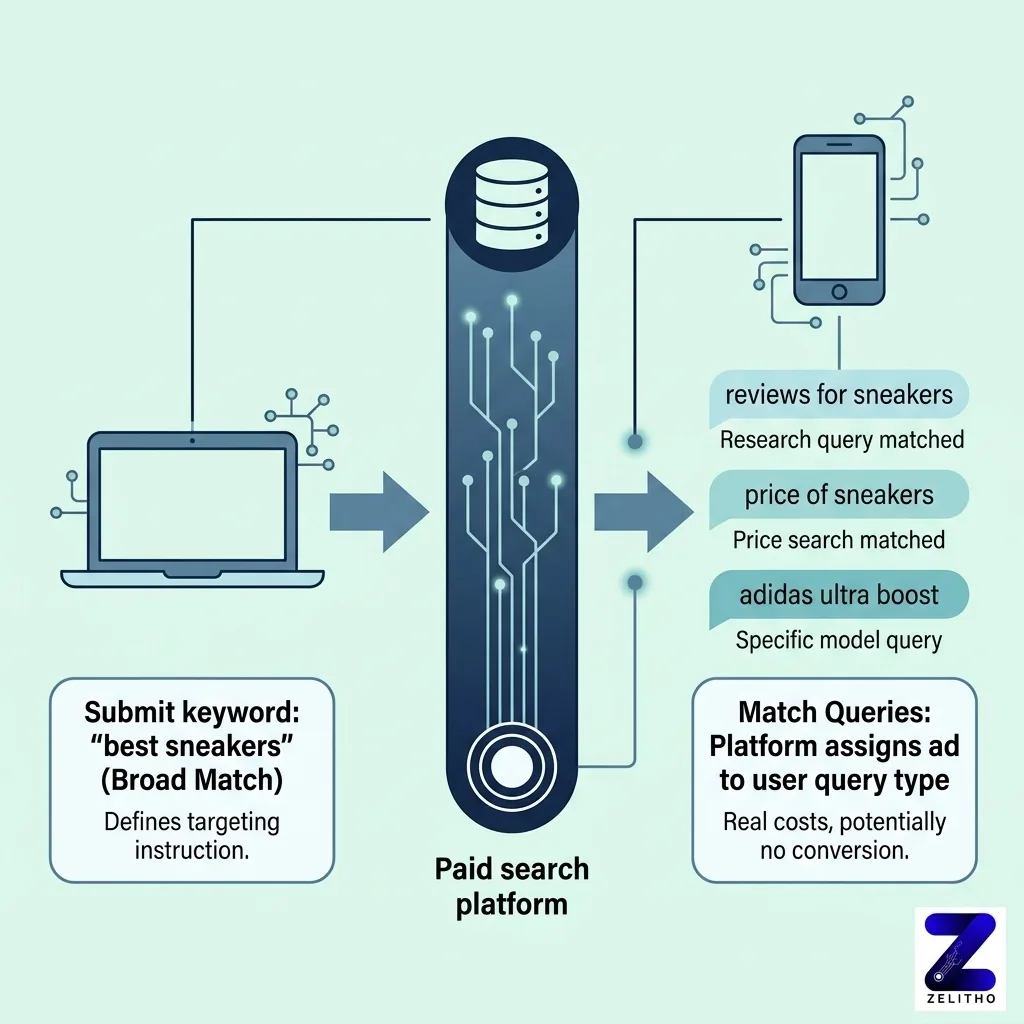
That distinction carries real cost.
A Paid Search Keyword Is Not What You Think It Is
Most people treat keywords as labels. They list topics they want to appear for and call it a strategy.
That framing is the first mistake.
A keyword is a targeting decision. It tells the ad platform which category of search queries should trigger your ad. You are not describing your product. You are instructing a system about which buyers to intercept, and at what point in their decision process.
The gap between your keyword and the actual query matters. Bidding on “project management software” can trigger searches from students writing essays, job seekers looking for tool experience, or IT managers comparing enterprise contracts. Only one of those groups is close to a purchase. The platform does not filter by buyer readiness by default. That is your job.
Stop treating any relevant-sounding term as a safe bid. Start treating each keyword as a claim that a specific type of buyer is ready to act.
The financial consequence of getting this wrong adds up fast. Paid search CPCs run $5 to $25 or more depending on the vertical [1]. The average site conversion rate sits between 2% and 5% [1]. At $25 per click and a 2% conversion rate, you spend $1,250 for a single conversion. That math assumes the clicks are qualified. Add unqualified traffic and the cost per actual conversion climbs well past $2,000.
A keyword is not a guess at relevance. It is a filter on buyer readiness, and every miscalibration costs you money before you see a single conversion.
Intent Is the Variable Everyone Skips and It Costs Real Money
High search volume does not mean high purchase intent. This is the assumption that drains more PPC budgets than any platform setting.
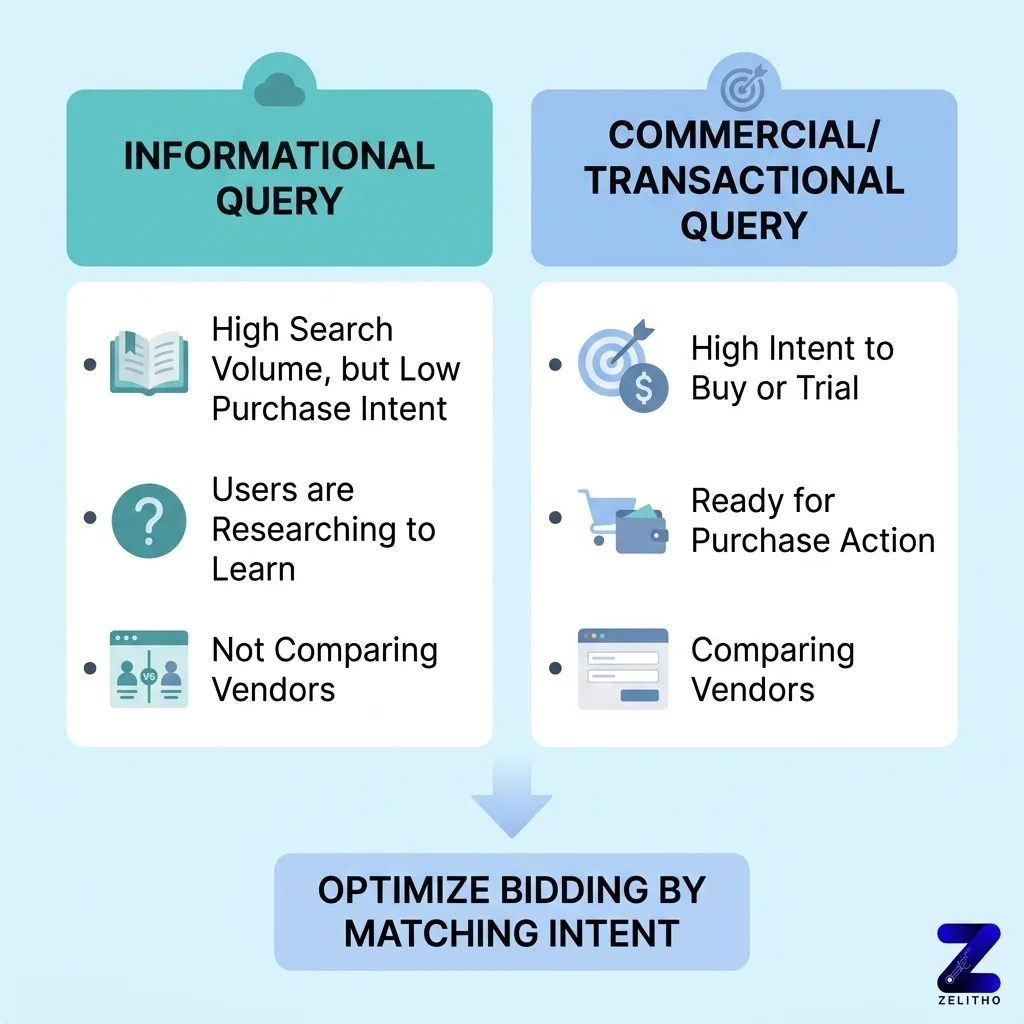
Every query a person types sits at a point in their decision process. Three stages describe that process clearly: informational, navigational, and commercial or transactional.
An informational query means someone is learning. “What is CRM software” is a real example. The searcher wants a definition. They are not comparing vendors. If your ad leads to a free trial signup page and you paid $15 for that click, you paid to interrupt someone who was not ready. The page bounces. The money is gone.
A navigational query means someone knows where they want to go. “Salesforce login” tells you the buyer already chose a vendor. Bidding on this type of term as a competitor is costly and low-yield.
A commercial or transactional query means someone is ready to evaluate or buy. “Best CRM for small business” or “CRM software pricing” signals purchase-stage thinking. These are the queries worth bidding on, because the searcher arrives with intent already formed.
Query Type | Example Search Term | Appropriate Ad Response |
|---|---|---|
Informational | “what is CRM software” | Educational landing page, gated content |
Navigational | “Salesforce login” | Brand defense only, rarely worth bidding |
Transactional | “CRM software pricing plans” | Direct offer, demo, or free trial page |
The data behind this is not abstract. Research shows 81% of buyers had a preferred vendor before their first sales contact [1]. By the time a buyer types a transactional query, they have already done significant research. Your keyword must meet them at that moment of readiness, not earlier.
A separate finding reinforces this: 61% of B2B buyers prefer a purchase process with no sales rep involved [1]. Buyers who are ready to convert will not wait for a follow-up call. They want a direct path. If your keyword and landing page do not align with that expectation, the click converts to nothing.
Volume is a measurement of how many people searched. It says nothing about why they searched. Building a keyword list by volume alone means buying attention from a crowd that includes everyone except the buyers you need.
Match Types and Negative Keywords Are How You Control What Actually Triggers Your Ad
Setting a keyword and launching a campaign does not mean qualified buyers see your ad. Match types determine which queries actually trigger it. Most accounts get this wrong by defaulting to broad match and skipping the follow-up work.
There are three major keyword match types [2]. Each one controls a different level of query expansion.
Broad match gives the platform the most latitude. It can expand your keyword to synonyms, related concepts, and query variations far outside your original term [2]. A broad match keyword of “accounting software” can trigger “free accounting software download,” “accounting tutorial for beginners,” or “spreadsheet templates for bookkeeping.” None of those queries have purchase intent. All of them cost money.
Phrase match uses quotation marks [2]. It requires the core meaning of your keyword to appear in the query, but allows words before and after. “Accounting software” as a phrase match would still trigger some variations, but the core concept must stay intact. This gives you more control than broad without the rigidity of exact.
Exact match uses square brackets [2]. It targets the tightest set of queries. Google still applies close-variation handling, which covers misspellings, singular and plural differences, acronyms, abbreviations, and stemmed variations [2]. “Accounting software” in exact match would not trigger “free accounting software download.” It targets people who searched specifically for that term.
Negative keywords are the filter layer that broad and phrase match require to function responsibly. Without negatives, broad match is an open invitation to waste budget on queries with zero purchase intent.
Here is a concrete audit sequence you can run today:
Open your Search Terms report in Google Ads.
Sort by cost, high to low.
Identify queries that have no commercial intent.
Add them as negative keywords at the campaign or ad group level.
Tighten match types on your highest-spend keywords where volume allows.
A campaign running broad match on “accounting software” without negatives will spend on queries from students, job seekers, and people looking for free tools. None of those clicks convert to paid customers. Tighter targeting has driven meaningful conversion improvements, with some accounts seeing 20% or more lift after restricting match types and building out a negative keyword list [3].
The hidden worry most advertisers carry: “I set up keywords, but I have no idea if the right people are seeing my ads.” The Search Terms report answers that question. Most people never look at it.
Campaign Structure Determines Whether You Can Measure and Improve Anything
Choosing the right keywords is necessary. Grouping them correctly is what makes the data readable.
When 50 keyword variations compete inside a single ad group, the account becomes unmanageable. Quality Score averages across all of them. Ad copy cannot match any single intent. Conversion data arrives as one blended number, and six weeks of spend produces no actionable signal. You cannot tell which keyword drove the conversion. You cannot tell which ad message worked. You have data but no information.
One ad group should map to one intent cluster, one audience signal, and one landing page. That is the structure that produces readable data.
The Keyword Clarity Framework pulls together what this article has covered into three executable steps.
Step 1: Intent-first selection. Before building any list, decide which stage of the buyer journey you are targeting. Informational keywords belong to top-of-funnel campaigns with educational landing pages. Transactional keywords belong to bottom-funnel campaigns with direct offers. Mixing them in one campaign makes both perform worse.
Step 2: Match-type control. Assign match types based on how much query variation you can afford to absorb. Start tighter than you think you need to. Broad match has its place, but only after you have a negative keyword list and a Search Terms review schedule.
Step 3: Structure for measurement. Each campaign should correspond to a funnel stage. Each ad group should correspond to one intent cluster. Each ad group should point to one landing page. If a conversion comes in, you know exactly which keyword, which ad, and which page produced it.
The financial weight behind this structure matters. Paid media takes up 30.6% of the average marketing budget [1]. Digital channels account for 70% to 85% of total budget allocation [1]. PPC is not a minor experiment. It is a primary spending category. A structure failure is not a configuration issue. It is a budget allocation failure.
Here is the operational difference between the two approaches:
Disorganized structure: All keywords in one campaign, mixed intent, one ad, one landing page. Conversion data is unreadable. Optimization requires guessing.
Intent-mapped structure: Separate campaigns by funnel stage. Ad groups by intent cluster. Each group has a matched landing page. Conversion data is clean. You can act on it.
The Keyword Clarity Framework is not a platform tutorial. It is a decision sequence you run before you touch any Google Ads setting. The platform executes. The framework decides.
Keywords Are Decisions Not Guesses Treat Them That Way
Every keyword in your account is a live claim. It says: I believe this search query comes from someone ready to take the action my landing page asks for.
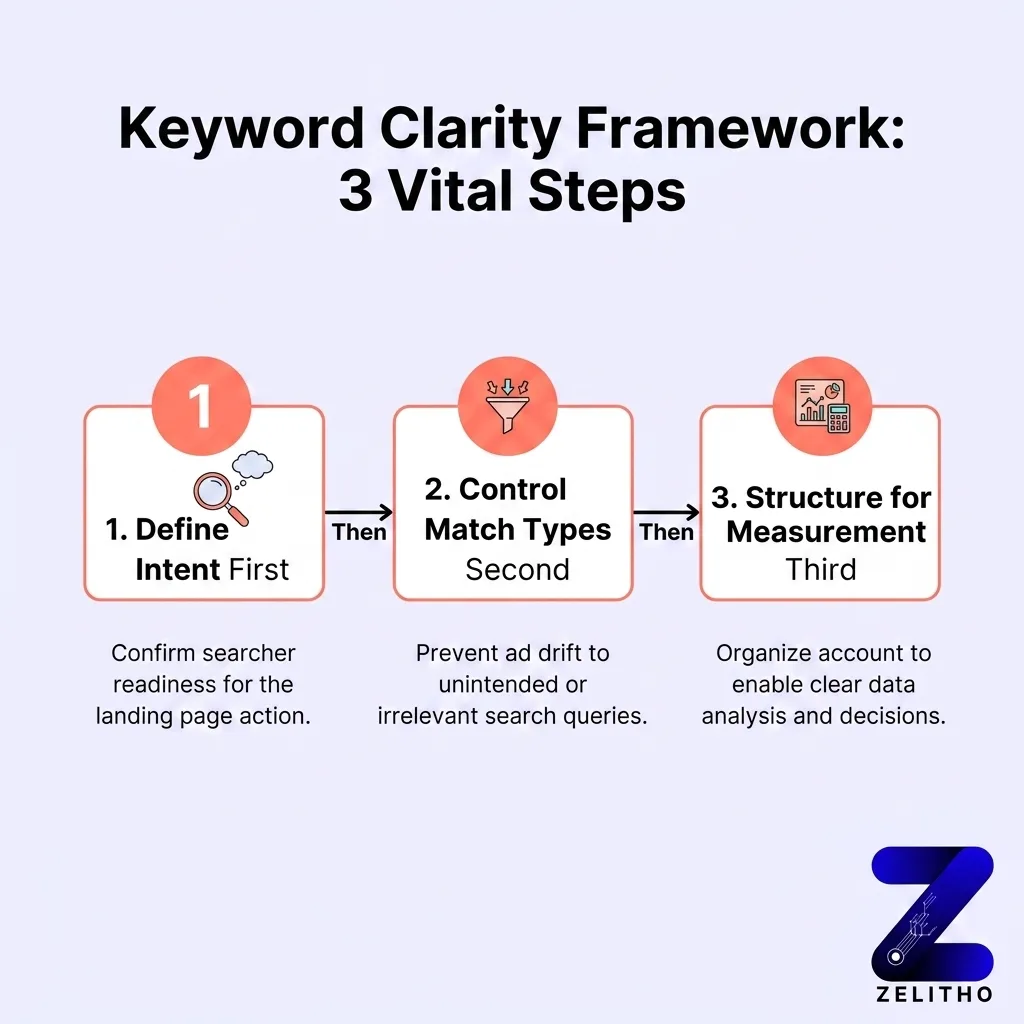
When that claim is wrong, the budget pays the price. The Keyword Clarity Framework exists to make the claim deliberate. Define intent first, so you only bid on queries from buyers who are ready. Control match types second, so the platform cannot drift into irrelevant territory. Structure for measurement third, so you know what worked and can do more of it.
Accounts that improve are not running more keywords. They are running fewer, better-targeted ones with clean structures and a Search Terms review on a fixed schedule.
Every keyword you add without running it through intent, match type, and structure is a bid placed without evidence.
FAQ
Paid search refers specifically to ads that appear on search engine results pages when someone types a query. PPC, or pay-per-click, is the pricing model used across multiple ad formats including display, social, and search. All paid search is PPC, but not all PPC is paid search.
The four keyword types most commonly referenced in PPC are broad match, phrase match, exact match, and negative keywords. Some frameworks also categorize keywords by intent: informational, navigational, commercial, and transactional. Both classification systems are useful and serve different planning purposes.
Paid keywords are the targeting terms you bid on inside a paid search platform like Google Ads. When a user’s search query matches your keyword according to your chosen match type, your ad becomes eligible to appear. You pay when someone clicks, not when the ad is shown.
At $20 a day, you are working with a limited testing budget. With CPCs ranging from $5 to $25 or more [1], you may receive as few as one to four clicks per day in competitive verticals. At that volume, collecting statistically meaningful conversion data takes weeks. It is not a bad starting point, but it requires tight keyword targeting to produce any usable signal.
References and Citations
[1]https://ppc.co/blog/keyword-mistakes
[2]https://incartmarketing.com/common-ppc-keyword-mistakes-understanding-broad-match-vs-phrase-match-vs-exact-match/
[3]https://webfor.com/blog/common-mistakes-to-avoid-in-your-ppc-campaigns/