
Semantic SEO: Complete Strategy Guide for Ranking in the AI Search Era

- Tl,dr
- Semantic SEO optimizes content for meaning and user intent rather than isolated keywords, aligning with how Google’s AI interprets search queries in 2025.
- This strategy involves keyword clustering to group related terms, building topical authority through comprehensive content coverage, and implementing schema markup to clarify context for search engines.
- With AI Overviews appearing in nearly half of all searches, sites must focus on answering complete questions, mapping intent accurately, and creating interconnected topic clusters.
- Tools like Keyword Insights and MarketMuse enable semantic analysis, while structured data improves rich snippet eligibility.
- By prioritizing depth over keyword repetition, semantic SEO delivers 3× more organic traffic and positions content for both traditional search and AI-generated results.
What is Semantic SEO and Why It Matters in 2026
Semantic SEO optimizes content for meaning and intent rather than isolated keywords. Instead of targeting “best running shoes” as a standalone phrase, semantic optimization addresses the complete user journey-comparing shoe types, understanding foot mechanics, reviewing brands, and answering related questions like “how to choose running shoes for flat feet.”
This approach aligns directly with how Google’s AI interprets search queries. The search engine analyzes context, recognizes entities (people, places, things, concepts), and evaluates whether content comprehensively answers user needs. With AI Overviews appearing in nearly half of all searches, understanding how algorithms interpret intent is essential for visibility.
Semantic SEO rests on four core principles. First, search intent matching ensures content addresses what users truly want-informational guidance, transactional options, navigational results, or commercial comparisons. Second, topical authority demonstrates expertise across an entire subject area through interconnected content clusters rather than isolated articles. Third, contextual relevance uses related terms, synonyms, and entities to reinforce meaning without keyword repetition. Fourth, user signals like dwell time and scroll depth confirm that content delivers value, influencing rankings through behavioral data.
The impact is measurable. Research shows that comprehensive, semantically optimized content drives 3× more organic traffic than shallow keyword-based pages. This happens because Google’s algorithms favor depth-pages that answer follow-up questions, explore subtopics, and demonstrate expertise naturally rank for hundreds of related search terms without explicitly targeting each one.
Google’s Knowledge Graph plays a central role in semantic search, connecting over 5 billion entities with 500 billion facts. When you mention “Apple” in content, Google’s AI determines whether you mean the fruit, the technology company, or Apple Records based on surrounding context and linked entities. This disambiguation allows search engines to serve precise results even when queries use ambiguous language.
How Google Understands Meaning: Knowledge Graph, NLP, and AI
Google’s semantic search capabilities rely on three interconnected systems: the Knowledge Graph, Natural Language Processing (NLP), and AI models like BERT and MUM. These technologies work together to interpret language nuance, identify entities, and understand relationships between concepts.
The Knowledge Graph functions as Google’s database of real-world entities and their connections. Launched in 2012, it contains 5 billion entities and 500 billion facts about those entities. When someone searches “who directed Inception,” Google doesn’t just match keywords-it recognizes “Inception” as a movie entity, identifies Christopher Nolan as its director, and may also surface related entities like his other films, collaborators, or awards.
Natural Language Processing allows Google to parse sentence structure, understand context, and interpret meaning beyond literal word matching. NLP models analyze syntax (how words relate grammatically), semantics (what words mean), and pragmatics (how context affects meaning). This enables Google to understand that “running shoes” and “athletic footwear for jogging” represent the same intent despite different phrasing.
BERT, introduced in 2019, revolutionized how Google processes language by analyzing words in relation to all other words in a sentence rather than individually. This bidirectional analysis captures nuance-understanding that “bank” means something different in “riverbank” versus “savings bank.” BERT improved Google’s ability to handle long-tail queries and conversational searches.
MUM (Multitask Unified Model), announced in 2021, processes information across 75 languages and multiple formats (text, images, video). It understands complex queries requiring multiple steps to answer and can synthesize information from diverse sources. For example, if you ask “I’ve hiked Mount Fuji; what training should I do to hike Mount Rainier?”, MUM can compare the two mountains, assess difficulty differences, and recommend specific preparation.
Four major algorithm updates illustrate Google’s evolution from keyword matching to semantic understanding. Hummingbird (2013) introduced semantic search capabilities, focusing on query meaning rather than individual terms. RankBrain (2015) applied machine learning to interpret unfamiliar queries by finding semantically similar searches. BERT (2019) refined language understanding through contextual analysis. AI Overviews (2024) brought generative AI directly into search results, synthesizing answers from multiple sources.
Structured data bridges the gap between how humans and machines understand content. Schema markup provides explicit signals about content meaning-identifying articles, recipes, products, events, and organizations with standardized vocabulary. This markup feeds the Knowledge Graph, improves rich snippet eligibility, and helps Google extract precise information for AI-generated answers. When you mark up an FAQ section with schema, Google can directly answer user questions in search results, increasing visibility even without a click.
Keyword Clustering: From Research to Topic Maps
Keyword clustering groups related search terms so a single page can rank for multiple queries simultaneously. This eliminates content cannibalization, where separate pages compete for the same rankings, and builds topical authority by demonstrating comprehensive coverage of a subject.
Two clustering methods dominate: SERP-based and semantic clustering. SERP-based clustering analyzes search results for each keyword, grouping terms that return similar URLs in the top 10 results. If “best coffee makers,” “top-rated coffee machines,” and “coffee maker reviews” all show the same websites, they belong to one cluster and should target a single page. This method reflects Google’s own judgment about which keywords share intent.
Semantic clustering uses Natural Language Processing to group keywords by meaning rather than search results. NLP models analyze linguistic relationships, identifying synonyms, related concepts, and topical connections. “Electric coffee maker,” “drip coffee brewer,” and “automatic coffee machine” might cluster together even if their SERPs differ slightly, because they describe the same product category.
A practical 5-step workflow transforms keyword research into actionable content clusters. First, conduct comprehensive keyword discovery using tools like Ahrefs, Semrush, or Google’s own autocomplete and “People Also Ask” features. Aim for 500–2,000 related keywords around your core topic. Second, set up your clustering project in tools like Keyword Insights or Cluster AI, defining parameters like SERP overlap threshold (typically 3–5 shared URLs) and search intent filtering. Third, upload your keyword CSV and let the tool analyze search results, grouping terms by similarity.
Fourth, review the clustering data and refine groupings. Some clusters may be too broad (combine “coffee maker types,” “coffee maker features,” and “coffee maker brands” into separate groups) or too narrow (merge “coffee maker for home” and “home coffee machines” if they’re nearly identical). This manual review ensures clusters align with your content strategy and audience needs. Fifth, create comprehensive content for each cluster’s primary keyword while naturally incorporating secondary terms. One detailed guide on “best coffee makers” can rank for 20–50 related searches if it covers subtopics thoroughly.
Keyword clusters differ from topic clusters in scope and purpose. Keyword clusters are tactical groupings for content creation-deciding which terms to target on which pages. Topic clusters are strategic site architecture, where a pillar page covers a broad subject and linked subtopic pages explore specific aspects in depth. A pillar page on “Content Marketing Strategy” might link to subtopic pages covering “content calendar creation,” “SEO content optimization,” and “content distribution channels.” This internal linking structure signals topical authority to Google while providing users with comprehensive resources.
Content cannibalization occurs when multiple pages target similar keywords, splitting ranking signals and confusing search engines about which page to rank. Clustering prevents this by consolidating intent. Instead of three mediocre pages competing for “organic gardening tips,” “natural gardening methods,” and “chemical-free gardening,” create one authoritative resource that ranks for all three and dozens of related terms.
Building a Semantic SEO Content Strategy
Implementing semantic SEO requires combining keyword research, intent mapping, and content depth into a cohesive workflow. Eight practical strategies form the foundation of effective semantic optimization.
Semantic keyword research and topic clustering begin with identifying your core topic and expanding outward to related concepts. Use tools like Answer the Public to discover question-based queries, Ahrefs’ “Related Terms” feature to find semantically connected keywords, and competitor analysis to identify content gaps. Group these keywords into clusters, then map clusters to either new content or existing pages that need expansion.
LSI (Latent Semantic Indexing) keywords are terms and phrases related to your main topic that search engines expect to see in comprehensive content. For a page about “dog training,” LSI keywords might include “positive reinforcement,” “puppy behavior,” “obedience commands,” and “socialization.” These aren’t synonyms but contextually related concepts that signal topic depth. Natural inclusion of LSI keywords improves semantic relevance without forcing primary keyword repetition.
Writing for user intent means understanding what users want when they search. Informational intent seeks knowledge (“how to train a puppy”), navigational intent looks for specific sites (“Petco training classes”), commercial intent researches options before buying (“best dog training methods”), and transactional intent is ready to convert (“sign up for dog training”). Analyze SERPs for your target keywords—if results show blog posts, your content should educate; if results show product pages, users want to buy. Mismatched intent kills rankings regardless of content quality.
Question-based content addresses specific user queries directly, improving featured snippet eligibility and voice search optimization. Structure sections around questions users actually ask, pulled from “People Also Ask” boxes, Reddit forums, Quora threads, and keyword tools. Implement FAQ schema markup to explicitly signal question-answer pairs to Google. This structured approach captured 5+ featured snippets for one case study site, dramatically increasing zero-click visibility.
Avoiding keyword cannibalization requires regular content audits. Use Google Search Console to identify queries where multiple pages rank, then consolidate or differentiate. If two pages target “email marketing tips,” either merge them into one comprehensive guide or pivot one to a specific angle like “email marketing tips for e-commerce.” Clear differentiation ensures each page has a distinct purpose and ranking opportunity.
Content comprehensiveness means answering follow-up questions users don’t explicitly ask but will naturally have. For “how to start a podcast,” comprehensive coverage includes equipment recommendations, recording software options, hosting platforms, promotion strategies, and monetization methods. Tools like MarketMuse and Frase score content based on semantic completeness, identifying missing subtopics that competitors cover. Adding these gaps transforms thin content into ranking content.
Internal linking strengthens topical authority by connecting related content. Link from pillar pages to detailed subtopic articles and from subtopics back to the pillar using descriptive anchor text that includes target keywords. This structure helps Google understand content relationships and distributes ranking power throughout your site. Sites with strong internal linking architectures show measurably higher topical authority scores.
Schema markup implementation provides explicit semantic signals. Add Article schema to blog posts (including author, publish date, and headline), FAQ schema to question-answer sections, Product schema to e-commerce pages, and LocalBusiness schema to service area pages. Structured data doesn’t directly boost rankings but improves rich snippet eligibility and clarifies content meaning for AI models that generate search summaries. Use Google’s Structured Data Testing Tool to validate implementation before publishing.
Schema Markup and Technical SEO for Semantic Visibility
Schema markup and structured data clarify content meaning for search engines, translating human-readable text into machine-understandable information. This technical layer improves rich snippet eligibility, supports AI Overview citations, and enables precise knowledge extraction.
Schema supports semantic SEO by explicitly defining entities and their relationships. FAQ schema marks question-answer pairs, making content eligible for featured snippets and “People Also Ask” expansions. Product schema identifies items for sale with properties like price, availability, and reviews, enabling rich results in shopping searches. Article schema defines news content, blog posts, and editorials with author attribution and publication metadata. LocalBusiness schema connects physical locations with services, hours, and contact information, powering local search results and map listings.
Implementation requires adding structured data to your HTML using JSON-LD (JavaScript Object Notation for Linked Data), the format Google recommends. For an FAQ section, the markup includes each question as a name property and its answer as an acceptedAnswer property. WordPress sites can use plugins like Rank Math or Yoast SEO to generate schema automatically. Custom sites require manual coding or schema generators like TechnicalSEO.com’s tool.
Technical best practices ensure schema delivers value. First, markup only visible content-don’t hide text solely for schema purposes, which violates Google’s guidelines. Second, validate markup using Google’s Rich Results Test before publishing to catch errors. Third, be specific with schema types-use the most precise category (Recipe, not just Article; VideoObject, not just CreativeWork). Fourth, maintain consistency between structured data and on-page content; discrepancies confuse crawlers and may result in penalties.
Semantic HTML reinforces content structure beyond schema. Proper heading hierarchy (H1 for title, H2 for main sections, H3 for subsections) helps Google parse content architecture. HTML5 semantic elements like `, `
`, `
`, and `
` clarify page organization. Lists (`
`, `
`) explicitly mark related items, making them eligible for featured snippet extraction. These elements provide semantic clues that AI models use when generating search summaries.
Entity markup connects your content to the Knowledge Graph. Marking up author entities with proper structured data establishes E-E-A-T (Experience, Expertise, Authoritativeness, Trustworthiness) signals. Linking to Wikipedia pages and other authoritative sources for entities mentioned in your content helps Google verify information accuracy. Internal linking using entity-rich anchor text (specific names, proper nouns, precise concepts) reinforces topical relationships.
Crawl budget considerations shift in the AI search era. Google increasingly allocates crawl resources based on semantic value-pages that comprehensively cover topics get crawled more frequently than thin content. Maintain fast load times (Largest Contentful Paint under 2.2 seconds), minimize duplicate content, and use canonical tags to direct crawlers to preferred versions of similar pages. Technical performance directly impacts whether AI models index your content for generative search results.
Mobile optimization remains critical, with over 68% of traffic coming from mobile devices in many industries. Responsive design ensures semantic structure remains intact across screen sizes. Tap targets, readable font sizes, and scrollable content without horizontal swiping maintain engagement signals that feed ranking algorithms. Mobile-first indexing means Google primarily evaluates your mobile version when determining rankings, making mobile semantic SEO non-negotiable.
Common Semantic SEO Mistakes to Avoid
Many sites still chase exact-match keywords without context, ignore search intent, or create shallow content that lacks topical depth. Understanding these pitfalls helps avoid wasted effort and ranking stagnation.
Keyword stuffing without semantic variety damages readability and signals low-quality content to Google’s algorithms. Repeating “best coffee maker” fifteen times in 500 words sounds robotic and provides no additional value after the second mention. Instead, use semantic variations: “top-rated brewing machines,” “high-quality coffee equipment,” “recommended makers for home use.” This approach maintains natural flow while still signaling topic relevance.
Failing to map intent creates content that doesn’t match user needs. If someone searches “wordpress hosting,” they likely want to compare options or sign up, not read a 3,000-word history of WordPress. Yet many sites create informational content for commercial or transactional queries, resulting in high bounce rates and poor conversions. Analyze SERPs carefully -the results reveal what Google considers the correct intent, and deviating from that rarely succeeds.
Neglecting internal linking breaks topical authority. Isolated pages, even if perfectly optimized individually, don’t demonstrate comprehensive coverage of a subject. A site with 50 related articles that don’t link to each other signals 50 separate topics rather than deep expertise in one area. Strategic internal linking using descriptive anchor text creates topical clusters that boost rankings across all connected pages.
Skipping schema implementation leaves semantic signals implicit rather than explicit. While Google’s NLP can often infer content meaning, structured data removes ambiguity. A restaurant page without LocalBusiness schema might not appear in local map results even if the content mentions the address, hours, and cuisine type. Schema provides the explicit machine-readable confirmation that algorithms require for rich results.
Missing AI Overview opportunities means forfeiting visibility in the fastest-growing search feature. AI Overviews appear for nearly half of all searches, synthesizing answers from multiple sources. Content that directly answers questions, uses clear formatting (lists, tables, definitions), and implements FAQ schema has higher citation probability. Sites that optimize only for traditional blue links miss the chance to appear in these prominent AI-generated summaries.
Voice search optimization requires natural language and question-focused content. Voice queries tend to be longer and more conversational than typed searches (“What’s the best way to clean leather shoes?” versus “clean leather shoes”). Content structured around complete sentences and questions performs better in voice results. Yet many sites still optimize for abbreviated keyword phrases, missing this growing search segment.
Tools and Techniques for Semantic SEO Success
Semantic SEO tools help discover related keywords, analyze content gaps, and optimize for meaning. Combining specialized platforms with manual analysis creates a complete optimization workflow.
Keyword Insights excels at SERP-based clustering, automatically grouping keywords by search result overlap. Upload a keyword list, set overlap threshold parameters, and receive clustered groups that show which terms should target the same page. The tool also provides search volume data and keyword difficulty scores, helping prioritize content creation. Pricing starts at $58/month for 750 clustering credits.
Ahrefs and Semrush offer comprehensive keyword research with semantic capabilities. Both platforms show “Related Keywords” and “Questions” tabs that reveal semantically connected terms users search. Their content gap analysis compares your site to competitors, identifying topics they rank for that you’re missing. Site audit features flag technical issues affecting semantic visibility, from duplicate content to missing schema markup.
MarketMuse and Frase use NLP to score content comprehensiveness. MarketMuse analyzes top-ranking pages for your target keyword, extracts key topics and entities they cover, then scores your draft against these benchmarks. Frase offers similar functionality with a more affordable entry point ($14.99/month), including an AI writing assistant that suggests semantically relevant content additions. These tools transform “write good content” into specific, actionable optimization steps.
Google’s Natural Language API reveals how Google’s own algorithms interpret your content. Submit text and receive entity analysis (which people, places, organizations are mentioned), sentiment scoring, and syntax parsing. This free tool shows exactly which concepts Google extracts from your content, helping verify that your intended meaning comes through clearly.
SEO checkers like Surfer SEO provide real-time optimization guidance. Surfer’s content editor suggests keyword density targets, heading structure, and content length based on what currently ranks. One case study improved a page’s Surfer score from 41 to 82, correlating with a ranking jump from #16 to #3 and a 719% traffic increase.
Competitor analysis techniques uncover semantic opportunities others miss. Export competitors’ ranking keywords from Ahrefs, filter for terms where they rank 1-3 but you don’t appear, then analyze the content gaps. Look specifically for question-based keywords and long-tail variations—these often represent quick wins with lower competition. Reddit mining adds another dimension: search your niche’s subreddit for recurring questions that aren’t well-answered by existing content, then create comprehensive resources targeting those queries.
Content scoring tools like Clearscope and SurferSEO measure semantic relevance by comparing your content to top-ranking pages. They identify missing topics, suggest related terms to include, and score your draft’s optimization level. While not perfect-quality still requires human judgment—these tools ensure you don’t miss obvious semantic elements that competitors cover.
Free alternatives like Google Search Console provide valuable semantic insights. The “Queries” report shows terms you rank for that you didn’t explicitly target, revealing semantic associations Google has made. If you rank for “best espresso machines under $500” but only optimized for “affordable espresso makers,” that indicates successful semantic optimization that can be replicated on other pages.
FAQ
Semantic SEO is the practice of optimizing content for meaning, context, and user intent rather than focusing only on exact-match keywords. It involves using related topics, entities, structured data, and comprehensive content so search engines can better understand what a page is about and match it to relevant queries.
Traditional SEO focuses mainly on targeting specific keywords, while semantic SEO focuses on understanding the search intent behind those keywords. Semantic SEO uses keyword clustering, topical authority, and contextual relationships between topics to help search engines interpret content more accurately.
With AI-driven search technologies like AI Overviews and advanced natural language processing, search engines now prioritize content that answers questions comprehensively and demonstrates topical authority. Semantic SEO helps content align with how modern search engines understand meaning and context.
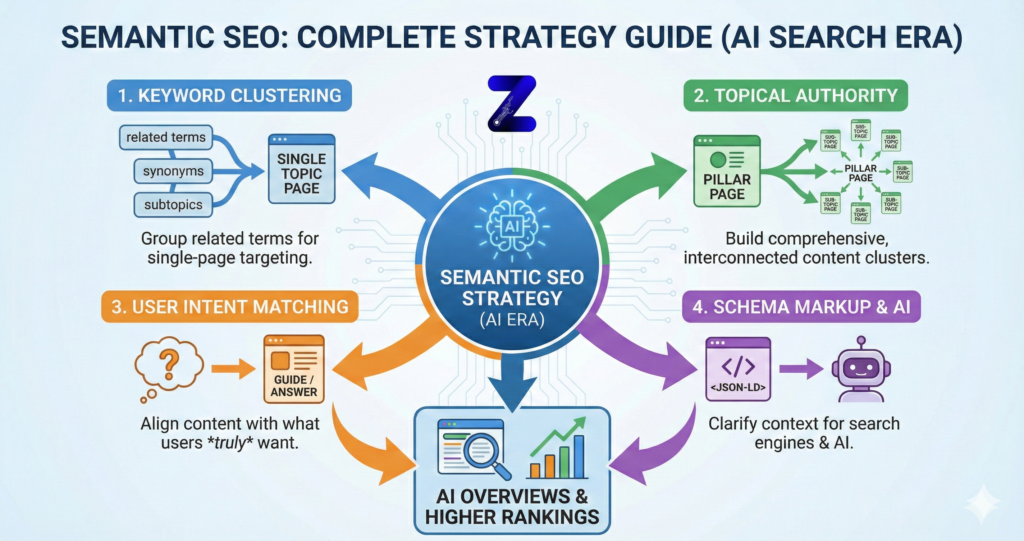
A strong semantic SEO strategy usually includes:
Keyword clustering to group related search queries
Topical authority through pillar pages and topic clusters
User intent matching to align content with what users want
Schema markup to help search engines understand context
These elements work together to improve visibility in AI-powered search results.
Schema markup provides structured data that explains content to search engines. By adding schema such as FAQ, Article, Product, or LocalBusiness markup, websites help search engines understand entities and relationships within the content, improving eligibility for rich snippets and AI-generated search results.
Keyword clustering groups similar search terms so a single page can rank for multiple related queries. Instead of creating many separate pages targeting similar keywords, semantic SEO uses one comprehensive page that covers the topic thoroughly, which improves rankings and prevents keyword cannibalization.