
LLMO vs AEO vs GEO vs SEO, what each means and how they differ

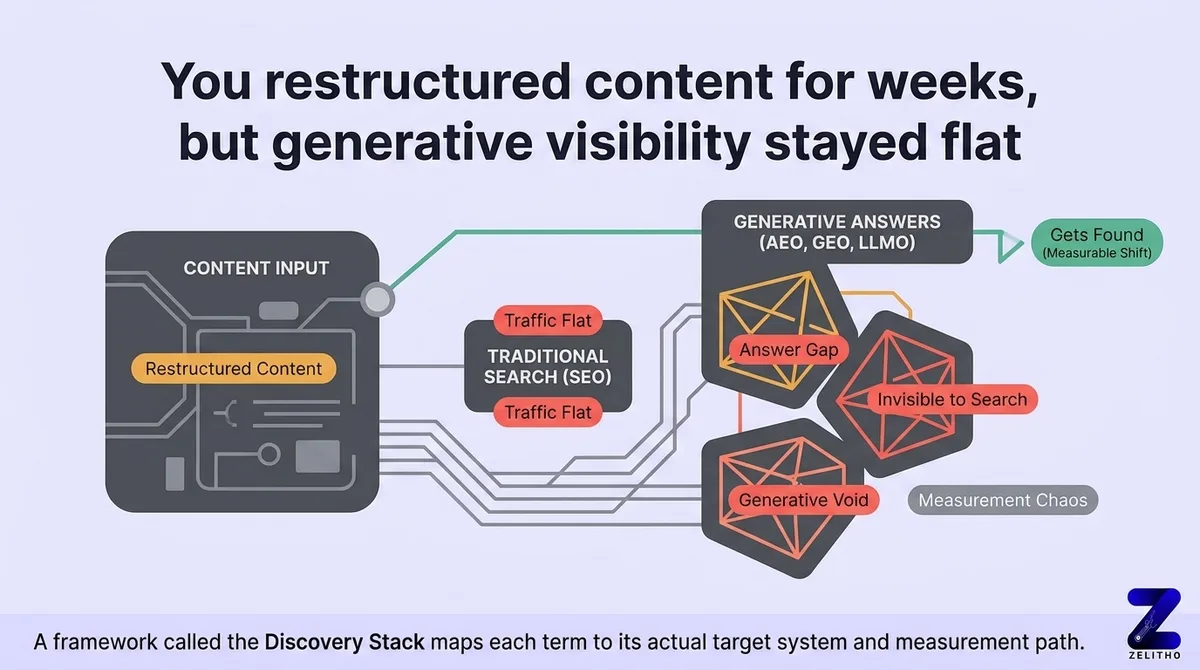
The difference between SEO (Search Engine Optimization) and GEO (Generative Engine Optimization) lies in the retrieval objective. Traditional SEO optimizes for ranked URL placement across crawler indexes, measuring success through organic impressions, keyword position, and click-through rates. GEO optimizes for citation inclusion within AI-generated synthesis, measuring success through prompt share of voice, citation frequency, and factual attribution across conversational engines like Microsoft Copilot, Perplexity, and ChatGPT Search.
What is the difference between SEO, AEO, GEO, and LLMO?
SEO targets ranked links in traditional search indexes. AEO targets direct answer boxes and voice results. GEO targets citations in AI-assembled generative responses. LLMO targets brand and entity presence across foundation model training datasets and parametric recall.
Each discipline addresses a different point along the transition from keyword retrieval to conversational synthesis:
| Discipline | Primary Target Surface | Discovery & Retrieval Mechanism | Content Architecture | Primary Metric |
|---|---|---|---|---|
| SEO | Google & Bing traditional SERPs | Keyword-based inverted index crawling and link graph analysis. | Comprehensive long-form pages, keyword placement, and internal linking. | Organic clicks and SERP positions. |
| AEO | Featured snippets, Knowledge Panels, voice search | Direct passage matching for specific single-intent questions. | Concise 40-word answer definitions, bulleted lists, and FAQ schema. | Featured snippet ownership. |
| GEO | Microsoft Copilot, Perplexity, ChatGPT Search, Gemini | Multi-source dense vector retrieval (RAG) and semantic reranking. | Answer-first headings, semantic tables, syntactic chunking, entity schema. | Citation frequency & share of voice. |
| LLMO | Parametric model weights, offline LLM chat | Pre-training dataset ingestion, fine-tuning, and token association. | Entity co-occurrence across authoritative datasets (Wikipedia, GitHub, PR). | Brand mention recall probability. |
What Each Term Actually Means (Definitions and Core Scopes)
To build an effective search strategy, marketing and editorial teams must separate these four concepts into distinct operational categories:
SEO Meaning and Scope
Search Engine Optimization (SEO) is the technical and editorial process of improving website visibility in traditional web search engines like Google and Bing. SEO relies on search engines crawling the web, building an inverted index of words, and ranking pages according to relevance algorithms (like PageRank and BERT). Success in SEO is fundamentally tied to driving human visitors through search results page clicks.
AEO (Answer Engine Optimization) Explained
Answer Engine Optimization (AEO) focuses on winning position-zero search real estate: Google featured snippets, Knowledge Graph panels, and voice assistant responses (Siri, Google Assistant, Alexa). AEO prioritizes concise, factual answers formatted to resolve a single query directly on the search results page without requiring a click.
GEO (Generative Engine Optimization) Explained
Generative Engine Optimization (GEO) focuses on source selection within generative AI systems that synthesize responses from multiple live web sources using retrieval-augmented generation (RAG). When a user asks a complex, multi-layered question in Microsoft Copilot or Perplexity, the engine breaks the prompt into multiple grounding queries, retrieves candidate passages, and synthesizes a structured answer. GEO ensures that your content provides the exact factual clarity and machine-readable data needed to earn a citation.
LLMO (Large Language Model Optimization) Explained
Large Language Model Optimization (LLMO) addresses how your brand and products are represented inside the static weights of language models. While GEO deals with live web retrieval, LLMO deals with how models remember your brand without browsing the web. Building presence in LLMO requires consistent digital PR, third-party entity consensus, and authoritative documentation across training corpora.
You Are Probably Treating Four Different Problems as One
A common point of failure for content teams is applying a single tactic across all four systems and expecting uniform results.
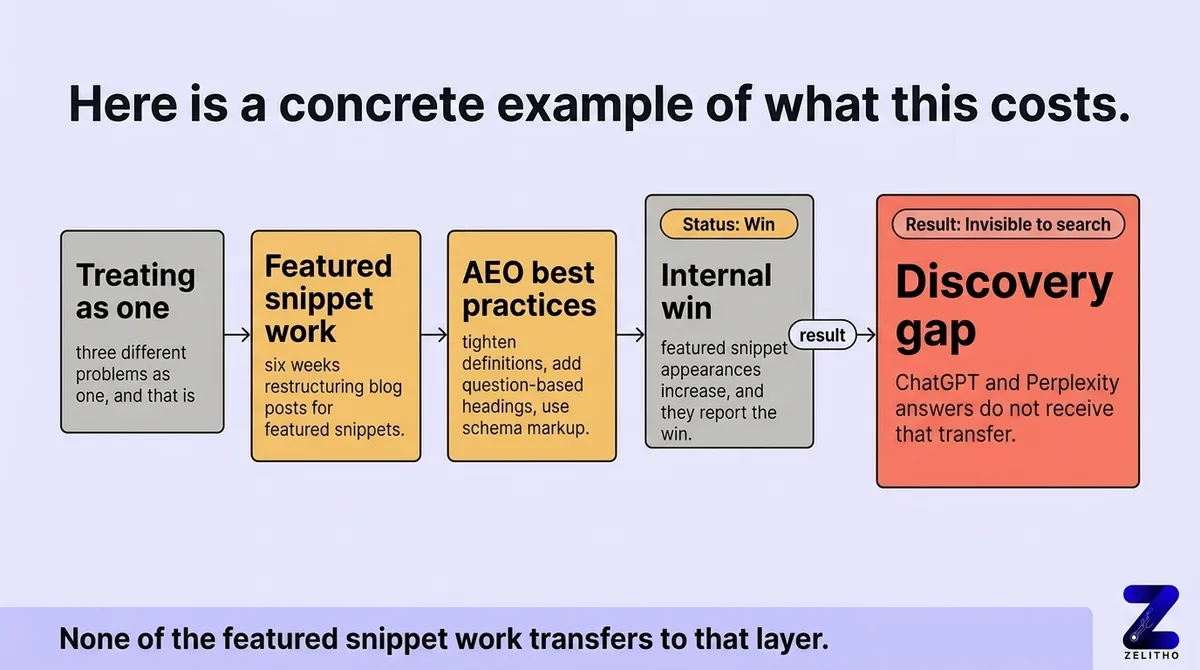
For example, a team might spend weeks restructuring articles for featured snippets by adding short Q&A summaries. While this improves AEO performance in Google, it often fails to earn citations in conversational engines like ChatGPT or Perplexity. Conversational engines require deeper comparative data, verifiable methodology, and clear entity attribution to support synthesized recommendations.
Search engines have also introduced dedicated tools for measuring generative visibility. Microsoft Bing Webmaster Tools recently rolled out **AI Performance** dashboards that explicitly track AI citations, grounding queries, and topic portfolio demand. Teams can now track exact citation numbers rather than guessing how generative engines perceive their content.
In addition, website operators can implement structured root files like llms.txt[2] to explicitly guide AI scrapers toward high-value technical documents and canonical research pages.
The Discovery Stack: Matching Tactics to Search Platforms
The industry trend of grouping everything into “AI SEO” creates confusion when allocating resources. Each layer of the Discovery Stack requires specific content formats and distinct measurement tools:
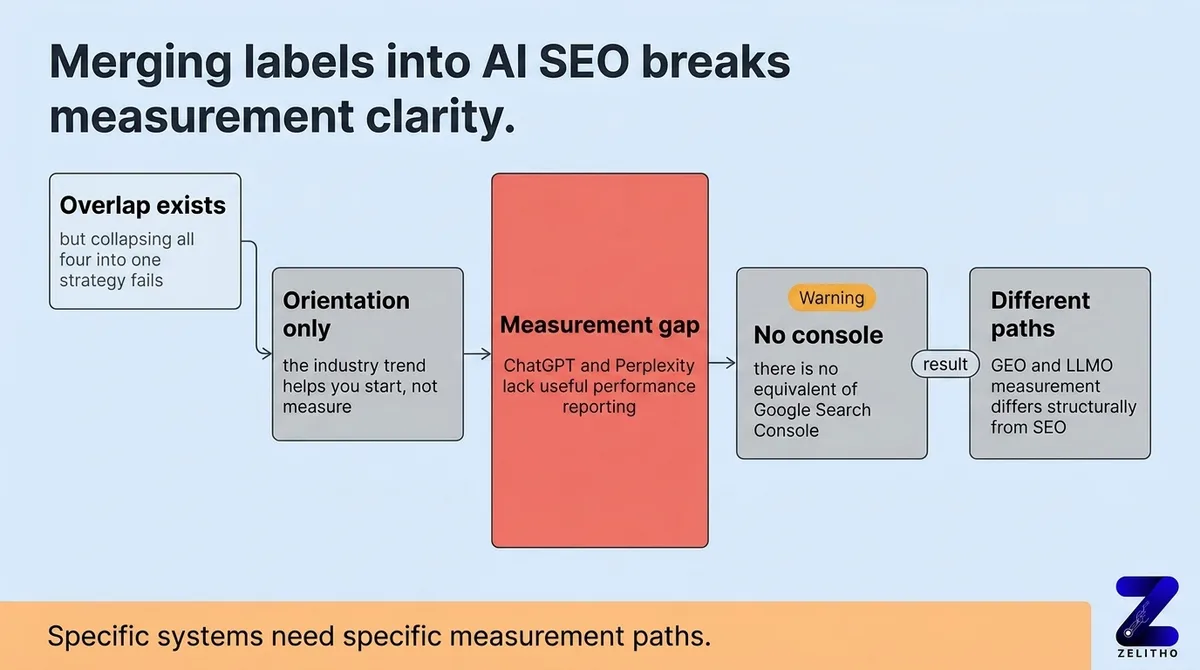
- SEO Layer: Measured via Google Search Console and Bing Webmaster Tools (organic clicks, impressions, average position).
- AEO Layer: Measured through featured snippet tracking and voice search query matching.
- GEO Layer: Measured through Bing AI Performance citation reporting, automated prompt probing in Copilot/Perplexity, and citation share of voice.
- LLMO Layer: Measured through ungrounded prompt sampling across base models (GPT-4o, Claude 3.5, Gemini Pro) to evaluate unprompted brand recall.
Observing how users phrase conversational questions on forums like Reddit and Quora helps across all three AI layers [2]. But the application differs: AEO uses questions for header matching; GEO uses questions to build compound comparison matrices; and LLMO uses them to build consistent entity relationships.
A Practical Decision Map: Choosing Your Next Optimization Move
To determine where to focus your engineering and editorial efforts, evaluate where your current visibility falls:
Your product relies on high-volume transactional keywords where users still click through to browse catalogs, directories, or pricing tables.
Your audience queries direct definitions, calculations, or straightforward procedural steps where featured snippet ownership builds immediate authority.
Prospective buyers conduct conversational product research (such as “best enterprise content workflow tools”) inside Copilot, Perplexity, or ChatGPT.
Your organization is establishing category leadership and needs base foundation models to recommend your brand organically in ungrounded conversational prompts.
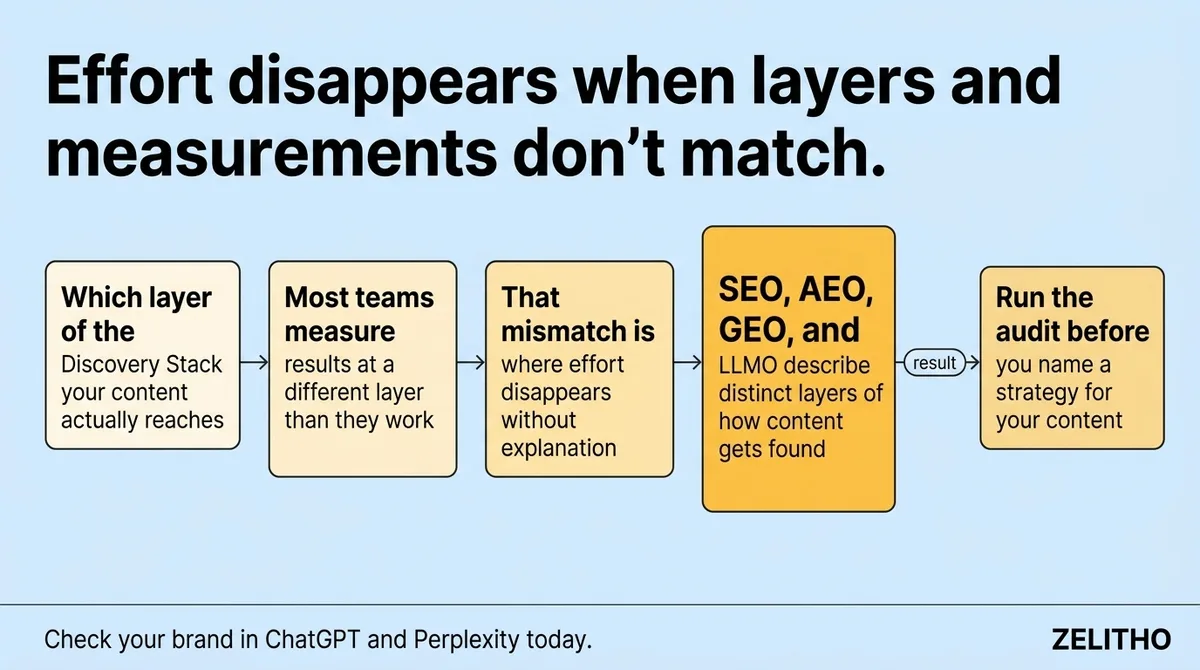
Maintaining clean semantic HTML hierarchy (H1 through H3) [1] remains an essential baseline across all four layers. Clean structure ensures that both traditional web crawlers and dense vector scrapers can parse content accurately.
You can use Zelitho’s AI Search Visibility platform to audit your current AI citation footprint and identify where your content is being referenced across generative engines.
Key Business Metrics and KPIs for SEO, GEO, AEO, and LLMO Teams
Measuring performance across search, generative engines, answer engines, and language models requires distinct key performance indicators. While traditional SEO evaluates organic traffic and ranking positions, modern optimization disciplines track prompt visibility, direct passage attribution, and citation share of voice.
| Discipline | Primary KPI | Secondary KPI | Executive Business Value |
|---|---|---|---|
| SEO | Organic Impressions and Clicks | Keyword SERP Positions | Cost-per-click savings and top-of-funnel inbound website visitors. |
| AEO | Answer Engine Direct Citations | Knowledge Graph Presence | Authority capture in zero-click voice and conversational answer boxes. |
| GEO | Citation Share of Voice (SoV) | Passage Extractability Index | Commercial discovery influence in Copilot, Perplexity, and ChatGPT Search. |
| LLMO | Training Corpus Representation | Entity Co-occurrence Frequency | Long-term brand recommendation memory encoded in base model weights. |
Frequently Asked Questions: SEO vs AEO vs GEO vs LLMO
What is the difference between GEO and SEO?
Traditional SEO optimizes web pages for keyword rankings and organic clicks in search engine results pages, whereas GEO (Generative Engine Optimization) optimizes content passages, data tables, and entities for citation inclusion within AI-synthesized responses.
What does SEO mean in modern search?
SEO stands for Search Engine Optimization. In modern search, it encompasses technical site health, crawler accessibility, keyword relevance, and content architecture designed to help web pages rank within traditional indexes and generative AI search surfaces.
How does AEO differ from GEO?
AEO (Answer Engine Optimization) targets single-source direct answers like Google featured snippets and voice search responses. GEO (Generative Engine Optimization) targets multi-source conversational answers synthesized by large language models, requiring deeper factual density and passage-level extractability.
What is LLMO?
LLMO stands for Large Language Model Optimization. It refers to the process of influencing how large language models represent a brand, entity, or concept within their training weights and parametric memory, independent of real-time search queries.
What are the most important KPIs for generative search visibility?
The most important KPIs for generative search visibility are Citation Share of Voice (SoV), passage extraction rate, brand recommendation sentiment, and direct AI referral traffic conversions.
What key business metrics should GEO teams report to leadership?
GEO teams should report category prompt win rate, competitive citation gaps across Microsoft Copilot and Perplexity, referral engagement metrics from AI crawlers, and downstream pipeline influence.
References and Citations
[1]https://www.luccaam.com/a-field-guide-for-ai-seo/
[2]https://digiday.com/media/wtf-are-geo-and-aeo-and-how-they-differ-from-seo/