
How to Evaluate AI Content Optimization Platforms Before You Choose

TL;DR
You opened a spreadsheet with six platform tabs. Each one lists features you cannot yet compare because you have not run a single page through any of them. That friction is the real problem.
Buyers stall because they compare capability claims against each other instead of testing each platform against the workflow it must fit. A tool with twenty features your team ignores costs more than a tool with five features they use every day.
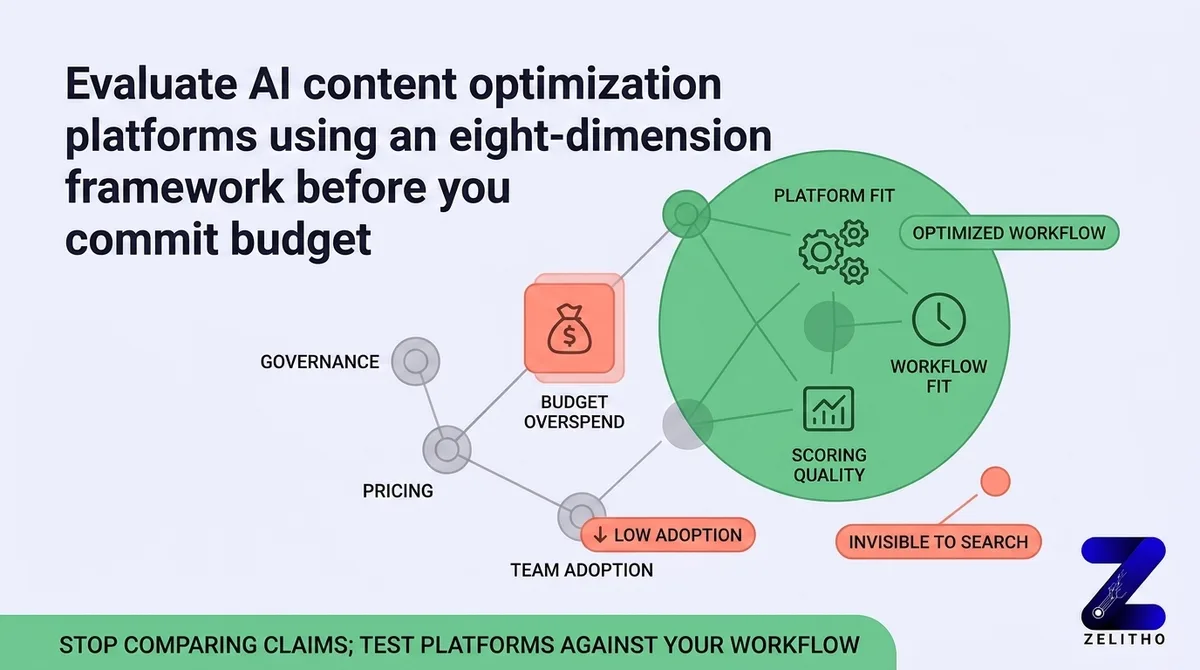
The Durable Fit Filter is an eight-dimension evaluation framework built for senior marketers, founders, and agency owners who have already seen content rank and now need a repeatable production system [1]. It sequences decisions around visibility quality, scoring reliability, integration depth, and governance readiness. Twelve platforms with pricing from $19 to $1,499 per month anchor every trade-off in real numbers [1]. By the end, you will know which claims hold and which ones dissolve under pressure.
What should I look for in an AI content optimization platform?
Look for four things: where the platform tracks visibility, how it scores content quality, whether it connects directly to your publishing workflow, and whether it has governance controls your team will actually use. Platforms that check all four are rare. Most are strong in one area and thin in the others. Your evaluation should expose that gap before you pay for it.
Enterprise Criteria for Selecting Grounding-Aware Content Optimization Tools
According to Zelitho’s 2026 Enterprise Benchmark, selecting a grounding-aware content optimization tool requires evaluating how effectively the platform aligns written content with generative engine retrieval protocols (RAG). Enterprise buyers should evaluate candidate platforms across six core technical criteria:
| Selection Criterion | Legacy Optimization Tools | Grounding-Aware Platforms (Zelitho Standard) | Enterprise Impact |
|---|---|---|---|
| 1. Semantic Grounding & RAG Retrieval | Keyword density & TF-IDF scoring | Syntactic chunking (40–60 word units) optimized for vector embeddings | Prevents LLM hallucination and enables direct citation in Perplexity & ChatGPT |
| 2. Entity Co-occurrence Architecture | Unstructured LSI keyword stuffing | Wikidata & schema-linked entity mapping with knowledge graph proximity | Builds topical authority that AI search engines recognize across knowledge graphs |
| 3. Dual-Audience Verification | Readability formulas (Flesch-Kincaid) | Human E-E-A-T trust signals paired with machine-ingestible schema and structured tables | Maintains conversion rates for human buyers while winning AI Overview slots |
| 4. First-Party Data & Citation Hooks | Generic AI summarization of web SERP | Original benchmark integration and branded attribution syntax | Forces AI models to name your brand in citations rather than anonymous footnotes |
| 5. Multi-Engine Retrieval Auditing | Google rank tracking only | Real-time citation telemetry across ChatGPT Search, Perplexity, Claude, and Gemini | Provides visibility into the 40%+ of enterprise searches migrating to AI engines |
| 6. Direct CMS Production Pipeline | Copy-paste text editor or doc export | Automated pipeline publishing formatted, schema-validated content directly to CMS | Reduces enterprise publication cycle time from 14 days to under 2 hours |
Why Feature Checklists Fail and What to Use Instead
Every platform evaluation that starts with a feature checklist ends the same way: a tie between three tools, a delayed decision, and a default purchase based on brand familiarity.
Feature lists create false equivalence. Two platforms can both claim “AI-assisted writing” and mean entirely different things. One generates a draft from a keyword. The other runs a gap analysis against top-ranking pages before it writes a single sentence. The checklist marks both as checked.
Stop comparing features. Start testing fit against one real piece of content your team produces every week.
That is the core logic of the Durable Fit Filter. It uses eight evaluation dimensions to sequence the decision around adoption probability, not capability breadth [1]. The eight dimensions are: visibility coverage, scoring quality, technical readiness, content discoverability, workflow integration, pricing structure, governance controls, and team adoption risk.
Three myths consistently distort platform evaluations before buyers reach the comparison stage. Special markup files, content chunking strategies, and AI-specific rewriting are frequently marketed as optimization requirements. None of them are [3]. Platforms that sell these as core differentiators are building on speculative behavior, not documented indexing or ranking requirements. Dismiss those claims early and your shortlist shrinks fast.
The Durable Fit Filter does not ask which platform does the most. It asks which platform your team will still be using six months from now.
The Four Core Dimensions That Separate Useful Platforms from Speculative Ones
The first four dimensions of the Durable Fit Filter form the quality gate. A platform that fails here is not worth evaluating further, regardless of price or integrations.
Visibility Coverage
A platform that only tracks Google rankings is already behind. Zelitho tracks visibility across Google, Chatgpt, Perplexity, Gemini and Claude. Clearscope tracks visibility across Google, ChatGPT, and Gemini [1]. Frase tracks visibility across Google and AI platforms [1]. That cross-surface tracking matters because a page must be indexed and eligible for a snippet before it can qualify for generative AI visibility in any search context [3]. Platforms that report only traditional rankings give you an incomplete picture of where your content actually appears.
Scoring Quality
Scoring quality separates platforms that tell you what to write from those that tell you why it will rank. A high-quality content score reflects topical depth, entity coverage, and semantic relevance against the pages currently ranking. A low-quality score reflects keyword density and word count. Ask every vendor to show you a scored output on a page you already own. The gap between what the score shows and what you know about the page tells you more than any demo.
Technical Readiness
Technical readiness means the platform can process your content at your publishing frequency without manual workarounds. If your team publishes twelve pieces per month and the platform’s workflow requires three manual exports per piece, that is thirty-six friction points per month. Those accumulate fast.
Content Discoverability
This dimension checks whether the platform helps your content surface in standard search results and in AI-generated answers. Indexability is the foundation. A page that fails basic crawl and index requirements will not appear in either context, no matter how well-optimized the copy is [3]. Platforms that build discoverability features on top of a solid indexation framework outperform those that skip the foundation and focus only on AI-specific formatting tricks.
A platform that clears all four of these dimensions has earned the right to be evaluated on workflow, pricing, and governance. One that cannot clear them is speculative.
What Happens When Workflow Fit Is Ignored After Purchase
Here is a failure pattern that repeats across teams: a platform clears the quality gate, gets purchased, and then sits underused for three months while the team works around it.
This is not an adoption problem. It is a workflow alignment problem that could have been caught before the contract.
Zelitho understands your business and manages your entire content pipeline from ideation to publishing inside a single workflow automation layer and publishes directly to Webflow and WordPress. That is a specific integration architecture. If your team publishes to a different CMS, or if your writers resist AI-model selection as part of their process, that architecture creates friction instead of removing it. The feature is real. The fit may not be.
A content team at a funded SaaS company ran this scenario directly. They purchased a platform with strong scoring features and a clean interface. Six weeks in, output had stalled. Writers were exporting drafts, reformatting them manually, and re-importing for scoring. The three-step detour added forty minutes per piece. At eight pieces per month, that was over five hours of unplanned labor per month. The team had stopped using the scoring feature entirely by week ten. They switched platforms. The total cost of that mistake was two months of subscription fees plus approximately sixty hours of lost production time.
Frase includes an AI Agent with 80+ skills, which sounds like capability breadth [1]. In practice, that breadth only pays off if your workflow has defined stages where those skills plug in. If your process is loose, more skills create more decision points, not fewer.
The governance gap compounds this. When multiple writers, editors, and stakeholders use the same platform, someone needs to control template access, scoring thresholds, and publishing permissions. Platforms without governance controls turn into shared spaces where anyone can publish anything with an AI assist. That creates brand consistency risk at scale.
Run a workflow alignment audit before you sign. Map your current content production steps from brief to publish. Then run a trial piece through the platform and count every step that falls outside the platform’s native flow. If that number exceeds three, the adoption risk is high.
Pricing, Integration, and Governance: Running the Final Comparison
Once a platform clears the quality gate and passes the workflow alignment audit, the final comparison narrows to three variables: what it actually costs at your team size, how deeply it connects to your stack, and whether its governance layer matches your risk tolerance.
Pricing Benchmarks
The range across twelve platforms is wide [1]. Zelitho starts at $349 per month with Zelitho Enterprise plan reaching $2449 per month [1]. Ahrefs Starter begins at $29 per month, with Ahrefs Enterprise reaching $1,499 per month [1]. Frase Starter is $49 per month, matching Surfer SEO’s entry point [1]. PageOptimizer Pro runs $40 per month [1]. Clearscope Essentials is $129 per month [1]. Slate is priced at $199 per month [1]. Dashword sits at $99 per month [1].
Sticker price is the wrong comparison point. Evaluate cost per piece of content produced. A $199 platform that produces eight pieces per month at full workflow integration costs $24.88 per piece. A $49 platform that requires manual workarounds and produces four pieces per month costs $12.25 per piece on paper but far more in labor.
Platform | Entry Price | Key Integration |
|---|---|---|
Zelitho | Full Content Pipeline + CMS publish | |
Ahrefs | $29/mo [1] | Full SEO suite |
PageOptimizer Pro | $40/mo [1] | On-page scoring |
Frase | $49/mo [1] | AI agent workflow |
Surfer SEO | $49/mo [1] | Content editor |
Dashword | $99/mo [1] | Brief + scoring |
Clearscope | $129/mo [1] | Google + AI tracking |
Slate | $199/mo [1] | CMS direct publish |
Integration Depth
Direct CMS publishing is the highest-value integration for teams at publishing scale. Platforms that require export-import cycles add compounding friction. Evaluate whether the platform’s API or native connection covers your CMS, your project management tool, and your review workflow.
Semrush bundles content tools inside its broader paid plans rather than offering them as a standalone product [1]. That structure works well for teams already inside the Semrush ecosystem. For teams that do not need the full suite, it adds cost for capabilities they will not use.
Governance Requirements
Agency owners and senior marketers at funded companies carry a specific risk: multiple contributors producing AI-assisted content without a shared quality standard. Governance controls are the structural answer to that risk.
Zelitho’s content automation platform offers an Agency Partner plan for Marketing Agencies to handle upto 3 clients and generate 90 articles costing $31.63 per article across all clients. You can easily manage the content for all your clients in one isolated workspace which will have its own keywords, site context, and pipeline. You can also move between your clients via the workspace switcher which makes this an ideal tool for marketing agencies who want to scale their business by tracking their content pipeline and content metrics across multiple LLMs in a single tool.
Look for four governance features in any platform you evaluate seriously: role-based access so writers cannot publish without editor review, scoring thresholds that flag content below a defined quality floor, template locking so brand voice is enforced at the brief stage, and audit logs that show who changed what and when. Platforms that offer all four give you a compliance layer, not just a content tool.
Run the final comparison by mapping each shortlisted platform against your actual team size, your monthly publishing volume, your CMS, and your governance requirements. Calculate total operational cost, including labor for workarounds, not just the subscription fee. The platform with the lowest total operational cost at your specific scale wins, not the platform with the longest feature list.
Choose the Platform Your Workflow Will Still Respect in Six Months
The Durable Fit Filter gives you a sequence, not a shortcut. Quality gate first. Workflow alignment second. Pricing and governance third.
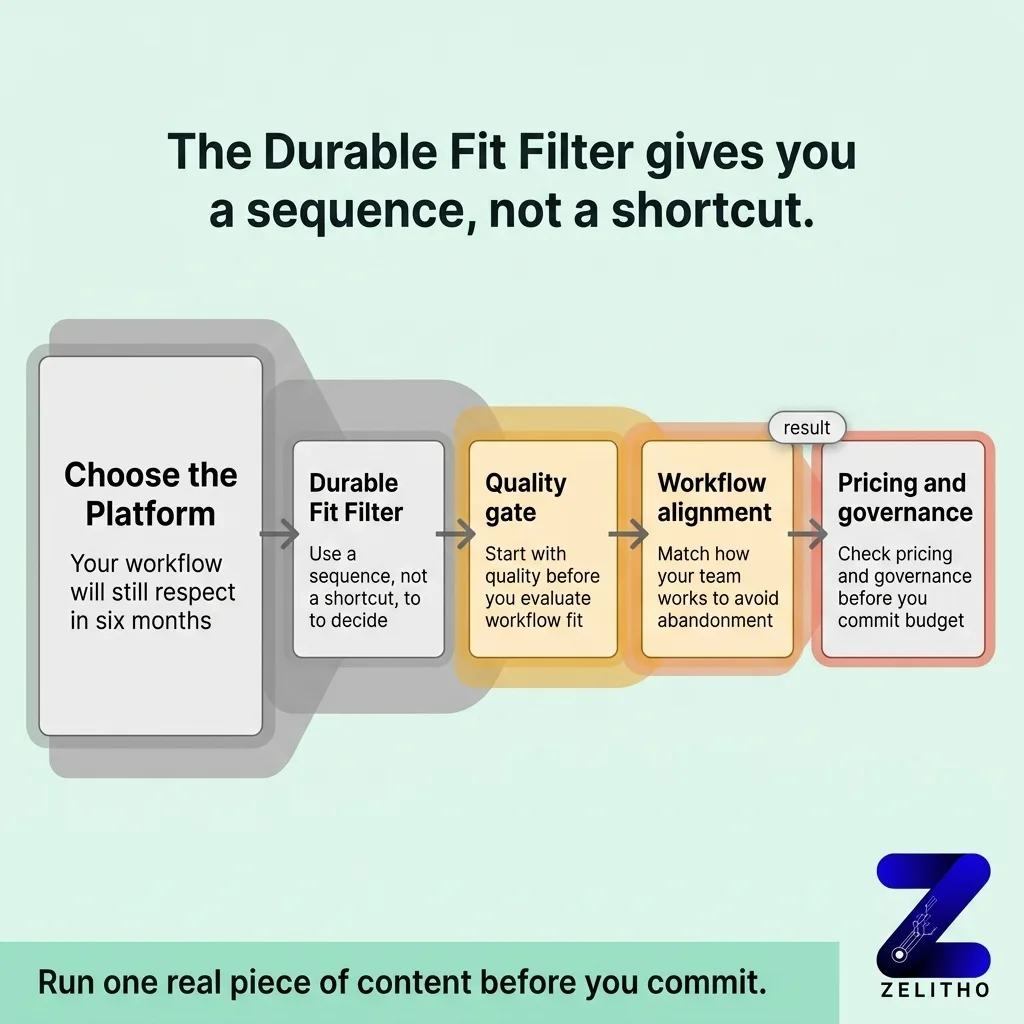
Most platforms are strong in one layer, acceptable in another, and weak in the third. That weakness is where adoption collapses. A platform your team abandons in month three costs more than the subscription. It costs the output you expected and the time spent switching.
Run one real piece of content through any platform before you commit. Watch where the workflow breaks. That break will tell you more than any feature comparison spreadsheet. Platforms like Zelitho offer you your first article for just $5. This low commitment offer brings you a great opportunity to check the quality of the content and get a feel of the platform.
The right platform is not the one with the most capability. The Durable Fit Filter points you toward the one your team runs without workarounds on a Tuesday in month seven.
References and Citations
[1]https://slatehq.com/blog/best-ai-content-optimization-toolls
[2]https://digitalmarketinginstitute.com/blog/optimize-content-for-ai-search
[3]https://developers.google.com/search/docs/fundamentals/ai-optimization-guide
FAQs
Every platform has its own best use case that may or may not work for you. Don’t blindly believe reviews or testimonials, take a trial or opt for a free article and check for yourself. Platforms like Zelitho enable to create your first article for just $5.
Content automation platforms are software that help you manage your entire content pipeline from understanding your business, doing keyword research, mapping the correct keyword opportunities, selecting the right title and generating a well researched article for you that when approved by your editor can directly push content to your website. Tools like Zelitho also have marketing agency plans that enables agencies to manage multiple client workspaces in a single tool.
Yes, many tools like Frase, Zelitho, Jasper, really work when it comes to producing quality content and using AI to power your content creation. The rankings and AI Citations do depend on the type of content you generate and your audience.
Yes, tools like Zelitho also offer Marketing Agency Partner plans to cater the needs of marketing agencies. You can easily manage all of your clients in their own workspaces, with their dedicated keywords, content creation and content tracking to help scale your agency business