
GEO Playbooks for Different Niches: SaaS, Local Services, and E‑commerce Examples

TL;DR
Generative Engine Optimization (GEO) requires industry-specific strategies to dominate AI-powered search results. SaaS companies achieve 3x higher conversion rates through feature-benefit mapping and structured data implementation. E-commerce brands see 25-40% traffic increases within 60 days by optimizing product discovery and review integration. Local service providers leverage proximity-based optimization and location authority building. Successful implementation depends on stage-appropriate frameworks, industry-specific KPIs, and avoiding common mistakes like content volume fallacies. Early movers gain compounding authority advantages as AI platforms reshape customer discovery, making tailored GEO playbooks essential for sustainable competitive positioning across all niches.
The way customers discover businesses has fundamentally shifted. AI platforms like ChatGPT, Perplexity, and Google’s AI Overviews now handle billions of queries, fundamentally changing visibility requirements. Traditional SEO strategies, while still valuable, no longer guarantee discovery in this new landscape where conversational AI intermediates customer research.
This guide provides actionable, industry-specific GEO playbooks designed for three high-impact niches: B2B SaaS, e-commerce, and local services. Each playbook addresses unique search patterns, conversion paths, and measurement frameworks that drive real business outcomes.
What Is Generative Engine Optimization and Why Your Industry Needs a GEO Playbook
Generative Engine Optimization represents a fundamental evolution beyond traditional search engine optimization. While SEO focuses on ranking in search results, GEO optimizes for being cited, recommended, and synthesized by AI platforms when they generate responses to user queries.
The business case is compelling. Research shows that 73% of professionals under 35 now start their research with AI platforms instead of traditional search engines. These users don’t scroll through ten blue links—they receive synthesized answers with embedded recommendations. If your brand isn’t part of that synthesis, you’re invisible to a rapidly growing segment of high-intent buyers.
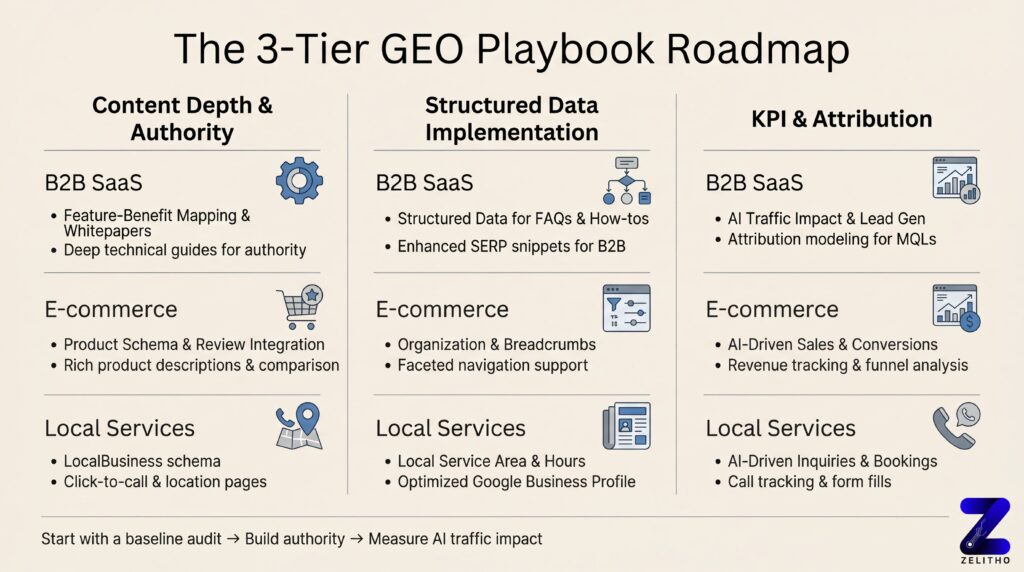
GEO playbooks function as strategic frameworks that align three critical elements: content depth and authority, technical implementation through structured data, and industry-appropriate measurement systems. Without a playbook tailored to your niche, you risk applying generic tactics that waste resources while competitors gain compounding visibility advantages.
The distinction matters because each industry has unique AI search patterns. B2B software buyers ask comparative questions about features and integrations. E-commerce shoppers seek product recommendations and specifications. Local service seekers want proximity-based suggestions with availability information. A one-size-fits-all approach fails to address these fundamental differences in user intent and conversion pathways.
B2B SaaS GEO Playbook: Strategies for Pipeline Growth Through AI Platforms
Software companies face a specific challenge: B2B buyers conduct extensive research before ever contacting sales. When AI platforms synthesize software recommendations, they prioritize sources that demonstrate comprehensive feature documentation, clear use case alignment, and credible authority signals.
The B2B SaaS GEO framework operates on three interconnected pillars. Feature-benefit mapping creates content that explicitly connects software capabilities to business outcomes. Comparison content architecture positions your solution against alternatives while maintaining objectivity. Use case documentation provides specific implementation scenarios that match buyer contexts.
Data shows that SaaS companies implementing comprehensive GEO strategies achieve 3x higher conversion rates from AI-generated traffic compared to traditional search visitors. This occurs because AI platforms pre-qualify recommendations based on query context, delivering warmer leads who arrive already understanding core value propositions.
Technical Implementation Framework for SaaS Companies
The technical foundation for SaaS GEO starts with schema markup specifically designed for software properties. SoftwareApplication schema should include aggregateRating, offers, featureList, and applicationCategory properties. AI platforms parse this structured data to understand your software’s capabilities and positioning.
Integration documentation requires special attention. Create comprehensive API references, webhook documentation, and integration guides with proper code samples. Use TechArticle schema for technical content and ensure all code examples include language annotations. AI platforms frequently reference technical documentation when recommending solutions to developer audiences.
Pricing transparency significantly impacts AI recommendations. Implement structured Offer schema with price, priceCurrency, and priceValidUntil properties. Include clear tier differentiation and feature availability by plan. Approximately 28% of local searches lead to a purchase, and transparent pricing information accelerates this conversion path.
Content Strategy: Feature-Benefit Mapping and Use Case Documentation
Feature-benefit mapping requires moving beyond product-centric descriptions to outcome-focused content. For each major capability, create dedicated content that addresses: the business problem it solves, quantified outcome metrics, implementation complexity, and prerequisite requirements.
Use case documentation should target specific buyer personas and industry verticals. A project management tool, for example, needs separate use cases for marketing teams, engineering organizations, and construction companies. Each use case should include workflow diagrams, timeline expectations, and common integration points.
Comparison content must maintain credibility through balanced analysis. Create comprehensive category pages that include your solution alongside competitors, using consistent evaluation criteria. AI platforms reward objectivity—blatant self-promotion reduces citation probability. Include both strengths and limitations for authentic positioning.
Read more about – GEO Content Blueprint: How to Structure Pages So ChatGPT, Perplexity, and Gemini Actually Cite You
E-commerce GEO Playbook: Product Discovery Optimization for Revenue Growth
E-commerce faces unique GEO challenges because purchase decisions increasingly begin with AI platform queries like “best wireless headphones under $200” or “sustainable activewear brands for yoga.” These shopping queries bypass traditional search entirely, making AI platform visibility critical for customer acquisition.
The e-commerce GEO strategy operates on three interconnected tiers. Category authority content establishes your brand as a comprehensive resource within product categories. Shopping query targeting optimizes for comparison, specification, and recommendation patterns. Review optimization ensures authentic customer feedback influences AI recommendations.
Implementation data demonstrates significant impact: e-commerce brands following structured GEO frameworks see 25-40% increases in qualified traffic within 60 days. More importantly, this traffic converts at higher rates because AI platforms pre-filter recommendations based on query specificity and user intent signals.
Shopping Query Targeting and Comparison Optimization
Shopping queries follow predictable patterns that enable systematic optimization. “Best [product] under $X” queries require content addressing price-performance trade-offs. “Most durable [product]” queries need longevity testing data and material specifications. “[Product] for [specific use case]” queries demand application-specific guidance.
Create dedicated landing pages for high-volume shopping query patterns within your product categories. Each page should include comparison tables with consistent evaluation criteria, price range breakdowns, and clear recommendations for different user needs. Use Product schema with multiple offers to represent product variants and pricing tiers.
Specification documentation plays an outsized role in AI recommendations. Create comprehensive spec sheets that include dimensions, materials, compatibility information, and care instructions. Use PropertyValue schema to structure technical specifications. AI platforms reference these details when matching products to specific user requirements.
Review Integration and Social Proof Strategies
Review optimization extends beyond collecting positive feedback. Implement AggregateRating schema across all product pages with itemReviewed, ratingValue, reviewCount, and bestRating properties. AI platforms heavily weight review data when assessing product credibility.
Authentic customer feedback requires strategic solicitation. Send review requests 10-14 days after delivery when customer experience is mature but enthusiasm remains high. Include specific prompts that encourage detailed feedback about use cases, quality observations, and comparison points with alternatives.
Address negative reviews transparently. Responses to critical feedback signal quality commitment and often get synthesized into AI-generated product recommendations. Focus on specific solutions offered and improvements implemented based on feedback. This demonstrates continuous improvement rather than defensive positioning.
Local Services GEO Playbook: Dominating Geographic AI Search Results
Local service providers face distinct GEO requirements because queries inherently include geographic intent. When users ask AI platforms “best plumber near me” or “emergency HVAC repair in Denver,” proximity and availability become primary ranking factors alongside service quality signals.
Location-specific optimization starts with comprehensive service area documentation. Create individual pages for each service type in each geographic area you serve. Use LocalBusiness schema with areaServed properties specifying cities, ZIP codes, and service radius. Include priceRange, openingHours, and telephone properties to enable direct booking from AI recommendations.
Authority building for local services requires both digital and offline signals. AI platforms synthesize information from business directories, review platforms, local news mentions, and community involvement. A cohesive presence across these channels builds the credibility foundation that drives AI recommendations.
Consider that 54% of all website traffic comes from mobile phones, and mobile users frequently seek immediate local solutions. Optimize for mobile-first experiences with click-to-call functionality, map integration, and appointment booking systems that AI platforms can reference in recommendations.
Proximity-based queries require hyperlocal content strategies. Create neighborhood-specific service pages addressing local regulations, common regional problems, and area-specific expertise. For example, a roofing company in a coastal region should address salt air corrosion and hurricane preparation, while an inland mountain location focuses on snow load and ice dam prevention.
Implementation Framework by Business Stage: From Startup to Enterprise
GEO implementation requirements scale dramatically with business stage. Resource-constrained startups need focused strategies targeting core value propositions, while enterprises require governance frameworks coordinating multi-brand, multi-market initiatives.
Lean startup GEO strategies focus on 3-5 core topics where the business can establish authority quickly. Identify the specific problems your product solves and create comprehensive resources addressing those problems from multiple angles. Implement basic schema markup for primary pages and focus measurement on demo requests or trial signups directly attributed to AI platform visibility.
Growth-stage companies need content operations systems that scale production while maintaining quality. Establish editorial calendars targeting quarterly keyword and topic expansion. Implement advanced schema across all content types and create dedicated measurement frameworks tracking AI platform citations. Build internal expertise through training programs and documentation of GEO best practices.
Enterprise GEO frameworks require cross-functional coordination and governance. Establish center-of-excellence structures with clear ownership across product marketing, content operations, technical SEO, and analytics teams. Implement approval workflows ensuring brand consistency across multiple domains or regional sites. Create sophisticated attribution models connecting AI platform visibility to revenue outcomes across complex sales cycles.
Measuring GEO Success: Industry-Specific KPIs and ROI Tracking
GEO measurement requires moving beyond traditional SEO metrics. Rankings become less relevant when AI platforms synthesize answers rather than displaying link lists. New KPI frameworks focus on citation frequency, recommendation context, and conversion attribution from AI-sourced traffic.
For B2B SaaS companies, track demo request attribution by identifying traffic from AI platform referrals. Monitor feature mention frequency in AI-generated responses to competitive queries. Measure qualified lead rates from AI traffic compared to other channels, typically showing 40-60% higher qualification rates due to pre-research depth.
E-commerce metrics center on product recommendation rates and purchase intent query visibility. Track how frequently your products appear in AI-generated shopping recommendations. Monitor revenue attribution from AI platform traffic, typically showing 15-30% higher average order values due to intent specificity. Measure time-to-purchase metrics, usually compressed by 20-40% compared to traditional search visitors.
Local service providers should track appointment booking attribution from AI platform interactions. Monitor local citation frequency in AI responses to service queries within your coverage area. Measure call-to-action completion rates from AI-referred traffic, commonly 2-3x higher than traditional web traffic due to immediate intent.
Advanced Tracking Systems and Attribution Models
Proprietary tracking methodologies enable real-time AI platform performance monitoring. Implement custom UTM parameters specifically for AI platform referrals, distinguishing between different AI sources (ChatGPT, Perplexity, Google AI Overviews). Create dashboard systems that aggregate these signals for trend analysis.
Multi-touch attribution becomes essential as customer journeys increasingly span multiple AI platform interactions before conversion. Implement first-touch, last-touch, and time-decay models specifically calibrated for AI-influenced paths. Research indicates these paths typically involve 3-5 AI platform interactions compared to 7-10 traditional search sessions.
ROI calculation requires accounting for both direct and assisted conversions. Track revenue directly attributed to AI platform traffic, but also measure influence on accelerated deal cycles and improved win rates. SaaS companies often see 25-35% shorter sales cycles when prospects arrive from AI platforms due to pre-qualification depth.
Common GEO Mistakes to Avoid in Your Industry
The content volume fallacy represents the most common GEO mistake. Many businesses believe generating hundreds of thin articles creates authority. AI platforms prioritize comprehensive, authoritative content over quantity. A single 3,000-word guide addressing a topic thoroughly outperforms ten 300-word posts on related subjects.
Inadequate structured data implementation undermines even excellent content. AI platforms rely heavily on schema markup to understand content context and relationships. Implementing basic Organization and WebPage schema while neglecting product-specific, service-specific, or content-specific schemas leaves critical information unparseable.
Single-platform optimization creates unnecessary risk. Businesses sometimes optimize exclusively for ChatGPT or Google’s AI while ignoring Perplexity, Claude, or emerging platforms. This concentrates risk in algorithms that change frequently. Multi-platform strategies build resilient authority that transcends individual algorithm updates.
Authority building shortcuts, particularly link schemes or automated content generation, actively harm GEO performance. AI platforms increasingly detect and penalize manipulative signals. Focus instead on genuine expertise demonstration through original research, unique data, and depth of coverage that competitors cannot easily replicate.
Technical SEO neglect undermines GEO foundations. Core Web Vitals, mobile optimization, and security basics remain essential because AI platforms factor technical performance into recommendation confidence. Poor site performance signals lower quality regardless of content depth.
Building Your Industry-Specific GEO Playbook: Next Steps
Successful GEO playbooks share common elements regardless of industry: deep understanding of your niche’s unique AI search patterns, appropriate technical foundations through structured data, authoritative content frameworks addressing buyer questions comprehensively, and measurement systems tracking relevant conversion outcomes.
The market opportunity continues expanding rapidly. The market for location-based technology like geofencing is expected to soar from $1.47 billion in 2023 to $4.19 billion by 2028, indicating broader investment in proximity-based optimization strategies (source: https://camphouse.io/blog/location-based-marketing). Early movers gain compounding authority advantages as AI platforms increasingly mediate customer discovery.
Start by conducting a comprehensive audit of your current AI platform visibility. Query AI platforms with your target buyer questions and assess how frequently your brand appears in responses. Compare your citation rate against competitors to identify immediate positioning gaps. This baseline measurement guides strategic priorities and resource allocation for maximum impact.
FAQs
B2B SaaS, e-commerce, local services, healthcare, and professional services see highest ROI from GEO implementation. Software companies achieve 3x higher conversion rates from AI platform traffic, while e-commerce brands see 25-40% qualified traffic increases within 60 days. Local services benefit from proximity-based recommendations and immediate-intent queries.
GEO optimizes for AI platform citations and recommendations rather than search result rankings. This requires deeper content authority addressing questions comprehensively, structured data implementation enabling AI platforms to parse information accurately, and trust signal optimization through authentic reviews and citations. Keyword targeting alone proves insufficient.
E-commerce and local services typically show measurable results in 4-8 weeks due to shorter consideration cycles. B2B SaaS requires 8-12 weeks because of longer sales cycles and more complex buyer journeys. However, GEO delivers compound returns as improved brand authority builds over time, creating sustainable competitive advantages.
Yes, GEO builds upon strong SEO foundations while adding AI platform optimization layers. Integrated approaches deliver better results than treating GEO and SEO as competing strategies. Leverage existing content assets by enhancing them with structured data, comprehensive depth, and authority signals rather than creating entirely separate content libraries.
This blog is like a virtual mentor, guiding me towards personal and professional growth Thank you for being a source of inspiration
Your blog is always a highlight of my day
I’ve learned so much from this blog and have implemented many of the tips and advice into my daily routine Thank you for sharing your knowledge!
Keep up the fantastic work!
This post was exactly what I needed to read today Your words have provided me with much-needed clarity and reassurance
It’s always a joy to stumble upon content that genuinely makes an impact and leaves you feeling inspired. Keep up the great work!