
How to Streamline Research to Draft Turnaround

TL;DR
Research to draft turnaround stalls when sources never become a usable brief. A structured handoff into drafting removes the most common pre-write delay.
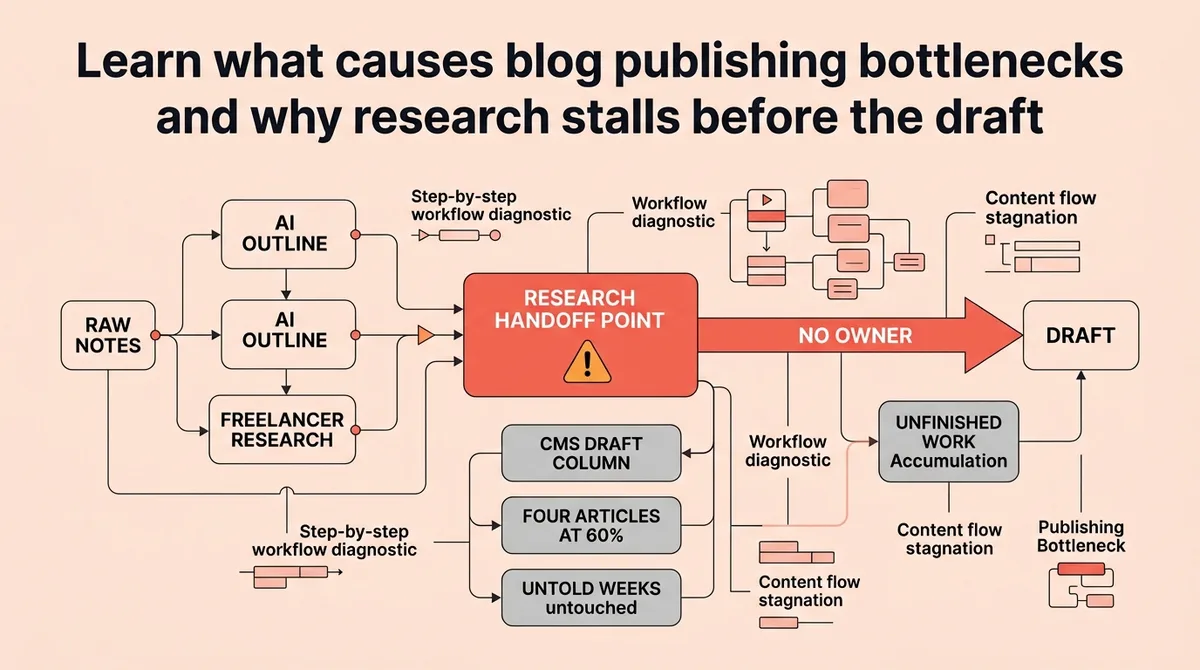
You open the CMS on a Tuesday. The draft column shows four articles sitting at 60%, untouched for three weeks. A freelancer submitted raw notes. An AI tool produced a passable outline. Neither moved forward because nobody owns the handoff between research and writing. That missing handoff is what slows research to draft turnaround more than any writing speed issue.
Most teams treat the draft as the problem. They hire faster writers, buy better AI tools, or add editorial deadlines. None of it works because the draft is not where content stops. It stops earlier, in the space between a collected source and a usable brief.
This article explains where content workflows break at each stage, from topic selection through CMS upload, and gives marketing leads and agency operators a structured process to close those gaps with a sequenced workflow that stops losing work between steps. If you want to know how to streamline research to draft turnaround, the steps below show exactly where to start.
What actually causes a blog to stop moving before anyone writes a word?
Blog publishing stalls because research, topic selection, drafting, and review run as separate tasks with no shared format connecting them. A topic gets chosen. Sources get collected. Then nothing bridges that material into a working draft structure. The gap between “research done” and “draft started” is where most content dies. Fixing the workflow at that handoff point is what gets articles to publication.
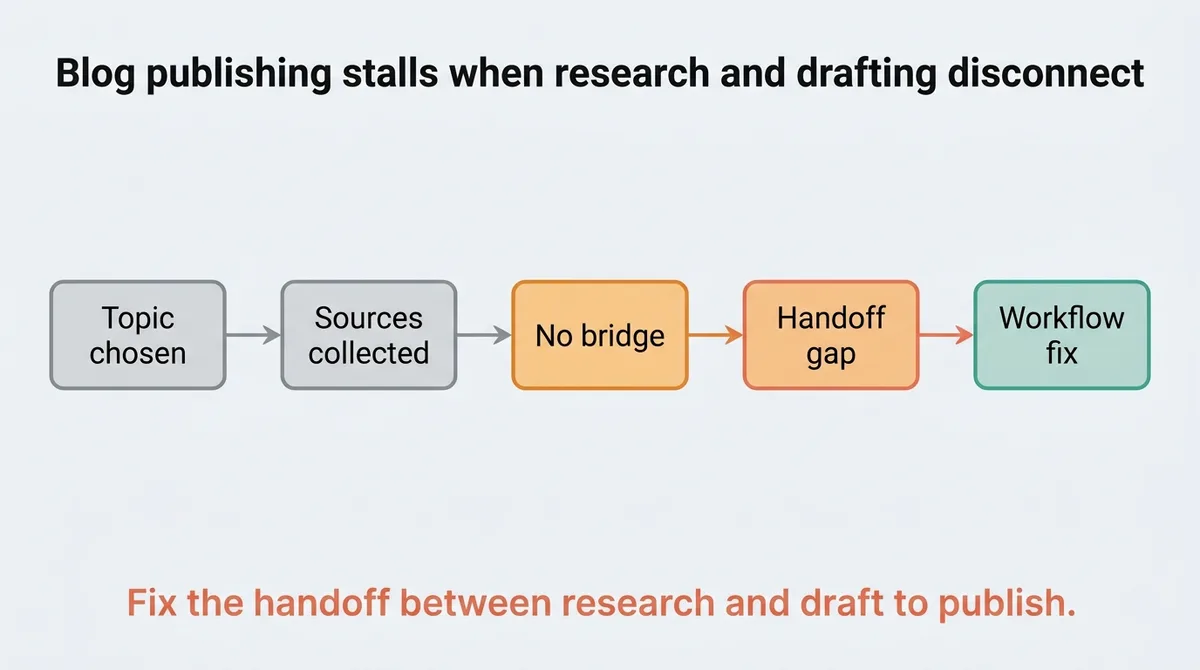
Why the Real Bottleneck Is Never the Draft Itself
You are not slow at writing. Your process has a gap between inputs and execution.
Most content leads identify the draft as the slow part. They watch a Google Doc sit empty for two weeks and conclude the writer is the problem. That conclusion skips the actual sequence. Before any writer opens a blank document, someone had to define the topic angle, compile the source material, and produce a usable brief. If that prep work is incomplete, the draft never starts cleanly.
Research volume alone explains part of the pressure. In academic publishing, as an analogy rather than a blog-ops benchmark, over three million research papers are published annually [2]. A single literature review commonly examines between 50 and 200 sources [2]. Those figures describe academic research, not blog operations, but the principle transfers as an analogy to content workflows. When a writer faces an unorganized folder of browser tabs and saved links, they are not slow. They are performing synthesis work that should have happened earlier in the process.
The real bottleneck sits in the pre-draft phase. Topics chosen in a Monday meeting exist as a Notion row. Research lives in a separate bookmark folder, a Slack thread, or a freelancer’s personal Google Drive. No one converted those inputs into a working structure the writer can open and build from.
Stop assuming the draft is the delay. Start treating the research-to-brief conversion as a separate, ownable step with a defined output.
The draft cannot move faster than the preparation that feeds it. When preparation is undefined, every article starts from zero.
The Chain of Connected Failure Points From Research to Ready-to-Publish
Every stage in a content workflow has a predictable place where it breaks. The failure points do not stack randomly. They appear in sequence, and each one makes the next stage harder.
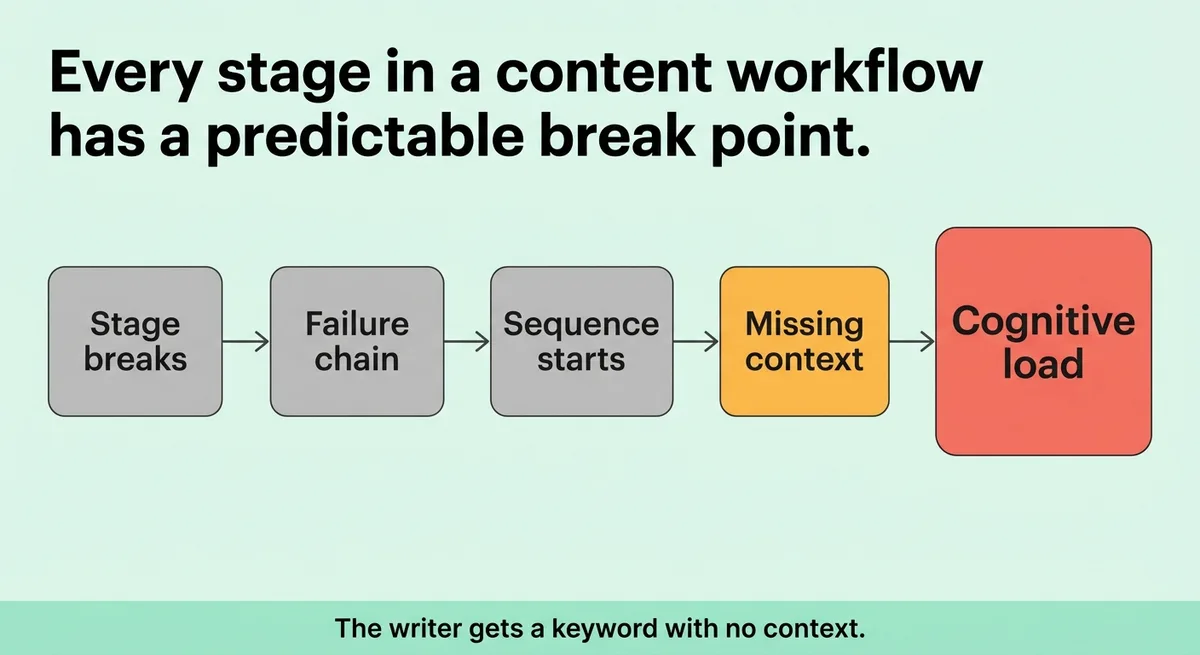
The first failure point is topic selection without a clear angle. A topic gets logged as a keyword phrase with no accompanying question, audience, or argument. The writer receives “content marketing ROI” with no context. They must define the angle themselves, which doubles the cognitive load before a sentence gets written.
The second failure point is research without a synthesis format. Sources get collected but not processed. A writer receives a folder of PDFs, a list of URLs, and maybe a half-filled content brief. In academic research reviews (a domain-specific analogy, not a content benchmark), the standard rigor setting covers roughly five themes and around 100 sources screened [2]. Screening that material without a structured format wastes hours that show up as missed deadlines.
The third failure point is the handoff between researcher and writer. In agency settings, this is where a contractor submits “background notes” that the lead writer cannot use. In in-house settings, this is where a junior marketer pulls five articles together and shares the link dump without identifying what each source contributes. No shared format means the receiving writer rebuilds the brief from scratch.
The fourth failure point is the editing stage without a clear scope. An editor reviewing a draft needs to know what the brief said, what the draft was trying to do, and what counts as a revision versus a rewrite. Without that shared context, editing becomes a conversation instead of a correction.
In clinical laboratory settings, offered here as an analogy rather than a blog-ops benchmark, a workflow where Lean principles reduced total turnaround time from 11,660 minutes to 3,308 minutes represents a 71.6% reduction in process time [3]. That result came from removing non-value-added steps across a multi-phase process, not from working faster within any single phase. The same logic applies to content. The time lost between stages is larger than the time lost within any one stage.
Workflow Stage | Common Failure Point | What Gets Lost |
|---|---|---|
Topic selection | No angle or audience defined | Writer must rethink scope before starting |
Research collection | Sources stored without synthesis | Handoff produces unusable material |
Brief creation | No standard format used | Each article restarts from different inputs |
Draft handoff | Incomplete brief reaches writer | Writer fills gaps instead of writing |
Editing | No brief reference available | Editor re-decides what the article should do |
CMS upload | No checklist or owner assigned | Final step delays by days without escalation |
Each row represents a place where work stops moving. Fix the handoff format at one stage, and the next stage becomes faster without any other change.
What You Believe About Productivity Is Keeping the Bottleneck in Place
The assumption most content leads carry is that the output problem is a speed problem. Hire a faster writer. Use a better AI tool. Add a weekly deadline. Those moves treat the symptom while the structural gap stays open.
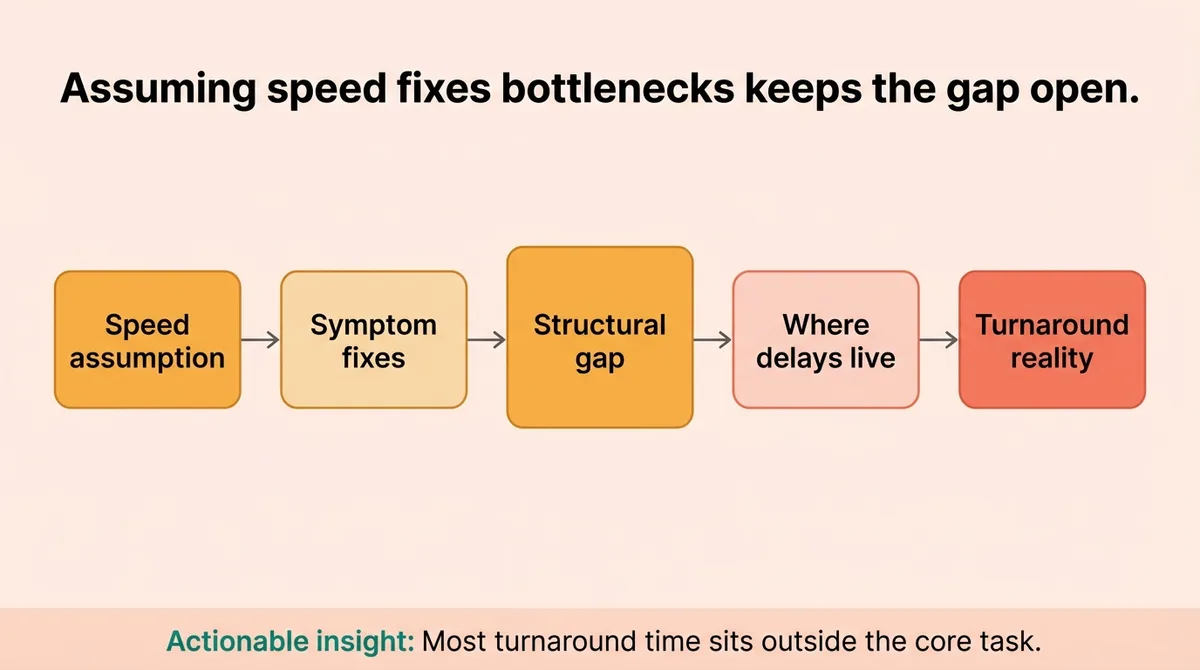
In clinical laboratory research, used here as an analogy, process improvement studies of multi-phase workflows show that roughly 75% of total turnaround time sits in the phases before and after the core task itself [3]. For content, the analogous takeaway is that much of the delay likely lives in topic prep and post-draft review, not in the writing. Lean process improvement approaches produced measurable quality gains in 85% of clinical laboratory settings by targeting those surrounding phases [3]. Those are lab results, not content benchmarks, but the principle offers a useful analogy: redesign the surrounding stages, and the core task resolves faster without direct intervention.
The productivity belief that blocks progress runs like this: if the team writes faster, the blog ships more often. That belief is structurally wrong. A team writing faster against a broken research handoff produces more incomplete drafts, more revision cycles, and more abandoned articles. Speed applied to a broken input stage multiplies the existing failure.
For example, imagine a content team where each writer spends roughly 90 minutes per article rebuilding a brief from raw research notes. Across five articles per week, that is 7.5 hours of rework that never appears on a project tracker. It shows up only as missed publish dates and overdue drafts.
The fix is not faster writers. It is a defined format that converts research into a brief before the writer opens the document.
A Standardized End-to-End Process That Removes Handoff Gaps and Reduces Rework
A connected workflow treats each stage as the input to the next. The output of topic selection is a scoped brief. The output of research is a structured set of source summaries mapped to that brief. The output of drafting is a document that an editor can review against a known target.
Five implementation steps address the most common handoff gaps [1]:
Step one: define the topic with an angle and a target reader before assigning it. The topic row in your project tracker should include the argument the article makes, not just the keyword it targets. This takes two minutes at assignment and saves thirty minutes at the draft stage.
Step two: assign research output a standard format. A research brief should include three to five source summaries, each with the source claim and how it connects to the article argument. The writer receives context, not links.
Step three: separate the research phase from the drafting phase with a handoff checkpoint. The checkpoint is a brief review by the article owner before the draft begins. It confirms the brief is complete. If it is not, it goes back before the writer starts.
Step four: give editors a brief reference during review. The editor reviews the draft against the brief, not against their personal judgment. This narrows the scope of feedback and removes the most common source of rewrite cycles.
Step five: assign a single owner to the CMS upload step. Publication consistently delays when this step floats between team members. One person owns it. One checklist covers it. It ships.
Four ongoing practices keep the workflow from degrading after initial setup [1]. First, review completed articles against the original brief once per month to find where the process still breaks. Second, track time per stage, not just total time per article. Third, flag any article that returns to a previous stage more than once. Repeated back-cycling indicates a broken handoff earlier in the sequence. Fourth, update the brief format whenever the same type of confusion appears in two consecutive articles.
The goal is not to write more articles. It is to stop losing the articles already in progress.
In legal document drafting, as a domain-specific analogy, practical methods suggest that structured input formats reduce revision time because writers spend fewer cycles deciding what the draft should accomplish [1]. When the brief answers that question before the draft opens, the writer executes instead of plans.
Where your research disappears before the draft ever starts
Research disappears at the handoff. Not because it was bad research. Because no standard format converted it into something a writer could use directly.
The pattern is consistent. A topic gets selected. Sources get collected. The connection between those two things never gets made explicit. The writer opens a blank document facing a folder of material with no map, and the draft stalls within the first hour.
Fixing that one handoff point, by requiring a structured brief that connects source material to the article argument before drafting begins, removes the most common delay in the entire workflow.
You do not need a new tool. You need a defined output for each stage, so that the next stage never starts from zero.
The brief format is the connective tissue. Build it, and your research reaches the draft.
References and Citations
[1]https://www.paxton.ai/post/5-techniques-every-lawyer-should-know-to-streamline-document-drafting-and-analysis
[2]https://www.inra.ai/blog/research-to-report
[3]https://pmc.ncbi.nlm.nih.gov/articles/PMC11486360/
FAQ
Blog articles most often stall at the handoff between collected research and a usable brief, not inside the draft itself. Sources land in a folder, a Slack thread, or a freelancer’s Google Drive, but nothing converts that material into a structured input the writer can open and build from. Fixing that single handoff point, by requiring a brief that maps each source to the article argument before drafting begins, removes one of the most common delays in the publishing workflow.
Build a workflow where each stage produces a defined output that feeds directly into the next: topic selection produces a scoped brief with an angle and target reader, research produces three to five structured source summaries mapped to that brief, and editing references the brief rather than personal judgment. Add a handoff checkpoint before drafting begins to confirm the brief is complete, and assign a single owner to the CMS upload step with a fixed checklist. Platforms like Zelitho are designed around this connected-stage logic, covering topic clustering, research-backed draft generation, and direct publishing to WordPress or Webflow inside one system which can reduce the handoff gaps between separate tools.
Bottlenecks return because faster writers and harder deadlines both target the draft, but most delay sits in the preparation and review stages surrounding it. In clinical lab workflows (an analogy, not a blog benchmark), roughly 75% of total turnaround time sits outside the core task itself, in topic prep and post-draft review. Applying speed to a broken research handoff produces more incomplete drafts and more revision cycles, not more published articles. The structural fix is a standard brief format that converts research into a usable input before the writer opens the document.
A content brief should define the article argument and target reader up front, include three to five source summaries that each state a claim and explain how it connects to the article angle, and be available to the editor during review so feedback is measured against the original target rather than personal preference. When editors have a brief reference, revision scope narrows because the question shifts from what should this article do to does this draft meet the stated goal. Without that shared reference, editing becomes a conversation instead of a correction, and rewrite cycles multiply.
A single platform can cover much of the path from keyword to published article, which can reduce the handoff gaps that cause many publishing delays. Zelitho is designed for this: it combines keyword discovery, clustered topic planning, research-backed draft generation with citations, on-page editing, and direct publishing to WordPress or Webflow inside one connected workflow. The intended benefit is that each stage produces a defined output for the next, so research reaches the draft and the draft reaches the CMS with less of the rework that accumulates when those steps live in separate tools.